
-
AI vendor lock-in doesn't announce itself. You're usually inside it before you realize it.
-
Lock-in hides across five layers, not just the API.
-
The AI model market shifted dramatically in two years. Your architecture needs to keep pace.
-
Model-agnostic development turns model-switching from an engineering project into a configuration change.
-
Flexible architecture means rerouting during outages. Single-provider architecture means waiting.
-
The right model for every workload only matters if your architecture lets you choose.
-
"We support multiple models" is easy to say. Ask how, specifically.
-
Build for flexibility before the first line of code. Retrofitting it costs more.
A Glimpse into the Past
What Is Vendor Lock-In, and Why Does AI Make It So Much Worse?
Most executives have felt this before, even if they didn't call it by this name.
You build something on top of a platform. Over time, your systems, your workflows, your team's habits all grow around that platform. Switching becomes less of a technical decision and more of an organizational excavation project. That's vendor lock-in. It's not a trap anyone sets deliberately. It's just what happens when you build deep on someone else's infrastructure.
Cloud taught enterprises this lesson the hard way. Companies that went all-in on AWS-native services in the early 2010s spent years and serious money trying to get any meaningful flexibility back. Most never fully did.
As enterprises expand AI adoption across departments, avoiding architectural constraints becomes an important part of broader artificial intelligence in business transformation initiatives.
Cloud Vendor Lock-In
AI Vendor Lock-In
And the market underneath all of this moves fast. The model that led on performance last year may not lead this year. Pricing changes. Providers enter and exit markets. Regional compliance issues surface with little notice.
The Five Places Lock-In Actually Hides
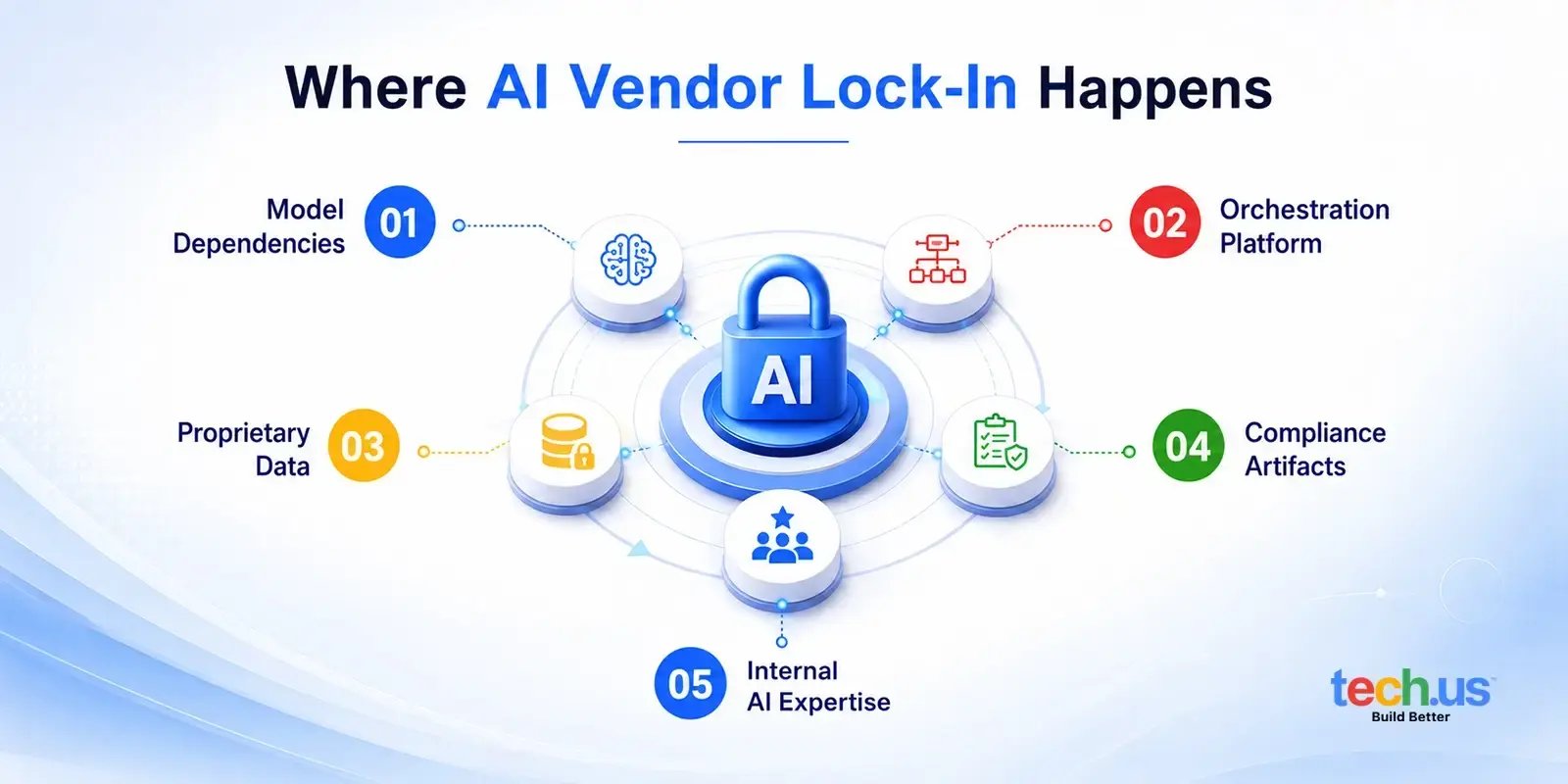
When people talk about AI vendor lock-in, they usually mean one thing. The API. One provider, one connection, one point of failure.
That's the visible part.
What's harder to see is everything built around it. Lock-in doesn't live in one place. It accumulates quietly across five layers, usually at different speeds, and almost always without anyone tracking it as a risk until something forces the conversation.
The model itself
The orchestration layer
Your data
Three questions worth asking right now, before they become urgent:
- Where does your data actually live?
- How is it formatted?
- Can you get it out in a portable format if you need to leave?
Most enterprises don't ask these at the start of an AI engagement. They ask them later, under pressure, when the answers matter most.
Compliance and governance evidence
Especially relevant in healthcare, financial services, manufacturing, and construction. Audit trails, access logs, model decision records, compliance documentation. Much of it gets generated and stored inside the vendor's system. Leaving doesn't just mean migrating a product. It means reconstructing a paper trail that regulators expect to be continuous and unbroken.
Your team's knowledge
The stickiest layer, and the most invisible one.
None of that lives in a config file. It lives in people's heads and in hundreds of small decisions baked into your workflows. Switch models, and you're not just pointing to a new API. You're asking your team to relearn, retune, and rebuild confidence in a system whose behavior they no longer fully know.
The AI Model Market Moves Faster Than Most Architectures Can
Two years ago, OpenAI held roughly 50% of enterprise LLM spend. Today that number is closer to 27%. Anthropic, meanwhile, has grown from about 12% to 40% over the same period, according to a study.
The model leading the market today may not be leading it next year
Teams are finding that different models perform differently on their specific workloads. A model that excels at document processing may not be the strongest choice for real-time decision support. A model optimized for cost efficiency may not meet the accuracy threshold a healthcare workflow requires.
Outages, deprecations, and regulatory shifts are part of the landscape
None of this reflects poorly on any specific provider. It's just the operating reality of a technology category maturing this fast.
So What Does Model-Agnostic AI Development Actually Mean?
After everything above, the definition lands differently than it would have at the top of this page.
The architecture in plain language
Think of it as a middle layer sitting between your applications and whichever AI model is doing the work.
- Your application talks to that layer
- That layer talks to the model
- When you want to switch models, or add one, or route certain tasks to a different provider, you change the configuration
Your application doesn't know or care which model is running underneath. That's the whole point.
What it isn't
A few things worth clarifying, because this term gets used loosely:
- It's not simply using different AI tools across different departments
- It's not avoiding commitment to AI investment
- It's not hedging because you can't decide on a provider
Organizations pursuing this approach are typically building systems designed for long-term scalability rather than short-term experimentation, which aligns closely with the goals of modern AI software development for business operations.
Model-agnostic vs model-specific
| Model-Agnostic | Model-Specific | ||
|---|---|---|---|
| Switching cost | Configuration change | Engineering project | |
| Outage resilience | Route to backup model | Wait it out | |
| Cost optimization | Choose by workload | Accept provider pricing | |
| Regulatory flexibility | Swap for compliant model | Rebuild or delay | |
| Negotiating leverage | High | Low |
The Business Case for Model-Agnostic AI
Architecture decisions can feel like engineering conversations. This one is a business conversation.
Here's why it belongs in the CIO's office, not just the engineering standup.
Cost: The routing advantage
Open-source models have closed the performance gap considerably over the last two years. For many enterprise workloads, particularly high-volume, repetitive tasks, they're more than capable.
The cost difference is significant. The ability to optimize model selection by workload is one of the operational advantages frequently associated with the broader benefits of custom AI development services for enterprise operations. Model-agnostic architecture lets you make that call deliberately:
- High-stakes, complex reasoning? Route to the most capable model
- High-volume, structured tasks? Route to the most cost-efficient one
- Locked into a single provider? You route to whatever they offer, at whatever price they set
Resilience: What happens when a provider goes down
The ChatGPT outage that disrupted GPT-4 and several related models simultaneously in 2025 is well known. For enterprises built entirely on that stack, it was an operational event, not just an inconvenience.
Regulatory agility: Reroute instead of rebuild
What to Ask Any AI Development Partner Before You Sign
The question that separates real flexibility from marketing language
- How is routing logic built into the system?
- What happens to our workflows if a preferred provider changes pricing significantly?
- Can you walk us through a real example where a client switched models without rebuilding?
What good contract language looks like
- Data portability — Can you export your data in formats that work outside this vendor's environment?
- Model substitution rights — If a model gets deprecated or becomes cost-prohibitive, is substitution built into the agreement?
- Audit trail ownership — Who owns the compliance documentation and governance records generated by the system?
- Dependency transparency — Does the contract clearly identify which components are proprietary and which are portable?
The simplest test
FAQ
It's building AI systems so they aren't tied to any single provider. The underlying model can be swapped or upgraded without rebuilding the application around it.
Cloud lock-in traps your infrastructure. AI lock-in traps your behavior — the prompts, workflows, and institutional knowledge your team has built around a specific model's quirks. That's considerably harder to migrate.
A middle layer that sits between your application and the AI model. Your software talks to the abstraction layer, which talks to whichever model you're using. Switching models becomes a configuration change rather than an engineering project.
It starts at the architecture stage, before development begins. The key is designing the integration layer to be provider-neutral from the start, rather than trying to retrofit flexibility into a system already built around one provider.
Ask them what switching the underlying model would actually involve six months after launch. A clear, specific answer with a realistic timeline is what you're looking for. Anything vague is worth probing further.
Any estimate that skips data engineering, MLOps, infrastructure, or post-launch support is not a complete estimate. It is the beginning of a budget overrun.
Vague scope and round numbers are the tell. A fair AI development quote breaks down cost by phase, names the deliverables, and does not hide the second half of the budget in fine print.

Tech.us is an AI development company that builds custom AI solutions for businesses seeking measurable results. We partner with organizations to design, develop, and deploy scalable AI systems that solve complex challenges and unlock new opportunities for growth. Our team delivers practical AI applications that create tangible business impact across industries.