Overview
- handle different parts of the same process
- share context with each other
- coordinate actions across systems
- escalate when human judgment is needed
Custom AI budgets scale with data readiness and integration depth far more than with the model you choose.
What is a Multi-Agent System?
- Role and responsibilities
- Access to tools and data
- Context about the task
- Decision-making boundaries
But the real value is not in the individual agents themselves. It comes from how they work together.

Many people assume a multi-agent system is simply a bigger version of a single AI agent. In reality, the difference is architectural.
A single-agent system is designed to handle a task from beginning to end. It receives input, performs reasoning, accesses tools if needed, and produces an output. This approach works well for focused use cases such as document summarization, customer support assistance, or report generation.
The challenge appears when the process becomes larger than what one agent can reasonably manage.
Enterprise workflows rarely follow a straight line. They involve multiple decisions, dependencies, systems, stakeholders, and exceptions. This growing complexity is one reason AI agents are disrupting traditional business processes across industries. Expecting one agent to manage all of that can create bottlenecks and make the system harder to maintain.
Multi-agent systems address this by distributing responsibilities across specialized agents. Instead of one agent trying to do everything, agents collaborate by sharing information, coordinating actions, planning tasks, and passing work to the most appropriate agent.
Think of it as the difference between a generalist employee and a well-organized team. Both can solve problems, but the team can usually handle larger and more complex work more effectively.
Single-Agent vs Multi-Agent Systems
| Area | Single-Agent System | Multi-Agent System |
|---|---|---|
| Scope | One task or workflow | Complex, multi-step processes |
| Responsibility | One agent handles most work | Specialized agents divide work |
| Coordination | Limited | Core system capability |
| Scalability | Harder as complexity grows | Easier through modular agents |
| Enterprise Fit | Best for focused use cases | Designed for cross-functional workflows |
| Decision Making | Centralized in one agent | Distributed across multiple agents |
| Adaptability | Limited flexibility | Easier to extend with new agents |
| Failure Impact | Single point of failure | Workloads can be distributed and rerouted |
Core Components of a Multi-Agent System
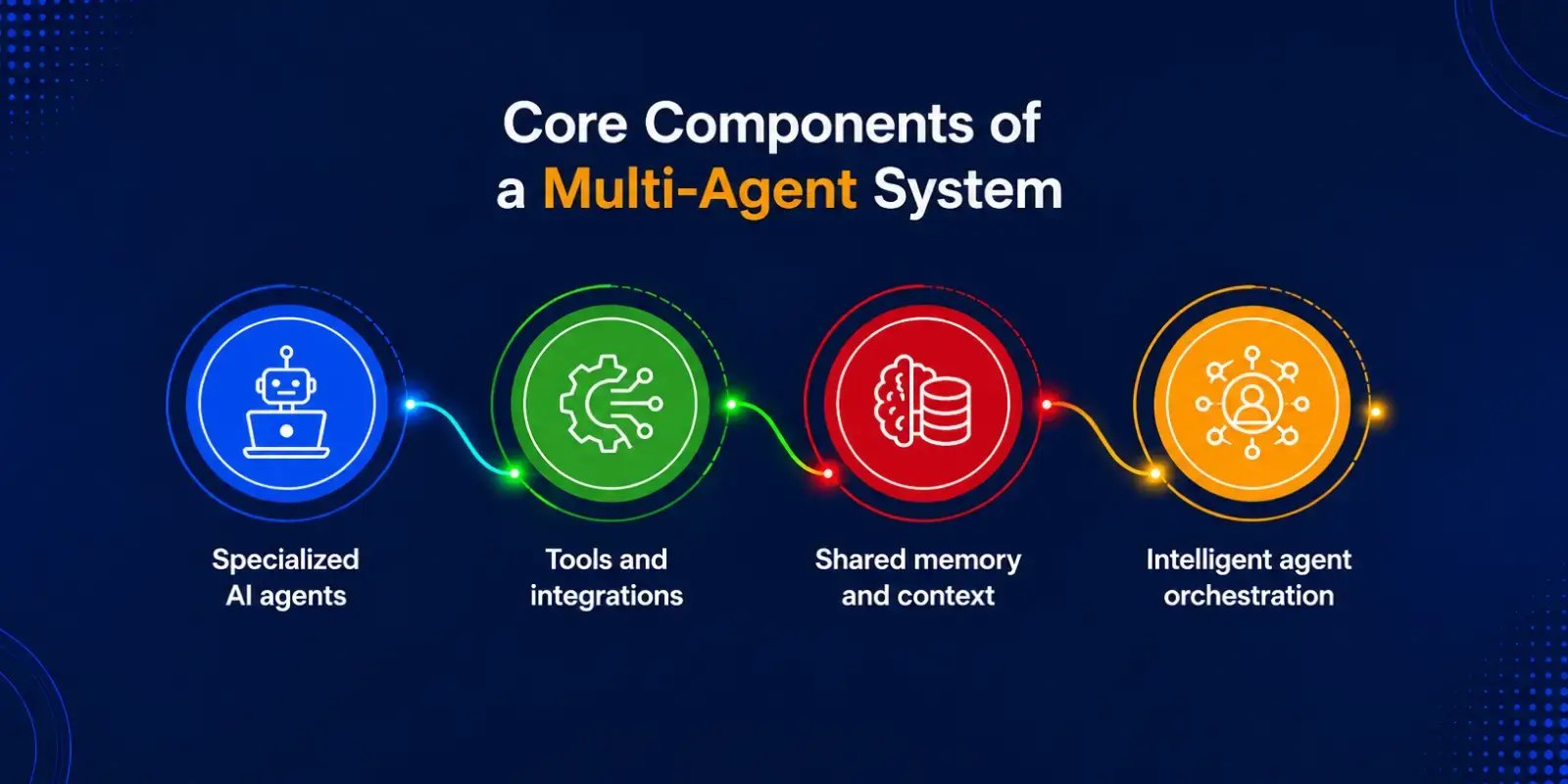
A multi-agent system is often described as a collection of AI agents working together. That definition is technically correct, but it leaves out something important. The agents alone are not what make the system work.
In enterprise environments, agents need access to business data, tools, historical context, coordination mechanisms, and governance controls. Without those supporting layers, even highly capable agents struggle to execute complex workflows reliably.
AI Agents
- Perceive information
- Reason about available context
- Take action toward a goal
Tools and System Connections
- APIs
- Databases
- ERP systems
- CRM platforms
- Document repositories
- Workflow and ticketing systems
Memory and Context
Without memory, every interaction becomes an isolated event. The system is forced to repeatedly gather the same information and re-establish context. With memory, agents can continue where they left off, maintain consistency across long-running processes, and collaborate with other agents using a shared understanding of the task at hand.
Orchestration Layer
Without memory, every interaction becomes an isolated event. The system is forced to repeatedly gather the same information and re-establish context. With memory, agents can continue where they left off, maintain consistency across long-running processes, and collaborate with other agents using a shared understanding of the task at hand.
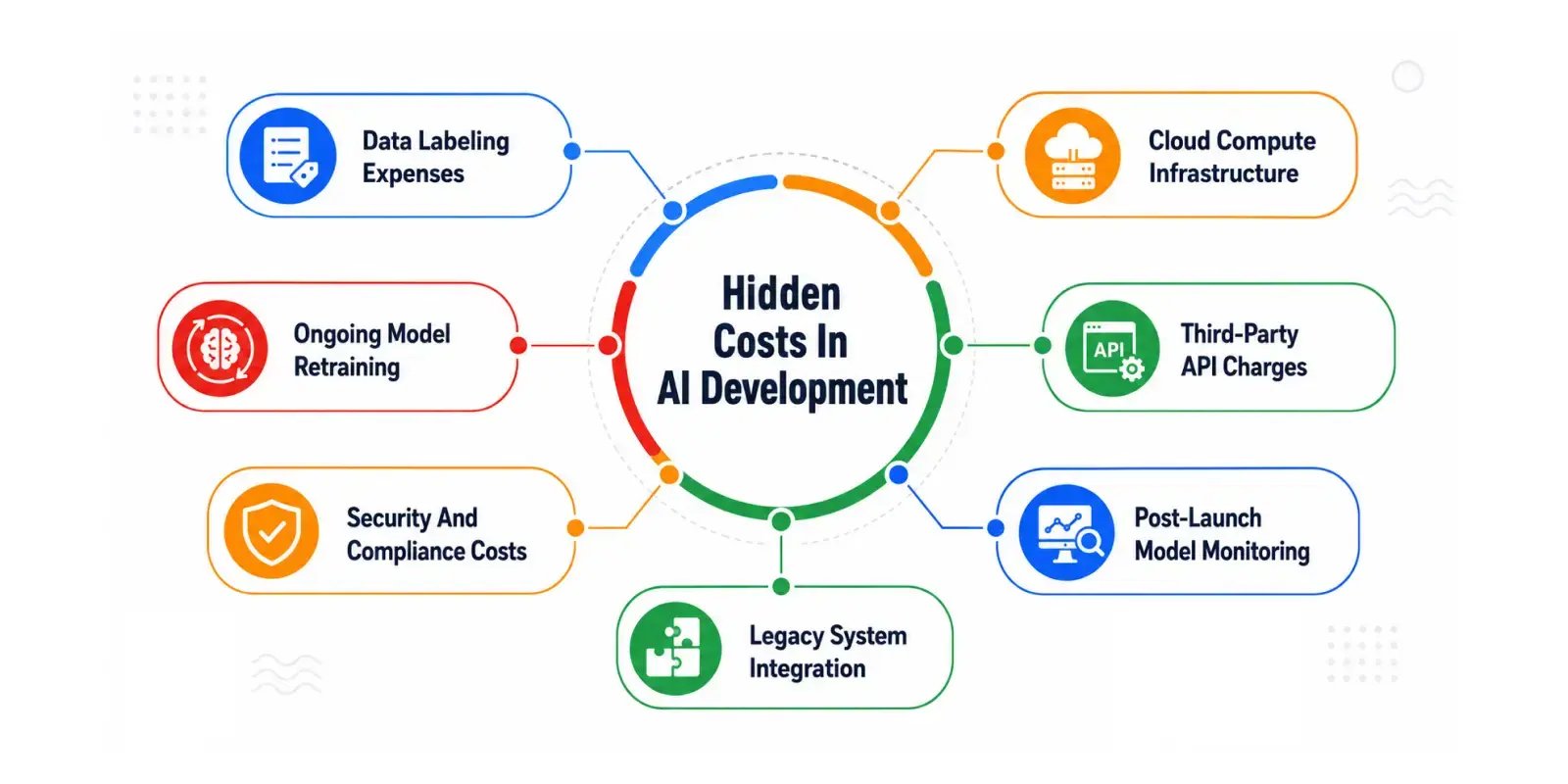
Here is what the second budget typically contains.
Data labeling and annotation. Human-in-the-loop annotation for supervised training datasets adds cost before a single model gets trained. Complex domains like healthcare or legal drive annotation costs significantly higher.
Cloud infrastructure and GPU compute. AWS, Azure, and GCP costs for model training and inference scale faster than most teams expect. GPU compute during training is a one-time spike; inference costs are recurring and grow with usage.
Model retraining over time. Production models drift as real-world data patterns change. Retraining cycles are not optional — they are a recurring line item in your operational budget.
Third-party LLM API costs. OpenAI, Anthropic, and other API providers charge per token at inference. High-volume production systems can accumulate significant monthly API spend that compounds year over year.
Security, compliance, and audit requirements. SOC 2, HIPAA, and GDPR compliance add engineering scope, legal review, and certification costs. For regulated industries, these are non-negotiable and should be scoped from day one.
Post-launch MLOps and model monitoring. Drift detection, alerting, and performance dashboards require dedicated tooling and ongoing engineering attention. Skipping this creates silent model degradation that shows up as business problems, not technical ones.
Integration with existing systems. Connecting AI to your CRM, ERP, or legacy infrastructure often costs more than the AI build itself. Custom middleware, API development, and data mapping all carry their own scope and timeline.
Ready to Turn AI Ideas into Real Business Impact?
FAQ
There is no flat number, as the cost of custom AI development in 2026 is a function of what you're building, how ready your data is, and who builds it. A scoping engagement will tell you more in two weeks than any price list will.
If your competitive advantage lives in your data or your workflows, off-the-shelf AI will always hit a ceiling. Custom AI development costs more upfront and owns the value long-term.
Most teams expect the model to be the expensive part. It rarely is. Data preparation — collection, labeling, and cleaning — is where custom AI budgets actually go.
A focused MVP takes 6 to 8 weeks. A production-grade enterprise AI system takes 6 to 12 months. The longer the build, the higher the total investment, but also the more reliable the output.
Yes, if the scope is honest. Start with a proof-of-concept, validate the business value, then scale.
Any estimate that skips data engineering, MLOps, infrastructure, or post-launch support is not a complete estimate. It is the beginning of a budget overrun.
Vague scope and round numbers are the tell. A fair AI development quote breaks down cost by phase, names the deliverables, and does not hide the second half of the budget in fine print.
Sources
-
1
AI governance platform market forecast & AI-ready data projectionsGartner · Sample reference · gartner.com
-
2
Production LLM inference cost benchmarks at scaleProductCrafters · Sample reference · productcrafters.io
-
3
ML model retraining cost benchmarksInventiple · Sample reference · inventiple.com