-
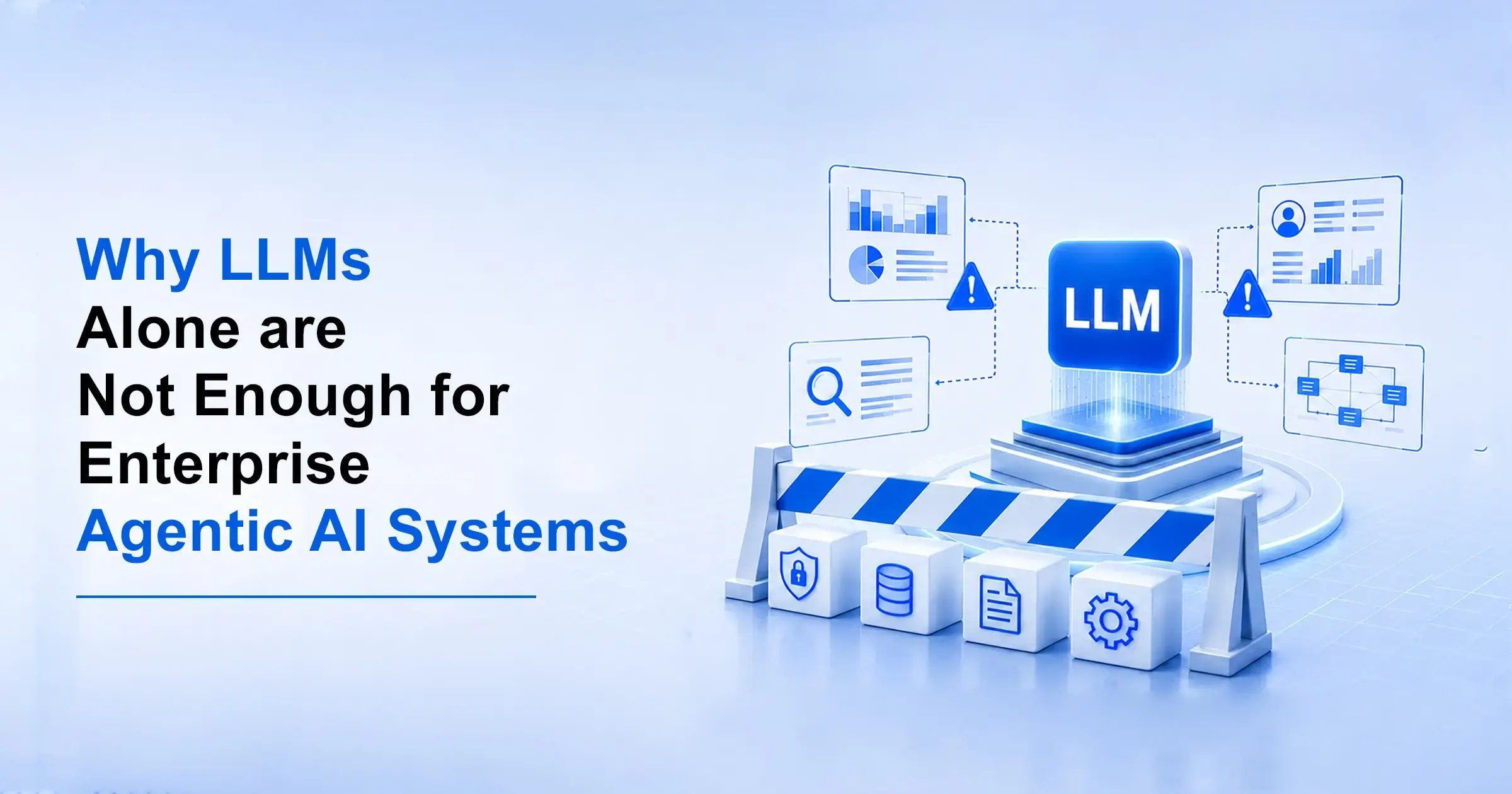
- LLMs are excellent at understanding language, but enterprise processes require much more than conversation.
-
- Most successful agentic AI systems combine LLMs with workflows, rules engines, and data systems.
-
- Understanding a request and making a business decision are two completely different tasks.
-
- Enterprise decisions must be consistent, explainable, and auditable, not just intelligent-sounding.
-
- Workflow infrastructure matters because real business processes rarely finish in a single interaction.
-
- Reliable AI agents depend on trusted data sources, not just information provided in a chat.
-
- The most effective agentic AI architectures assign different technologies to different responsibilities.
-
- Enterprise agentic AI succeeds when LLMs work alongside specialized systems, not when they try to replace them all.
Overview
LLMs are a huge part of the story. They understand intent, handle messy language, answer questions, and make the experience feel natural. That is why it is easy to mistake the chat layer for the whole system. But in an enterprise setting, conversation is only the front door.
Can the system remember where a customer left off? Can it apply the same business rule every time? Can it explain a decision to an auditor? Can it pull reliable data from internal systems before acting?
That is where LLM-only systems start to struggle.
IBM’s Global AI Adoption Index found that 42% of enterprise-scale companies had already deployed AI, while another 40% were still exploring or experimenting. The next challenge is not access to AI. It is building AI that can actually operate inside the business through enterprise AI services and production-ready agentic systems.
What LLMs Do Well in Agentic AI Systems
Enterprise agentic AI development would not look the way it does today without LLMs. The issue is not that they are ineffective. The issue is that organizations sometimes expect them to do jobs they were never designed for.
Let's take a simple example. Imagine an employee at a large company needs a new laptop.
Understanding What People Are Asking For
In most organizations, requesting equipment is surprisingly messy. One employee might write: "My laptop is getting slow. Can I get a replacement?"
Another might say: "The design software I use requires more memory. I need an upgrade."
To a human, these requests are easy to understand. Traditional systems are not nearly as forgiving. This is where LLMs are incredibly useful. They can interpret the intent behind different styles of communication and convert them into something a business process can understand.
Making Enterprise Knowledge Easier to Access
Now suppose the employee asks: "Am I eligible for a laptop upgrade?"
An LLM can search across those resources and provide a direct answer. Not a document. Not ten links. Just an understandable explanation of the policy powered by natural language processing (NLP).
Turning Documents Into Usable Information
Notice the pattern here. LLMs are at their best when they help bridge the gap between how humans communicate and how enterprise systems operate. They can understand requests, interpret documents, and surface information in a way that feels natural.
Those are not small capabilities. In many agentic AI systems, they are some of the most important ones.
Where LLM-Only Agentic Systems Break Down
Business Processes Need More Than Conversation
A real enterprise process is rarely a single interaction. It has steps. It has approvals. It has missing information. It has exceptions.
Decisions Must Be Consistent
Enterprise decisions cannot shift based on how someone phrases a request.
- Role eligibility
- Replacement cycle
- Budget limits
- Manager approval
- Device configuration rules
Data Has to Come from Reliable System
Another issue is context.
Enterprise agents cannot make decisions based only on what the user says in a chat. They need verified data from internal systems.
For a laptop request, that could mean checking the employee’s role, current device age, department budget, past approvals, vendor quote, and procurement policy.
Some of that data may come from HR. Some from IT asset management. Some from finance or procurement.
The LLM can help interpret the request, but the system still needs trusted data pipelines and integrations behind it. Otherwise, it is just making a polished guess.
Explanations Need to Match the Actual Decision
This is the part many teams underestimate.
If a request is rejected, the user may ask, “Why?” A manager may ask the same thing. An auditor might ask later.
A vague explanation is not enough.
What Enterprise Agentic AI Systems Need Beyond LLMs
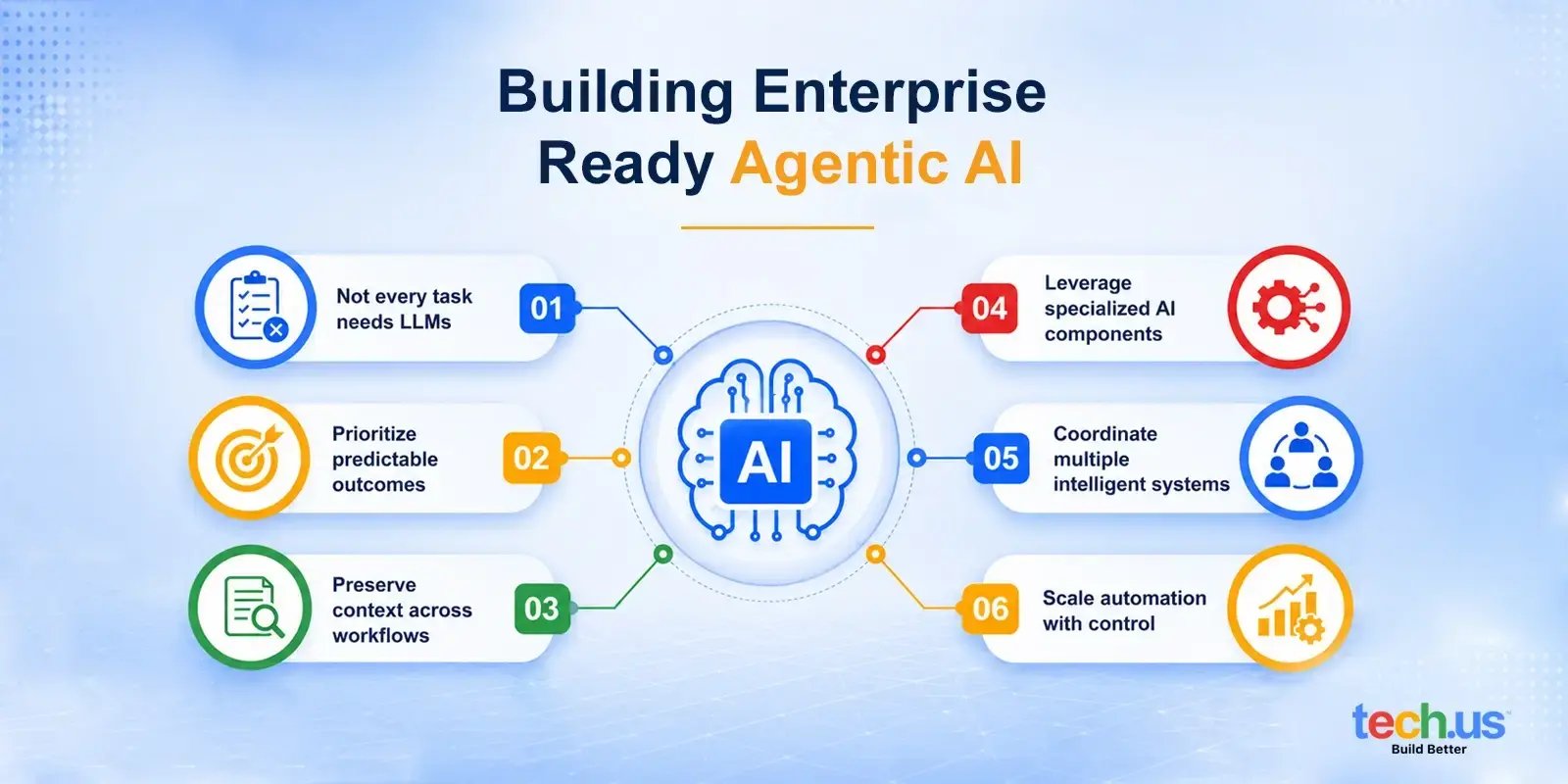
One useful way to think about enterprise agentic AI is that the architecture should be designed around the problem, not around the LLM. That may sound like a small distinction, but it changes how you build agentic systems.
A customer asking a question, a process that spans multiple days, a policy decision that must survive an audit, and a document that needs information extracted from it are fundamentally different problems.
Not Every Agent Should Be an LLM Agent
The term AI agent has created an assumption that every agent in the system should be powered by an LLM. In reality, different AI agents are transforming business processes in different ways.
The conversational agent is an LLM because understanding human language is exactly what LLMs do well.
Enterprise Systems Need Deterministic Decisions
Businesses often do not care whether a decision is intelligent. They care whether it is repeatable. Think about that for a moment.
A lending decision, eligibility determination, compliance check, or policy validation is not judged by how creative the reasoning is. It is judged by whether the same logic is applied consistently every time.
- Why was this approved?
- Why was this rejected?
- Which rule triggered this outcome?
- Would another customer receive the same treatment?
State Is More Valuable Than Most Teams Realize
Many agentic AI demos assume a user completes everything in a single interaction.
- Real life rarely works that way.
- People stop halfway through.
- Documents are missing.
- Approvals take time.
- Human intervention becomes necessary.
The Real Value Comes from Combining Specialized Systems
- LLMs handle language.
- Workflow systems handle process execution.
- Decision engines handle business logic.
- Data services provide trusted information.
- Orchestration layers coordinate everything.
A Practical Example: How Multiple Types of AI Agents Work Together
Let us imagine a manufacturing company that wants to automate its supplier onboarding process.
Step 1: A Supplier Starts a Conversation
The process begins with a conversational agent.
The supplier might ask: "We'd like to become an approved vendor. What information do you need from us?"
Step 2: The Request Is Routed to the Right Process
Understanding the request is only the first step. The system now needs to decide what happens next.
An orchestration agent identifies that this is a supplier onboarding request and routes it to the appropriate onboarding workflow.
The chat agent understands the request. The orchestration layer decides where that request should go. Those are two completely different responsibilities.
Step 3: Company Policies Are Retrieved and Explained
- What certifications are required?
- Which supplier categories are accepted?
- What compliance standards must be met?
Step 4: The Supplier Onboarding Process Begins
The onboarding workflow collects company details, tax information, certifications, insurance documentation, and other required information.
Step 5: Risk and Compliance Checks Are Evaluated
- Operate in approved regions
- Meet minimum insurance requirements
- Pass compliance screenings
- Maintain specific certifications
These checks are performed by decision agents using predefined business rules.
The goal is not to generate an answer. The goal is to apply the same logic consistently to every supplier.
Step 6: Additional Data Is Collected Automatically
- Business registration data
- Financial information
- Compliance records
- Sanctions screening results
- Previous supplier history
Step 7: Documents Are Processed
Step 8: Human Review Is Supported When Needed
Perhaps a compliance issue appears during review. Maybe a certification is expired. Maybe financial information conflicts with external records.
The Shift from LLM-Centric AI to Enterprise Agentic AI
LLMs Are Part of the System, Not the Entire System
Why Multi-Method Agentic AI Is Gaining Ground
The most mature agentic AI systems today combine multiple capabilities rather than relying on a single model.

Tech.us is an AI development company that builds custom AI solutions for businesses seeking measurable results. We partner with organizations to design, develop, and deploy scalable AI systems that solve complex challenges and unlock new opportunities for growth. Our team delivers practical AI applications that create tangible business impact across industries.