Overview
Then something starts to change.
That is exactly why AI performance degradation has become a growing concern for organizations investing heavily in AI. In fact, a study published in Nature found that 91% of machine learning models experience some degree of performance degradation over time after deployment.
This is what many organizations experience as AI performance drift. Not a technical failure, but a growing gap between how the business operates today and what the AI was trained to understand.
The companies seeing long-term AI ROI are not necessarily building better models. They are building systems to keep those models relevant through artificial intelligence development services.
The Hidden Reality of Enterprise AI: Deployment Is Not the Finish Line
It usually happens for a more practical reason. Once the model goes live, everyone moves on to the next priority. This is one reason many enterprise AI initiatives fail to deliver expected results. The implementation team closes the project. Business teams start using the system. Leadership expects the AI to keep producing value because, from the outside, it looks like any other software system.
But AI does not behave like standard software.
Why Businesses Treat AI Like Traditional Software
This is a common mistake, but it is understandable.
Most companies are used to launching systems that remain stable unless someone changes the code. If a CRM workflow is configured correctly, it keeps routing leads. If an accounting tool is set up correctly, it keeps applying the same logic. So teams naturally expect AI to work the same way.
A model trained on last year’s customer behavior may not understand this year’s buying patterns. A support AI trained before a product update may give answers that are technically outdated. A risk model built on older transaction data may miss new fraud patterns.
What Makes AI Systems Different
AI systems are tied to moving conditions.
For example:
- A sales forecasting model may lose accuracy after pricing changes.
- A claims automation system may struggle when policy rules are updated.
- A customer support chatbot may become unreliable after new service terms are introduced.
- A recommendation engine may perform poorly when customer preferences shift.
The Cost of Ignoring AI Performance Decay
Once people inside the business stop trusting the system, it becomes much harder to rebuild adoption. Even if the model is later improved, teams may hesitate to rely on it again.
Why AI Performance Declines Over Time
01. The Business Environment Changes Faster Than the Model
One of the most common reasons AI performance drops has nothing to do with the model itself.
02. The Data Feeding the AI Changes
Most discussions about AI performance focus on the model itself. In practice, the data is often the bigger issue.
- New fields are added to forms.
- Teams adopt new software platforms.
- Customers provide information differently.
- Data collection processes change.
- Employees relying on coworkers instead of internal resources
- Certain fields become incomplete or inconsistent.
Why These Issues Often Go Undetected
Many organizations closely monitor system uptime, API performance, and infrastructure health. Those are important metrics.
03. Business Processes Evolve While AI Remains Static
Businesses rarely operate the same way for long.
As organizations grow, they refine workflows, introduce new controls, adopt new tools, and adjust responsibilities across teams. These changes are usually made for good reasons. They improve efficiency, reduce risk, or help the business scale.
The challenge is that AI systems are often not updated alongside those operational changes, which is one of the most common AI integration mistakes in existing systems.
A model may have been trained when approvals followed one process, customer requests moved through a specific workflow, or certain decisions were handled by particular teams. Months later, those processes may look completely different.
- New approval workflows
- Updated compliance requirements
- Department restructuring
- Changes in operating procedures
- New business rules and policies
The AI continues making recommendations based on how work used to happen.
04. Human Behavior Adapts to the AI
Many organizations focus on data, models, and infrastructure when discussing AI performance. What often gets overlooked is people.
Once AI becomes part of everyday operations, employees and customers naturally begin adjusting their behavior around it.
Employees Change How They Use the System
As teams change their behavior, workflows evolve, and decision-making patterns shift, the environment the model was originally trained on begins to look different.
Why This Creates Performance Drift
7 Warning Signs Your AI System May Already Be Drifting
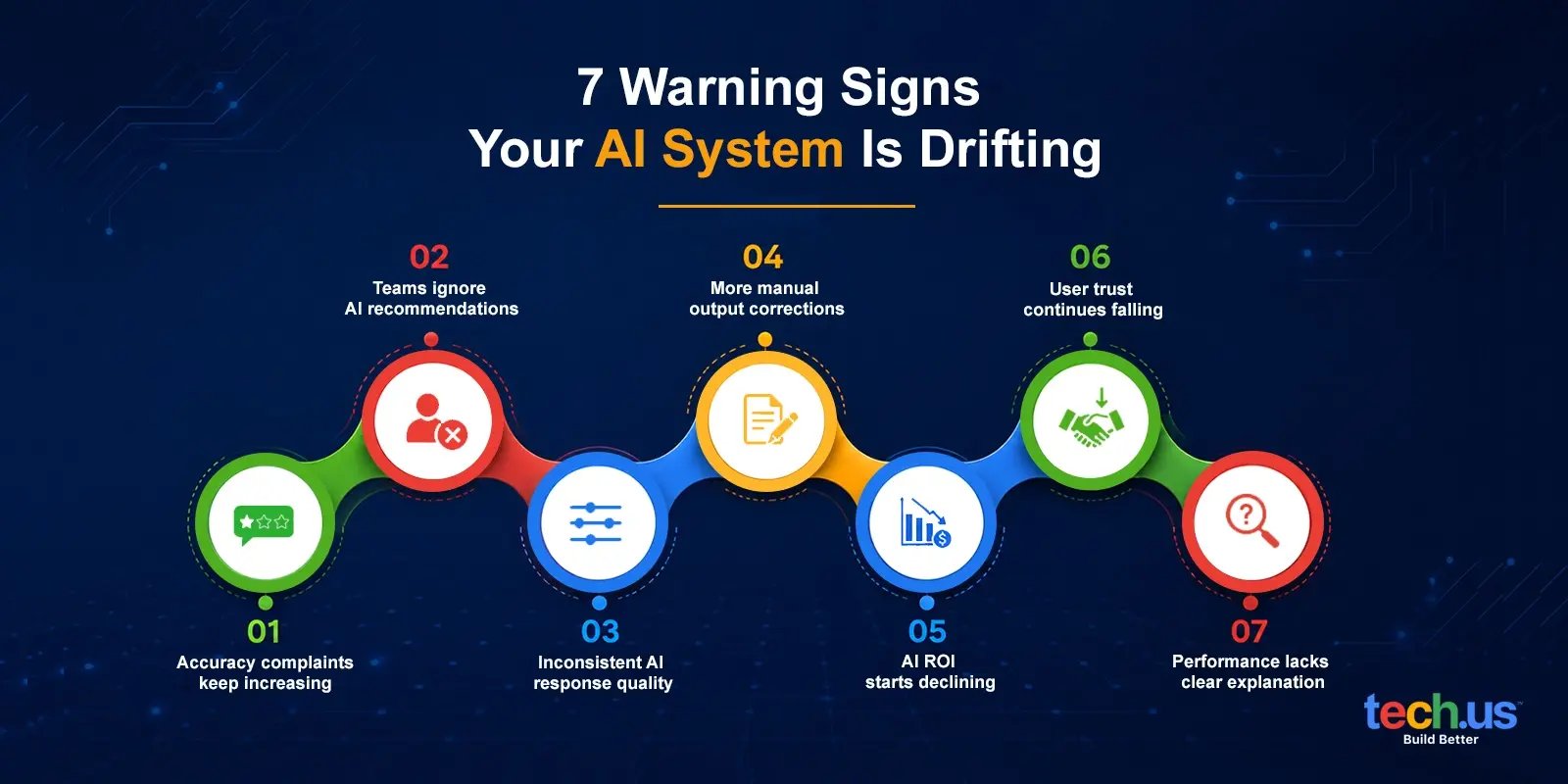
Accuracy Complaints Are Increasing
One complaint is not a concern. A consistent pattern is.
Teams are Overriding AI Recommendations More Frequently
A healthy level of human review is expected. A growing trend of overrides is different.
If employees routinely ignore AI recommendations and rely on their own judgment instead, it often signals that the system is no longer aligned with current business realities.
Response Quality Feels Less Consistent
Consistency is often one of the first things to decline.
Users may notice that the AI performs well in some situations but struggles in others that previously caused no issues. The system starts producing good results one day and questionable results the next.
AI Outputs Require More Human Corrections
One practical way to assess AI health is to measure how much additional work people must do after receiving an output.
Business KPIs Are Falling Despite AI Usage
This is where business leaders should focus their attention.
Users Are Losing Trust in the System
Trust is difficult to measure but easy to observe.
You will hear comments such as, "I always double-check it now" or "I don't rely on that recommendation anymore."
Nobody Can Explain Current Performance Levels
This may be the most overlooked warning sign.
Ask a simple question: How is the AI performing today compared to six months ago?
If nobody can answer confidently, the organization may have a monitoring problem and may be missing the operational practices commonly associated with MLOps. Many businesses track system availability and infrastructure metrics but have limited visibility into actual model performance.
When performance cannot be measured, performance drift can continue unnoticed for months before its business impact becomes obvious.
A Practical Framework for Preventing AI Performance Drift
Update models before problems become visible: Reassess and retrain models whenever major business changes occur.
FAQ
There is no fixed schedule. Retraining should happen when the business changes significantly, not just because a calendar says it's time.
AI failure is when the system stops producing useful results. AI drift is much subtler. The system still works, but its outputs become less relevant as business conditions change.
Not really. Businesses evolve constantly. The goal is not to eliminate drift but to detect it early and keep its impact small.
Systems tied to customer behavior, market conditions, risk assessment, forecasting, and recommendations tend to drift fastest because those environments change most often.
Look at the business outcome the AI was built to improve. If those results are getting weaker despite continued AI usage, it's time to investigate why.

Tech.us is an AI development company that builds custom AI solutions for businesses seeking measurable results. We partner with organizations to design, develop, and deploy scalable AI systems that solve complex challenges and unlock new opportunities for growth. Our team delivers practical AI applications that create tangible business impact across industries.