Overview
What Digital Transformation Was Actually About
What It Got Right
- Centralized data replaced fragmented, siloed records across departments
- Cloud infrastructure cut operational overhead and improved system reliability
- SaaS platforms standardized workflows that had been running on tribal knowledge
- Real-time reporting replaced the week-long wait for monthly dashboards
For organizations that executed it well, digital transformation built the operational backbone that everything else now depends on.
Where It Fell Short
Here’s How Digital Transformation Played Its Key Role
What AI Transformation Actually Means (And What It Doesn't)
The scale of that shift isn’t theoretical. According to McKinsey, generative AI features alone could add between $2.6 trillion and $4.4 trillion in annual economic value across the 63 business use cases they analyzed.
AI Adoption vs. AI Transformation: Not the Same Thing
- AI adoption is tool-level: deploying AI products into existing workflows to improve speed or reduce manual effort
- AI transformation is system-level: redesigning how the business operates around AI-native capabilities, including how data flows, how decisions get made, and who is accountable for outcomes
What Changes at the System Level: From Deterministic to Probabilistic
That shift alone changes how you govern, test, and manage these systems. The old playbook doesn't cover it, which is why organizations often need to revisit the key aspects of AI development for businesses before scaling AI initiatives.
Here’s How AI Transformation Changed the Game
- They predict demand before orders are placed
- They dynamically reroute inventory across fulfillment centers based on real-time signals
- They adjust staffing models accordingly
The Real Differences Between Digital and AI Transformation
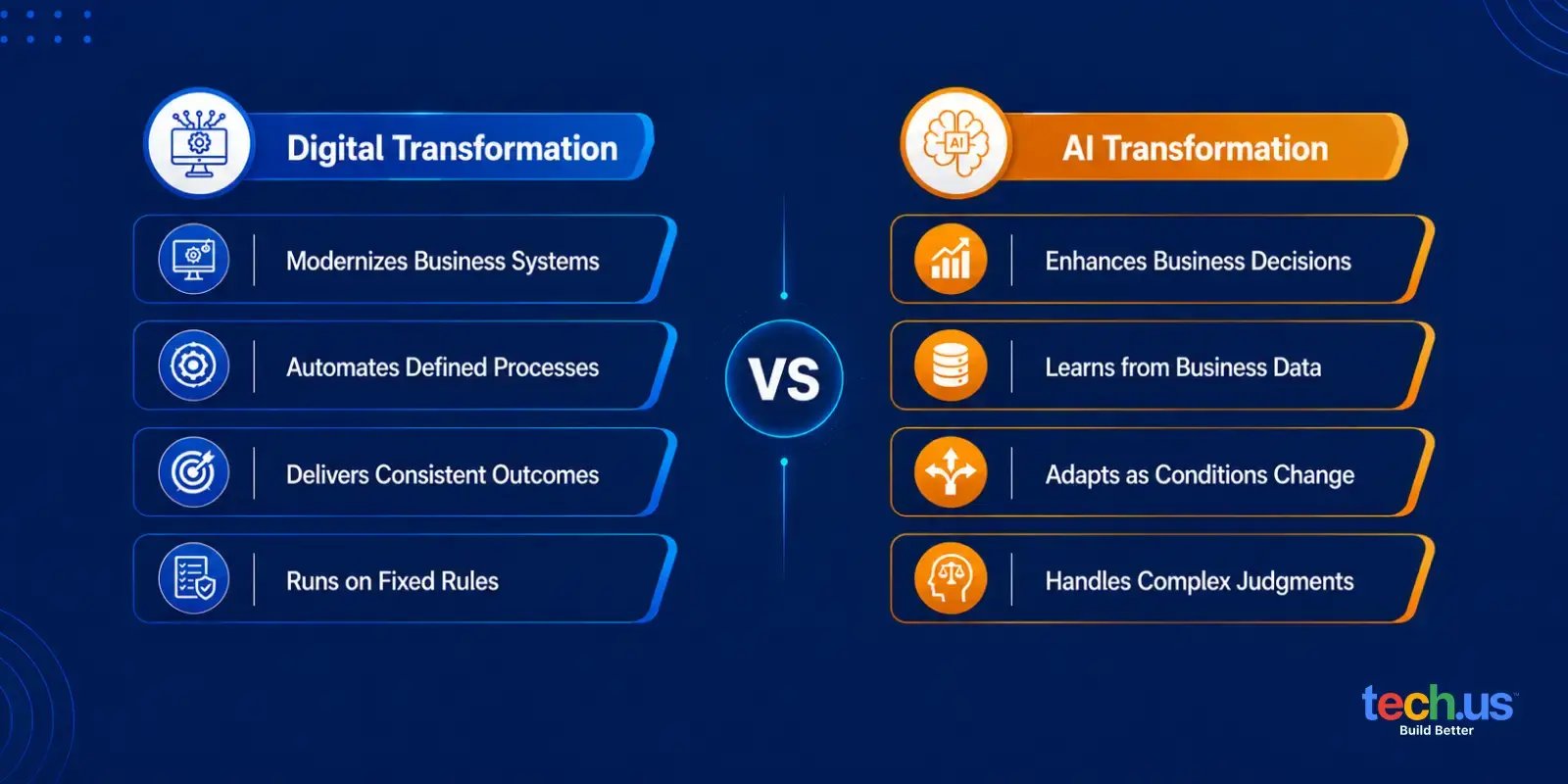
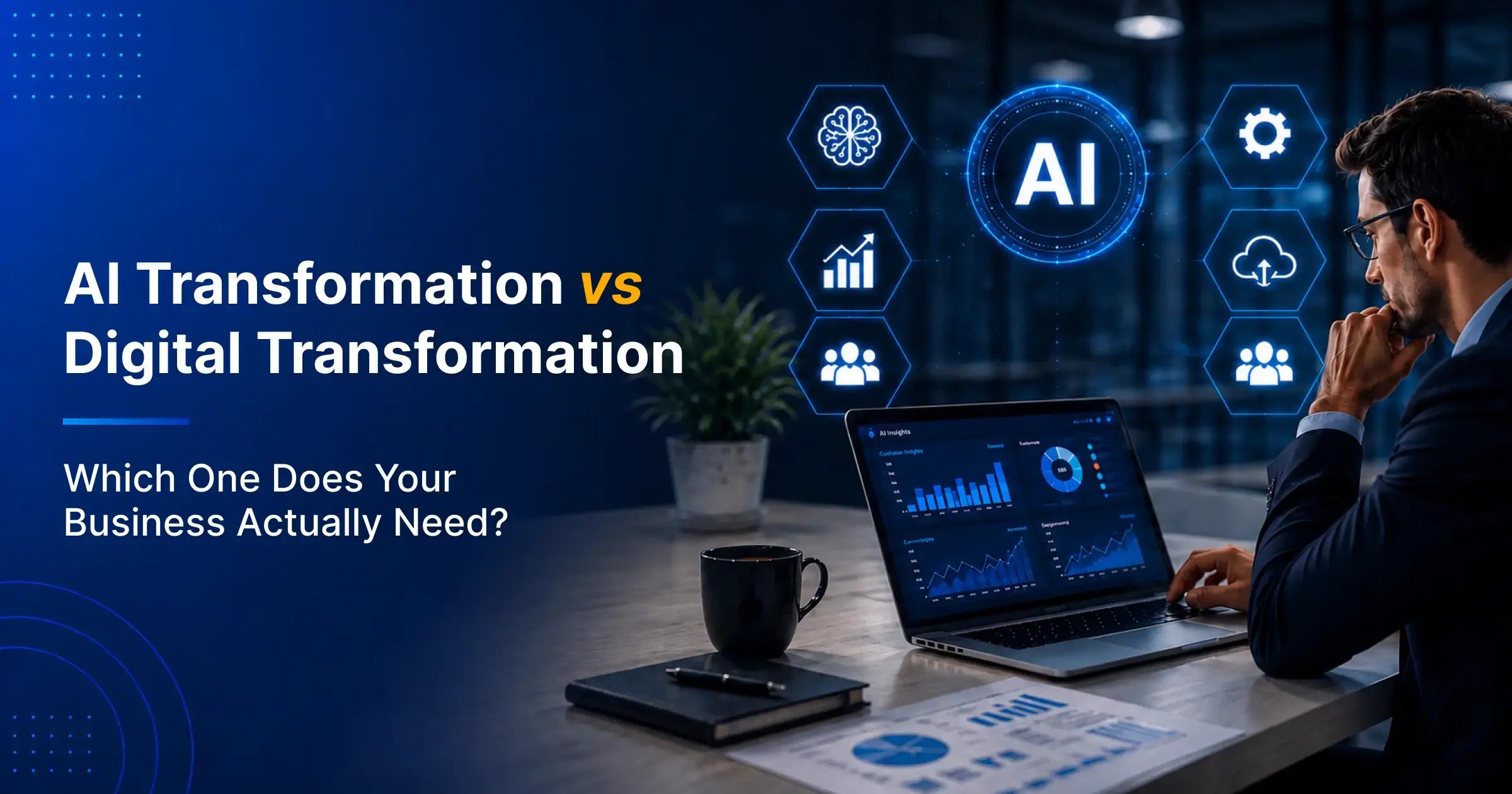
Digital and AI transformation are often treated as phases of the same journey. They're not. They differ at the level of how the technology works, what it does with data, who carries the decision-making load, and whether the work ever actually ends. Here's where those differences play out in practice.
How the Technology Works: Predictable Systems vs. Probabilistic Models
How Data Is Used: Reporting Asset vs. Living Intelligence
What "Done" Looks Like: Finish Line vs. Moving Target
New capabilities emerge that change what's possible every few months. The strategy you wrote in January is partially obsolete by April. This isn't a project with a completion date. It's an operational capability that has to be continuously managed.
Where the Cognitive Load Lives: Offloaded vs. Redistributed
Who Owns the Outcome: IT Projects vs. Business-Wide Accountability
AI transformation can't live in IT alone, which is why many organizations are investing in broader enterprise AI services for business operations.
When an AI system influences a pricing decision, a hiring shortlist, or a customer communication, the accountability for that output belongs to the business function using it. Legal, compliance, operations, and leadership all have skin in the game in ways they simply didn't during digital transformation.
Digital Transformation vs. AI Transformation: At a Glance
| Dimension | Digital Transformation | AI Transformation |
|---|---|---|
| Core objective | Modernize systems and digitize operations | Build intelligent, adaptive, decision-making capability |
| How technology works | Deterministic: same input, same output | Probabilistic: outputs vary, models evolve |
| Role of data | Reporting and analytics asset | Continuous learning engine |
| Failure mode | Breaks visibly, traceable cause | Fails silently, confidently wrong |
| Project timeline | Defined phases, completion point | Ongoing, no fixed endpoint |
| Cognitive load | Moves work into systems | Redistributes decision weight to humans |
| Ownership | Primarily IT-led | Cross-functional business accountability |
| Success metric | Adoption rate, system uptime | Decision quality, model accuracy, business outcomes |
What Carries Over, and What Doesn't
What Still Works
- Change management: Whether you're rolling out a new ERP or an AI-powered decision system, human adoption is still what determines success, which is one of the key benefits of working with an AI software development company.
- Executive sponsorship: If leadership isn't visibly using and championing the initiative, the organization won't follow. That hasn't changed.
- Governance frameworks: Access control, data classification, audit trails, and accountability structures still matter. They just need to expand to cover new territory like model evaluation and prompt oversight.
- Stage-gate scoping: Starting with a constrained use case, proving value, then expanding is still the right approach. Broad rollouts without validated pilots fail in AI just as they did in digital.
- Cross-functional program structure: Steering committees, named owners, and working groups keep large programs from drifting. That discipline carries over cleanly.
What Will Get You in Trouble
- Waterfall planning: A 36-month AI roadmap planned in detail is obsolete before it's approved, especially given how quickly generative AI capabilities continue to evolve.
- Pass-fail acceptance testing: You cannot verify a probabilistic system the way you verified a CRM migration. You need ongoing evaluation, not a sign-off checklist.
- One-and-done training: AI tools change constantly. Training your team once at rollout and moving on guarantees drift between how people use the tools and what the tools are actually capable of.
- Measuring ROI only in hours saved: The real value from AI often shows up in decision quality, new revenue models, and capabilities that didn't exist before. If your CFO is only looking for productivity savings, you'll undervalue what's actually working.
How to Move Forward Without Getting It Wrong
The companies that struggle with AI transformation aren't typically short on tools or budget but mostly on clarity.
FAQ
Not exactly. Digital transformation modernized your systems. AI transformation changes how those systems think and decide. One builds the foundation; the other changes what you build on top of it.
In most cases, no. AI systems need clean, connected, well-governed data to function reliably. If your digital foundation is shaky, your AI initiative will be too.
Start by asking whether your data is centralized, accessible, and trustworthy. If your teams are still reconciling numbers across spreadsheets, you have foundational work to finish first.
Mostly because organizations treat it like a technology project when it's really an organizational change problem. The tools are the easy part. Getting people to use them well, consistently, is where most programs break down.
Align your leadership team on what AI transformation actually means for your business specifically, not the industry definition, but the operational and strategic changes you're committing to. Without that clarity at the top, everything downstream gets harder.