
Overview
The Assessment Measures What's Easy to Score, Not What Determines Success
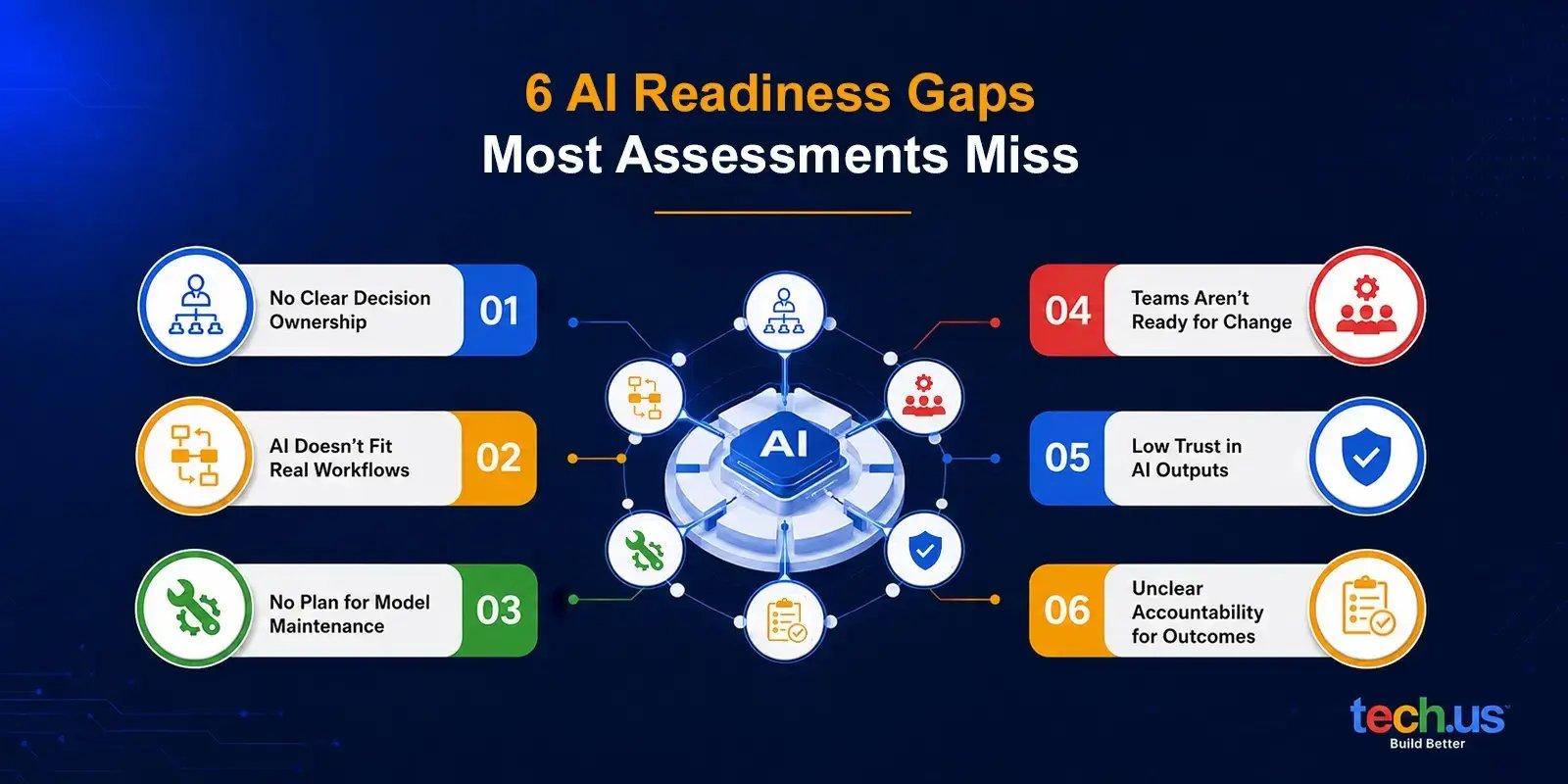
Gap 1: Who actually has the authority to kill or scale a model?
- The data team says it's a business decision.
- The business says it's a technical one.
- Weeks pass, and the model keeps running.
Gap 2: Does the AI fit how work actually gets done?
The Assessment Assumes Conditions That Don't Hold After Launch
Gap 3: Who keeps the model accurate after month three?
And here's where it gets awkward: when you ask who's responsible for catching that drift and fixing it, you often get a shrug. Was that the vendor's job? The data team's? Nobody scoped it, so nobody owns it.
Gap 4: Can the organization actually absorb one more change?
The Assessment Ignores the Human and Governance Variables That Quietly Sink Adoption
Gap 5: Will people actually trust the output, or quietly double-check it?
Gap 6: When the model is wrong, who owns the outcome?
How to Pressure-Test Your Own Readiness Assessment
| The Gap | The Question Your Assessment Probably Skipped | A Weak Answer Sounds Like |
|---|---|---|
| Decision rights | Who can pull this model from production, on their own authority, by end of day? | "It has an owner." |
| Workflow fit | Was this validated against how the work actually happens, or the process doc? | "It matches our documented process." |
| Drift ownership | Who is named and scheduled to check accuracy at month three and month six? | "The model is accurate." |
| Change capacity | What else is this same team absorbing right now, and can they take more? | "The org is ready for AI." |
| User trust | Will people stop double-checking the output, and how do we know? | "Users have been trained." |
| Accountability | When the model is wrong, who owns the outcome, and is that written down today? | "We have a governance framework." |
Notice the pattern in that last column. Every weak answer is technically true. The project does have an owner. The framework does exist. That's exactly why these gaps survive the assessment. They pass on paper.
A real pressure test isn't about finding a no. It's about refusing to accept a vague yes. If the answer to any of these is a job title instead of a person, or a policy instead of a process, you've found work to do before launch, not after.
Where Most Teams Go From Here
- Not "is there an owner," but who can stop or scale this model on their own authority.
- Not "does it match the process doc," but does it fit how the work truly gets done.
- Not "is the model accurate," but who keeps it accurate at month three and month six.
- Not "is the org ready," but can this team absorb one more change right now.
- Not "were users trained," but will they actually trust the output instead of double-checking it.
- Not "is there a governance framework," but who owns the outcome the day the model is wrong.
FAQ
Readiness asks whether you can start; maturity asks how far along you already are. Both tend to measure capability, and neither checks whether a model will survive once it's actually in use.
More often than once. Revisit it at launch, around month three, and any time something big shifts, like a reorg or a major data change.
No, and it was never meant to. A strong score lowers risk, but it says nothing about trust, ownership, or upkeep, which are the things that actually decide whether AI sticks.
Ideally both an internal team and an outside reviewer. Internal teams know the systems but miss their own blind spots; an outsider who's seen deployments break spots them faster.
Ownership after launch. They confirm a project has an owner but rarely ask what that owner can actually do, or who keeps the model accurate months in.