By end of 2026, Gartner predicts 40% of enterprise applications will embed AI agents, which is up from less than 5% just a year ago. Most businesses are aware of this shift. The benefits of enterprise AI are no longer theoretical.
The question is no longer whether to adopt agentic AI for enterprise operations. The question is which path you take to get there, and whether that path leaves you in control two years from now.
The build vs buy agentic AI decision is not a cost question alone. It is a question of strategic differentiation, data control, and how much of your competitive advantage sits inside the workflows the agent will run.
This post lays out a practical agentic AI implementation strategy for making that call.
What Agentic AI is in Business Terms
Agentic AI refers to AI systems that can plan multi-step tasks, use external tools, retain memory across sessions, and act with limited human oversight. That is a fundamentally different thing from the AI tools most enterprises are already running. If you want a deeper grounding before going further, here is everything you need to know about AI agents.
A chatbot responds and waits. An agentic system decides what to do next.
Where the Market Stands Today
Off-the-shelf platforms are catching up, but not all the way
Enterprise AI agent deployment has moved fast. Platforms exist today that would have taken a dedicated engineering team 18 months to build three years ago. That is worth acknowledging before anything else.
Microsoft Copilot Studio, Salesforce Agentforce, AWS Bedrock Agents, Google Vertex AI Agent Builder, they all have real capabilities. They connect to common enterprise systems out of the box.
So what is the problem?
The ceiling. Every off-the-shelf AI agent platform is built around assumptions about how your workflows operate. When your workflows match those assumptions, the platform works well.
When they do not, you start running into walls. Rigid orchestration logic. Limited control over how proprietary data moves through the system. Agentic AI guardrails you cannot adjust without breaking the platform's architecture.
According to Dynatrace's Pulse of Agentic AI 2026, summarized by Business Wire, roughly 50% of enterprise agentic AI projects are still in POC or pilot stage.
Getting from agentic AI pilot to production is where most platforms show their limits — organizations discover mid-pilot that the platform they chose cannot handle what production actually demands.
| Platform Type | Best For | Where It Breaks Down |
|---|---|---|
| Off-the-shelf (SaaS) | Standard workflows, fast pilots, established integrations | Custom logic, proprietary data, compliance requirements, scale |
| Custom-built | Complex, differentiated, evolving use cases | Longer time to first value without the right team or partner |
| Hybrid | Enterprises with mixed use case maturity | Governance complexity, inconsistent observability across systems |
Three Decision-Makers, Three Different Calls
The build vs buy AI agents decision looks different depending on where you sit. These are composite perspectives involving agentic AI development and how it impacts business processes.
The one who built from scratch
- They own the IP completely
- The agent architecture is model-agnostic, so they are not exposed when a vendor changes pricing
- The system has been extended three times without a rebuild
- Data never leaves their environment
The one who bought an off-the-shelf platform
Let’s consider a B2B SaaS company. They needed an internal support agent fast, the use case was relatively standard, and the team had no appetite for a long build cycle. They went with an established platform and had something working in about six weeks. Genuinely the right call for that context.
- Custom logic for enterprise tier customers does not fit the platform's orchestration model
- Scaling agent workflows across regions is running into data residency constraints they did not fully anticipate
- Every new capability requires a vendor support ticket, not an internal sprint
- Pricing has increased twice as usage grew, and the contract renewal is not looking friendly
The one who would do it differently
This one is the most instructive. A manufacturing company that spent most of 2024 evaluating options, running small pilots, waiting for the market to settle. Reasonable thinking at the time.
- The competitor's agent had already processed months of real transaction data, making it measurably smarter
- Their team had built internal capability around agent observability and governance
- They had already iterated through three versions of the workflow logic
- The gap in operational efficiency was visible to the market, and to the board
How the Three Paths Compare
| Built from Scratch | Bought a Platform | Waited Too Long | |
|---|---|---|---|
| Time to first value | Slower upfront (6+ months) | Fast (weeks) | Delayed by months of evaluation |
| IP ownership | Full ownership, fully portable | Vendor owns the architecture | Nothing built, nothing owned |
| Data control | Proprietary data stays internal | Data flows through vendor systems | No data flywheel started |
| Scalability | Extends without rebuild | Hits ceiling as complexity grows | Competitor scaled while you evaluated |
| Vendor dependency | None, model-agnostic | High, pricing and roadmap exposure | N/A, but market dependency grew |
| Long-term cost | Front-loaded, lower at scale | Grows with usage and seats | Cost of catching up is higher |
| Competitive position | Compounding advantage over time | Parity at best, ceiling risk | Competitor pulled ahead |
| Biggest risk | Slower start without the right team | Lock-in as workflows get complex | Irreversible head start lost to competition |
The Real Cost of Getting This Wrong
Why "we'll revisit this next quarter" is itself a decision
The cost of waiting is not just time.
- Data flywheel maturity. The agent your competitor deployed a year ago has processed a year of real decisions. Yours has not started.
- Institutional learning. Their team knows how to build, govern, and iterate on agentic systems. Yours is still in planning.
- Talent. The engineers who have done this before gravitate toward companies already doing it.
The cost of the wrong platform is less visible, but just as real.
- 6 to 12 months of sunk integration work
- Internal credibility damage when the team has to reverse course
- A migration that is not a migration, it is a rebuild from scratch
- And a vendor who still charges you while you transition off
When Buying Agentic AI Makes More Sense
The speed argument is real
The right question to ask before you decide
Buy when these conditions apply
- The use case is standard and not unique to your business model
- You have no proprietary data advantage tied to this workflow
- Speed to deployment matters more than long-term control
- Your internal AI or engineering team does not exist yet
- You are running a proof of concept before committing to a larger build
- Compliance and data residency requirements are manageable within the platform's guardrails
One thing to keep in mind
When Building with an Agentic AI Partner Makes More Sense
When does the build path make more sense
- Your workflows involve proprietary data that cannot flow through a third-party vendor's infrastructure
- The logic the agent needs to execute is specific to your business and cannot be configured inside a platform
- You are in a regulated industry where AI governance, audit trails, and human-in-the-loop controls need to meet standards the platform does not support
- You have tried a platform pilot and already hit the ceiling on what it can do
- You are thinking about this as a 3 to 5 year capability investment, not a 6-month fix
What to look for in an agentic AI development partner
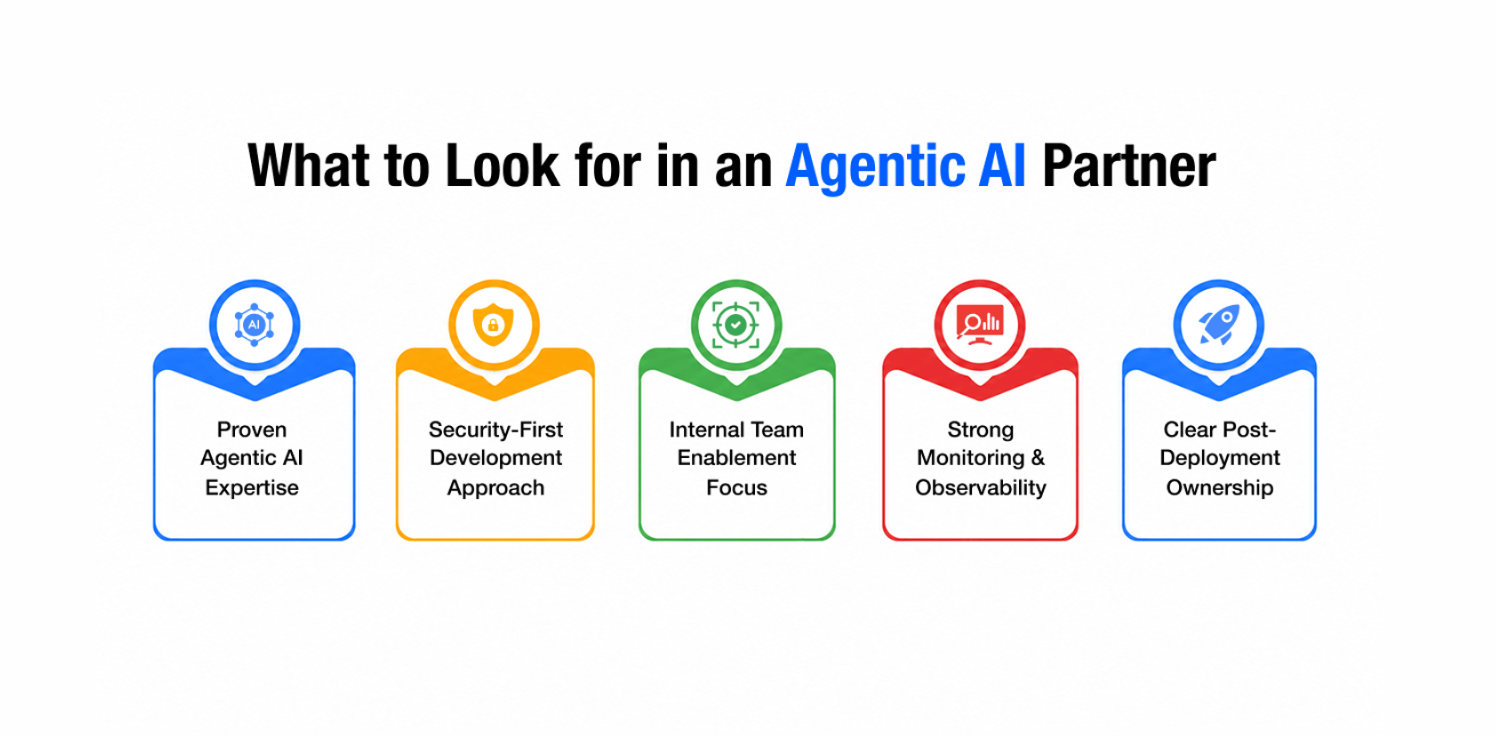
- Hands-on experience with AI agent orchestration frameworks like LangGraph, CrewAI, and the Microsoft Agent Framework, not just familiarity
- A security-first architecture approach, especially around data pipeline ownership and how proprietary data is handled during development
- A delivery model that builds internal capability on your team rather than creating long-term dependency on the partner
- Clear answers on how the system will be monitored, how agent observability works in production, and who owns the architecture documentation when the engagement ends
How to Move Forward – A 30-Day Clarity Plan
Most businesses do not have a decision problem. They have a prioritization problem. The build vs buy agentic AI question does not need another quarter of evaluation. It needs a structured 30 days and a decision criteria that goes beyond cost.
Week 1: Audit your use cases
- List your top 3 candidate workflows for agentic AI deployment
- Score each one on differentiation, data sensitivity, and workflow complexity
Week 2: Run a platform proof of concept
- Pick the leading platform option for your top use case
- Test it against your actual data and workflow logic, not a demo environment
- Document exactly where it works and where it breaks
Week 2 in parallel: Scope a custom build
- Engage a custom agentic AI development partner for the same use case
- Get a scoped proposal, not a ballpark quote
- Compare architecture ownership, data pipeline control, and AI scalability side by side
Week 3 to 4: Make the call
- Compare control, ceiling, and data risk, not just upfront cost
- Factor in agentic AI total cost of ownership across 3 years, not 3 months
- Account for IP ownership, vendor dependency, and what happens at 3x your current scale
The decision criteria that actually matters
- Does this workflow give us a competitive edge, or is it table stakes?
- Can we afford for this data to live in a vendor's environment long term?
- Will this platform still fit us in 18 months?
- Is the cost of being wrong here recoverable?
FAQs
Agentic AI plans and executes multi-step tasks autonomously, uses external tools, and self-corrects mid-workflow. Regular automation follows a fixed script. An agentic system decides what to do next.
Treating it as a cost decision instead of a strategic one. The real question is whether the workflow the agent runs is a competitive differentiator or something any competitor could replicate using the same platform.
When the use case is generic, the internal AI team does not exist yet, and differentiation is not the goal. Platforms like Salesforce Agentforce or Microsoft Copilot Studio are legitimate choices for standard workflows with no proprietary data advantage.
It is harder to escape than typical SaaS lock-in. You are not just migrating data. You are rebuilding accumulated prompt logic, integration work, and agent memory structures that are tied to that platform's architecture.
A production-grade custom build typically runs between $75,000 and $300,000 depending on complexity. But the more important number is total cost of ownership over 3 years, where custom builds almost always come out lower than platform licensing at enterprise scale.
With the right development partner, a production-ready agent for a well-scoped use case typically takes 3 to 6 months. The first 6 weeks are usually discovery, architecture design, and data pipeline setup.
Unless you already have an experienced AI engineering team, building a custom AI agent in-house carries significant execution risk. Partnering with a specialized custom agentic AI development firm is faster and lower risk. See how to select the best AI development partner for a detailed evaluation framework.
The most widely used in enterprise production environments right now are LangGraph for stateful workflows, CrewAI for role-based multi-agent systems, and the Microsoft Agent Framework for Azure-native stacks. A good development partner will be hands-on with all three.
Agentic AI total cost of ownership includes model and API usage, orchestration development, vector infrastructure, monitoring, governance controls, compliance layers, and ongoing maintenance. The license fee or build cost is only part of the picture.
If you have a clearly defined workflow, a data environment that can support the agent, and at least one internal owner accountable for the outcome, you are ready to move. This guide on whether your business is ready for AI development walks through the readiness criteria in detail.

Tech.us is an AI development company that builds custom AI solutions for businesses seeking measurable results. We partner with organizations to design, develop, and deploy scalable AI systems that solve complex challenges and unlock new opportunities for growth. Our team delivers practical AI applications that create tangible business impact across industries.