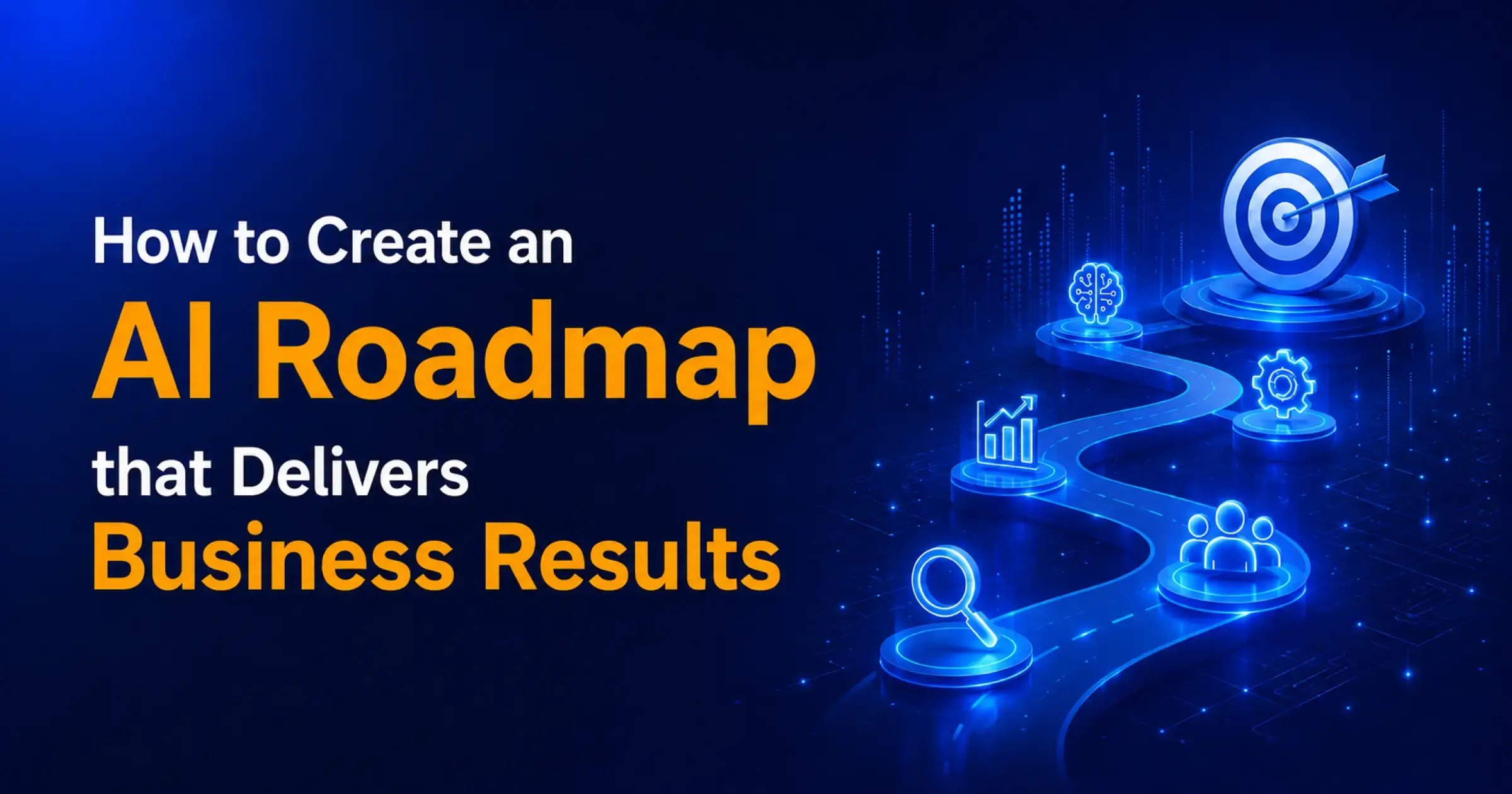
Overview
Yet when you look beneath the surface, a different story often emerges. Companies are investing in AI. They're running pilots. They're experimenting with new technologies.
Why Most Companies Don't See Meaningful Results?
According to BCG's AI Radar research, three out of four executives rank AI among their top strategic priorities. Yet only about one in four organizations report seeing significant value from their AI initiatives.
That gap is worth paying attention to. Because it tells us something important. (We break down the root causes in detail in our guide on why enterprise AI initiatives fail to deliver results.)
Most organizations can access the same AI models, platforms, and tools. What separates successful AI adopters from everyone else is not access to technology. It's having a clear plan for where AI should be applied, why it matters, and how success will be measured.
Start With Business Problems, Not AI Use Cases
One of the fastest ways to waste time, money, and executive support is to start an AI roadmap by brainstorming AI use cases.
That may sound counterintuitive, but it happens all the time.
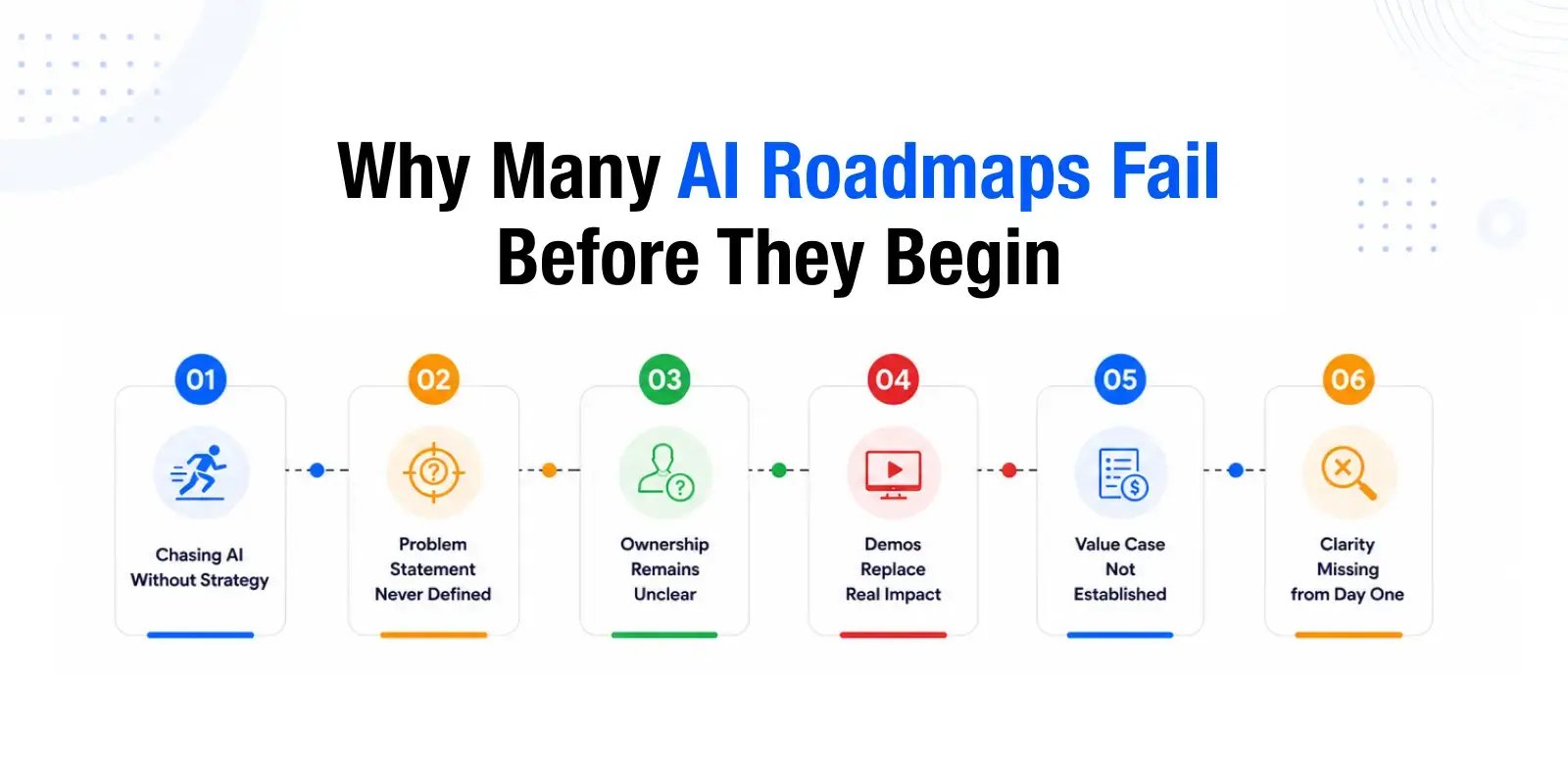
Why Many AI Roadmaps Fail Before They Begin
I've seen organizations invest months evaluating models, platforms, and vendors before they've even agreed on the problem they're trying to solve. The result is predictable.
Teams build solutions that nobody truly owns. Pilots generate interesting demos but never make it into production. Business leaders struggle to justify further investment because the value was never clearly defined in the first place.
One common example is customer service.
A company decides it needs an AI chatbot because everyone else seems to have one. Six months later, the chatbot is live, but call volumes remain unchanged, customer satisfaction does not improve, and support costs stay exactly where they were.
- What specific customer problem are we solving?
- Which support processes create the most friction?
- What outcome are we trying to improve?
Identify the Bottlenecks That Are Costing the Business Money
A stronger AI strategy begins by looking at where the business is struggling today. Forget AI for a moment. Look at the processes that repeatedly create delays, inefficiencies, or unnecessary costs.
- Where are employees spending hours on repetitive work?
- Which decisions take too long to make?
- Where do customers experience the most friction?
- Which operational problems keep appearing quarter after quarter?
In many organizations, the answers tend to fall into familiar categories:
- Teams manually reviewing thousands of documents every month.
- Sales forecasts that are consistently inaccurate.
- Customer inquiries waiting days for responses.
- Employees searching across disconnected systems for information.
- Critical business decisions delayed because data is scattered across multiple platforms.
Connect Every AI Initiative to a Business Metric
This is where many AI roadmaps separate into two very different paths. One path focuses on features. The other focuses on outcomes.
- Document automation reduces processing time by 40%.
- AI-assisted support lowers customer service costs.
- Predictive analytics improves forecast accuracy.
- Intelligent lead scoring increases conversion rates.
- Knowledge assistants reduce employee search time.
They invest because they want faster operations, lower costs, better customer experiences, and stronger growth.
Prioritize AI Opportunities Based on Value and Feasibility
Once you've identified the business problems worth solving, the next challenge is deciding where to start.
Not Every AI Opportunity Is Worth Pursuing
One mistake I see repeatedly is organizations treating every AI use case as equally important. They're not.
Some initiatives can deliver measurable value within months. Others may require years of data preparation, process changes, and system integration before they produce meaningful results.
That's why asking, "Can we build this?" is often the wrong question. A better question is: "Should we build this right now?" Those are very different conversations. This step, AI use case prioritization, is where feasibility and business value have to be weighed side by side.
What Should Businesses Prioritize First?
- Customer service automation
- Document intelligence and data extraction
- Internal knowledge management
- Workflow automatio
- Predictive analytics for high-value decisions
How to Build an AI Roadmap That Creates Momentum
Once you've identified the right opportunities and prioritized them, the next question is straightforward:
How do you turn those priorities into an AI implementation roadmap that actually moves the business forward?
This is where many organizations get stuck.
Start With One High-Impact Use Case
There's often a temptation to launch multiple AI initiatives simultaneously. On paper, it sounds efficient. In practice, it usually creates confusion. Teams compete for resources. Priorities shift. Progress slows.
Instead, focus on one use case that solves a meaningful business problem and has a clear path to measurable value.
When that happens, something important changes. Stakeholders stop viewing AI as an experiment and start seeing it as a business capability.
Create a 12-Month Roadmap Instead of a 5-Year Vision
Many AI strategies fail because they try to predict a future that is changing too quickly. Think about how much the AI landscape has changed in just the last two years.
Now imagine trying to lock in a five-year roadmap. A more practical approach is to focus on the next twelve months. A typical 12-month AI roadmap might look something like this:
- Months 1-3: Validate opportunities, assess feasibility, define success metrics.
- Months 4-6: Deploy the first use case and measure outcomes.
- Months 7-9: Expand successful initiatives into adjacent workflows.
- Months 10-12: Standardize processes and prepare for broader scaling.
Balance Quick Wins With Long-Term Strategic Investments
Here's a mistake I see frequently. Organizations become obsessed with quick wins. Quick wins are valuable, but they should not become the entire strategy. A mature AI roadmap includes two categories of initiatives.
Quick Wins
- Document processing
- Customer service automation
- Knowledge assistants
- Workflow automation
Strategic Investments
- Predictive operations
- Decision intelligence systems
- Enterprise AI platforms
- AI-powered forecasting
Quick wins create credibility. Strategic investments create long-term differentiation. You need both.
Define Success Before Implementation Begins
Before a single model is deployed or a single workflow is automated, there should be complete clarity around what success looks like.
Not vague goals. Specific outcomes. Ask questions such as:
- How much time should this save?
- How much cost reduction are we targeting?
- What productivity improvement would make this initiative worthwhile?
- Which customer metric should improve?
Conclusion
The companies seeing the greatest value from AI are not necessarily the ones investing the most. They're the ones approaching AI with a clear business objective from the start.
A successful AI roadmap isn't about deploying as many AI solutions as possible. It's about solving the right problems, prioritizing opportunities that matter, and creating a path from early wins to long-term impact.
The key is to stay focused on outcomes. If an AI initiative doesn't improve efficiency, reduce costs, enhance customer experiences, or support growth, it's worth questioning why it exists in the first place.
As AI adoption continues to accelerate, businesses that connect AI investments to measurable outcomes will be in a far stronger position to create lasting competitive advantage. For organizations looking to move from experimentation to execution, working with an experienced AI development partner like Tech.us, and the right AI development services, can help transform AI initiatives into practical solutions that deliver real business value.

Tech.us is an AI development company that builds custom AI solutions for businesses seeking measurable results. We partner with organizations to design, develop, and deploy scalable AI systems that solve complex challenges and unlock new opportunities for growth. Our team delivers practical AI applications that create tangible business impact across industries.

Continue reading the blog
with a Tech.us subscription
You’re now subscribed!