blog-img

POPULAR POSTS

  • 01

    How To Improve Document Processing Accuracy Using Document AI

  • 02

    11 Proven Benefits of AI Chatbots for Businesses in 2025

  • 03

    The Guide to Chatbot Development & What to Seek while Hiring a Company

  • 04

    What Digital Transformation Means for Businesses in 2026

  • 05

    Understanding Natural Language Processing: The What? The How? and The Why?

7 Business Benefits of Enterprise AI in 2026
Posted by Tech.us Category: software product development saas

tech.us-recognized-by-mobile-app-daily

Overview


A few years ago, artificial intelligence inside companies often looked like an experiment. Teams tested machine learning models in isolated projects. Innovation teams ran pilots. A few departments explored automation. Many organizations were curious about AI, but the adoption was cautious.


That phase is fading quickly.


In 2026, enterprise AI is moving into the center of business operations. Companies are no longer asking, “Should we explore AI?” The real question now is much more practical.


How do we use AI across the organization to create measurable business value?


Before that, let’s be clear about the basics first.


What is Enterprise AI?


Enterprise AI refers to artificial intelligence systems that are embedded into large-scale business workflows and decision processes. Instead of running as small experiments, these systems operate inside everyday operations such as finance, customer service, supply chain management, product development, and cybersecurity.


What You Will Learn in This Blog


This guide explores the most important business outcomes organizations are seeing from enterprise AI today.


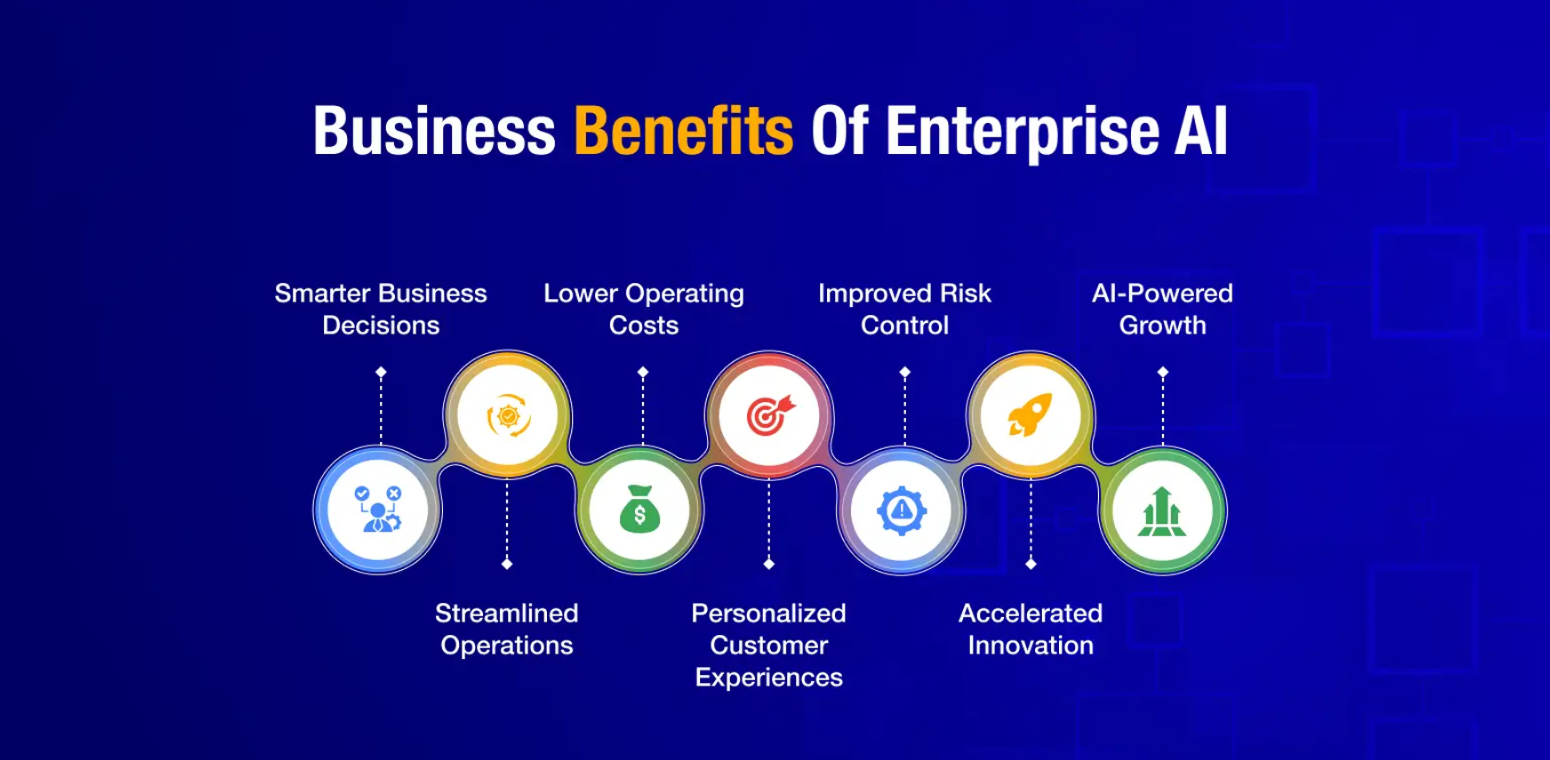
In the next sections, we will break down seven major business benefits of enterprise AI in 2026.


You will learn:


  • How enterprise AI improves decision-making across organizations
  • How AI-powered automation increases operational efficiency
  • How AI solutions reduce costs and improve productivity
  • How artificial intelligence enhances customer experiences
  • How AI strengthens risk management and security
  • How AI accelerates innovation and product development
  • How enterprise AI enables scalable business growth

What Does Enterprise AI Mean for Modern Organizations?


Let’s start with a simple question.


When people talk about enterprise AI solutions, what exactly do they mean?


Many assume it simply refers to using artificial intelligence in a company. That explanation sounds easy, but it misses an important point. Enterprise AI is not just about using a few AI tools inside a business.


It is about integrating artificial intelligence directly into large-scale business operations.


In simple terms, enterprise AI refers to AI systems that operate across core business functions and continuously support decision-making, automation, and analytics at scale.


Think about how modern organizations run. Every department generates data. Finance tracks transactions. Customer support logs thousands of interactions. Supply chains generate operational signals every minute.


Now imagine intelligent systems analyzing this data in real time and recommending actions.


That is the foundation of enterprise artificial intelligence.


Instead of sitting in research labs, AI becomes part of everyday workflows. Teams rely on it to process information, automate tasks, and improve operational outcomes.


What Powers Enterprise AI Systems?


Enterprise AI services work because several technologies come together. These technologies allow organizations to process large volumes of data and turn insights into actions.


Most enterprise AI solutions include a combination of the following capabilities:


  • Machine learning systems that learn patterns from business data
  • Generative AI models that create content, responses, and insights
  • AI copilots and assistants that support employees in daily tasks
  • Predictive analytics platforms that forecast trends and outcomes
  • Intelligent automation tools that streamline repetitive workflows
  • AI-powered decision engines that recommend optimal actions

These technologies often run on enterprise data platforms that connect information from multiple systems.


For example, a retail company may combine predictive analytics with AI-powered automation to manage inventory. A financial institution may use machine learning models to monitor transactions and detect anomalies. A healthcare provider may apply AI-powered analytics to patient data for early risk detection.


Different industries apply enterprise AI in different ways. But the goal remains similar. Improve AI-driven decision making and increase operational efficiency.


How Enterprise AI Differs from Traditional AI Projects


Earlier AI initiatives often looked very different. Many companies started with experimental projects. These projects explored possibilities but rarely scaled across the organization.


Enterprise AI takes a broader approach.


Instead of isolated experiments, organizations deploy AI systems that operate across departments and support long-term AI transformation.


Here is a simple comparison that helps explain the difference.


Traditional AI Projects

Enterprise AI

Small isolated use cases

Organization-wide deployment

Experimental pilot programs

Operational systems used daily

Department-specific tools

Cross-functional integration

Short-term innovation efforts

Long-term strategic capability


Why does this difference matter?


Because isolated AI projects create insights. Enterprise AI creates business impact.


When artificial intelligence connects multiple systems, it can analyze larger datasets, automate workflows, and generate insights faster. That is why many organizations now view enterprise AI adoption as a key step toward building AI-powered enterprises.


7 Business Benefits of Enterprise AI in 2026


tech.us-recognized-by-mobile-app-daily


Now that we understand some key concepts about enterprise AI, let’s look into the key benefits that it offers for businesses in 2026 and beyond.


1. How Does Enterprise AI Improve Strategic Decision-Making?


Business leaders make dozens of important decisions every day. Pricing decisions. Market expansion choices. Investment planning. Risk management.


But here is the challenge.


Traditional analytics tools often rely on historical reports. By the time insights arrive, the business environment may already have changed.


This is where enterprise AI becomes extremely valuable.


AI-powered analytics can analyze massive volumes of operational data in real time. These systems detect patterns, identify risks, and generate predictive insights.


Executives can see trends earlier. They can test scenarios before making decisions.


Imagine this situation.


A retail company wants to forecast product demand for the next quarter. Instead of relying on spreadsheets, predictive analytics models analyze sales data, customer behavior, and seasonal trends. The system generates a demand forecast within minutes.


This kind of AI-driven decision making helps leaders respond faster.


What Capabilities Enable AI-Powered Decision Intelligence?

Enterprise-grade artificial intelligence services support decision-making through several capabilities.


Key features include:


  • Predictive analytics for forecasting demand and revenue
  • Real-time analysis of operational and market data
  • AI-powered scenario simulation for strategic planning
  • Machine learning models that detect emerging patterns
  • Decision-support systems integrated into enterprise dashboards

These capabilities allow organizations to move from reactive decisions to proactive strategy.


Enterprise AI improves decision-making by turning large datasets into actionable insights. Leaders can analyze trends faster, forecast outcomes more accurately, and make strategic decisions based on real-time intelligence.


2. How Does Enterprise AI Increase Operational Efficiency Across Departments?


Every organization has processes that consume time and resources. Invoice processing. Customer support ticket routing. HR onboarding workflows.


Many of these tasks are repetitive. Many involve structured data. And many are still handled manually.


This creates inefficiencies.


Enterprise AI helps solve this problem through AI-powered automation and intelligent workflow systems.


Instead of relying on manual processes, AI systems can analyze documents, classify requests, route tasks, and trigger automated actions.


Consider a customer support team. Thousands of support tickets arrive every day.


An AI system can automatically:


  • Read the incoming request
  • Identify the issue type
  • Assign the ticket to the right team
  • Suggest a response to the support agent

This dramatically improves AI operational efficiency.


Key AI Technologies Driving Enterprise Automation


Several technologies power automation inside AI-powered enterprises.


Important ones include:


These technologies allow companies to scale operations without expanding manual workloads.


Enterprise AI increases operational efficiency by automating repetitive workflows across departments. Intelligent automation reduces manual work and allows teams to focus on higher-value activities.


3. How Does Enterprise AI Reduce Operational Costs?


Cost efficiency remains a major driver of enterprise AI adoption.


Running a modern enterprise involves thousands of operational tasks. Many tasks require manual review. Many involve repetitive processes. These activities consume time, labor, and resources.


Artificial intelligence helps reduce these costs in several ways.


First, AI-powered automation reduces manual effort. When repetitive tasks are automated, organizations can handle larger workloads without increasing headcount.


Second, predictive analytics helps prevent costly problems.


For example, in AI in manufacturing, predictive maintenance models monitor equipment performance. The system detects early signs of failure. Maintenance teams can fix issues before machines break down.


This prevents production disruptions and expensive repairs.


AI systems also optimize resource allocation.


Key Cost Optimization Capabilities


Enterprise AI solutions reduce operational expenses through:


  • Automated processing of invoices, claims, and documents
  • Predictive maintenance for equipment and infrastructure
  • Inventory optimization in supply chain operations
  • AI-powered energy consumption optimization
  • Automated compliance monitoring and reporting

These capabilities reduce waste and improve resource efficiency.


Enterprise AI helps organizations lower operational costs by automating repetitive work, reducing errors, and optimizing resource usage across operations.


4. How Does Enterprise AI Improve Customer Experience?


Customer expectations have changed dramatically.


Customers expect fast responses. Personalized recommendations. Smooth service interactions.


If businesses cannot deliver these experiences, customers quickly move to competitors.


Enterprise AI helps companies deliver better customer experiences at scale. It leverages intelligent AI chatbots to efficiently interact with customers.


AI systems can analyze customer behavior, purchase history, and interaction patterns. These insights help organizations personalize services and anticipate customer needs.


For example, AI in retail often powers recommendation engines. These systems analyze browsing patterns and suggest products customers are likely to purchase.


Customer support is also changing.


AI-powered virtual agents can answer common questions instantly. Human agents receive AI-generated suggestions during conversations. This improves response speed and service quality.


Key Features That Improve Customer Experience


Enterprise AI enhances customer interactions through:


  • AI-powered chatbots and virtual agents
  • Personalized product recommendations
  • Sentiment analysis of customer feedback
  • Predictive customer support systems
  • Omnichannel service automation across platforms

These capabilities allow companies to serve millions of customers efficiently.


The Role of Generative AI in Customer Interactions


Generative AI is expanding customer service capabilities.


Key applications include:


  • AI agents that handle conversational support
  • AI copilots assisting customer support representatives
  • AI-generated response suggestions for faster replies

These systems improve service consistency and reduce response times.


Enterprise AI improves customer experience by enabling faster support, personalized recommendations, and predictive service interactions.


5. How Does Enterprise AI Strengthen Risk Management and Security?


Modern organizations face a growing range of risks.


Cybersecurity threats. Fraud attempts. Compliance violations. Operational disruptions.


Traditional monitoring systems often struggle to detect complex patterns hidden inside large datasets.


Enterprise AI addresses this challenge using advanced analytics and anomaly detection models.


AI systems continuously analyze behavior across digital systems. They monitor transactions, user activity, and operational data.


When unusual patterns appear, the system flags potential risks.


Banks use AI in finance to detect fraudulent transactions. Healthcare organizations monitor patient data anomalies. Insurance companies analyze claims patterns to detect fraud.


These capabilities help organizations respond faster to emerging risks.


Key AI Capabilities for Risk Detection


Enterprise AI strengthens risk management through:


  • AI-powered fraud detection models
  • Cybersecurity anomaly detection systems
  • Automated compliance monitoring tools
  • Behavioral pattern analysis for threat detection
  • Real-time risk alerts across enterprise systems

These tools provide continuous monitoring across business operations.


Quick Summary


Enterprise AI improves risk management by analyzing behavioral patterns and detecting anomalies earlier than traditional monitoring systems.


6. How Does Enterprise AI Accelerate Innovation and Product Development?


Innovation often depends on experimentation.


Teams test ideas. Analyze customer feedback. Study market trends. Build prototypes.


These activities can take months using traditional methods.


Enterprise AI dramatically speeds up this process.


AI systems can analyze market data and customer feedback to identify product opportunities. Generative AI models help teams create design prototypes quickly. Predictive analytics can estimate product demand before launch.


Consider AI in healthcare.


Researchers use AI models to analyze biological datasets. These systems can identify patterns that accelerate drug discovery.


Product teams in many industries also use AI copilots to support development workflows.


Key Innovation Capabilities


Enterprise AI accelerates product development through:


  • AI-assisted product design and prototyping
  • Generative AI for design exploration
  • AI-driven market research and customer insights
  • Rapid experimentation using AI simulations
  • Demand forecasting for product launches

These tools help organizations move from ideas to market faster.


How AI Copilots Improve Developer Productivity


AI copilots assist engineering teams during development.


Examples include:


  • AI coding assistants that suggest code improvements
  • Automated testing tools that detect errors early
  • Code generation tools that speed up development tasks

These capabilities increase developer productivity and accelerate innovation cycles.


Enterprise AI enables faster innovation by helping teams analyze data, design products, and test ideas more efficiently.


7. How Does Enterprise AI Enable Scalable Business Growth?


Scaling a business often increases operational complexity.


More customers. More transactions. More operational data. More support requests.


Without automation, growth can strain internal systems.


Enterprise AI helps organizations scale efficiently.


AI-powered systems automate workflows, analyze large datasets, and support decision-making across global operations.


For example, a global retail company expanding into new markets may face several operational challenges.


How do they manage customer service across languages? How do they forecast demand across regions? How do they optimize supply chain logistics?


Enterprise AI solutions help manage these challenges.


Key Capabilities That Enable Scalability


Enterprise AI supports scalable growth through:


  • AI-powered decision systems for global operations
  • Automated service delivery using AI agents
  • Scalable data analysis using machine learning platforms
  • Real-time visibility across enterprise data platforms
  • Demand forecasting across global markets

These systems allow organizations to grow without dramatically increasing operational complexity.


Enterprise AI enables scalable business growth by automating operations, improving data visibility, and supporting decision-making across expanding organizations.


What Challenges Do Enterprises Face When Implementing AI?


Enterprise AI adoption sounds exciting. Faster decisions. Smarter automation. Better insights. But the journey is rarely simple.


Many organizations quickly realize that deploying enterprise AI solutions requires more than just installing a tool.


The real challenge often starts with the foundation. Data.


Is the data clean? Is it connected across systems? Can AI models trust it?


Poor data quality can weaken predictive analytics models. Inconsistent datasets can produce unreliable insights. That is why many AI-powered enterprises invest heavily in data preparation before scaling AI systems.


Here are some common barriers organizations encounter:


  • Data quality issues that affect AI model accuracy
  • AI governance challenges around ethics and accountability
  • Integration complexity with legacy enterprise systems
  • Model reliability concerns when AI outputs change over time
  • Regulatory and compliance requirements in industries like finance and healthcare

These challenges are real. But they are manageable with the right approach.


How Enterprises Can Overcome AI Adoption Barriers


Organizations that succeed with enterprise artificial intelligence usually focus on a few foundational steps:


  • Build strong enterprise data platforms that unify business data
  • Establish clear responsible AI governance frameworks
  • Design scalable AI architecture that supports long-term growth
  • Encourage collaboration between data teams, engineers, and business leaders

When these elements come together, enterprise AI moves from experimentation to real business impact.


In a Nutshell


Enterprise AI is no longer a futuristic idea. It is becoming a core capability for modern businesses.


Organizations today run on data. But data alone does not create impact. The real value comes from turning data into faster decisions and smarter operations. That is where enterprise artificial intelligence plays a major role.


Companies adopting enterprise AI solutions are seeing clear benefits:


  • Faster AI-driven decision making
  • Higher operational efficiency through intelligent automation
  • Scalable systems that support long-term growth

One thing is becoming clear. The next generation of AI-powered enterprises will shape how businesses compete, innovate, and grow in the years ahead.


FAQs


Why is enterprise AI important for modern businesses?


Modern companies generate huge volumes of data every day. Enterprise AI helps analyze that data quickly and turn it into actionable insights. This allows organizations to make smarter decisions and run operations more efficiently.


What technologies power enterprise AI systems?


Enterprise AI usually combines several advanced technologies. These technologies work together to process data and automate workflows.


For example:


  • Machine learning models
  • Generative AI systems
  • Predictive analytics tools
  • Intelligent automation platforms

Together, these technologies enable AI-powered enterprises.


What are the first steps for adopting enterprise AI?


Most companies begin by identifying a few high-impact business problems where AI can deliver measurable value. Then they focus on building strong data foundations and integrating AI solutions into existing workflows. Starting small and scaling gradually usually leads to the best results.


How do enterprises ensure responsible and secure use of AI?


As AI adoption grows, organizations must ensure that these systems operate safely and ethically. This is where enterprise AI governance becomes important.


A strong governance framework typically includes:


  • Clear policies for responsible AI usage
  • Human oversight for critical decisions
  • Data security and privacy protections
  • Regular monitoring of AI model performance
  • Compliance with industry regulations

What role does data play in successful enterprise AI implementation?


Data is the foundation of every enterprise AI system.


AI models learn patterns from historical and real-time data. If the data is incomplete, inconsistent, or disconnected across systems, the insights produced by AI will be unreliable.


That is why many organizations focus on building strong enterprise data platforms before scaling AI solutions.


What role do AI agents play in enterprise operations?


AI agents act like digital workers inside enterprise systems. They can monitor data, trigger workflows, and complete tasks without constant human supervision.


For instance, an AI agent might automatically:


  • Route customer support tickets
  • Monitor fraud signals
  • Trigger supply chain alerts

These systems help organizations automate complex operational workflows.

Top 10 AI Development Companies Offering End-to-End AI Development Services

Top 10 AI Development Companies Offering End-to-End AI...

NEWSLETTER


RECENT POSTS


blog-img

7 Business Benefits of Enterprise AI in 2026

blog-img

Top 10 AI Development Companies Offering End-to-End AI Development Services

blog-img

Top 5 Business Processes that are Perfect for AI Automation in 2026

blog-img

How Enterprise AI is Changing Business Operations in 2026

blog-img

What are the top benefits of custom AI development services for enterprise...