In 2026, enterprise AI has moved into the center of business operations. It is no longer treated as a side initiative. It now supports the systems that keep organizations running every day.
Artificial intelligence used to feel like a future project. Many companies experimented with it through small pilots and research initiatives. It sat in innovation labs and proof-of-concept environments. Today the story is very different.
Let’s look at it in depth.
What are Enterprise AI Services?
What are the Constituents of Enterprise AI Services?
- AI model development and training
- Machine learning solutions for prediction and pattern detection
- Generative AI systems that assist with knowledge work
- AI driven workflow automation
- Intelligent data analytics platforms
- Integration of AI with enterprise software systems
These capabilities allow companies to bring intelligence into their daily operations. Instead of relying on manual analysis or rule based software, teams can use AI to process information faster and more accurately.
How Different is Enterprise AI than Generic AI Tools?
Enterprise AI systems must handle enormous volumes of data. They also operate within strict security frameworks. Organizations need to protect customer information, financial records, and proprietary data. AI systems must follow these policies carefully.
Regulatory requirements also play a major role. Many industries such as finance, healthcare, and insurance operate under strict compliance rules. AI systems must support transparency and traceability. Businesses must understand how decisions are made and ensure they meet regulatory standards.
Why are so many companies investing in enterprise AI solutions today?
Key Features of Enterprise AI Services
- Ability to process large volumes of enterprise data
- Integration with core business systems such as ERP and CRM platforms
- Support for advanced analytics and predictive insights
- Automation of repetitive and data intensive workflows
- AI powered decision support for business leaders
- Scalable infrastructure that supports enterprise level operations
- Strong security controls for sensitive business data
- Compliance support for regulated industries
How are Enterprise AI Services Changing Business Operations in 2026?
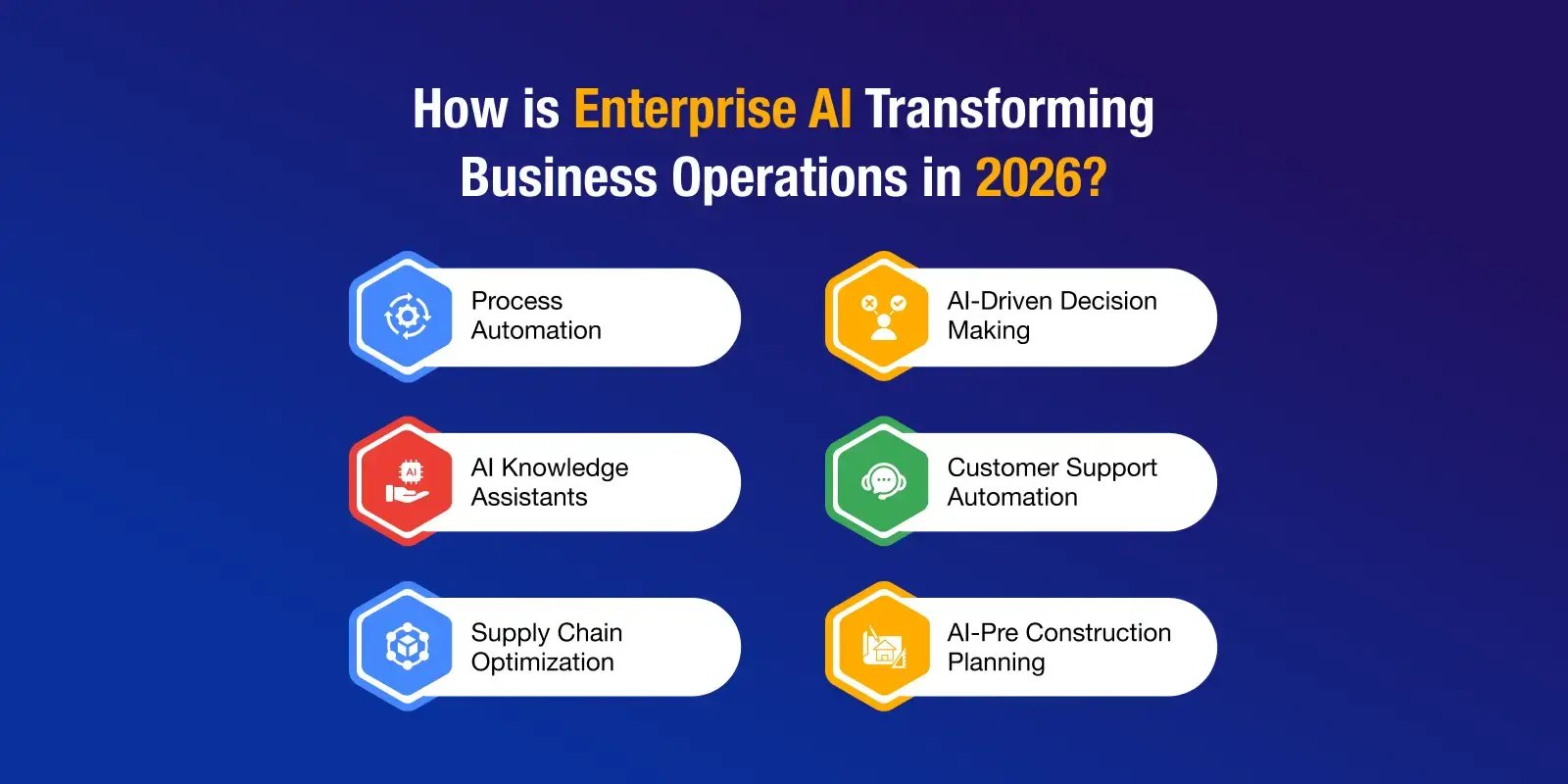
1. How is Enterprise AI Automating Complex Business Processes?
- Invoice processing and payment data extraction
- Document classification and routing
- Contract analysis and clause detection
- Compliance checks and regulatory validation
- Insurance claim verification
Rule based systems follow fixed instructions. They struggle with changing document formats. AI works differently. It learns patterns from data. It can interpret unstructured documents and make intelligent decisions.
- Intelligent document processing
- Natural language processing
- Machine learning decision engines
- AI workflow orchestration platforms
- Faster document processing
- Fewer manual errors
- Less repetitive work for employees
2. How is AI Transforming Enterprise Decision-Making?
For years, business decisions relied on reports and historical data. Leaders reviewed past performance. Then they planned the next move. But here is the problem. By the time reports arrive, the situation may already have changed.
- Real time analytics platforms
- Predictive modeling systems
- Decision intelligence dashboards
- Supply chain demand forecasting
- Financial risk modeling
- Sales performance prediction
- Marketing campaign optimization
This raises an interesting question. What happens when every department has access to reliable insights?
3. How are AI-Powered Knowledge Assistants Improving Employee Productivity?
- AI assistants for internal documentation search
- Coding copilots that help developers write and review code
- Sales assistants that retrieve product and pricing information
- HR assistants that answer employee policy questions
- Retrieving information from internal knowledge bases
- Summarizing long documents in seconds
- Assisting with research tasks
- Drafting emails, reports, and presentations
- Employees spend less time searching for information
- Teams access knowledge faster
- Productivity improves across departments
4. How is Enterprise AI Reshaping Customer Support Operations?
- Intelligent chatbots that answer common questions
- AI agents that guide customers through solutions
- Automated ticket triaging systems
- Sentiment analysis tools that detect customer emotions
- Resolve simple customer queries instantly
- Route complex issues to the right human agent
- Analyze conversations to detect frustration or urgency
- Faster response and resolution times
- Lower operational support costs
- More satisfied customers
Support teams can then focus on the issues that truly need human attention.
5. How is AI Optimizing Supply Chain and Logistics Operations?
- Demand forecasting based on historical and market data
- Inventory optimization across warehouses
- Early detection of supply disruptions
- Automated procurement planning
- Predictive inventory management systems
- Route optimization for transportation networks
- Warehouse robotics that speed up order handling
- More accurate demand planning
- Reduced inventory shortages and overstock
- Faster delivery operations
6. How is Enterprise AI Transforming Pre-Construction Planning and Estimation?
- AI RFP analysis that scans project requirements and highlights key details
- AI takeoff tools that extract quantities from construction drawings
- AI cost estimation models that predict project costs using historical data
- AI document summarization for large bid packages
- What materials are required for the project?
- How much labor will the project need?
- What risks exist in the project scope?
- Faster RFP analysis and project evaluation
- More accurate quantity takeoffs
- Better cost estimates during early planning
What Challenges Do Enterprises Face When Implementing AI?
Data Quality Issues
- Data stored in silos across different systems
- Inconsistent formats and missing data fields
- Limited data standardization across departments
Integration Complexity
- Multiple disconnected enterprise systems
- Legacy infrastructure that limits data access
- Complex workflows that span several platforms
Governance and Compliance Concerns
Many industries operate under strict regulations. Financial services, healthcare, and insurance organizations must follow specific compliance standards.
- Strong data privacy and security controls
- Clear documentation of AI decision processes
- Compliance with industry regulations and standards
Skill Gaps
- Shortage of experienced AI and machine learning experts
- Limited internal expertise in model development
- Need for upskilling across technical teams
Model Reliability and Continuous Monitoring
- Continuous performance monitoring of AI models
- Regular updates using new data inputs
- Detection of bias or unexpected prediction errors
FAQ
Enterprise AI services are artificial intelligence solutions designed specifically for large organizations. They connect AI models with real business systems so companies can automate workflows, analyze data, and improve decision making.
In simple words, they help businesses turn large volumes of data into useful insights and faster operations.
Enterprise AI is already used across many departments.
Some common use cases include:
- AI chatbots in customer support
- Predictive analytics for supply chains
- Fraud detection in banking
- Automated document processing
Generative AI is a type of artificial intelligence that creates content such as text, code, or images. Tools like chatbots and AI writing assistants fall into this category.
Enterprise AI is broader. It includes generative AI, but it also covers:
- Predictive analytics
- Workflow automation
- Decision intelligence systems
In short, generative AI is one component within the larger enterprise AI ecosystem.
Many organizations face technical and operational challenges when adopting AI.
Common issues include:
- Poor data quality or fragmented datasets
- Difficulty integrating AI with legacy systems
- Shortage of AI and machine learning experts
- Governance and compliance concerns
Solving these challenges is essential for successful AI adoption.
Think about how much time employees spend on repetitive tasks.
AI systems can automate many of these activities. They can analyze data, summarize documents, and provide insights instantly. This allows employees to focus on strategic work instead of routine tasks.
As a result, organizations often see:
- Faster workflows
- Better use of employee time
- Improved operational efficiency
This is one of the main reasons enterprise AI is becoming essential for modern business operations.