But six months later, that same model was barely being used.
Now let’s compare that with another organization that took a different path. In this, before writing a single line of model code, they worked with an experienced AI development partner to map business to everything that mattered, right from their goals and data readiness to system integration and long-term ownership.
When they launched their AI solution, it was more than just a model, as it was embedded into their daily workflows and supported by a clear lifecycle plan. Their team adopted it naturally, which was followed by measurable results.
The stark difference between these two outcomes wasn’t anything about algorithms or whether or not the previous model was good enough. It was simply the approach, and more importantly, the partner behind it.
Let’s look at a scenario: On a Monday morning strategy call, a global retail company’s leadership team was celebrating what looked like a breakthrough. Their data science team had built a powerful AI model which could predict demand with impressive accuracy. The demo went smooth, and everybody was thrilled to see promising numbers with the solid expectation of future growth.
Now let’s compare that with another organization that took a different path. In this, before writing a single line of model code, they worked with an experienced AI development partner to map business to everything that mattered, right from their goals and data readiness to system integration and long-term ownership.
When they launched their AI solution, it was more than just a model, as it was embedded into their daily workflows and supported by a clear lifecycle plan. Their team adopted it naturally, which was followed by measurable results.
The stark difference between these two outcomes wasn’t anything about algorithms or whether or not the previous model was good enough. It was simply the approach, and more importantly, the partner behind it.
This is where choosing the right AI development partner becomes pivotal and a strategic business decision. Let’s uncover how you can pick the right one.
What Makes Enterprise AI Systems Different from Regular AI Projects
Enterprise AI sounds exciting at first. A smart model. A cool dashboard. A strong proof of concept.
But once AI moves into real operations, things change fast. As the environment is bigger, the risks are higher with the systems deeply connected. What works in a lab or pilot often struggles in production, especially at an enterprise level.
That is why enterprise AI needs a different level of planning and engineering. Let’s look at what really makes these systems more complex than typical AI projects.
Scale and System Complexity
This is very different from a standalone AI tool. Here, the model is just one piece of a much larger machine.
Key characteristics:
- Data pipelines must pull from ERP, CRM, data lakes, and live transactional systems at the same time
- AI outputs often trigger downstream workflows, approvals, or automated system actions
- Infrastructure must support high availability, load balancing, and failover planning
Data Sensitivity and Governance
Enterprise AI runs on sensitive data, which prompts strong cybersecurity practices and compliance mechanisms. This can include customer information, financial records, operational metrics, or internal performance data.
AI systems must follow internal governance policies and external regulations, such as HIPAA compliance and GDPR, which adds layers of responsibility that smaller AI projects rarely face.
- Access to training data often requires role-based controls and audit trails
- Data lineage must be traceable from raw source to model output
- Model behavior must be explainable for compliance reviews and internal audits
Cross-Functional Impact
Enterprise AI does not stay within one team but touches many parts of the organization.
- A forecasting model may influence procurement.
- A risk model may affect finance decisions.
- A recommendation engine may change customer experience.
Key characteristics:
- AI outputs must fit into existing workflows, not force teams to change tools overnight
- Business teams need visibility into how predictions are generated and used
- Process changes often require training, documentation, and internal champions
Long-Term Lifecycle, Not One-Time Deployment
- Models require performance tracking against live production data
- Retraining pipelines must be scheduled and validated before release
- Version control is needed to track model updates and rollback if issues appear
How to Choose the Right AI Development Partner for Enterprise AI Systems
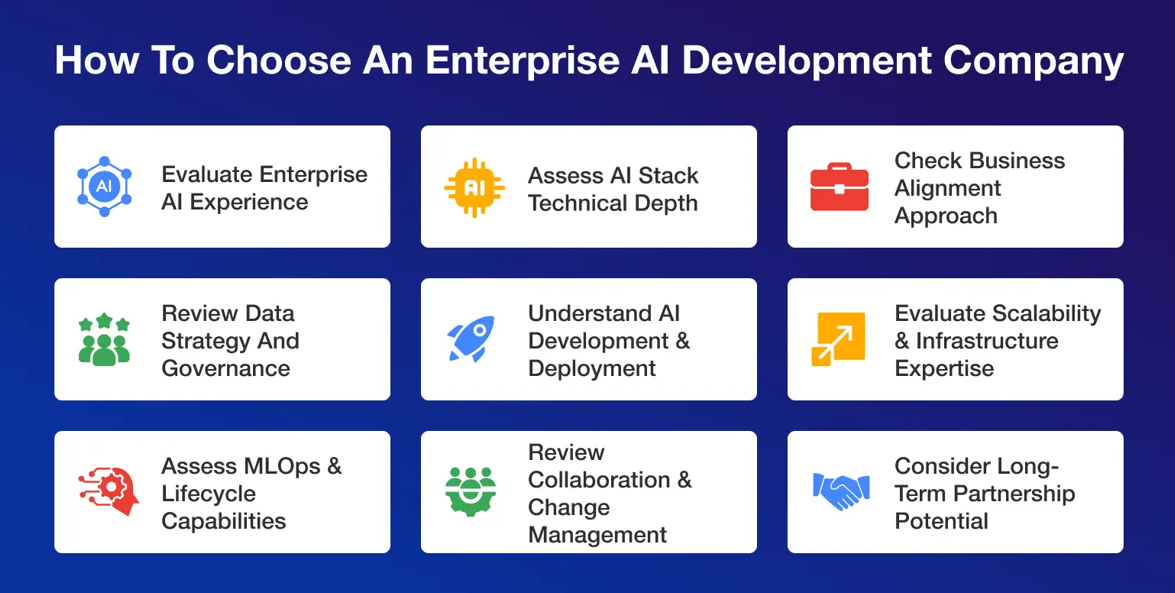
This is where the decision gets real. Many companies can build a model but far fewer can help you run AI inside live business systems without friction. An enterprise AI partner must think beyond experiments. They must understand scale, ownership, risk, and long-term value.
Here is how to evaluate them in a practical and structured way.
Evaluate Their Enterprise AI Experience
Vendor’s AI experience shows up in the kind of problems a partner has already solved. Production systems behave very differently from demos. Real environments have messy data, strict uptime needs, and many system dependencies. A capable partner has worked through these realities before.
What strong experience looks like:
- Delivered AI systems that run inside live operational workflows with real users
- Handled model deployment in environments with strict uptime and rollback needs
- Built solutions that interact with multiple internal platforms through stable APIs
- Shown measurable business impact beyond model accuracy metrics
Assess Technical Depth Across the AI Stack
Signs of deep technical capability:
- Designs data pipelines that handle schema drift and inconsistent source formats
- Builds feature stores to standardize inputs across multiple models
- Implements automated testing for models before production release
- Integrates AI services into existing enterprise platforms without breaking workflows
Check Their Approach to Business Alignment
What business alignment looks like:
- Translates business KPIs into model performance targets
- Maps AI outputs directly to operational decision points
- Designs feedback loops from end users back into model improvement
- Helps define adoption metrics alongside technical metrics
Review Their Data Strategy and Governance Capabilities
Enterprise AI depends on trusted data. A partner must know how to work inside controlled environments and follow internal policies. They must treat governance as part of system design, not an afterthought.
Strong governance practices include:
- Creates clear data lineage from source systems to model outputs
- Applies access controls during data preparation and model training
- Designs logging systems that support internal audits
- Plans for model explainability in regulated use cases
Understand Their AI Development and Deployment Process
A reliable process usually includes:
- Early feasibility checks using real enterprise data samples
- Iterative validation with business stakeholders before full rollout
- Staged deployment that limits risk during initial release
- Post-launch performance reviews tied to business impact
Evaluate Scalability and Infrastructure Expertise
Scalability shows up in these ways:
- Uses distributed processing frameworks for large-scale data workloads
- Designs inference services that handle peak traffic without delays
- Plans infrastructure with cost monitoring and optimization in mind
- Builds systems that support expansion into new regions or business units
Assess Their MLOps and Lifecycle Management Capabilities
Strong MLOps capability includes:
- Tracks model performance using live production data streams
- Detects data drift and prediction drift with automated alerts
- Maintains version histories for models, data, and features
- Supports controlled model updates with rollback procedures
Look at Collaboration, Communication, and Change Management
Effective collaboration looks like:
- Runs workshops to align technical teams and business teams early
- Shares clear documentation for system behavior and limitations
- Trains internal users on how AI outputs should guide decisions
- Provides structured knowledge transfer before project closure
Consider Long-Term Partnership Potential
Enterprise AI evolves over time. New use cases appear. Systems expand. Models improve. A partner should be ready to grow with your roadmap.
Long-term partnership signals include:
- Offers ongoing performance reviews after initial deployment
- Supports roadmap planning for future AI capabilities
- Invests in understanding your internal systems deeply
- Brings proactive ideas based on trends seen across industries
A Simple Checklist for Shortlisting an AI Development Partner
Shortlisting Checklist
- Proven experience delivering AI systems inside live enterprise environments
- Case studies that show operational impact, not just model performance
- Strong data engineering skills for handling large and complex internal datasets
- Clear MLOps practices for monitoring, retraining, and maintaining models
- Simple FAQ bots sit at the lower end. Context-aware enterprise copilots with memory and multi-system integrations sit much higher.
- A structured AI development lifecycle from discovery to post-deployment support
- Ability to integrate AI solutions with existing enterprise platforms and workflows
- Clear understanding of data governance, access controls, and audit requirements
- Experience working within regulated or compliance-driven environments
- Infrastructure and cloud expertise for scaling AI workloads reliably
- Approach that links AI outputs to real business decisions and performance metrics
- Strong documentation, knowledge transfer, and internal team enablement
- Long-term support model for optimization, upgrades, and new AI initiatives
This checklist keeps the focus on partners who can build AI that works in the real world. It helps you avoid getting distracted by flashy demos that never make it into daily operations.
The Right AI Partner Is a Strategic Advantage
The right partnership gives your enterprise more than an AI system. It gives you a foundation for continuous improvement, smarter decisions, and stronger resilience in a fast-changing landscape.
FAQ
An AI development partner helps turn business goals into working AI systems that operate inside real enterprise environments. Their role goes far beyond building models.
They typically support:
- Identifying high-impact AI use cases linked to business priorities
- Designing data pipelines and model architectures
- Integrating AI outputs into existing enterprise applications
- Monitoring, improving, and updating systems after launch
Start by looking at how well they connect technology to business outcomes. Strong partners speak clearly about impact, risks, and long-term ownership. Review their past enterprise projects and ask how their solutions performed after deployment. Their answers should show structured thinking and real operational experience.
An AI vendor usually focuses on delivering a defined technical task. The engagement often ends once the solution is handed over.
An AI partner stays involved beyond delivery. They help plan roadmaps, improve systems over time, and adapt AI capabilities as business needs change. The relationship is more collaborative and long-term.
Timelines vary based on the size of the use case, the condition of existing data, and the number of systems involved. Smaller initiatives may take a few months. Larger, cross-functional AI systems can take much longer as they move through integration, validation, and adoption stages.
Most failures come from gaps in preparation and ownership rather than model quality.
Common causes include:
- Data that is incomplete, inconsistent, or hard to access
- AI goals that are not clearly tied to business outcomes
- Limited involvement from operational teams
- Lack of a plan for monitoring and improving models after launch

Continue reading the blog
with a Tech.us subscription
You’re now subscribed!