blog-img

POPULAR POSTS

  • 01

    How To Improve Document Processing Accuracy Using Document AI

  • 02

    The Guide to Chatbot Development & What to Seek while Hiring a Company

  • 03

    Understanding Natural Language Processing: The What? The How? and The Why?

  • 04

    11 Proven Benefits of AI Chatbots for Businesses in 2025

  • 05

    A Complete Guide to SaaS Product Development

9 Signs Your Business is Ready for Artificial Intelligence Development

Posted by Tech.us Category: software product development saas

tech.us-recognized-by-mobile-app-daily

Introduction


Artificial intelligence development is changing the way businesses work today, as more teams intend to incorporate AI into their workflows. There is a growing interest among various businesses to adopt AI, and the promise feels real. But the big question remains, which is “Is your business ready to take this step?”

AI readiness is the point where your goals, data, people, and processes support AI in a stable way, as it is an important stage before you build anything. It is the point where you know AI can fit into your daily work without stress.


It is possible that some companies rush into AI just because it sounds exciting only to realize they need a few basics in place first. This is why AI readiness matters.


Let’s dissect it in this blog, and you will learn nine clear signs that show your business is prepared for artificial intelligence development.


What Does AI Readiness Mean for a Business


AI readiness is the point where your business has the basics in place to start implementing artificial intelligence in a helpful way.


It means you have clear goals. It means your data is in good shape. It means your team can support this change.


When all of these parts come together, your business is ready to explore AI development with confidence.


Why AI Readiness Matters Before Starting Artificial Intelligence Development


AI for businesses is a pivotal step because it can solve unique problems and significantly reduce manual work, which help teams make informed decisions and automate workflows effortlessly. But AI works well only when the basics are in place, which is why AI readiness plays a huge role before you start any development.


Many companies move into AI with big expectations because they want fast results and clear changes in the way they work. But when the foundation is weak, early excitement fades away as fast as it appears.


There are some prerequisites which make AI implementation a success. AI needs clean data. It needs clear goals. It needs people who can support the shift.


When these things are missing, the entire effort turns slow and stressful.


AI readiness gives you a simple way to avoid these issues, as it helps you understand what your business can handle right now.


It also helps you plan the next steps in a safe way, so AI works best when you treat it like a long-term path and not a quick fix. Once your business is ready, the journey feels smooth and steady.


Key features of AI readiness


  • You understand the business problem you want to solve.
  • Your data is organized and easy to use.
  • Your team is open to learning new tools.
  • Your goals for AI are clear and realistic.

9 Signs Your Business is Ready for Artificial Intelligence Development
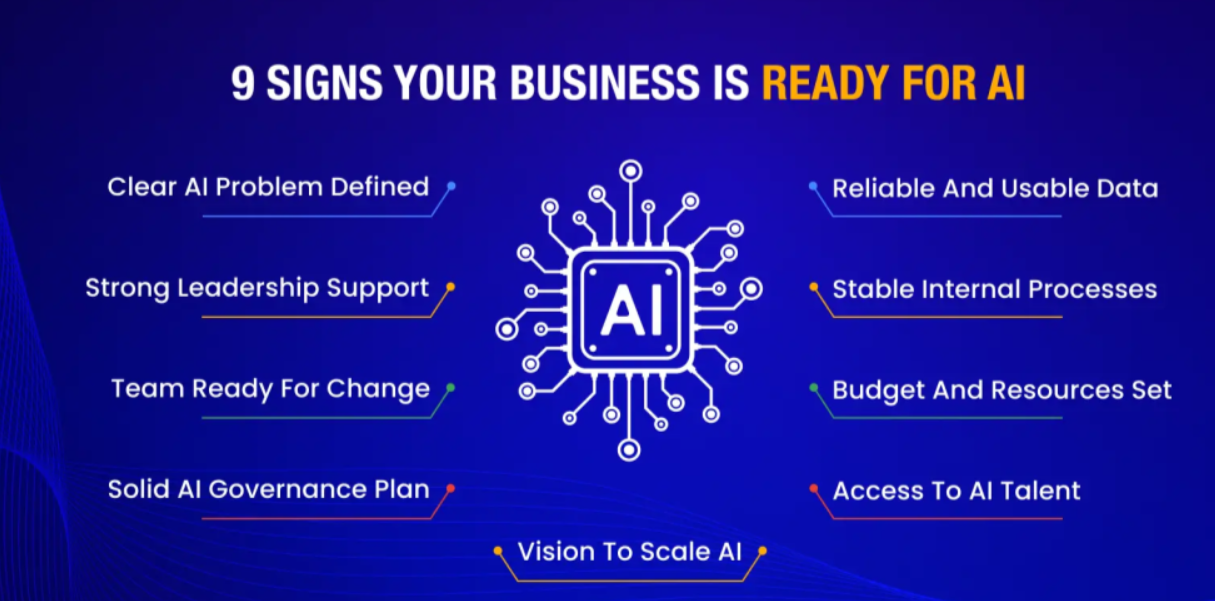


Before you start any AI development work, it helps to know if your business is actually ready for it. To use AI in a smooth way, your team, data, tools, and processes must be in a steady place, and when these pieces come together, AI becomes much easier to adopt and much easier to scale.


Just imagine if you are planning to implement Generative AI for automating certain tasks or building an intelligent chatbot that supports your customers. It sounds great when you think about the results, however, in reality, AI works well only when your business has the right foundation.


So, let’s look at the 9 signs that show your business is ready for artificial intelligence development.


1. You Have a Well-Defined Business Problem That AI Can Solve


Just imagine your business is looking for ways to reduce manual work, predict sales, or improve customer response time.


Now these are real goals that your business wants to achieve. These are real pain points. But AI comes into the picture only when the problem is clear.


It is not the right approach to rush into AI without clearly having the core business problems that you want to achieve using AI. A clear problem gives direction, which helps you pick the right AI solution, so your team stays focused.


When you know the exact task for which you want AI support, things move fast, which saves you a lot of time and avoids confusion. You also reduce rework.


So, start thinking about implementing AI, if:


  • You know the exact task you want to improve.
  • The problem is clear to your team.
  • The solution path feels simple to understand.
  • AI has a clear purpose from day one.

2. Your Business Has Reliable Data That Supports AI Development


If you try to build an AI solution but you have poor-quality data, it will never give the output you expect. Because AI models learn from what you give them, the quality of your data sets the quality of your results.


Many businesses think they have enough data only to discover later that it is spread across different tools, or it is not updated.


Data silos are common as well as one of the critical problems why many AI projects do not meet the expectations. Even robust data mining may not be effective if your data is broken.


Reliable data is the first building block of AI, which guides your model and gives you accuracy. It helps you trust the output.


So, before AI development, what you need to focus on is cleaning the data using extensive data analytics services, which help you eliminate silos and make data suitable for AI to train.  


When your data is organized and easy to access, you can move ahead without stress. Your AI


So, think about building AI for your business when:


  • Your data is clean and updated.
  • Your data is easy to access.
  • Your data supports the outcome you expect.
  • Your team knows where your data lives.

3. You Have Stakeholder Alignment and Leadership Support


Just imagine you start an AI project but you don’t have the clear support from the stakeholders and your teams. This will create lots of delays at every step for AI is not a small project but touches many parts of your business. So, everyone needs to move in the same direction.


Only when decision-makers are aware of its precise applications for their business, will the teams feel confident and ready to adapt their workflow accordingly. This alignment builds trust and reduces pushback, which also helps your AI partner understand what matters most for your business.


Your AI implementation will succeed when:


  • Leaders show interest in AI adoption.
  • Managers support the plan.
  • Teams know why the project matters.
  • Work moves in one clear direction.

4. Your Processes Are Mature Enough for AI Integration


It is impossible to build AI on top of unclear, broken, or outdated processes and expect clear-cut results. It will only create more confusion because AI works well only when your processes run in a predictable way.


It needs a structure and a stable workflow to perform at its best.


When your processes are clean, AI fits in with ease, and your teams know what comes next. Your operations run in a smooth way, and in this way, AI becomes a support system and not a burden.


This clarity helps your AI project move without constant interruptions. It brings better results when:


  • Your processes are easy to follow.
  • Your workflows run in a stable way.
  • Your team knows each step clearly.
  • AI can support your flow without confusion.

5. Your Team Is Open to Change and Comfortable with Technology Adoption


Change management is a critical factor in any business, especially when you bring a new AI system into your workplace.


If your team has a hard time accepting this change and knowing ways to adapt to it, businesses may not work the way they were intended with AI adoption.


Because many fear it may replace them, as a result, they might resist learning it. Other times, they may simply not have been trained how to leverage AI. This slows down everything.


AI adoption works best when people feel safe and curious. When they accept the shift, the learning curve becomes short, and they tend to explore features and use the tools with confidence.


So before implementing AI for your business, make sure:


  • Your team shows interest in new tools.
  • People feel safe to learn and adapt.
  • They do not fear the shift.
  • They support the AI plan.

6. You Have the Budget and Resources to Support Artificial Intelligence Development


Building an AI system with tight budgets and very limited room for resources may slow down the entire project.


It doesn’t mean you need hefty money before starting your AI development project. But you need to understand the cost implications involved with AI implementation as it is not a one-time activity.


It needs proper planning with the right tools and experts who know how to build and maintain it.


With the right budget, you can plan building AI suitable for your business and scale it as your business grows.


A clear budget makes your AI plan practical and stress free. So, make sure:


  • You know the budget needed for each stage.
  • You have access to the required tools.
  • You can involve trained experts.
  • Your project does not pause due to resource limits.

7. You Understand the Risks and Have a Plan for AI Governance


Just imagine using AI without thinking about privacy, data use, or security, which could put your business at risk. Before planning on building AI, you need to give some serious thought to its governance.


It is rather simple because all you have to do is to know what rules are in place for different geographies that must follow. It ensures your business data is safe and you use AI in a fair way.


You can partner with an external vendor who can help you stay compliant with regulations such as GDPR or HIPAA compliance. This is highly useful if your business handles any sensitive data.


With this clarity, your AI project can grow in a stable way and build trust with your teams and customers.


Good governance shows that your business is serious about AI. So, make sure:


  • You follow clear data rules.
  • You protect user information.
  • You understand the risks.
  • You have a plan to stay compliant.

8. You Have Access to AI Talent or a Trusted Technology Partner


It is a challenging task to build AI for your business by relying only on your internal teams. Even if you’re planning to hire AI experts to modernize your business with the latest technology, it will cost you time and money because you need to be involved with hiring and training.


It is better to partner with an AI development company than planning in-house AI development because with an external partner, you can leverage top talents and save costs considerably. But before choosing, carefully analyze the AI development companies.


With the right support, your AI project becomes fast and predictable. With the right AI development company:


  • You have access to trained AI experts.
  • You do not face long hiring delays.
  • You can use ready tools and frameworks.
  • You get guidance at each stage.

9. You Have a Clear Vision for Scaling AI Across the Business


Just imagine building a small AI feature today and then having no plan for the next stage. Several businesses have been there. Not having clear scalability plans, your growth can get hindered. AI becomes useful when it scales across teams and becomes powerful when you plan for long term use.


A clear vision helps you think ahead so you can understand how AI can fit into each operation of your business.


A strong vision turns AI into a long-term advantage. With a clear plan for scaling AI:


  • You know how AI fits into your future plan.
  • You think beyond small pilots.
  • You want AI to support many teams.
  • You see AI as a long-term investment.

Key Indicators of AI Readiness for Modern Businesses


Before you move any deeper into the AI plan, it helps to see all the signs in one place. This table gives you a quick view of what each sign means and how it helps your business.


Sign

What It Means

How It Helps Your Business

Key Internal Check

Clear Problem

You know the exact issue you want AI to solve.

Helps you choose the right solution and avoid confusion.

Is the problem simple to explain in one or two lines?

Reliable Data

Your data is clean, updated, and easy to access.

Improves accuracy and reduces model errors.

Do you have organized data that supports your goal?

Leadership Support

Leaders and managers back the AI plan.

Keeps the project moving without internal delays.

Are key decision makers aligned with the project?

Stable Processes

Your workflows are smooth and easy to follow.

Makes AI integration simple and predictable.

Are your processes clear and working well right now?

Team Readiness

Your people are open to learning new tools.

Reduces resistance and speeds up adoption.

Does your team feel safe and curious about AI?

Budget and Resources

You have money, tools, and experts ready.

Prevents interruptions during development.

Do you have a clear budget for each stage?

Governance Awareness

You understand data rules and risks.

Builds trust and keeps your business safe.

Do you follow clear privacy and security practices?

Access to Talent

You have skilled AI experts or a trusted partner.

Gives you fast progress and strong support.

Do you have a team or partner ready to guide you?

Clear Vision to Scale

You see how AI will grow across your business.

Helps you plan long term and improve many teams.

Do you have a plan beyond the first pilot?


In a Nutshell


AI becomes powerful when your business is ready for it. The above discussed signs give you a clear way to check your starting point, as they show you if your goals, data, teams, and tools can support AI in a steady way.


If you feel ready, you can begin your AI journey with a simple plan. Work with a trusted partner like Tech.us who guides you through each stage of AI development in a focused and clear way.


FAQs


How do I know if my business is ready for AI development?


Your business is ready when you have clear business goals, and your data is organized. Your AI development will be seamless if your team supports the plan and your workflows run in a steady way.


What is the first step to start AI implementation in a business?


Follow the below three steps to start your AI implementation:


  • Begin with one clear problem.
  • Confirm your data supports it.
  • Then run a small pilot.

This gives you clarity before moving to a bigger plan.


Can small businesses adopt AI in a simple way?


Yes, AI will be highly useful in small businesses. Small teams can begin with one focused use case, which helps them learn fast. With AI, they can grow at a steady pace without stress.


How long does it take to see value from an AI project?


It depends on the complexity of the task. Many teams see early value when they start with a simple and targeted use case.


What should a team prepare before working with AI?


Teams should understand the goal, learn the basics of the tool, keep their data ready, and stay open to small changes in their daily work.

blog-img

How Smart Data Annotation Cuts the Hidden Cost of Bad...

NEWSLETTER


RECENT POSTS


blog-img

9 Signs Your Business is Ready for Artificial Intelligence Development

blog-img

How Smart Data Annotation Cuts the Hidden Cost of Bad Data in Enterprise AI

blog-img

In-House vs Outsourced Software Development: A Strategic Guide for CEOs

blog-img

What Are the Key Enterprise Software Development Considerations for...

blog-img

7 Qualities to Look for in a Custom Enterprise Software Development...