
blog-img

POPULAR POSTS

  • 01

    How To Improve Document Processing Accuracy Using Document AI

  • 02

    The Guide to Chatbot Development & What to Seek while Hiring a Company

  • 03

    11 Proven Benefits of AI Chatbots for Businesses in 2025

  • 04

    Understanding Natural Language Processing: The What? The How? and The Why?

  • 05

    Top Technology Trends in 2025

7 Key Aspects of AI Development Every Business Should Address

Posted by Tech.us Category: software product development saas

tech.us-recognized-by-mobile-app-daily

Introduction


Before businesses even start thinking about diving into AI development, one of the most common questions they end up asking themselves is - Should we be throwing our hat into the ring with AI development right now, or should we just wait and see if it's really the right time for our business to get on board?


It's totally understandable that business leaders find themselves in this position, unsure how to even start fitting AI into their existing priorities, teams, and long-term plans - let alone trying to make sense of the whole thing.


The problem is that way too often, AI development gets lumped in with purely technical initiatives. But in reality, the impact of AI goes way beyond just fancy tools and software. 


It’s got real business implications & consequences, so understanding those is key. You really need to put AI under the business microscope before you start moving forward.


Before you take the plunge, why not step back for a second and look at impacts of AI development on businesses? Ask yourself a few simple, practical questions.


  • What specific business problem are we trying to use AI to solve or make better?
  • Are our internal processes solid and stable enough to support some automation or AI systems?
  • Do we have a clear idea of how we'll measure success on an ongoing basis?
  • Are our teams going to be able to work alongside AI-driven systems, or have we got some major cultural hurdles to clear first?

When you do a bit of upfront thinking on these questions, your AI initiative is likely to be a lot more focused and confident - and if you don't put in that upfront work, even with a big budget and all the best intentions, your AI project can end up a whole lot less successful than you were hoping.


So it's super important to look at the key factors that make successful AI development from a business perspective.


Let's take a closer look.


What Does AI Development Mean?


AI development, in a business context, does not mean building complex systems or experimenting with advanced technology for the sake of innovation.


It simply refers to using AI as a capability to support better business decisions, all the while reducing manual effort across everyday operations.


Unlike traditional software development, AI development is not a one-time build-and-finish activity because AI systems learn from data, adapt over time, and improve based on real usage, which makes AI less like a product you purchase and more like a business capability you develop and refine, as the value comes from how well it fits into your existing processes rather than how advanced the technology sounds.


In most businesses, AI works quietly in the background as it supports teams through analyzing information faster and recommending actions based on data.


The key point here is that AI becomes part of how work gets done, and not a separate system running in isolation.


Another important aspect to understand is ownership. While technical teams or external partners may build and maintain AI systems, the responsibility for AI outcomes always sits with the business.


Decisions about what problems to solve and how much autonomy AI should have must be driven by business leaders, as this perspective also makes it easier to evaluate priorities and partnerships before moving forward.


Seven Aspects of AI Development for Businesses
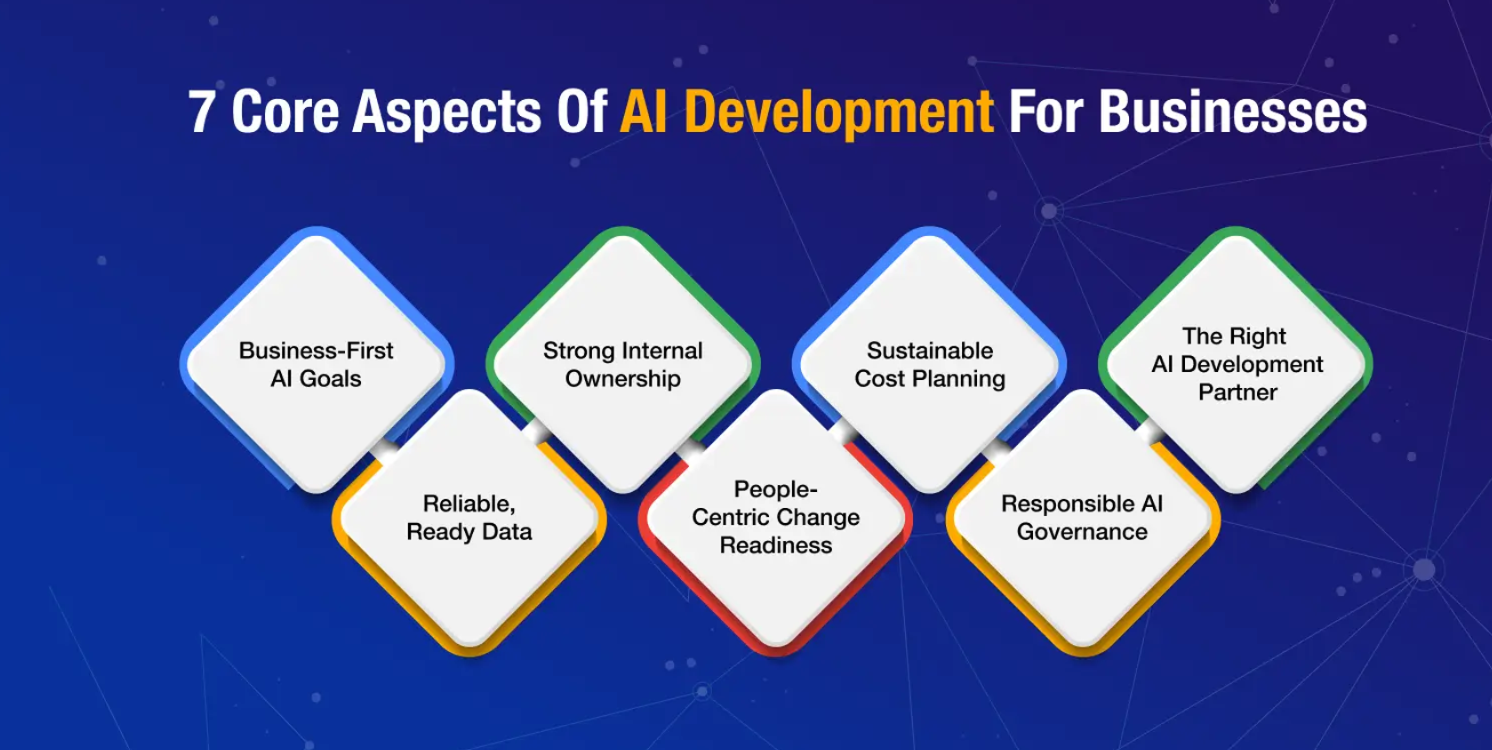


AI development, when approached by businesses, often starts as an initiative to improve efficiency and decision-making, among other things. AI initiatives often influence multiple parts of an organization at the same time and continue to evolve after they are deployed.


This makes AI development more than a technical task and positions it as an ongoing business effort.


A structured approach helps businesses move forward with clarity and control. With a solid structure, leadership teams can align AI initiatives with real business priorities and long-term goals, which brings consistency to how decisions are made and how outcomes are measured.


Let’s get into this.


1. Clear Business Objectives and Use-Case Alignment


Before any AI initiative takes shape, one fundamental question needs to be answered is that
“Why are we building this in the first place?”


This may sound obvious, but many AI projects begin with curiosity rather than clarity, as businesses hear about AI success stories and feel the pressure to act, even when the actual business problem is not well defined.


Clear business objectives act as the foundation for AI development, which helps teams understand what success looks like and prevents AI initiatives from drifting into experimentation without direction. However, with vague objectives, AI projects often struggle to move beyond pilots or fail to gain internal support.


The next step is about aligning those objectives with the right use cases. With strong alignment you can ensure that AI efforts are focused on areas where they can realistically improve outcomes.


When businesses take the time to define objectives and align them with practical use cases, AI becomes easier to measure and easier to scale, which also helps teams stay grounded when trade-offs and prioritization decisions need to be made.


So, to sum up,


  • AI initiatives should start with a clearly defined business problem, not a technology idea.
  • Each use case should be directly tied to measurable business outcomes.
  • Clear objectives help prevent stalled pilots and unfocused experimentation.
  • Alignment creates shared understanding across leadership, teams, and partners.

2. Data Readiness and Information Quality


Just like any other business capability, data also has its own strengths and gaps. For AI initiatives to work as intended, businesses need to clearly understand how prepared their data really is and where it may create limitations down the line.


Data is the foundation on which AI systems operate, as every prediction or insight generated by AI is shaped by the information it receives. If the data is incomplete or outdated, the outcomes will reflect those issues, which is why data analytics plays a critical role in determining how effective AI development can be.


Many businesses assume they are data-ready simply because they store large volumes of information. However, in practice, data often exists across disconnected systems or follows different formats, as these challenges usually surface only after AI initiatives begin, causing delays, rework, and many others.


So, to sum up,


  • Business data should be accurate, accessible, and relevant to the intended AI use case.
  • Fragmented systems and inconsistent records often limit AI effectiveness.
  • Early data assessment helps prevent delays and rework later in the project.
  • Strong data quality improves trust in AI-driven outcomes across teams.

By addressing data readiness upfront, businesses create a more stable foundation for AI development and increase the likelihood of achieving reliable and meaningful results.


3. Internal Ownership and Cross-Functional Involvement


A clear ownership within the business has its own advantages. For one thing, it keeps AI initiatives closely aligned with your company goals and priorities. You decide why AI is being used and how its outcomes should support the business.


When AI initiatives are owned internally, teams have a clearer understanding of the business context behind every decision, as all stakeholders are involved from the beginning, which helps shape AI solutions around real workflows rather than assumptions.


This shared involvement creates responsibility and encourages teams to think long term instead of treating AI as a short-term experiment.


So, to sum up,


  • Business leaders stay directly involved in defining AI goals and outcomes.
  • Teams across functions contribute their perspective, not just IT or technology groups.
  • Decisions stay aligned with real operational needs and priorities.
  • Accountability remains clear as AI systems evolve over time.

4. Change Management and Workforce Readiness


In many businesses, technology changes are no longer the biggest challenge, as the real challenge often lies in how teams respond to those changes, which is especially true with AI adoption, where new ways of working can raise questions, concerns, and hesitation among employees.


Because of this, change management and workforce readiness become two critical aspects of AI development.


When AI systems are introduced, teams need clarity on how their roles will evolve, and without proper communication and preparation, AI can feel disruptive rather than supportive.


Businesses that take the time to prepare their workforce usually see smoother adoption and better long-term outcomes, the preparation of which includes explaining why AI is being introduced, how it will be used, what it means for day-to-day work, and many more.


Another important factor is transparency because when teams understand that AI is meant to assist them and not replace them, resistance reduces naturally. Open communication is the key as it helps address concerns early and builds trust across the organization.


To put it precisely,


  • Teams are better prepared when they understand how AI fits into their daily work.
  • Clear communication helps reduce fear and uncertainty around AI adoption.
  • Training and guidance make it easier for employees to work alongside AI systems.
  • Transparency builds trust and improves acceptance across the organization.

5. Cost Planning and Long-Term Investment View


A major reason businesses take cost planning seriously in AI development is mainly because the investment does not just stop after the first release. But, AI systems continue to evolve and require attention over time, and if this is not planned early, costs can quickly feel unpredictable or difficult to justify.


Beyond initial development, AI involves ongoing elements that businesses need to account for, which includes everything from maintaining models and updating them as data changes to improving outcomes as business needs evolve. These are not optional add-ons but necessary parts of keeping AI useful and reliable.


  • Need to refine AI outputs as customer behavior changes? That requires ongoing tuning.
  • Need to monitor accuracy and reliability over time? That involves continuous oversight.
  • Need to improve results as the business scales? That calls for regular updates and adjustments.

All of this happens without rebuilding the system from scratch, but it still requires time and effort along with budget allocation.


Businesses that plan with a long-term investment view are better prepared for this reality.


To put it precisely,


  • AI development involves ongoing costs beyond the initial build.
  • Maintenance and monitoring are essential to keep AI effective.
  • Long-term planning helps avoid budget shocks later.
  • Sustainable investment leads to consistent business value over time.

When cost planning is done with a long-term perspective, AI becomes a manageable and strategic investment rather than an unpredictable expense.


6. Governance, Control, and Responsible Use


In today’s business environment, AI adoption is expanding and increasingly used across different business functions, as a result, there are a few aspects that clearly differentiate well-managed AI initiatives from poorly governed ones. They are,


  • the control businesses maintain over AI systems, and
  • the clarity around how AI decisions are monitored and reviewed

When businesses put proper governance in place, they gain better control over how AI systems operate and evolve, which gives leadership direct visibility into outcomes and allows them to supervise how AI-driven decisions are being used across the organization.


One main advantage of this is that any issues or inconsistencies can be addressed immediately.


It also becomes easier to establish clear oversight and review processes, which is a significant advantage because businesses can quickly understand how decisions are made, introduce corrections, set boundaries, and guide AI usage in the right direction. Clear governance ensures that AI does not operate without accountability.


To put it precisely,


  • Businesses retain direct control over AI-driven decisions and outcomes.
  • Issues can be identified and addressed without unnecessary delays.
  • Clear oversight helps in making adjustments and correcting course faster.
  • Everyone understands boundaries, which improves trust and consistency.

This level of control and clarity helps businesses use AI responsibly while ensuring it continues to support business objectives in a reliable and predictable way.


7. Choosing the Right AI Development Partner


Ever thought of building AI-driven business capabilities without having to take on the full complexity and long-term overhead on your own? This is where choosing the right AI development partner makes a real difference.


Instead of building everything internally, businesses can move faster by working with partners who already understand how to translate business goals into practical AI solutions.


To simply put, a good AI partner helps you focus on outcomes rather than getting stuck in execution details. They bring experience from working across industries and business scenarios, which allows you to avoid common pitfalls and shorten the learning curve. This way, your time and investment go directly into creating real business value.


To sum up,


  • You gain access to experienced teams without building everything in-house.
  • You avoid long setup cycles and reduce internal operational burden.
  • You pay for relevant expertise and delivery, not trial and error.
  • You get ongoing support as AI systems evolve with your business.

Choosing the right AI development partner allows businesses to move confidently, maintain quality, and scale AI initiatives responsibly while keeping costs and complexity under control.


In a Nutshell


The business landscape has shifted at a dizzying pace over the last few years, with change no longer happening in slow increments & never to be expected in a long time from now.


With decision making no longer able to afford those lengthy waiting periods, businesses are now heavily reliant on the ability to respond thoughtfully in a time-sensitive manner.


And, it’s the reason why building AI in a way that puts business needs first is now more important than ever.


When you approach AI purely as a technology that you need to be working on right now, it all too often ends up being a disconnected entity that has little concern for what the business actually needs.


Have a clear vision to improve efficiency, decision-making, or customer experience but unsure how all the pieces fit together? Focusing on the right aspects helps you move step by step instead of rushing into fragmented efforts.


Want to adopt AI without disrupting existing operations or overwhelming teams? A holistic approach makes that possible.


FAQs


What is AI development in a business context?


AI development in business is all about using AI to make everyday work easier, as it helps teams make better decisions with reduced manual effort, all the while improving results. The focus is fully on solving real business problems, and not experimenting with technology.


Is AI development only relevant for large enterprises?


No. AI works for well for all business sizes, and what really matters is that you need to have clear goals and stable processes, as many growing companies use AI to improve operations and customer experience in very practical ways.


How do businesses decide where to apply AI first?


Most businesses start where AI can make an immediate difference, such as:


  • Repetitive tasks
  • Data-heavy processes
  • Slow decision points

Clear use cases help avoid confusion and overcomplication.


Do businesses need technical expertise to start AI development?


Not really. Businesses need clarity and ownership more than technical depth.


  • Leaders define goals
  • Teams review outcomes
  • Experts handle execution

This keeps AI aligned with business priorities.


Why is data readiness important for AI development?


AI depends on business data to work well. With outdated or scattered data, you cannot expect results that you expect. Clean and accessible data highly helps AI deliver reliable insights and supports better decision-making.


What role do business leaders play in AI development?


Business leaders guide AI direction. They decide:


  • Which problems to solve
  • How outcomes are used
  • Where AI fits in strategy

Technology teams support execution, not ownership.


Is AI development a one-time initiative?


No, it hardly is. As AI keeps learning and improving over time, it needs regular monitoring and refinement. Businesses that treat AI as an ongoing capability see better and more stable results.


How does AI development support long-term business growth?


AI helps businesses work smarter. It improves efficiency and enables faster adaptation. Over time, this strengthens operations and supports steady growth.


Can AI development work alongside existing systems?


Yes. AI often builds on what businesses already use. It adds intelligence and automation without disrupting current systems or workflows.


blog-img

9 Real Business Problems You Can Solve with Data...

NEWSLETTER


RECENT POSTS


blog-img

7 Key Aspects of AI Development Every Business Should Address

blog-img

9 Real Business Problems You Can Solve with Data Mining Services in 2026

blog-img

7 Things to Look for while choosing a SaaS Development Partner in 2026

blog-img

9 Signs Your Business is Ready for Artificial Intelligence Development

blog-img

How Smart Data Annotation Cuts the Hidden Cost of Bad Data in Enterprise AI