Overview
Artificial intelligence service is quickly becoming part of everyday business operations. A few years ago, many companies treated AI as an experiment. Teams tested small machine learning models. Innovation groups ran pilots. Most projects stayed inside labs.
That situation has changed.
Today, enterprises are building AI systems that influence real decisions. Think about customer support automation, fraud detection, predictive analytics, or computer vision systems used in manufacturing. These are not small experiments anymore. They are enterprise AI applications running inside core workflows.
But here is an important question.
What actually makes these AI systems work?
Many people assume the answer is better algorithms or more powerful models. That sounds logical. Yet in practice, the real foundation is much simpler. High-quality data.
More specifically, high-quality labeled data for AI.
Machine learning models learn patterns from examples. They need AI training data that clearly shows what each piece of information represents. This is where data annotation enters the picture.
Data annotation converts raw information into structured signals that machines can understand. Images receive labels. Text receives tags. Video frames get marked objects. These steps create annotated datasets for AI model training datasets.
Without this process, AI systems struggle to learn anything meaningful.
Think about it for a moment.
If an image recognition model receives thousands of pictures but none are labeled, how will it know what a car looks like? How will it detect a pedestrian? How will it identify a defect on a production line?
It cannot.
That is why enterprise data annotation plays such an important role in AI data preparation and machine learning training data pipelines.
Strong annotation workflows, reliable annotation accuracy, and scalable data annotation services allow companies to transform raw data into high-quality labeled data that models can actually learn from.
In this guide, we will break down how data annotation supports enterprise AI systems, why annotation quality directly affects model performance, and how organizations build scalable data annotation workflows that power real-world AI solutions.

What is Data Annotation and Why is it Important for AI?
AI systems learn from data. That part is widely known. But raw data alone does not teach a machine much. It needs structure. It needs meaning. This is where data annotation becomes essential.
As per Research and Markets, the Data Collection & Labeling Market will grow from USD $6.12 billion in 2026 to USD $22.71 billion by 2032 at a CAGR of 24.32%.
What is data annotation?
Data annotation is the process of labeling raw data so machines can understand it. The goal is simple. Convert unstructured information into machine learning training data.
Think of it as teaching a model with examples.
An annotator reviews raw data and adds labels, tags, or markers. These labels create annotated datasets that models can learn from during training.
This process sits at the center of AI data preparation.
A typical annotation workflow includes:
- Collecting raw data
- Defining annotation guidelines
- Labeling the data
- Reviewing labels for quality
- Creating final AI model training datasets
Once this pipeline runs properly, the result is high-quality labeled data for AI systems.
Common types of data annotation

Different AI projects require different annotation methods. Here are the most common ones used in enterprise AI applications.
| Annotation Type | What It Does | Example Use Case |
|---|---|---|
| Image annotation | Labels objects inside images | Autonomous vehicles detecting pedestrians |
| Text annotation | Tags words or sentences with meaning | Chatbots understanding customer intent |
| Video annotation | Labels objects across frames | Security monitoring systems |
| Audio annotation | Marks speech patterns or sounds | Voice assistants and call analytics |
These annotation tasks help build supervised learning datasets that models use during training.
Why do machine learning models require labeled data?
Let’s ask a simple question.
How does a machine recognize a dog in an image?
It learns from thousands of labeled examples.
Each image shows the model what a dog looks like. Over time, the model detects patterns.
This process is called supervised learning.
Without labeled examples, a model cannot connect patterns with meaning. That is why machine learning data annotation is essential for building accurate systems.
What annotation techniques are used in enterprise AI?
Large AI systems rely on many annotation methods. Some of the most common include:
- Bounding boxes for object detection in computer vision
- Semantic segmentation for pixel level labeling
- Named entity recognition (NER) for identifying names and locations in text
- Sentiment labeling for analyzing opinions in reviews
- Intent classification for chatbot interactions
- Keypoint annotation for pose detection
- Polygon annotation for precise object boundaries
Each technique helps create structured AI data pipelines and improves data quality for AI systems.
Why is Data Annotation Critical for Enterprise AI Applications?
Many AI projects start with excitement. Teams build models. Data scientists train algorithms. Everything looks promising in early tests.
Then the system goes live.
Suddenly predictions become unreliable. Accuracy drops. Edge cases fail.
Why does this happen?
According to curated data from several studies, roughly 70% or more of AI project failures can be traced back to data problems, many of which are closely related to data quality, fragmentation, governance, and bias, rather than algorithmic shortcomings.
In many cases, the problem is simple. Poor or inconsistent data annotation.
Enterprise AI services depend heavily on machine learning training data. If the annotated datasets for AI are weak, the model struggles to learn patterns correctly.
Let us break down why enterprise data annotation plays such a critical role.
How does data annotation affect AI model accuracy?
AI models learn from examples. Each labeled example teaches the model what something represents.
When training data labeling is done carefully, models learn faster and perform better.
Key factors that influence accuracy include:
- Training quality: High-quality labeled data helps models understand patterns clearly.
- Pattern recognition: Consistent labels allow models to detect similarities across datasets.
- Error reduction: Accurate annotation reduces incorrect predictions during deployment.
There is a simple principle in machine learning.
Garbage in. Garbage out.
If the AI model training datasets contain incorrect labels, the system learns incorrect patterns.
Why do enterprise AI systems require large annotated datasets?
Enterprise AI applications operate in complex environments. Small datasets rarely capture real-world scenarios.
Large annotated datasets help models learn how to handle many situations.
Key reasons include:
- Large data volume: More examples improve pattern learning.
- Edge case coverage: Rare scenarios appear only in larger datasets.
- Domain complexity: Enterprise systems deal with specialized data such as medical images or financial documents.
This is why companies invest in scalable data annotation workflows and reliable data annotation services.
How does annotation quality influence model performance?
Good annotation improves model reliability.
Important performance factors include:
- Precision: Correct predictions among all predicted results.
- Recall: Ability to detect all relevant patterns.
- Bias control: Balanced datasets reduce skewed predictions.
- Generalization: Models perform better on new unseen data.
Strong annotation accuracy metrics help maintain these standards.
Why can poorly annotated data break AI systems?
Bad labels cause serious problems inside AI data pipelines.
Some common issues include:
- Misclassification: A model learns incorrect object categories.
- Model hallucinations: The system predicts patterns that do not exist.
- Edge case failures: Rare situations confuse the model.
This is why high-quality labeled data for AI remains one of the most important ingredients for reliable enterprise AI applications.
What Happens when Enterprises Ignore Data Annotation Quality?
Many companies invest heavily in AI. They hire data scientists. They buy powerful infrastructure. They build complex models.
But one small piece often gets overlooked.
When machine learning data annotation is rushed or poorly managed, problems start appearing across the entire AI system. These issues rarely stay small. They grow as the system scales. That’s why many companies prefer outsourcing data annotation for machine learning models to train better.
Let’s look at what actually happens when annotation quality is ignored.
How does poor annotation increase AI development costs?
Many teams assume annotation mistakes are easy to fix later. In reality, the cost grows quickly.
Why?
Because bad labels affect the entire AI model training dataset.
Common cost drivers include:
- Model retraining: Incorrect labels cause the model to learn the wrong patterns. Teams must retrain models multiple times.
- Data rework: Engineers often need to revisit large portions of the dataset and repeat the training data labeling process.
- Engineering delays: Development slows down while teams debug data issues inside the AI data pipeline.
A small labeling mistake in the early stage can trigger weeks of rework later.
Why do many AI projects fail due to poor data quality?
Let’s ask a simple question.
What happens if annotators label the same data differently?
The model becomes confused.
This problem appears frequently in enterprise data annotation projects.
Common causes include:
- Mislabeling: Objects or text are tagged incorrectly.
- Inconsistent annotation guidelines: Different annotators follow different rules.
- Lack of quality review: No validation process exists for checking labels.
Without strong annotation workflows and annotation accuracy metrics, datasets quickly lose reliability.
Poor data quality for AI leads to weak supervised learning datasets.
How does bad annotation affect production AI systems?
Now imagine these problems reaching production. The impact can be serious for enterprise AI applications.
Typical issues include:
- Autonomous system errors: Computer vision models misidentify objects during computer vision annotation training.
- Recommendation system failures: Incorrect labels distort user behavior patterns.
- Incorrect predictions: Decision models generate unreliable outputs.
In short, weak annotated datasets for AI lead to unstable systems. That is why many organizations invest in scalable data annotation workflows and professional data annotation services to protect the quality of their AI training data.
How Does Data Annotation Enable Enterprise AI Use Cases?
Enterprise AI applications solve real business problems. They detect fraud. They automate customer service. They inspect products on factory floors. They analyze documents.
But here is an important question.
How do these systems actually learn to perform these tasks?
The answer almost always leads back to data annotation. Without properly labeled data, AI systems struggle to understand patterns, objects, and meaning. Annotation transforms raw data into machine learning training data that models can learn from.
Let us look at how this works across different enterprise AI use cases.
How is data annotation used in computer vision systems?
Computer vision systems rely heavily on image annotation and video annotation. These systems need to recognize objects inside visual data. Humans teach them how to do this.
Imagine an autonomous vehicle system. Engineers feed thousands of road images into the model. Each image contains cars, pedestrians, traffic lights, and road signs.
But the model does not understand these objects at first.
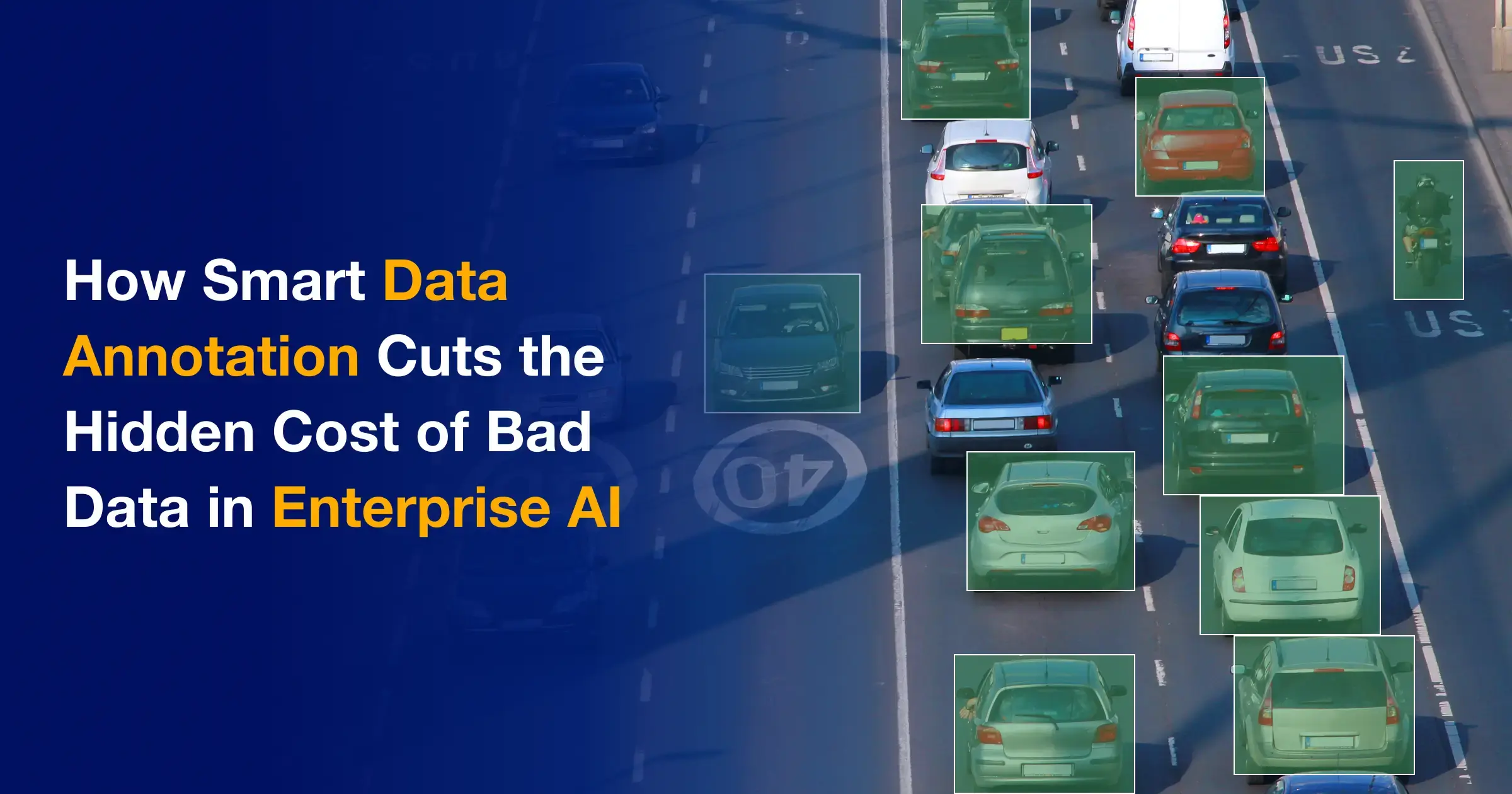
Annotators label each object using computer vision annotation techniques. They draw bounding boxes around vehicles. They mark pedestrians. They highlight traffic signals. These labeled examples become annotated datasets for AI.
Over time, the model begins to recognize patterns.
The same approach powers many enterprise systems.
Retail companies use computer vision to analyze customer movement inside stores. Manufacturing plants use visual AI to detect defects on assembly lines. Healthcare industry relies on annotated medical images to train diagnostic models.
In all these cases, high-quality labeled data determines how well the system performs.
How does text annotation power NLP and generative AI?
Visual data is only part of the story. Many enterprise systems work with text. Emails, customer chats, reports, legal documents, and support tickets generate large volumes of unstructured information.
This is where text annotation and NLP data annotation come into play.
Consider a customer service chatbot. The model must understand what a user is asking. Is the user requesting a refund? Reporting a bug? Asking for product details?
Annotators label thousands of conversations with intent categories. They mark entities such as product names, locations, or account numbers. These annotations create supervised learning datasets used in natural language models.
The same method helps organizations build systems for:
- , where AI extracts key information from contracts or invoices.
- Sentiment analysis, where models detect opinions in reviews or social media.
- Knowledge extraction, where AI identifies relationships between pieces of information.
Without strong training data labeling, language models struggle to understand context.
How does annotation support enterprise automation and decision systems?
Many AI systems support business decisions. These systems analyze patterns inside large datasets and help organizations act faster.
For example, fraud detection systems rely on labeled historical transactions. Each transaction is marked as legitimate or fraudulent. These labels help the model identify suspicious behavior.
Risk scoring models use annotated financial data to predict potential defaults. Supply chain forecasting models analyze labeled operational data to detect demand trends.
In each case, annotation helps convert raw business data into AI model training datasets.
This process improves data quality for AI and strengthens the AI data pipelines that support enterprise automation.
So, the next time someone talks about advanced AI systems, it is worth asking a simple question.
What does the training data look like?
Because behind every reliable AI system, there is a carefully built set of annotated datasets created through consistent and scalable data annotation workflows.
What Challenges Enterprises Face with Data Annotation

At first glance, data annotation sounds straightforward. Label images. Tag text. Feed the dataset into a model.
That seems simple.
But once companies start building real enterprise AI applications, things change quickly. Teams discover that creating high quality machine learning training data is much harder than expected.
Why?
Because enterprise AI operates at scale. The data is messy. The edge cases are endless. And consistency becomes difficult when many people are involved in training data labeling.
Let us break down the biggest challenges organizations face when building annotated datasets for AI.
Why does data volume become a major challenge?
Enterprise AI systems need massive datasets.
A small prototype might work with a few thousand samples. Production systems are very different. Many models require hundreds of thousands or even millions of labeled examples.
Think about a computer vision annotation project. A retail analytics system may analyze store cameras. Each video frame may contain people, shelves, products, and carts. Every object needs to be labeled.
Now imagine doing this across thousands of hours of footage.
The volume quickly becomes overwhelming.
This is why companies often build scalable data annotation workflows and structured AI data pipelines.
Key challenges related to volume include:
- Massive datasets required for reliable AI model training datasets
- Large numbers of images, videos, and text files that need annotation
- Managing annotation teams across multiple datasets
- Maintaining consistent progress across the data labeling pipeline
Why is enterprise data so complex to annotate?
Enterprise data is rarely clean.
Documents have different formats. Images contain overlapping objects. Text can contain slang, sarcasm, or incomplete information.
This complexity creates problems for annotators. They must interpret the meaning before assigning labels.
Consider a document processing system. One invoice might place the total amount at the top. Another might place it at the bottom. Annotators must recognize these patterns during AI dataset preparation.
This is why strong annotation workflows and experienced annotators matter.
Common complexity challenges include:
- Unstructured business data that requires interpretation
- Domain specific knowledge needed for correct labels
- Ambiguous content that multiple annotators may interpret differently
- Difficult edge cases within supervised learning datasets
Why do edge cases create serious problems for AI models?
AI models perform well when patterns repeat often. Rare scenarios cause problems.
These rare scenarios are called edge cases.
Imagine a self-driving vehicle system. Most images contain clear road conditions. But sometimes a pedestrian appears behind a parked truck. Sometimes heavy rain obscures objects.
If these situations are missing from AI training data, the model struggles.
Enterprises must deliberately include edge cases during machine learning data annotation.
Typical edge case challenges include:
- Rare scenarios missing from annotated datasets
- Unusual visual patterns in image annotation
- Unexpected language patterns in text annotation
- Difficult examples that reduce annotation accuracy
Why is annotation consistency difficult to maintain?
Consistency becomes harder when many annotators work together.
One annotator may label an object differently from another. Small differences in labeling create confusion for machine learning models.
Over time, these inconsistencies weaken data quality for AI.
Annotation guidelines help reduce this problem. So do strong review systems and clear annotation accuracy metrics.
Still, maintaining consistency across large datasets remains difficult.
Common consistency challenges include:
- Different interpretations of annotation guidelines
- Variations in labeling decisions across teams
- Quality drift over time in large projects
- Difficulty maintaining consistent high quality labeled data
These challenges explain why many organizations rely on structured enterprise data annotation workflows or specialized data annotation services. Building reliable AI training data requires more than simple labeling. It requires careful processes, skilled annotators, and strong quality controls.
In a Nutshell
Enterprise AI looks impressive on the surface. Powerful models. Advanced algorithms. Smart automation. But step back and ask a simple question. What teaches these systems how to think?
The answer is data annotation.
Strong AI training data builds reliable models. Weak labels create unreliable predictions. That is the reality many teams discover late in the process.
Before scaling any AI system, it helps to ask:
- Is our labeled data for AI accurate?
- Is our labeled data for AI accurate?
- Do our annotation workflows support growth?
When enterprises invest in high quality machine learning data annotation, their enterprise AI applications become far more dependable.
FAQs
Data labeling vs data annotation is something that causes confusion among many. These two terms are often used interchangeably, but they are slightly different.
Data labeling usually refers to assigning a simple category to data. For example, labeling an image as “cat” or “dog.”
Data annotation is a broader concept. It includes adding deeper context and metadata to raw data so machines can understand it better.
In short, labeling is one part of the larger data annotation workflow used to create machine learning training data.
Some examples of annotation include:
- Drawing bounding boxes around objects in images
- Highlighting entities in text for NLP data annotation
- Marking objects frame by frame in video annotation
There is no universal number. The amount of annotated datasets for AI depends on the complexity of the problem.
Simple classification models may work with thousands of labeled examples. Complex systems such as autonomous driving or medical imaging often require millions of labeled data points.
Many industries depend on enterprise data annotation to build reliable AI systems.
Some of the most common sectors include:
- Healthcare for medical image analysis
- Automotive for autonomous driving systems
- Retail for visual search and customer analytics
- Finance for fraud detection and document processing
- Agriculture for crop monitoring and disease detection
These industries rely on high quality labeled data for AI to train models that operate in real-world environments.
Yes, if the scope is honest. Start with a proof-of-concept, validate the business value, then scale.
Accuracy is critical when building AI model training datasets.
Companies usually combine several techniques to maintain high annotation accuracy metrics.
Common quality control practices include:
- Clear annotation guidelines for annotators
- Multi-layer review processes
- Inter-annotator agreement checks
- Continuous feedback loops during the data labeling pipeline
Data annotation partners typically support machine learning services through:
- Scalable annotation teams for large datasets
- Expertise in image annotation, text annotation, and video annotation
- Quality assurance systems for consistent labels
- Efficient AI data pipelines and annotation workflows
This allows data scientists to focus on model development instead of manual data preparation.
Almost any type of data used in AI can be annotated.
Common formats include:
- Images used in computer vision annotation
- Text used in chatbots and NLP models
- Videos used in autonomous systems
- Audio used in speech recognition systems
- Documents used in enterprise automation
Each data type requires specific data annotation tools and labeling techniques to create supervised learning datasets.
Teams rely on specialized data annotation tools to manage large datasets. These tools help annotators label data efficiently and maintain quality.
Typical features include:
- Image and video labeling interfaces
- Collaboration and review systems
- Version control for datasets
- Automated suggestions using AI
Automation helps speed up annotation. Still, human judgment remains essential. Because machines struggle with context, ambiguity, and edge cases, and humans understand nuance better.
This is why many enterprise AI applications use human-in-the-loop annotation. Humans review complex examples, resolve ambiguous labels, and maintain high data quality for AI systems.
The result is more reliable AI training data and stronger model performance.