Posted by Tech.us Category: software product development saas
We are a team of technology experts who are passionate about what we do. We LOVE our customers. We LOVE technology. We LOVE helping you grow your business with technology.
Artificial Intelligence Services
Machine Learning Solutions
Generative Al Companies
Robotic Process Automation
Natural Language Processing
Chatbot Development Services
Enterprise AI Solutions
Data Annotation Services
MLOps Solutions
IoT Solutions
Data Mining Solutions
Computer Vision Services
Custom LLM
AI Agents
Agentic AI Development
Custom Software Development
Enterprise Software Solutions
Software Development Services
Website Development Services
Software Product Development Services
SaaS Development Services
Mobile App Development Services
Custom Mobile App Development
IOS App Development
Android App Development
Enterprise Mobile App Development
Hybrid App Development
Software Development Outsourcing
Dedicated Development Team
Staff Augmentation Services
IT Outsourcing Services
Data Analytics Services
Data Analytics Consulting Services
Business Intelligence Solutions
Software Modernization
Application Modernization Services
Legacy System Modernization
IT Security Solutions
Cyber Security Solutions
Cyber Security Managed Services
HIPAA Compliance Cyber Security
Cloud Application Development
Custom Web Application Development
Cloud Consulting Services
AWS Cloud Consulting Services
Enterprise Cloud Computing
Azure Cloud Migration Services
POPULAR POSTS
01
How To Improve Document Processing Accuracy Using Document AI
02
The Guide to Chatbot Development & What to Seek while Hiring a Company
03
Understanding Natural Language Processing: The What? The How? and The Why?
04
11 Proven Benefits of AI Chatbots for Businesses in 2025
05
A Complete Guide to SaaS Product Development
Posted by Tech.us Category: software product development saas
Before you start building or integrating any AI system, there is one thing that often goes unnoticed, even by experienced teams, which is the quality of the data you feed into your AI models.
You may not think about it at first, but bad quality data slowly eats into your AI performance and business outcomes in ways you may not immediately see. Many enterprises come to this realization only after their models start giving unpredictable results, and by then the damage is already done.
The challenge here is very subtle. Poor quality data often comes unnoticed, and once it slips into your pipeline, it could start creating errors and even weaken your AI outputs over time.
Why, because every prediction your model makes depends on the clarity and correctness of the data it learns from.
So before jumping into any new AI development process, ask the following questions to yourself:
If most of your answers point toward unclear data quality, inconsistent labels, or recurring errors in model behavior, then it is time to look at data annotation services seriously.
Data annotation gives you a straightforward way to clean and prepare your data, way before it reaches your AI models for training. But again, this is a critical step, so understanding its importance early can save you from long-term setbacks.
To help you make a more informed decision, in this blog, we will break down how bad data quietly increases hidden costs in your AI projects and why smart data annotation can immediately improve performance and reliability.
So, let’s dive in.
Data annotation refers to the process of adding meaningful tags to raw, unstructured data so machine learning models can comprehend and understand the data and then make meaningful predictions.
Data annotation in enterprise AI is all about preparing your data in a way that AI models understand and train with it. For that, it is important to add labels or meaningful tags to different types of data such as text, images, videos, audio files, and even tabular records.
Here, every label you add helps the AI system learn the right patterns and make accurate predictions.
In this model, the goal is simple. You take unprocessed data and make it ready for training by describing what each piece of information represents.
Many businesses rely on this mainly because it gives them a much stronger control over model performance, but it often comes with challenges such as the volume of data, the time it takes to label everything correctly, the expertise required to avoid errors, and so on.
Data annotation becomes even more important when you think about the role it plays in the entire AI lifecycle.
Imagine you are collecting thousands of customer queries, defect images from a factory line, or transaction logs from your banking system. Without robust data annotation, this information just sits there with no structure and cannot train your model in any meaningful way.
With annotation, every data point receives a clear definition.
This becomes a strategic advantage for your AI initiative because your model now learns from clean, structured, and meaningful examples.
Annotation also fits neatly inside your AI lifecycle, which sits between data collection and model training, and plays a critical role in shaping how well your model performs once deployed. Without this step, the entire process becomes unstable and difficult to control.
But it also comes with responsibilities on your end. To make annotation effective, you need proper workflows and quality checks with the right level of expertise in place. Only then your model can perform reliably in real-world conditions.

Although data plays a central role in every AI initiative, poor data quality comes with several challenges which many teams often overlook. And you’ve got to understand them before you move forward with any AI-driven project.
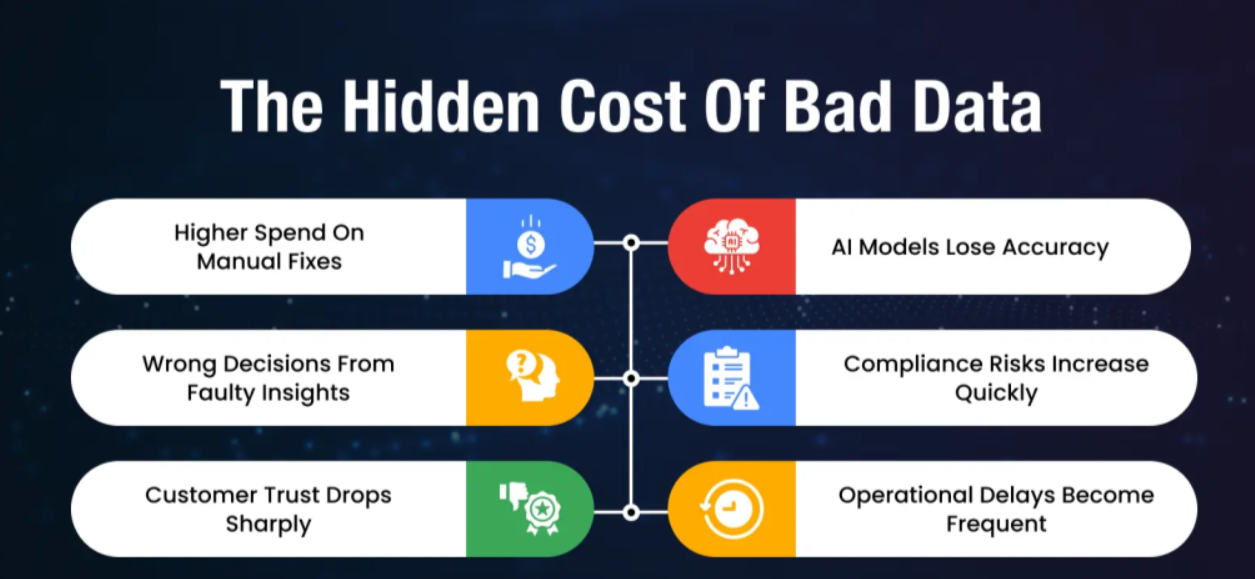
Bad data is one of the biggest reasons why enterprises lose money without realizing it, as it directly affects how your teams make decisions, how your customers experience your product, and even how much time your employees spend fixing repeated issues. All these factors could significantly increase overall operational expenses.
Here are some signs that poor data may already be impacting your business:
AI systems mainly depend on the quality of data they are trained on. When the data is inaccurate or mislabeled, the model produces unreliable results. This not only delays progress but also introduces more risks for your business. It becomes especially challenging when your AI is customer-facing or used for critical decision-making.
Some common failure signs include:
AI does not just repeat the mistakes hidden inside your data. It multiplies them. A small inconsistency at the training stage can turn into a much bigger issue once the model is deployed at scale. This makes the risks harder to control and even harder to fix later in the development cycle.
The following issues become more visible when AI learns from bad data:
Although AI models come with impressive capabilities, improving their performance does not happen on its own. And you’ve got to understand this before relying on any system for important decisions. Smart data annotation plays a central role here, because the quality of your labels directly affects how reliable your model becomes.
High-quality annotation is one of the strongest contributors to accurate AI predictions. With clean and consistent labels, you can train the model correctly during training, which reduces confusion and helps it learn the right patterns. When this step is done well, your AI system becomes more stable and dependable across different scenarios.
Some clear benefits you will notice include:
Bias often enters your AI system quietly, and many organizations only notice it later when customers or auditors raise concerns. But with smart data annotation, you can prevent this early by ensuring your data represents different groups accurately. This becomes important especially in regulated industries where fairness and auditability are highly regarded.
Here are some advantages careful annotation brings:
AI models get improved when they receive feedback, and with the right annotation workflow, you can review live predictions and feed better examples by fixing errors back into the model. This shortens the improvement cycle and helps you adapt faster to new data or changing conditions.
Some outcomes you can expect are:
AI can support different functions across an enterprise, but incorrect or poorly annotated data doesn’t come without drawbacks. And you’ve got to understand them before depending on AI systems for customer, risk, or operational decisions.
Customer-facing AI systems are highly critical as they rely heavily on the accuracy of the labeled data they are trained on. In the case of incorrect labels, the AI model may start giving irrelevant recommendations, slow or confusing chatbot replies, and search results that do not match what the user expects, all of which can significantly affect customer experience and conversion rates.
Here are some signs that poor annotation is affecting your customer-facing systems:
Risk and fraud models need extremely accurate labels to function properly because if fraud cases are mislabeled as normal or risky transactions are incorrectly marked safe, it could create major financial and regulatory issues. This becomes even more challenging for industries that must meet strict compliance standards.
Here are a few risks businesses typically encounter:
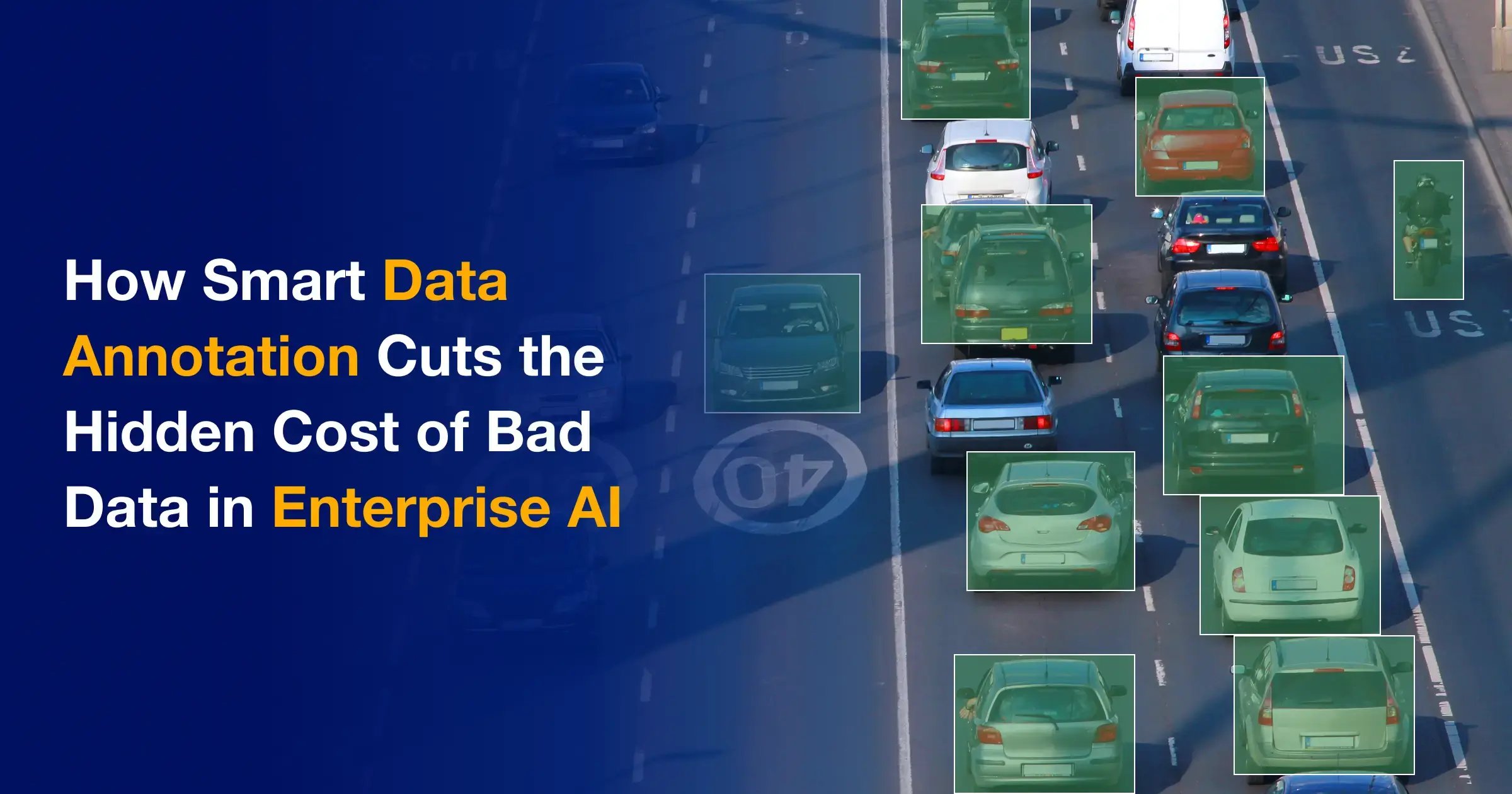
Many businesses rely on Computer vision models for detecting defects and anomalies and monitoring safety conditions. This is where image annotation and video annotation play crucial roles. Incorrect annotations in these systems can cause them to fail, which slows down production and affects workplace safety. This becomes a hurdle especially when you want to scale automation.
Some common issues that arise include:
Now that you know how smart data annotation improves your AI performance in many ways, you should also have clarity on where different annotation models work for you.
It’s crucial that you clearly understand the in-house vs outsourced data annotation teams like where in-house teams make sense and where partnering with external specialists becomes more practical.
This helps you make an informed decision when you are at this crossroad.
In-house data annotation works well when your data is extremely sensitive or when the labeling work requires deep domain knowledge, about which external teams may not have. It is also suitable when the volume of data is within the manageable limits but remember that the complexity is high, and you want close control over every stage of the process.
Situations where this model usually fits include:
Outsource data labeling and annotation to experts, especially when your project relies on large-scale data including multiple data types or multilingual content. These vendors are often equipped with dedicated tools, experienced annotators, and established workflows, all of which can speed up your project without sacrificing quality. It becomes especially beneficial when your internal teams are already managing other priorities.
Some scenarios where external partners are more effective include:
At Tech.us, we follow a structured and quality-driven approach to annotation by combining AI tools with domain-aware human expertise. With this, we help you achieve reliable training data without worrying about workflow complexities or security risks. Our goal is to support your AI initiatives with accurate, well-governed data which strengthens model performance.
Some key strengths you can expect include:
It is evident that the role of AI in business is so profound, and enterprise AI is experiencing faster shift than most teams expect. With the rate at which data grows and customer expectations rise, it puts pressure on businesses across every industry to strengthen their AI foundations or risk falling behind.
Smart data annotation helps you structure your data in a meaningful way, which helps your AI models to actually learn what they are supposed to learn. You no longer have to deal with unpredictable outputs or spend time fixing repeated issues that pull your teams away from important work.
Have a new AI idea that depends on accurate predictions, but your current data is messy or inconsistent? Start with data annotation and get your model trained on clean and trustworthy information.
Looking to scale AI into new departments but worrying that your existing data might not support those initiatives? Strengthen your annotation workflows and bring more confidence into every model you deploy.
Data annotation gives you the flexibility and clarity you need, so you can channel your focus on strategic areas and improve your business outcomes. It becomes a foundational step that supports every AI decision you make going forward.
Data annotation refers to the process of adding meaningful labels or tags to raw data (text, image, audio, video, tabular) so models can learn from clear examples.
Annotators convert messy data into explicit examples like tagging intents in text, drawing boxes around objects in images, marking timestamps in audio, and many more.
There are several debates about data labeling vs data annotation, and many use the terms interchangeably. But data labeling basically refers to the simple process of giving pre-defined categories (labels) to data, while data annotation goes a step further and involves in adding contextual and spatial information to each data.
There’s no fixed quantity of data that you may need, as it entirely depends on the problem’s complexity and variability. Start small with a representative, well-annotated sample to validate the approach, then scale the volume guided by model performance.
Some common data labeling mistakes are:
The labeling errors can magnify into large model failures, so accuracy in labeling is the key.

In-House vs Outsourced Software Development: A...
9 Signs Your Business is Ready for Artificial...
Get Free Tips
NEWSLETTER
Get Free Tips
Submit to our newsletter to receive exclusive stories delivered to vou inbox!
Thanks for submitting the form.
RECENT POSTS
9 Signs Your Business is Ready for Artificial Intelligence Development
How Smart Data Annotation Cuts the Hidden Cost of Bad Data in Enterprise AI
In-House vs Outsourced Software Development: A Strategic Guide for CEOs
What Are the Key Enterprise Software Development Considerations for...
7 Qualities to Look for in a Custom Enterprise Software Development...
We are a team of technology experts who are passionate about what we do. We LOVE our customers. We LOVE technology. We LOVE helping you grow your business with technology.
Our Services
Talk to US