
Something interesting is happening inside modern companies. AI is no longer a side experiment. It is quietly becoming part of the core infrastructure that runs daily operations.
As per the study by Grand View Research, the global market size of AI in software development is tremendous and is projected to reach USD $15,704.8 million by 2033.
Think about the amount of data businesses generate today. Customer interactions, transactions, support tickets, logistics data, sales reports. It keeps growing every day. The real question is simple. How can teams actually make sense of all this information?
This is where AI software development is changing the game.
AI software can analyze large datasets in real time. It spots patterns that humans may miss. It helps leaders move from guessing to data-driven decision making. Many organizations now build AI-powered applications to automate workflows and improve operational efficiency.
Here is what many businesses are realizing:
- Teams spend hours on repetitive operational tasks
- Decision cycles become slow when data is scattered
- Important insights often stay hidden inside large datasets
With the right AI-powered business automation, companies can change that.
Businesses use AI to automate workflows like:
- customer support routing
- invoice processing
- sales forecasting
- inventory planning
This shift is also why many companies now invest in custom AI software development instead of relying on generic tools. Off-the-shelf platforms often struggle with complex workflows or unique industry data.
The result? Faster operations. Smarter decisions. Better customer experiences.
Organizations that adopt AI for business operations today are building systems that learn and improve over time.
So the real question becomes this.
Where does AI software development create the biggest operational impact inside a business?
What Does AI Software Development Actually Mean for Businesses?
Let us clear something up first. Many leaders hear the term AI software development and assume it is just another technology buzzword. It is not.
AI software changes how business systems think, learn, and respond to data.
McKinsey's 2025 Global AI Survey reveals that 88% of organizations now regularly use AI in at least one business function, which goes up from 78% last year. It underscores the importance of generative AI services that has seen a spike of 79%. This confirms AI's shift from experiment to operational standard.
Traditional software follows instructions. Someone writes rules. The system executes them. That works well for structured tasks. But modern business environments are messy. Data flows from dozens of systems. Customer behavior shifts constantly. Market signals change every week.
So the real question becomes simple.
Can software learn from data and improve decisions on its own?
That is exactly where artificial intelligence software development comes in. Businesses now build AI-powered systems that analyze patterns, automate complex workflows, and support faster decision making.
Many organizations adopt enterprise AI solutions because they want more than automation. They want smarter operations.
Let us break it down in a simple way.
What is AI Software Development?
At its core, AI software development is about building systems that can learn from data and continuously improve outcomes.
Instead of writing rigid rules, developers build models that use technologies like:
These technologies power many modern AI-powered applications that businesses use every day.
You have probably interacted with some of these systems already.
Examples include:
- recommendation engines used in ecommerce platforms
- demand forecasting tools used by retailers
- AI chatbots that handle customer queries
- fraud detection systems used by banks
- computer vision tools that detect defects in manufacturing
What makes these systems powerful is simple. AI software can analyze large datasets in real time and extract meaningful insights.
Businesses use AI to automate workflows and uncover patterns that traditional tools miss.
Here is a quick comparison.
|
Traditional Software
|
AI Software
|
|
Works on fixed rules written by developers
|
Learns from historical and real-time data
|
|
Executes predefined workflows
|
Adapts as new data arrives
|
|
Generates reports after events occur
|
Predicts outcomes before they happen
|
|
Requires manual analysis
|
Supports data-driven decision making
|
This shift is why many companies invest in AI development services to build intelligent systems tailored to their operations.
How is AI Software Different from Traditional Business Software?
Let me explain this in a very practical way.
Imagine a sales dashboard built using traditional software. It shows numbers from the past week. The team studies the report and then decides what to do next.
Now imagine an AI-powered system analyzing the same data.
Instead of just showing numbers, it might say:
- Sales in one region may drop next month
- A pricing change could increase conversion
- Certain customer segments are more likely to churn
This is the difference.
Traditional software reports what happened. AI-driven operations help teams understand what will happen next.
Several capabilities make this possible.
Data-driven decision making
AI systems analyze historical and live data. Leaders receive insights much faster. Many companies implement AI business intelligence tools to improve planning and forecasting.
Automation beyond simple workflows
Basic automation follows predefined steps. AI takes it further through AI workflow automation. Systems can route tasks, classify data, and trigger actions automatically.
Predictive intelligence
Businesses implement AI for predictive insights such as:
- sales forecasting
- supply chain demand prediction
- customer churn analysis
- fraud risk detection
This is powered by machine learning software development and predictive models.
Continuous learning
Traditional software remains static. AI models improve as they receive new data. This helps organizations improve operational efficiency with AI over time.
That is why many companies view AI as a strategic capability rather than a simple tool.
Why Off-the-Shelf AI Tools Often Fail for Complex Business Operations
Many companies start their AI journey with packaged tools. That seems like the easiest path. But after some time, they hit limitations. Why does that happen?
Because most business operations are unique. Workflows differ across industries. Data structures vary widely. Generic tools struggle to handle this complexity.
Here are some common challenges companies face with off-the-shelf AI platforms.
Limited customization
Generic tools work well for simple use cases. They often struggle when businesses require domain-specific models.
Integration issues
Enterprise systems rarely operate in isolation. AI tools must integrate with CRM systems, ERP platforms, and internal data pipelines. Many prebuilt platforms lack deep integration capabilities.
Limited domain knowledge
AI models trained on generic datasets may not understand industry nuances. For example:
- healthcare workflows
- financial risk models
- manufacturing quality checks
These require specialized training data.
Data security concerns
Some businesses cannot send sensitive operational data to external AI platforms. This becomes a major issue for regulated industries.
Scalability problems
As data grows, systems must scale efficiently. Many packaged AI solutions struggle with large enterprise workloads. This is why many organizations turn to custom AI software development.
Custom systems allow companies to:
- build models trained on their own data
- integrate AI with internal platforms
- create scalable AI enterprise platforms
- support long-term AI transformation for businesses
In many cases, partnering with an experienced AI development company helps enterprises design solutions aligned with their operational goals.
The result is simple. AI becomes deeply embedded inside the organization instead of functioning as a disconnected tool. And that is when AI-powered business automation starts delivering real business impact.
How AI Software Development Transforms Business Operations
Businesses adopt AI software development for one simple reason. Daily operations are becoming harder to manage manually. Data grows fast. Teams struggle to process it quickly. Decisions slow down.
AI changes that.
Instead of reacting after problems occur, companies build systems that learn from data and automate routine work. Many organizations now adopt AI-powered business automation to simplify workflows and improve operational efficiency.
Where does the biggest impact happen? Let us explore the key areas.
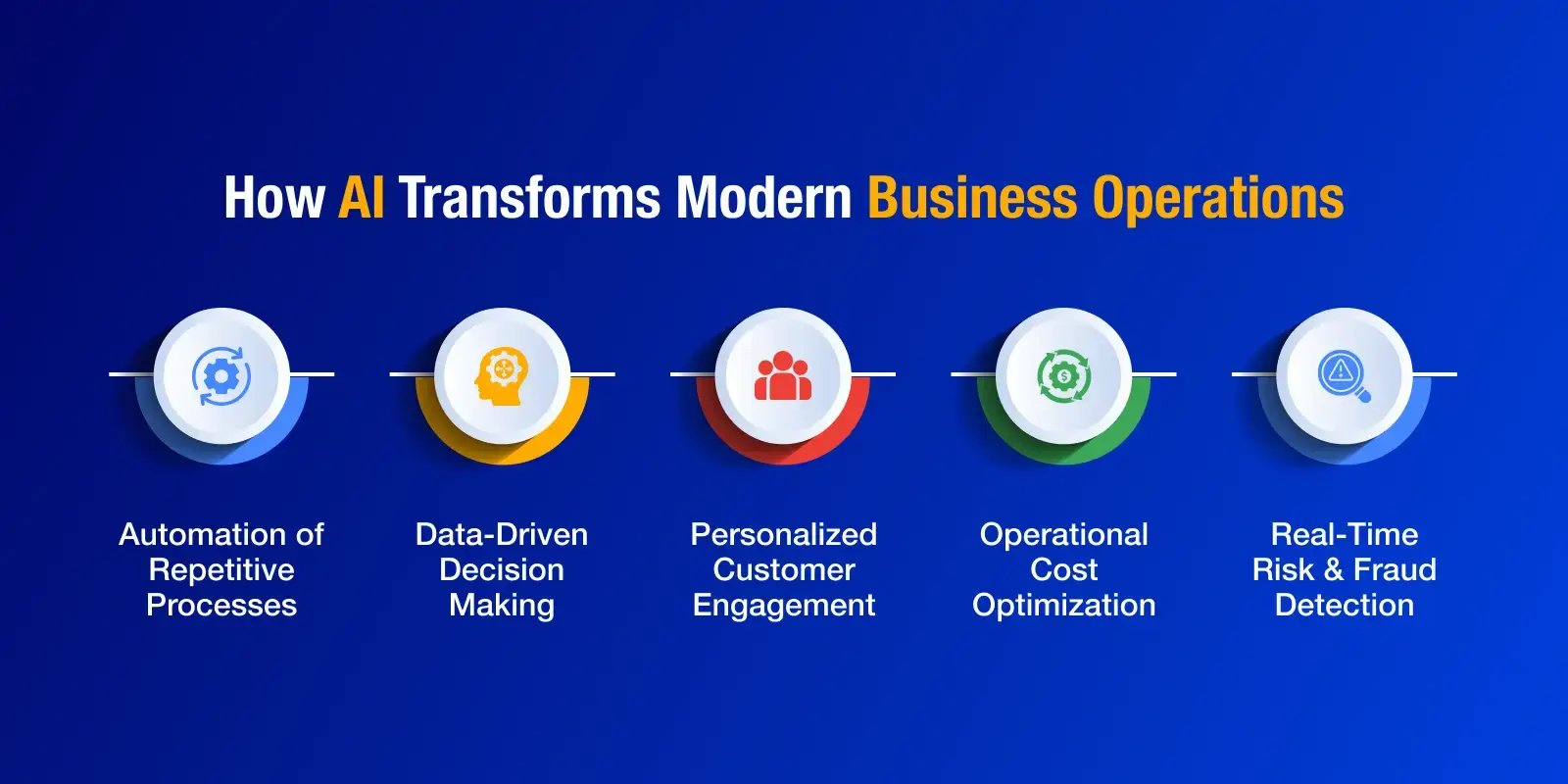
How Can AI Automate Repetitive Business Processes?
Every business has repetitive tasks. Someone processes invoices. Someone sorts support tickets. Someone enters data into systems. These tasks take time. They also create room for human error.
This is where AI workflow automation helps. Businesses use AI to automate workflows that previously required manual effort.
For example:
- Can extract data from invoices automatically
- Customer support tickets can be classified instantly
- Reports can be generated from live operational data
- Data entry tasks can be automated
Employees spend less time on routine work. They focus on strategic tasks.
Key features
Businesses use AI to automate workflows and reduce repetitive operational tasks. Teams work faster and systems run more smoothly.
Can AI Improve Decision-Making Across Departments?
Most business decisions depend on data. But data often lives in many systems. That creates a problem. Leaders struggle to see the full picture.
AI solves this by analyzing large datasets quickly. AI-powered applications identify patterns and deliver insights faster than traditional analytics tools.
For example, AI systems can help teams:
- Forecast sales demand
- Identify pricing opportunities
- Detect supply chain disruptions
- Analyze customer behavior trends
Many organizations build AI decision systems using machine learning software development to support strategic planning.
Key features
- Predictive analytics dashboards
- Pattern detection across large datasets
- Forecasting models for planning
- AI-driven business intelligence insights
AI helps companies make data-driven decisions by analyzing operational data at scale and delivering faster insights.
How Does AI Improve Customer Experience and Engagement?
Customer expectations have changed. People expect fast responses and personalized experiences. AI helps businesses deliver that.
Modern AI-powered applications analyze customer behavior, preferences, and past interactions. This allows companies to personalize engagement at scale.
Examples include:
- AI chatbots answering customer queries instantly
- Recommendation engines suggesting relevant products
- Personalization systems tailoring digital experiences
- Voice assistants handling service requests
Many organizations adopt enterprise AI solutions to strengthen customer engagement strategies.
Key features
- Natural language processing for chatbots
- Real-time recommendation engines
- Customer sentiment analysis
- AI-driven personalization systems
AI-powered systems optimize customer interactions. Businesses respond faster and create more personalized experiences.
How Can AI Optimize Operational Costs?
Operational inefficiencies are often hidden. Supply chains break down. Equipment fails unexpectedly. Inventory levels fluctuate.
AI helps detect these problems early.
Businesses use predictive analytics and machine learning to monitor operations continuously. These systems identify inefficiencies before they become costly.
Examples include:
- Demand forecasting for better inventory planning
- Predictive maintenance for equipment monitoring
- Workforce planning based on operational data
- Supply chain optimization models
Many enterprises deploy AI enterprise platforms to manage operational insights across departments.
Key features
- Predictive analytics models
- Equipment monitoring using machine learning
- Inventory optimization algorithms
- Operational dashboards for real-time insights
Companies implement AI for predictive insights that reduce operational waste and improve resource utilization.
How AI Helps Businesses Detect Risks and Fraud
Risk management has become harder in digital environments. Fraud attempts increase. Cyber threats evolve quickly.
Manual monitoring systems struggle to keep up.
AI helps businesses detect risks earlier. Modern AI software development enables systems that analyze transaction patterns and identify anomalies in real time.
Banks, fintech companies, and ecommerce platforms already rely on these systems.
Examples include:
- Fraud detection in financial transactions
- Cybersecurity monitoring of network activity
- Anomaly detection in operational data
- Automated compliance monitoring
Many companies deploy enterprise AI solutions to strengthen risk management frameworks.
Key features
- Machine learning fraud detection models
- AI-powered anomaly detection systems
- Real-time risk monitoring dashboards
- Compliance monitoring automation
AI-powered systems analyze large volumes of data and detect risks early. Businesses respond faster and reduce the impact of fraud and operational threats.
What Should Businesses Consider Before Building AI Software?
Many leaders get excited about AI. They see competitors talking about it. Vendors promise fast results. So the natural question comes up.
"Should we build an AI solution for our business?"
That is a good question. But an experienced AI development company like Tech.us will usually ask a few important questions first.
- Do you have reliable data?
- Do your systems connect with each other?
- Does your team have the right technical skills?
AI software development works best when the foundation is strong. Without that, even the most advanced models struggle.
Let us walk through the key things businesses should evaluate before starting their AI implementation strategy.
Do You Have the Right Data Infrastructure?
Let me be direct. AI runs on data. If the data is messy, the AI will be messy too.
Many companies want enterprise AI solutions, but their data sits across different systems. CRM platforms, spreadsheets, ERP tools, support platforms. Nothing connects properly.
Before building AI systems, organizations must focus on their enterprise AI infrastructure.
Key elements include:
- Clean and structured datasets
- Reliable data pipelines that move data across systems
- Proper data labeling for machine learning models
- Data governance policies for security and accuracy
If these pieces are missing, AI models struggle to produce useful results.
AI software can analyze large datasets in real time. But those datasets must be structured and reliable.
Should You Build Custom AI or Use Pre-Built Models?
Many businesses start with prebuilt AI tools. That is fine for simple use cases. But complex operations often need deeper customization.
This is where custom AI software development becomes important.
Different approaches serve different business needs.
|
Approach
|
Best For
|
|
Proprietary AI
|
Highly sensitive or regulated data environments
|
|
Custom AI models
|
Domain specific problems and unique workflows
|
|
Hybrid AI models
|
Scalability, flexibility, and cost control
|
Hybrid approaches are becoming popular. They combine proprietary systems with large language models and custom components.
This allows companies to build scalable AI-powered applications without exposing sensitive data.
Companies implement AI for predictive insights when the solution fits their specific operational workflows.
What Skills are Required to Build AI Systems?
AI systems are powerful, but they require the right people behind them. Many organizations underestimate this part. Building reliable AI solutions for enterprises involves multiple technical roles working together.
Key roles include:
-
Data scientists who design machine learning models
-
ML engineers who deploy and optimize models
-
AI architects who design scalable AI platforms
-
Software engineers who integrate AI into applications
These teams build systems that support AI-driven operations and intelligent automation.
Some companies build internal teams. Others partner with an experienced AI development services provider.
Strong talent and the right architecture are essential for long-term AI transformation for businesses. AI is not just a tool. It becomes part of the company’s operational backbone.
FAQs
What is AI software development?
AI software development is nothing but building software that is capable of learning and evolving from data. Such software does not follow fixed rules but uses technologies like machine learning and predictive analytics to analyze patterns and support smarter business decisions.
How can AI improve business operations?
AI improves business operations by helping companies automate workflows and analyze data faster.
For example, businesses use AI to:
- automate repetitive processes
- forecast demand and trends
- detect risks or anomalies early
What industries benefit most from AI software?
Industries that generate large volumes of data mostly benefit from AI. Some key industries include:
- Construction
- Retail
- Healthcare
- Finance
- Manufacturing
- Logistics
These industries commonly use AI for business operations that help them improve productivity and increase efficiency.
Is AI software development expensive?
The cost highly varies based on the complexity, the amount of data involved, system integration needs, and many other factors. Many businesses start with a small use case and expand their AI implementation strategy after they see measurable results.
What is the difference between AI software and traditional software?
Traditional software follows fixed rules written by developers. AI software learns from data and improves over time. This allows businesses to automate complex tasks and support data-driven decision making.