blog-img

POPULAR POSTS

  • 01

    How To Improve Document Processing Accuracy Using Document AI

  • 02

    11 Proven Benefits of AI Chatbots for Businesses in 2025

  • 03

    The Guide to Chatbot Development & What to Seek while Hiring a Company

  • 04

    What Digital Transformation Means for Businesses in 2026

  • 05

    Understanding Natural Language Processing: The What? The How? and The Why?

What are the top benefits of custom AI development services for enterprise operations in 2026?

Posted by Tech.us Category: software product development saas

tech.us-recognized-by-mobile-app-daily

Overview


The role of AI in modern enterprises has transformed from a niche technological novelty to a mainstream business necessity. In 2026, it is the businesses that don't leverage AI development services that have risk falling behind.


As AI continues to mature, custom solutions tailored to specific business needs are becoming highly important for maintaining operational efficiency and driving growth.


Over the years, AI has surpassed many boundaries, and instead of being a tool for large corporations, AI can be adopted by enterprises of all sizes. They are actively investing in custom AI solutions to transcend the way they work and deliver better outcomes.


But why is AI becoming so integral? Let’s dive into the benefits that custom AI development services can bring to enterprise operations in 2026.


Why AI Development is Critical for Enterprises in 2026


What Is AI Development for Enterprises?


AI development for enterprises means building custom AI solutions that solve your operational problems, using your data, inside your systems, with your constraints. It’s not “install a tool and hope it fits.”


It’s closer to how you’d design a workflow, a data pipeline, or a pricing engine: you start with the operational reality and build around it.


That distinction matters because most enterprises aren’t short on software. They’re short on software that works together.


A custom AI system can be designed to sit across the messy places where work actually happens like ERP, CRM, ticketing, spreadsheets, warehouse systems, email threads, and the “temporary” processes that become permanent.


This is why AI development services have become less about novelty and more about operational hygiene at scale.


Examples vary, but the pattern stays the same:


  • A predictive maintenance model trained on your machine telemetry, not a generic benchmark dataset.
  • Customer segmentation built on your purchase cycles, channel mix, and churn signals.
  • Supply chain optimization that reflects your lead times, vendor reliability, and regional constraints.

In plain terms: AI in business operations works best when it’s designed to match how your business really runs, not how a vendor’s demo says it runs.


AI’s Growing Impact on Business Operations


AI is changing enterprise operations because it tackles a specific pain most teams live with: work happens faster than reporting and coordination can keep up.


In a typical enterprise, friction comes from familiar places:


  • Data fragmentation across systems that don’t share a common language.
  • Integration overload, too many apps, too many connectors, too many handoffs.
  • Reporting limitations that lag behind reality by a week (or a quarter).
  • Manual workarounds that quietly become “the process.”
  • Hidden cost growth caused by rework, exceptions, escalations, and firefighting.

This is where AI for enterprises earns its keep. It can automate repetitive steps, surface anomalies earlier, and turn scattered operational signals into something leaders can actually act on.


More importantly, AI shifts decision-making from “best guess based on partial data” to “a reasoned recommendation backed by patterns we can explain.” That’s the practical value. Not magic. Not hype. Just better operational leverage.


And in 2026, that leverage is becoming harder to ignore, because customers expect faster response, teams are leaner, and complexity keeps rising even when headcount doesn’t.


How Custom AI Development Benefits Enterprise Operations
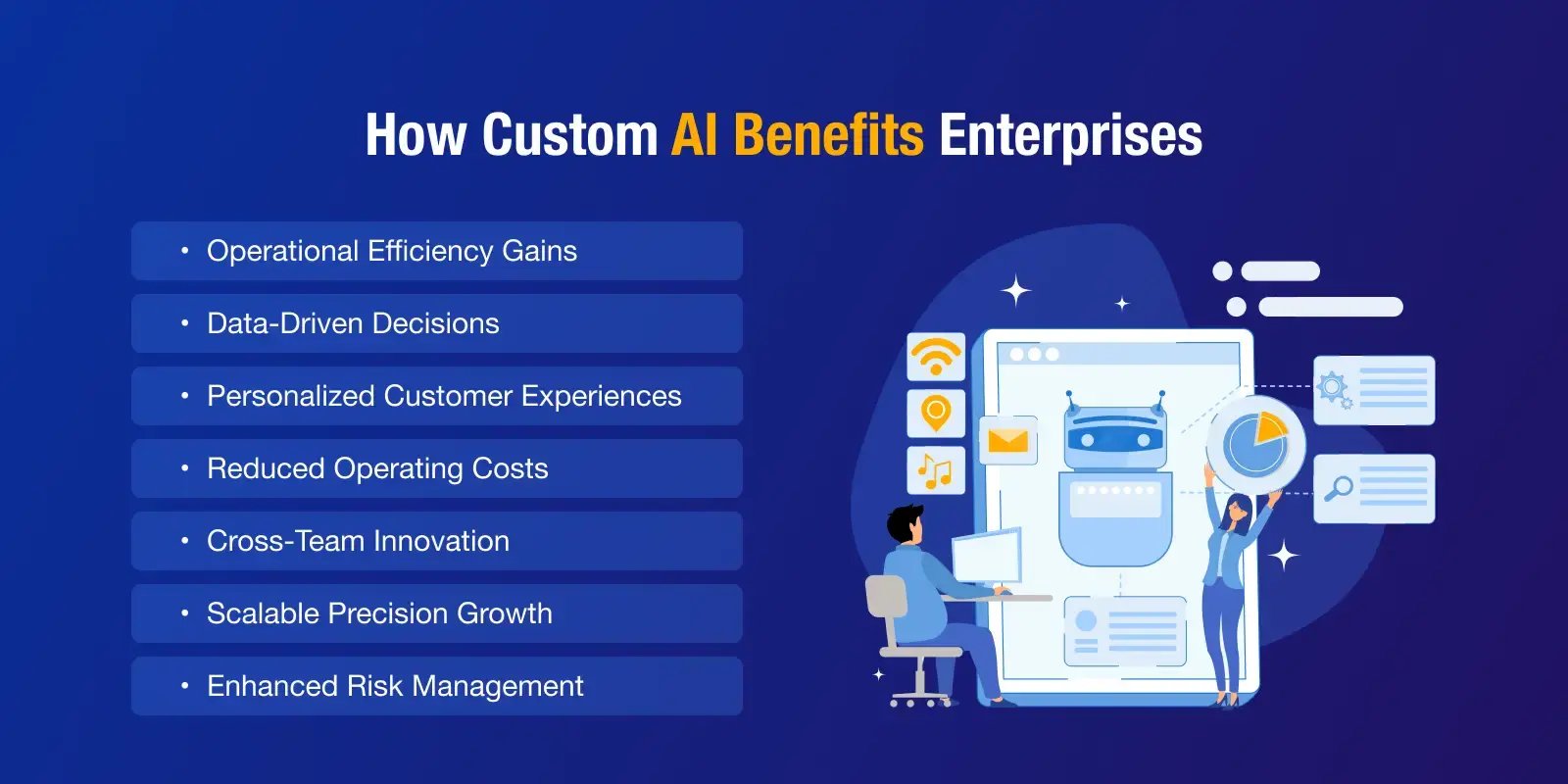


Enterprises get benefited by custom AI solutions in the following ways:


  • Increased Operational Efficiency
  • Improved Decision-Making with Data Insights
  • Personalized Customer Experience
  • Reduced Operational Costs
  • Better Innovation Across Teams
  • Higher Scalability with Precision
  • Improved Security & Risk Management

Boosting Operational Efficiency


Automating Repetitive Processes


Operational efficiency rarely collapses in a big dramatic way. It usually leaks out through repetition.


Think about how many hours disappear into tasks like:


  • copying information from one system into another
  • cleaning spreadsheets before someone trusts the numbers
  • triaging tickets that follow predictable categories
  • reconciling inventory exceptions caused by timing gaps
  • reviewing documents where only 3% is actually important

Custom AI solutions can automate large parts of this work, but the real advantage is where they automate.


Off-the-shelf automation often breaks at the first exception. Enterprises live on exceptions. A well-designed AI workflow accounts for them. It learns patterns in how your teams resolve edge cases, what they escalate, what they ignore, and what always causes delays.


That’s why advantages of AI-driven automation for enterprises tend to show up first in “middle-office” work: the operational glue between departments. When that glue gets stronger, everything downstream moves faster.


Eliminating Time-Consuming Activities


It’s tempting to describe this as “saving time,” but what actually happens inside enterprises is more specific: AI removes the slowest parts of coordination.


The bottleneck often isn’t the task itself, it’s the waiting:


  • waiting for someone to approve a request because the context isn’t clear
  • waiting for a report because data is scattered across systems
  • waiting for a customer response because the support team can’t find history
  • waiting for finance to validate numbers because definitions vary by team

AI helps by packaging context in the moment. For example, instead of asking a manager to “review this exception,” the AI can present: what changed, why it’s unusual, what similar cases looked like, and what action historically worked.


That changes the rhythm of work. It reduces back-and-forth, shortens cycles, and increases throughput without pressuring people to move faster. In many operations teams, that’s the most realistic path to AI for efficiency, less chasing, less rework, fewer loops.


Improved Decision-Making with Data Insights


How AI Analyzes Big Data for Business Insights


Most enterprise leaders don’t struggle with a lack of data. They struggle with data that doesn’t line up.


Sales has one view of “active customer.” Finance has another. Operations defines “fulfilled” differently than logistics. Meanwhile, dashboards pull from systems that update on different schedules. So decisions become debates about definitions instead of discussions about action.


This is where AI data analytics and business intelligence with AI become genuinely useful. AI can:


  • unify signals across sources (even when fields don’t match cleanly)
  • detect patterns that don’t show up in average-based reporting
  • flag leading indicators before lagging indicators appear in dashboards
  • explain “why” something changed, not just “what” changed

And when you build it as part of AI solutions for business operations, the output isn’t a generic analytics chart. It’s operational guidance: what’s drifting, what’s breaking, what’s likely to happen next, and what decisions are available.


This is also the core reason why enterprises need custom AI solutions for decision-making in 2026: the competitive gap isn’t information. It’s speed-to-clarity.


Personalization and Customer Experience


Custom AI Solutions for Personalized Customer Experiences


Customer experience often fails for boring reasons: context is missing.


A customer asks a question, and the support agent can’t see prior history. A sales rep promises something, and operations doesn’t get the updated requirement.


A renewal comes up, and no one has a clean view of product usage or customer sentiment. So customers repeat themselves, issues take longer, and trust erodes.


Custom AI solutions can personalize customer experience by stitching together the context that already exists across systems. That’s why AI for customer experience is less about fancy personalization and more about relevance.


Personalization beats everything when it’s practical:


  • “We know what you bought, what you struggled with, and what you’re likely to need next.”
  • “We can anticipate questions before they turn into escalations.”
  • “We can route you to the right resolution without bouncing you around.”

When done well, personalization isn’t “creepy.” It’s helpful. It reduces customer effort, which is usually what customers actually want.


AI-Driven Product Recommendations and Customer Support


In e-commerce, product recommendations are the obvious example. But in enterprise operations, the more valuable version is often support and account service.


AI can help a support team by:


  • summarizing customer history automatically
  • suggesting likely root causes based on similar tickets
  • drafting responses grounded in internal knowledge bases
  • identifying when an issue is trending across accounts
  • escalating earlier when risk signals appear

This is where personalized AI services matter. Generic chatbots “deflect tickets.” A custom AI assistant can resolve them because it understands the business context, the customer context, and the operational constraints.


Reducing Costs and Optimizing Resources


Lowering Operational Expenses


Cost reduction from AI is rarely a simple “replace humans with software” story. The bigger savings usually come from reducing the hidden costs that accumulate quietly:


  • rework caused by errors and inconsistent data
  • overtime caused by unpredictable workload spikes
  • refunds or credits caused by service failures
  • inventory waste caused by poor forecasting
  • extra headcount hired just to manage manual coordination

AI lowers operational expenses when it reduces those leaks.


For example, automating document processing doesn’t just save time, it reduces downstream exceptions. Automating routing decisions doesn’t just speed up delivery, it reduces customer support load caused by late shipments.


This is why the cost-saving potential of AI in enterprise operations is often indirect but meaningful.


Optimizing Resource Distribution


Resource allocation is where enterprises get trapped. Teams often spend months justifying budgets and headcount, then spend the next year compensating for the mismatch between forecast and reality.


AI helps by making resource needs more observable.


A custom AI model can forecast workload based on seasonality, pipeline signals, customer behavior, and operational constraints. It can recommend staffing changes, inventory shifts, or capacity adjustments before the pressure hits.


For example, if your service desk sees rising volume in a category that historically leads to escalations, AI can flag it early. That gives you options: add coverage, adjust workflows, fix the underlying issue, or update customer comms.


This isn’t “perfect forecasting.” It’s better planning with fewer surprises, which is usually what ops leaders actually want.


Real-World Return on Investment (ROI)


ROI conversations get messy because the benefits of AI show up in multiple places. If a custom model reduces delivery delays, finance sees fewer credits, support sees fewer tickets, operations sees fewer escalations, and sales sees fewer churn risks.


So ROI is often a portfolio effect.


That said, the businesses that see strong ROI tend to share a pattern: they focus AI on processes with high volume, high variability, and high exception rates. That’s where small improvements multiply.


If you want a grounded takeaway: ROI is most reliable when AI reduces rework and exceptions, not just when it speeds up “happy path” workflows.


Driving Innovation Across Teams


Faster Time-to-Market for New Products


Innovation gets stuck in enterprises because product teams don’t move as fast as the operational constraints around them. Approvals take time. Data is scattered. Testing cycles are long because insights come late.


AI helps shorten those cycles.


With AI-assisted analysis, teams can detect early signals from usage data, customer feedback, support tickets, and win/loss notes, then turn that into product decisions faster. It also helps with operational readiness: forecasting demand, planning inventory, and preparing support.


So “faster time-to-market” isn’t only about engineering speed. It’s about reducing the coordination burden that slows launches down.


Quick Adaptation to Market Changes


Markets shift. Regulations change. Supply chains wobble. Competitors adjust pricing. Enterprises don’t struggle because they can’t respond, they struggle because response requires coordination across teams and systems.


AI helps by detecting change earlier and making it easier to reason about.


If an AI model identifies a demand shift in a segment, the business can adjust inventory and messaging sooner. If risk signals appear in supplier reliability, procurement can act before a shortage becomes a crisis.


Agility isn’t about moving fast for its own sake. It’s about reducing the lag between reality and decision-making.


Scaling with Precision


AI Systems That Evolve with Your Business


Scaling introduces complexity that most org charts don’t show.


You add locations, vendors, product lines, channels, and compliance requirements. Each addition creates new coordination pathways. Suddenly teams rely on more manual workarounds just to keep things running.


Custom AI solutions scale because they’re built around your operating model. They can adapt to new data sources, new workflows, and new constraints without requiring constant reinvention.


That’s what makes custom AI development for business growth a practical investment: it reduces scaling friction rather than adding another layer of tooling.


Supporting Operations Across Regions and Markets


Multi-region operations often fail in small ways:


  • one region uses different definitions for key metrics
  • customer service quality varies by site
  • inventory signals don’t reconcile across warehouses
  • reporting arrives at different times and in different formats

Cloud-Based AI for Enhanced Flexibility


Cloud-based AI makes scaling easier because it reduces infrastructure overhead and supports distributed teams. But the real flexibility comes from how cloud AI can integrate across systems without becoming yet another silo.


In a good setup, cloud-based AI becomes a shared operational layer: it connects signals from tools, provides consistent logic, and updates as the business evolves.


For enterprises balancing growth with cost control, this can be a sensible path, especially when internal teams don’t want to maintain heavy AI infrastructure.


Security and Risk Management


AI’s Role in Identifying and Mitigating Business Risks


Risk in enterprise operations isn’t only cybersecurity. It’s also:


  • process risks (workarounds that bypass controls)
  • vendor risks (reliability drift over time)
  • financial risks (exceptions that hide in reconciliation gaps)
  • compliance risks (inconsistent handling across regions)

AI helps by noticing patterns humans miss, especially early-stage anomalies. It can flag unusual behavior, detect drift, and surface weak signals before they become incidents.


That’s why AI security and risk management is becoming part of core operational design, not just an IT initiative.


Improved Security Protocols and Fraud Detection


In cybersecurity and fraud prevention, AI’s value is straightforward: it can monitor continuously and detect suspicious patterns faster than manual review.


For example, AI can:


  • detect anomalous transactions that don’t match normal customer behavior
  • flag unusual login patterns or access behavior
  • identify data exfiltration signals in network activity
  • prioritize incidents so teams focus on what matters

This doesn’t eliminate human oversight. It improves it. Security teams get better triage, better prioritization, and faster response paths, especially important when threats move quickly.


Challenges in Implementing Custom AI Solutions


Custom AI is powerful, but implementation is where reality shows up.


One challenge is cost, not just development cost, but the hidden cost of getting the organization ready. Data might be fragmented, definitions inconsistent, and processes undocumented. AI can’t fix a process it can’t see.


Integration is another issue. Many enterprises already have a complex web of systems. Adding AI can feel like adding one more layer. The difference is whether AI becomes a unifying layer or another silo. That depends on architecture and discipline.


The talent gap is real as well. Building and maintaining AI systems requires a mix of skills: data engineering, ML, software integration, security, product thinking, and operational understanding. Most companies don’t have all of that in-house.


These are manageable challenges, but they require honest scoping. The best implementations start small, focus on a clear operational problem, and expand once the system proves value.


That approach also reduces the risk of expensive pilots that never move into production.


To Sum Up


In 2026, the conversation about AI is less about whether it’s useful and more about whether it’s usable inside your operation.


Custom AI development services help enterprises reduce friction, improve decision-making, personalize customer experience, and scale without multiplying manual workarounds.


The top benefits of custom AI development services for businesses show up in day-to-day reality: fewer bottlenecks, fewer exceptions, clearer signals, and better operational control.


If you’re evaluating AI development services, the practical question is simple: where does your operation lose time, clarity, or money, and what would change if that friction disappeared?


FAQs


What are custom AI development services for enterprises?


Custom AI development services involve a variety of services that help deploy AI in your workflows specific to your business operations. These solutions are more effective than generic, off-the-shelf tools because they usually align with the company’s specific operations and objectives.


How can AI improve business efficiency?


AI helps improve business efficiency in many ways, and automation of repetitive tasks is one important use case to start with. While doing that, it reduces human error essentially and speeds up processes.


Besides automation, AI helps you make intelligent decisions by analyzing data that might rather go unnoticed otherwise. It ultimately gives you a competitive edge.


Is custom AI development expensive for small enterprises?


It may be true that some initial investments can be a bit higher when it comes to custom-built AI solutions. However, the long-term benefits, such as cost savings, efficiency improvements, and ROI, often justify the expense.


How does AI impact customer service?


AI enhances customer service by offering personalized recommendations, automating routine queries, and providing 24/7 support through chatbots.


What industries benefit the most from custom AI solutions?


Industries that predominantly benefit from AI include:


  • Construction
  • Healthcare
  • Manufacturing
  • Retail
  • Finance
  • Logistics

Can AI replace human jobs in businesses?


AI is not intended to replace human jobs; rather, it augments human capabilities by essentially automating repetitive, mundane tasks, which allows humans to focus on higher-value work.


How long does it take to implement custom AI solutions?


The timeline for implementing custom AI solutions varies depending on the complexity of the project. On average, businesses can expect to see tangible results within 3-6 months, with full implementation taking up to a year.

10 Most Trusted AI Development Companies to Partner With in 2026

10 Most Trusted AI Development Companies to Partner...

NEWSLETTER


RECENT POSTS


blog-img

What are the top benefits of custom AI development services for enterprise...

blog-img

10 Most Trusted AI Development Companies to Partner With in 2026

blog-img

Do Businesses Still Benefit from Native iOS App Development in 2026?

blog-img

When Do Businesses Actually Need Data Analytics Services? A Practical...

blog-img

11 Ways Android App Development Outperforms iOS for Business Growth in 2026