Businesses rarely struggle with whether AI matters anymore. The real challenge is deciding who should build it, and how deeply it should integrate into operations.
A serious AI partner who offers AI development services today isn’t just experimenting with models. They are shaping how work flows across systems: generating reports automatically, coordinating workflows through agents, interpreting documents, forecasting demand, and reducing manual coordination across departments.
The shift is visible across industries:
- As per McKinsey reports as summarized in Enricofoglia, around 70–80% of organizations now use AI in at least one business function.
- A study by Gartner predicts 50% of business decisions will be supported by AI agents by 2027.
- Grand View Research estimates enterprise AI market will surpass $150 billion before the decade ends.
The difference between success and frustration usually isn’t the model, but it’s the implementation depth, data integration, and operational alignment.
This guide is specifically for CTOs, founders, operations leaders, and CXOs who are evaluating long-term AI implementation partners, and not just vendors for a one-off prototype.
Quick Comparison Overview
| Company | Key AI Focus | Industries | Pricing Model | Best For |
|---|---|---|---|---|
| Tech.us | Custom AI & AI Agents | Enterprise Ops | Project-based | Operational automation |
| Azumo | Computer Vision & Agents | Tech startups | Flexible | Early AI adoption |
| BairesDev | Enterprise AI engineering | Cross-industry | Dedicated teams | Large organizations |
| ScienceSoft | AI consulting & solutions | Regulated sectors | Structured | Compliance-heavy businesses |
| Chetu | AI integration & automation | Multi-sector | Scalable teams | System modernization |
| HatchWorks AI | Generative AI implementation | Digital platforms | Sprint-based | Product companies |
| Intellectsoft | AI transformation | Enterprises | Custom engagement | Digital transformation |
| Biz4Group LLC | AI chatbots & agents | SaaS & platforms | Fixed + hourly | Customer experience automation |
| Blackthorn Vision | ML & predictive analytics | Data-driven companies | Custom | Analytics initiatives |
| Scopic | Applied AI software | SMEs | Flexible | Mid-market projects |
10 Most Trusted Artificial Intelligence Development Companies in 2026
Here’s a comprehensive list of AI development firms that you can rely on for your AI projects and digital transformation.
1. Tech.us
A custom engineering-focused AI company emphasizing operational integration rather than standalone AI tools. Known for building AI directly into business workflows and enterprise systems.
Key AI Services
- AI development services
- AI agents workflow automation
- Machine learning services
- LLM development
- Computer vision solutions
- AI consulting (AI 10X Accelerator)
Details
- Hourly Rate: $49–$149/hr
- Team Size: 50–249
- Minimum Project Cost: $20,000 onwards
Why Choose Them
- Strong focus on operational automation rather than experimental AI
- Works well when AI must integrate with existing or legacy systems
- Suitable for companies looking for reliable AI-powered solutions
Looking for the right AI development partner to scale with?
Talk to an AI Expert2. Azumo
An AI development partner commonly selected by startups experimenting with early AI product capabilities. Often chosen by product teams exploring how AI could enhance an application. Useful when you’re validating product value before committing to a large transformation.
- Generative AI solutions
- AI agents
- Computer vision
- NLP solutions
- AI integration
- Hourly Rate: $25–$49/hr
- Team Size: 50–249
- Minimum Project Cost: $10,000+
- Cost-effective experimentation partner
- Works well for new product features rather than internal operations
- Suitable for companies validating AI feasibility
3. BairesDev
Large-scale engineering organization often engaged by enterprises needing AI teams quickly. Primarily a scaling partner. If architecture is already defined and you need capable engineers quickly, they fill that gap well. Less about deciding what to build, more about executing reliably at volume.
- AI development
- LLM integration
- Data engineering
- Automation systems
- Predictive analytics
- Hourly Rate: $50–$99/hr
- Team Size: 1,000–9,999
- Minimum Project Cost: $50,000+
- Scales large teams quickly
- Works well when internal architecture is already defined
- Reliable for long-term staff augmentation
4. ScienceSoft
Structured and methodical. Organizations in regulated industries tend to prefer this style because documentation and predictability matter as much as model accuracy. Projects move steadily rather than rapidly, but surprises are rare.
- AI consulting
- Predictive analytics
- NLP processing
- Automation solutions
- Decision support systems
- Hourly Rate: $50–$99/hr
- Team Size: 250–999
- Minimum Project Cost: $5,000+
- Strong compliance awareness
- Documentation-heavy processes
- Good fit for regulated environments
5. Chetu
Frequently brought in when AI has to live inside an existing platform. Their work usually centers on integration, where replacing systems isn’t realistic. Practical choice when modernization must happen without disruption.
- AI consulting
- Automation systems
- AI-ready CRM development
- Integration services
- Predictive solutions
- Hourly Rate: Undisclosed
- Team Size: 1,000–9,999
- Minimum Project Cost: $10,000+
- Strong legacy system expertise
- Handles multi-platform environments well
- Useful for modernization initiatives
6. HatchWorks AI
More product-experience oriented than operations oriented. Teams use them to design and launch AI features customers will interact with directly. Expect iterative releases and experimentation cycles rather than heavy backend restructuring.
- Generative AI solutions
- LLM integration
- AI product design
- Conversational AI
- AI consulting
- Hourly Rate: $50–$99/hr
- Team Size: 250–999
- Minimum Project Cost: $25,000+
- Good for digital products and customer-facing AI
- Structured sprint-based delivery
7. Intellectsoft
Fits organizations undergoing broader digital transformation alongside AI adoption. Architecture conversations are part of the engagement, not just model development. Better suited for companies prepared to commit to multi-phase change.
- Custom AI development
- AI DevOps
- Data engineering
- Edge AI
- Integration services
- Hourly Rate: $50–$99/hr
- Team Size: 50–249
- Minimum Project Cost: $50,000+
- Works well in multi-system enterprise environments
- Combines architecture and engineering
8. Biz4Group LLC
Focused on conversational and interaction-driven automation. Useful when the primary goal is reducing repetitive communication workload. Less about internal operations, more about customer-facing efficiency.
- AI chatbots
- AI agents
- NLP systems
- Predictive analytics
- AI avatars
- Hourly Rate: $25–$49/hr
- Team Size: 50–249
- Minimum Project Cost: $10,000+
- Good for service automation and customer interaction workflows
- Strong conversational AI experience
9. Blackthorn Vision
A data-centric partner. They are typically engaged when companies already have datasets and want forecasting, scoring, or classification to influence decisions. Works well where analytics maturity exists but modeling capability does not.
- Machine learning models
- Predictive analytics
- Data science
- NLP solutions
- Custom AI systems
- Hourly Rate: Varies
- Team Size: Mid-sized
- Minimum Project Cost: Custom
- Strong data science expertise
- Suitable for analytics-heavy environments
10. Scopic
Applies AI as part of broader software development rather than as a standalone initiative. Good middle ground for companies improving internal tools gradually. Projects usually evolve from practical needs instead of starting with an AI mandate.
- Applied machine learning
- Automation tools
- AI-enabled software
- Data processing solutions
- Hourly Rate: Flexible
- Team Size: 250+
- Minimum Project Cost: Custom
- Good for mid-market operational software
- Balanced engineering capability
How We Selected the Top AI Development Companies
Most rankings quietly reward marketing visibility. We tried to reward implementation credibility instead.
The difference matters.
What We Looked for First: Implementation Depth
We started with a simple question:
- AI embedded inside ERP workflows rather than separate dashboards
- Systems handling messy real-world inputs (documents, emails, human entries)
- Automation replacing coordination steps instead of just generating outputs
In other words, less “demo intelligence”, more “organizational usefulness”.
Then We Checked Scalability Behavior
Many AI solutions work beautifully for 20 users. However, things change at 2,000.
- latency spikes
- retraining cycles
- monitoring drift
- fallback logic when models fail
How to Choose the Right AI Development Company
Choosing an AI partner is less like hiring developers and more like choosing an operations architect.
You are not buying a feature. You are deciding how work will happen in the future.
Most failed projects come from picking a technically capable team that doesn’t match organizational reality.
Let’s walk through how leaders usually misjudge this, and how to avoid it.
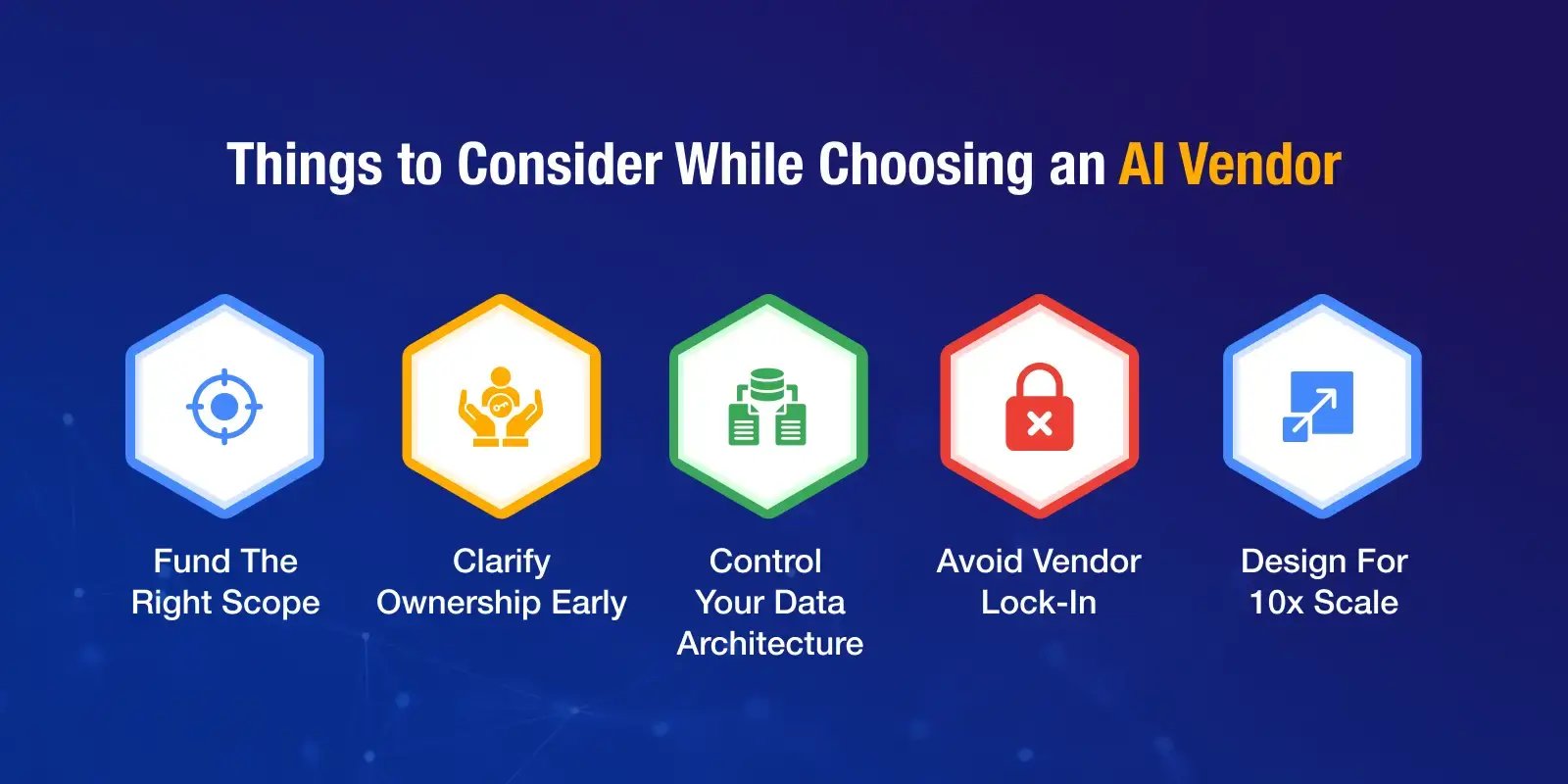
Start With Budget
Many teams ask: What does AI cost? That’s the wrong framing.
A better question is:
Rough expectations still help:
| Stage | Typical Investment | What Actually Happens |
|---|---|---|
| Exploration | $10K–$40K | Proof a problem is solvable |
| Operational system | $50K–$250K | AI joins real workflows |
| Enterprise automation | $250K+ | Cross-department coordination changes |
If a vendor promises enterprise automation at pilot pricing, they are either misunderstanding the scope, or postponing difficult integration work.
Decide: Extension of Your Team or Replacement for Missing Capability?
Many organizations debate outsourcing versus building internally. But the real difference is responsibility ownership.
Outsource when you hear internal conversations like:
- “We know the problem but not the architecture.”
- “Integration complexity keeps blocking progress.”
- “We need this running before we can hire a team.”
- AI is your product
- You expect continuous experimentation
- You already employ ML leadership capable of model governance
Security and Data Control
Ownership
Six months into deployment, leadership often realizes they don’t actually own the intelligence layer.
- Do we own trained models?
- Can we migrate providers later?
- What breaks if we stop working together?
The Scaling Conversation That Reveals Everything
Before signing, ask one uncomfortable question:
When usage grows 10x, what fails first?
In a Nutshell
Most AI initiatives fail for predictable reasons: disconnected data, unclear ownership, and unrealistic expectations of automation replacing process design.
A good AI development partner doesn’t start with a model. They start with how work currently happens, and where friction accumulates.
FAQs
Most operational AI projects range from $50,000 to $250,000 depending on integrations and data readiness.
A usable internal system typically takes 3–6 months. Enterprise-wide automation often exceeds 9 months.
Operations-heavy sectors: logistics, finance, healthcare administration, real estate operations, and SaaS platforms.
Consulting defines the plan. Development embeds AI into daily workflows and systems.
Yes, if AI affects core product value. Otherwise, start with narrow use cases.

Tech.us is an AI development company that builds custom AI solutions for businesses seeking measurable results. We partner with organizations to design, develop, and deploy scalable AI systems that solve complex challenges and unlock new opportunities for growth. Our team delivers practical AI applications that create tangible business impact across industries.