Key Findings
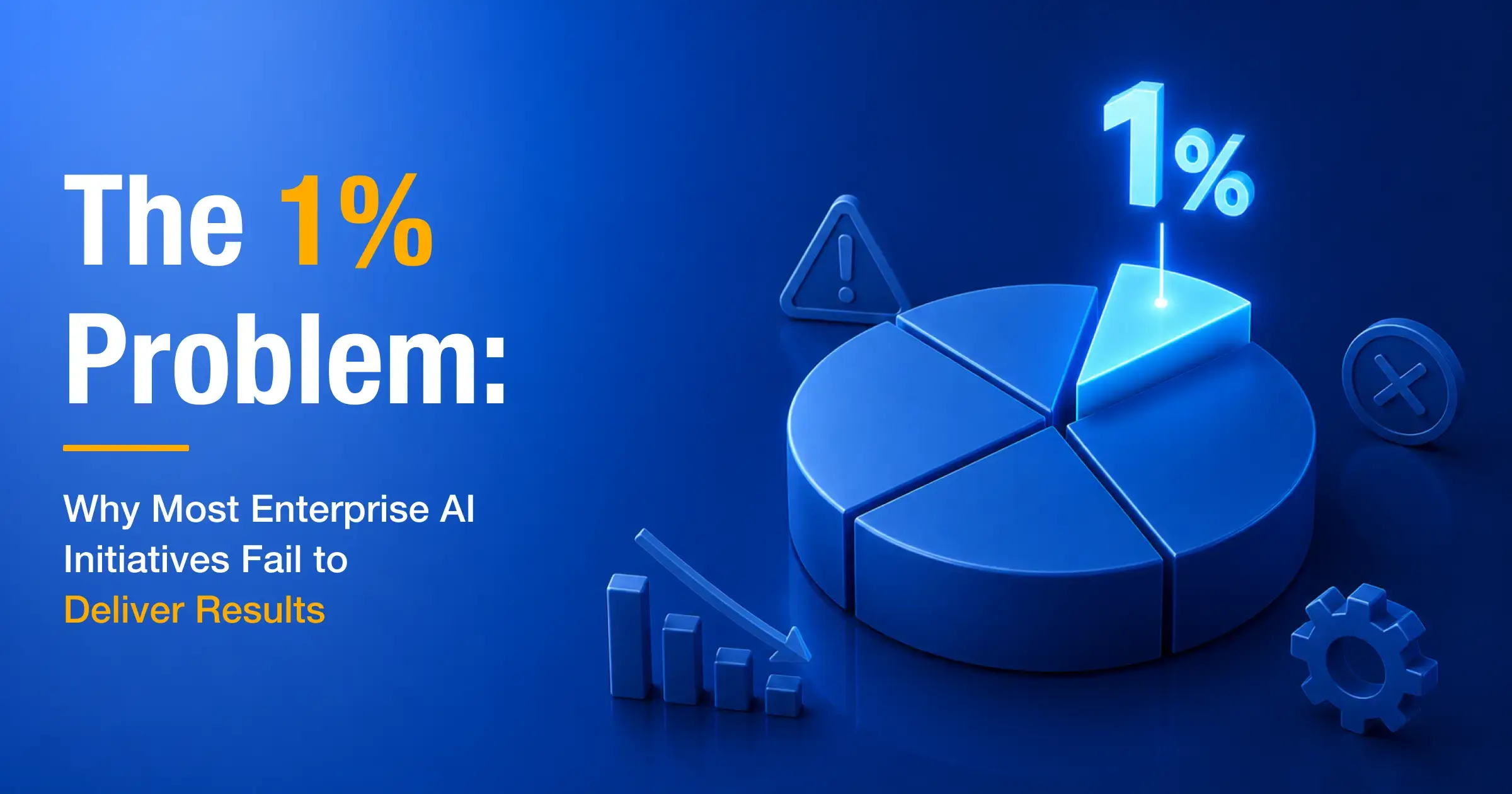
- Only 1% of enterprises have achieved AI maturity.
- 95% of AI pilots deliver zero measurable P&L impact.
- The failure is structural, not technological.
- JPMorgan's approach offers a replicable structural model.
- Operational groundwork always comes before tool selection.
Why is Enterprise AI Transformation Failing Despite Massive Investment?
Most companies aren't behind on AI. They're ahead on the wrong thing.
The investments are real. The announcements are real. The internal Slack channels called #ai-taskforce are very real. What isn't real yet is the part that actually matters.
In decisions made faster. In costs that quietly stopped compounding. In the kind of results that make a competitor suddenly look like they're operating in a different decade.
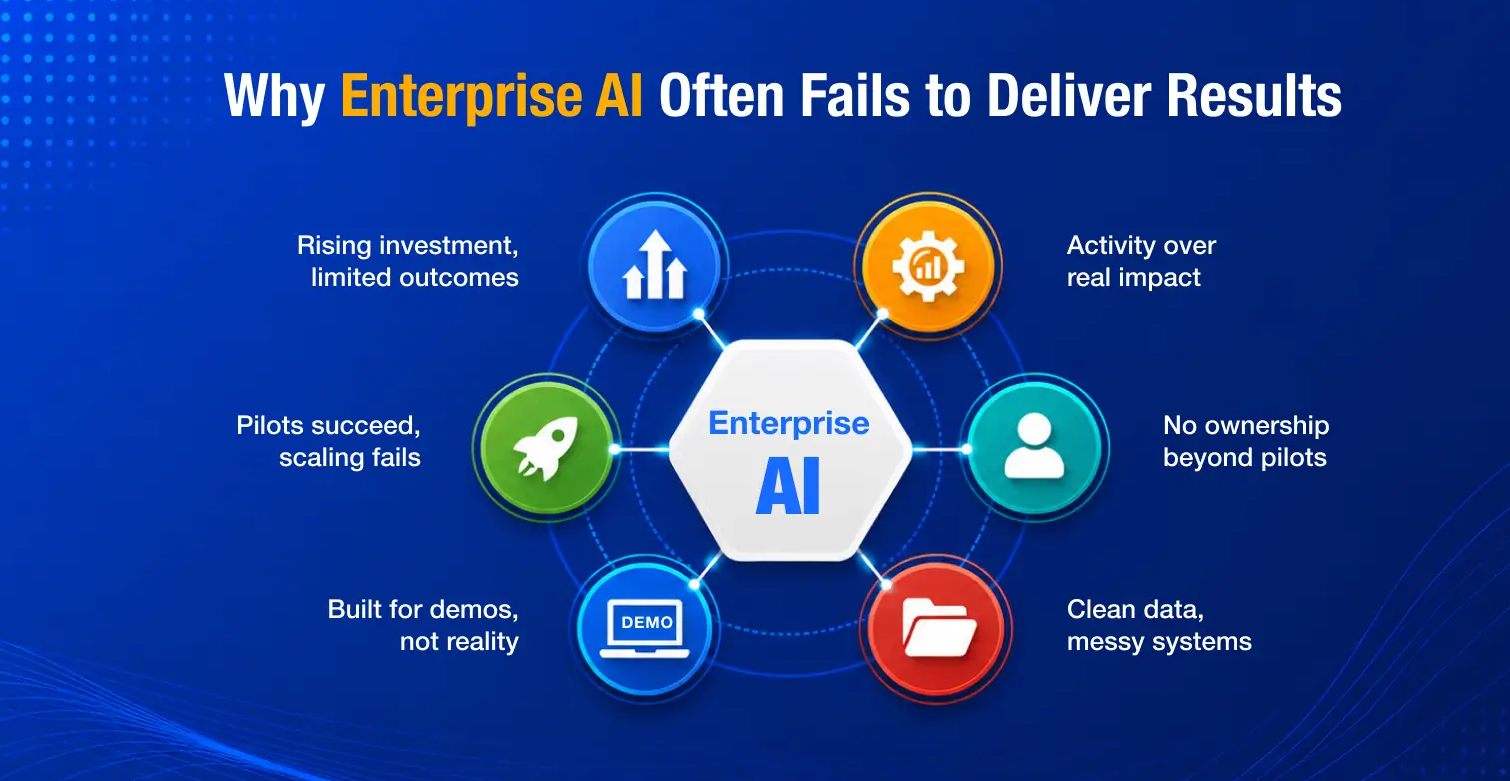
They have pilots. Pilots that worked in the demo, impressed the steering committee, and then met the real world with its fragmented data, its legacy systems, its middle managers who weren't consulted, and quietly stalled.
The pilot gets extended, a new vendor gets evaluated, another proof-of-concept gets greenlit, and somewhere in all of that motion the original problem quietly stops being anyone's priority.
Meanwhile, the gap widens.
McKinsey's research puts a number on it that should stop any executive mid-sentence: nearly 90% of companies have invested in AI, yet fewer than 40% report any measurable gain.
Think about what that means. The majority of enterprise AI spending right now is generating activity, not outcomes.
What most organizations have is not transformation. It is the blueprint of transformation, framed and mounted on the wall, while the actual building never broke ground.
The uncomfortable question this raises, the one most strategy sessions quietly avoid, isn't "are we moving fast enough?" It's something considerably more unsettling: what if the thing we're building was never designed to work in the first place?
Why Enterprise AI Pilots Keep Failing
You've probably been in that meeting.
And the numbers show exactly what happens when organizations keep confusing the two. Concentrix and Everest Group studied more than 450 enterprises and found that half of large companies are stuck in what the researchers called the "pilot plateau," most projects never make it past testing, and 77% of companies have scaled fewer than 40% of their AI pilots enterprise-wide.
What Do the 1% of AI-Mature Companies Actually Do Differently?
What data says about AI maturity in enterprises
One percent of companies broadly, including the large, well-resourced, seriously-intentioned enterprises that have been pouring money into AI services and infrastructure for the better part of three years.
According to McKinsey's January 2025 report, just 1% of leaders describe their organizations as AI-mature, meaning AI is fully integrated into workflows and driving substantial business outcomes.
The question the 1% asked first
So what did the 1% do differently?
The instinct is to look at what tools they used, what models they chose, what AI development companies they partnered with. But that's looking at the surface of the thing.
Jamie Dimon, whose bank sits firmly in that 1%, put it plainly in his 2025 annual shareholder letter: "AI will affect virtually every function, application, and process in the company. And in the long run, it will have a huge positive impact on productivity" (excerpts from: JPMorgan Chase Annual Report, 2025).
Proof at Scale: What JPMorgan Actually Built
A 227-year-old company with a startup's urgency
JPMorgan Chase is not a company that stumbled into financial services. It is a 227-year-old bank operating inside one of the most heavily regulated industries on earth, with over 300,000 employees, legacy infrastructure going back decades, and a compliance function that could give most CIOs a recurring nightmare.
If any organization had a legitimate excuse to stay stuck in pilot mode, it was this one.
- Standardize data collection across departments, and yes, the AI data preparation budget for this alone surprises most teams
- Document processes that currently exist informally
- Resolve inconsistencies in reporting structures and naming conventions
- Clarify ownership and accountability before automation touches it
Why infrastructure is the foundation of scalable AI systems
JPMorgan didn't start by asking which AI tools to buy. They started by asking what the business actually needed to run better, and then built the infrastructure that would let AI plug into those specific places.
They created internal platforms, including generative AI platforms, not as experiments but as foundational systems designed from day one to scale across the entire organization.
What compounding actually looks like
Today, more than 200,000 JPMorgan employees use the LLM Suite (the platform they built) daily. The COiN platform handles what used to require 360,000 hours of legal work every year, reduced now to something that happens in the background without anyone thinking about it.
AI-driven tools lifted gross sales in Asset and Wealth Management by 20%. The firm estimates between $1.5 and $2 billion in annual business value generated from its AI infrastructure, a number that keeps growing as the system absorbs more of the organization's daily operations (Source: JPMorgan Chase Annual Report, 2025).
They didn't get here because they had advantages nobody else has. They got here because they made a specific architectural decision early: The real benefits of AI for business only show up when that foundational layer exists.
Why businesses should focus on operational problems before AI tools
Most organizations choose the technology first and then hunt for somewhere useful to put it. You buy the tool, then figure out the problem it solves. It feels logical because that's how most software procurement works.
But AI isn't most software.
That map becomes the blueprint. The technology comes after. One approach builds a road to somewhere meaningful. The other lays asphalt in a parking lot and hopes traffic shows up.
How you build AI systems that continuously learn and improve
A pilot gets deployed and then essentially freezes. The model is what it is. The workflow is what it is. You measure it, report on it, and move on to the next initiative.
That's not a feature. That's a different kind of organization.
Why deep AI integration is more effective than broad implementation
This is where most implementations quietly fail without anyone naming exactly why.
A powerful model dropped into a generic workflow produces generic results. Impressive in a demo. Forgettable in production.
What actually moves the needle is AI software development done with a specific business in mind. Where your data lives. What it means in context. Where the real friction is hiding underneath the surface of what people report in status updates.
That's the work companies like Tech.us do with enterprise clients across industries through end-to-end enterprise AI services, starting from the structure of the business itself rather than the feature list of a platform, and building a custom AI development process that is specific enough to actually become load-bearing over time.
How to Move Enterprise AI Beyond the Pilot Stage
Let's make this practical.
You don't need a bigger budget or a new vendor shortlist. You need one honest conversation inside your organization, starting with a single question.
Is your AI load-bearing yet?
If it stopped tomorrow, would something important actually break? That answer tells you more than any pilot metric ever could.
Here's what moving toward that looks like:
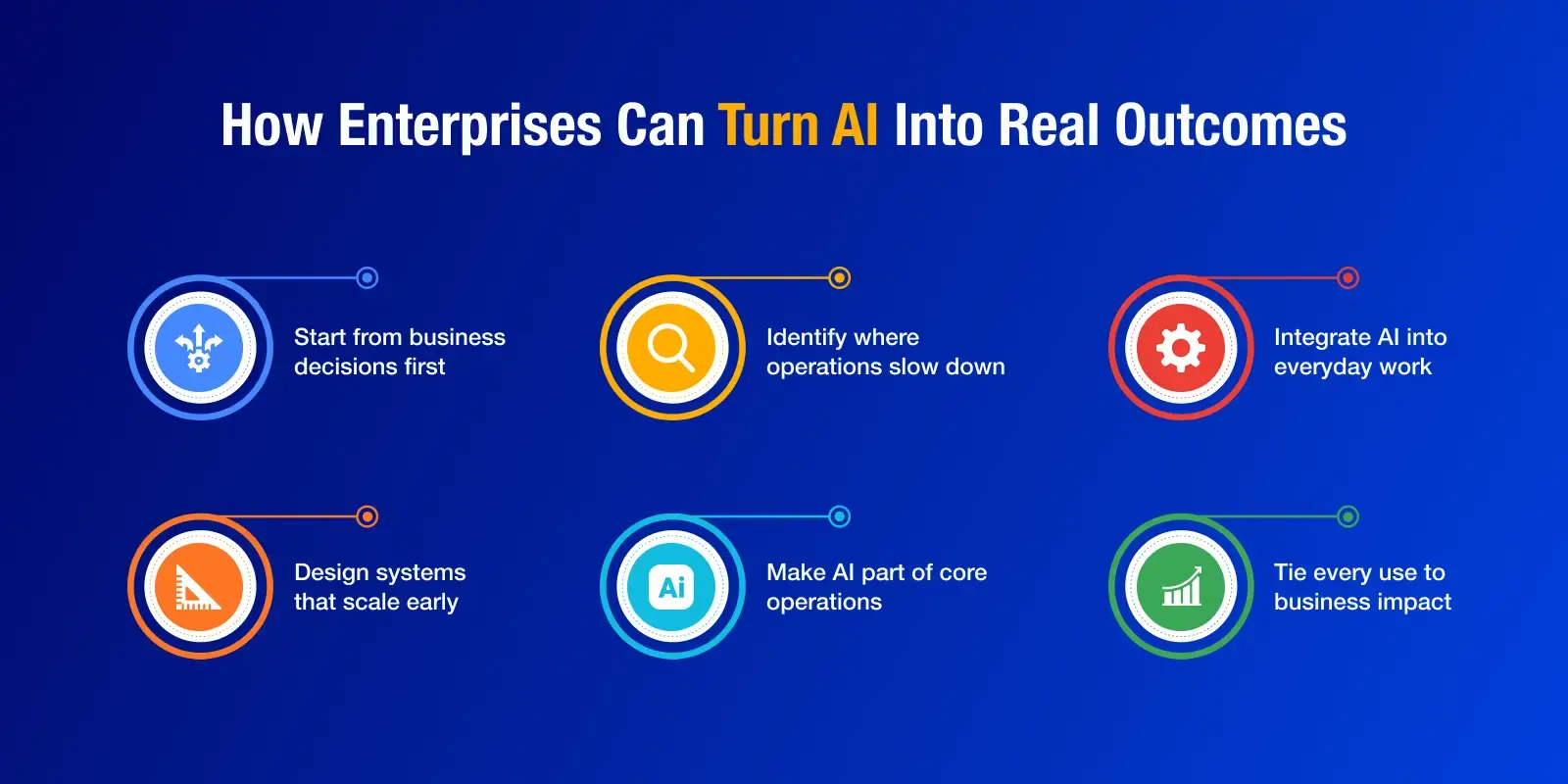
- Stop evaluating tools before mapping the operational terrain first
- Go deep on one workflow before going wide across many
- Build feedback mechanisms in before deployment, not after
- Audit the architecture underneath before launching the next initiative
- Measure business outcomes, not model accuracy
The window is open. The question is simply whether you walk through it before your competitors do.
FAQs
Because pilots are built to succeed in controlled conditions, not to survive real ones. They usually run on clean data and often get measured on accuracy rather than usual business outcomes, which means everything that makes them work in a demo is exactly what makes them fail in production.
Sequence. AI-mature companies map their operational terrain first and choose technology second. Everyone else does it the other way around, which is why they keep building pilots that impress in rooms and stall everywhere else.
Audit where decisions are slow, where data is unreliable, and where smart people are doing work that shouldn't need them. That map is your real brief. Any tool evaluation that happens before that conversation is premature.
MIT's research found that top-performing companies moved from pilot to full implementation in roughly 90 days, not because they moved fast, but because they did the operational groundwork before the pilot launched rather than after it stalled.
AI maturity is the point where AI stops being something your organization uses and becomes something it runs on, which is embedded in core workflows that generate measurable business outcomes.
The simplest way to measure it is by answering this: if your AI went offline tomorrow, would the business actually feel it?

Tech.us is an AI development company that builds custom AI solutions for businesses seeking measurable results. We partner with organizations to design, develop, and deploy scalable AI systems that solve complex challenges and unlock new opportunities for growth. Our team delivers practical AI applications that create tangible business impact across industries.

Continue reading the blog
with a Tech.us subscription
You’re now subscribed!