Why Choosing the Right AI Partner Is a High-Stakes Decision
AI is no longer a side experiment. It is shaping how businesses operate, compete, and grow. From LLM-powered applications to RAG-based AI systems, companies are moving fast. The question is simple. Are you moving with the right partner?
Why is AI adoption no longer optional for businesses in 2025?
Customers expect speed, personalization, and smarter experiences. Competitors are already investing in enterprise AI solutions and AI deployment services at scale. If your business delays, you risk falling behind. AI today drives real outcomes like faster decisions, better customer insights, and improved efficiency.
What happens when you choose the wrong AI development partner?
This is where things get expensive.
- Misaligned solutions that do not solve real business problems
- Poor AI integration with existing systems
- Rising costs with no clear ROI
- Weak AI model optimization and monitoring
What does the right AI partner actually mean?
A strong AI development partner focuses on business-aligned AI solutions. They think beyond models. They look at outcomes, scalability, and long-term value. That is what drives ROI-driven AI implementation.
What Should You Evaluate Before Shortlisting an AI Development Partner?
Jumping straight into vendor comparisons? That is where most teams go wrong. Before you even speak to an AI development company, you need clarity on your side. Otherwise, every pitch will sound good. But will it solve your problem?
Let’s break this down.
What are your business goals for AI?
Start here. What do you really want from AI?
Is it faster operations? Better customer experience? New revenue streams?
Be specific. Vague goals lead to vague outcomes.
- Do we want efficiency gains or revenue growth?
- Are we trying to reduce manual work or improve decision-making?
- What does success look like in numbers?
Are you solving a real problem or just exploring AI?
This is a tough one. Many teams explore AI because it feels urgent. But urgency without direction leads to wasted budgets.
- What exact problem are we solving?
- Is this problem frequent and costly?
- Can AI realistically improve it?
- Repetitive manual processes
- Slow customer response times
- Data that no one is using effectively
Do you need a vendor, consultant, or long-term partner?
Not every company needs the same kind of support.
Here is a simple way to think about it:
| Need | What You Should Look For |
|---|---|
| Quick execution | AI outsourcing company |
| Strategy and planning | AI consulting services |
| End-to-end ownership | Custom AI development company |
The 7 Key Criteria for Selecting the Best AI Development Partner
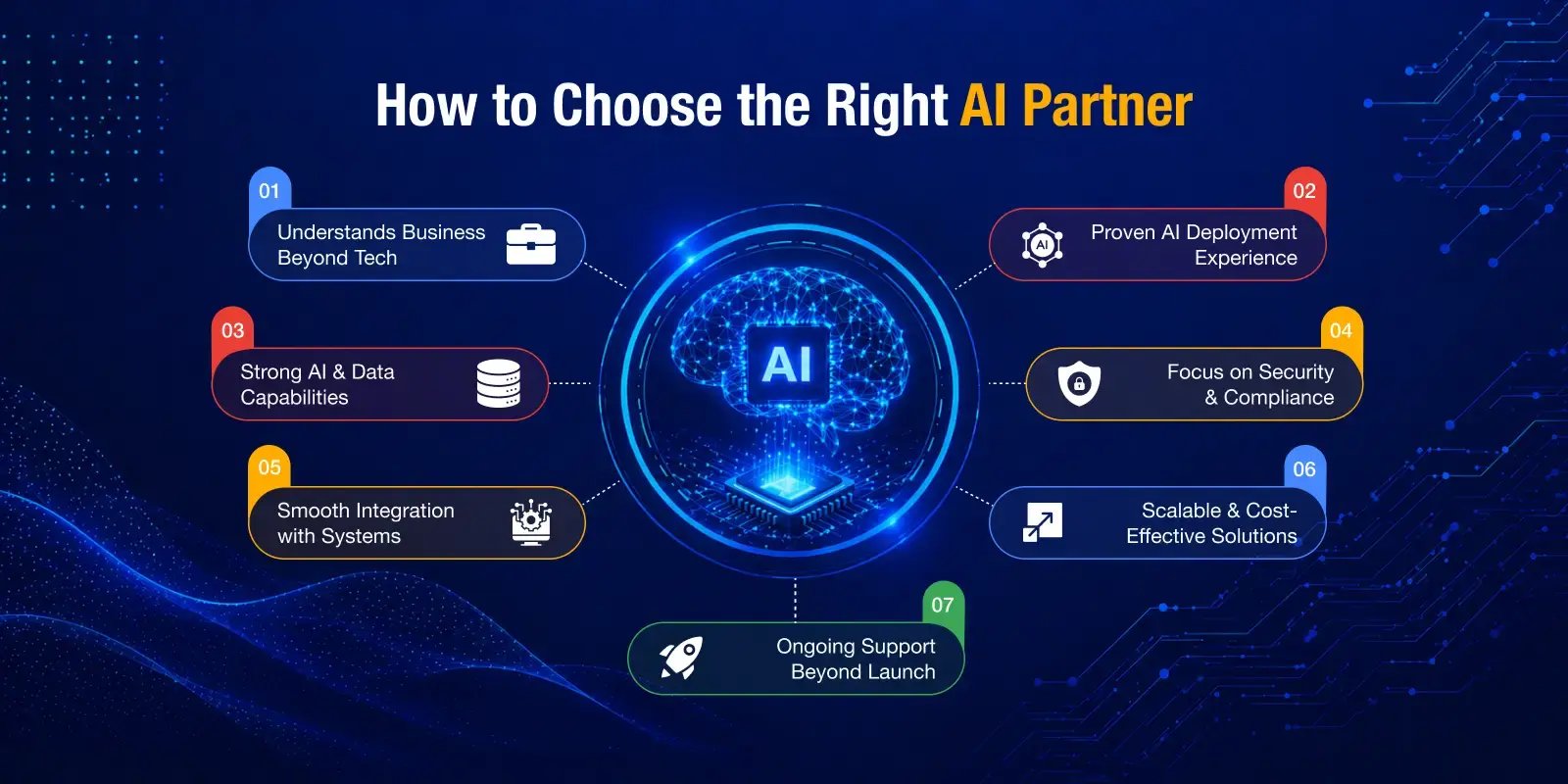
Here are seven key criteria you should consider while choosing the best AI development vendor who will help improve your business.
1. Does the AI Partner Understand Your Business, Not Just Technology?
A lot of AI vendors sound impressive. They talk about models, frameworks, and tools. But here is the real question. Do they understand your business?
Can they take your problem and translate it into a working AI solution? Or are they just suggesting generic use cases?
- Are they talking about your KPIs or just algorithms?
- Do they understand your industry challenges?
- Are they asking deep questions about your data and processes?
Key things to look for:
- Clear mapping from problem to solution
- Industry-specific experience
- Focus on outcomes, not just features
- Ability to define success metrics
If your partner cannot explain how AI will impact your business in simple terms, they are not the right fit.
2. Do They Have Proven Experience with Real-World AI Deployments?
Anyone can build a demo. That is easy. The real test? Can they deploy AI in real business environments?
A reliable AI software development company will show proof. Not just concepts. Not just prototypes. Real deployments with measurable results.
Think about this. Have they helped companies reduce costs? Improve efficiency? Increase revenue?
Also, ask about scale. Have they handled AI deployment at scale? Or are they still experimenting?
- Case studies with clear business outcomes
- Experience beyond pilot projects
- Ability to handle production-level deployments
- Exposure to multiple industries
- What results did your last project deliver?
- How did you measure success?
- What challenges did you face during deployment?
Execution matters more than ideas. A partner with real-world experience reduces your risk significantly.
3. How Strong Is Their AI & Data Engineering Capability?
Do they work with modern technologies like LLM-powered applications or RAG-based AI systems? Can they build a scalable AI architecture that grows with your needs?
- Expertise in data pipelines and MLOps
- Experience with modern AI stacks
- Strong focus on scalability and performance
- Ability to deliver end-to-end AI development
- How do you handle large-scale data processing?
- How do you ensure model accuracy over time?
- What tools and frameworks do you use?
4. Do They Prioritize Data Security, Compliance, and Governance?
AI runs on data. And data comes with risk.
- Compliance with GDPR, HIPAA, SOC 2
- Strong data governance practices
- Secure data handling and storage
- Options for private or hybrid models
- How do you protect sensitive data?
- Where is the data stored and processed?
- Do you offer custom or private AI models?
5. Can They Integrate AI Seamlessly into Your Existing Systems?
- Experience with legacy system integration
- Ability to connect with multiple platforms
- Focus on usability and workflows
- Minimal disruption during implementation
- Have you worked with similar systems before?
- How long does integration usually take?
- What challenges should we expect?
AI creates value only when it works within your ecosystem.
6. Do They Offer Scalable and Cost-Efficient AI Solutions?
A smart AI outsourcing company focuses on ROI-driven AI implementation. They balance performance with cost.
Key things to look for:
- Scalable infrastructure design
- Cost optimization strategies
- Flexible engagement models
- Transparent pricing
- How do you control AI infrastructure costs?
- What happens when usage increases?
- Can we scale without major rework?
7. Will They Support You Beyond Deployment?
AI is not a one-time project. It evolves.
Models degrade. Data changes. Business needs shift.
- Ongoing AI model optimization and monitoring
- Support for model updates and retraining
- Clear post-deployment roadmap
- Long-term partnership mindset
- How do you handle model drift?
- What kind of support do you provide after launch?
- How often do you optimize models?
How to Evaluate and Compare AI Development Companies
You have a shortlist. A few strong-looking vendors. Great presentations. Confident pitches.
Now what?
This is where most decisions go wrong. Teams rely on gut feeling. Or they pick the most popular AI development company. But AI is not a branding exercise. It is a long-term investment.
A Practical AI Partner Evaluation Checklist
Use this as your go-to framework. It is simple, but powerful.
| Criteria | Questions to Ask | Why It Matters |
|---|---|---|
| Business Understanding | Can they connect AI to your KPIs? | Drives ROI-driven AI implementation |
| Experience | Do they have real case studies with results? | Reduces execution risk |
| Tech Capability | Do they work with modern AI stacks like LLMs and RAG? | Ensures future-ready solutions |
| Security | How do they handle data security and AI compliance? | Protects sensitive data |
| Integration | Can they support AI integration with existing systems? | Ensures real-world usability |
| Scalability | Can they build scalable AI architecture? | Supports long-term growth |
| Support | Do they offer AI lifecycle management and optimization? | Keeps systems relevant over time |
Build vs Buy vs Partner: What’s the Right Approach for Your Business?
Should you build AI capabilities in-house?
- Do we have strong AI and data engineering talent?
- Can we build and maintain enterprise-grade AI systems?
- Are we ready to invest long-term?
When does outsourcing AI development make sense?
You skip hiring delays. You get access to proven frameworks. You move faster toward AI deployment at scale.
- You need quick execution
- Your internal team lacks AI expertise
- You want predictable costs
How does a hybrid AI model approach work?
- Internal team drives business context
- External partner delivers end-to-end AI development
- Both collaborate on AI model optimization and monitoring
FAQs
Choose a partner that shows real results, understands your business goals, and can deliver scalable, ROI-driven AI solutions.
- Strong business understanding
- Proven deployment experience
- Clear approach to scalability, integration, and security
Costs vary widely based on complexity, but most AI projects range from a few thousand dollars for pilots to large investments for enterprise-grade AI systems.
Industries like healthcare, finance, retail, manufacturing, and logistics see major gains from automation, predictive insights, and improved customer experiences.
Outsource for speed and expertise. Build in-house if AI is core to your business and you have strong technical capabilities.
- Poor solution fit
- Wasted budget with no clear ROI
- Security and compliance gaps
- Projects that never move beyond pilot stage
Tech.us is an AI development company that builds custom AI solutions for businesses seeking measurable results. We partner with organizations to design, develop, and deploy scalable AI systems that solve complex challenges and unlock new opportunities for growth. Our team delivers practical AI applications that create tangible business impact across industries.

Continue reading the blog
with a Tech.us subscription
You’re now subscribed!