Every organization is either building AI into their products and operations or actively planning to. And yet, one of the most searched questions in 2026 is still: how much does this actually cost?
The truth is, custom AI development pricing is not a number. It's a function of what you're building, what data you have, who builds it, where they're located, and how production-ready the output needs to be.

What Type of AI Solution Are You Building?
Different AI solution types carry fundamentally different levels of complexity, data requirements, and engineering effort. Knowing your category is the first step toward a realistic budget.
- AI chatbots and virtual assistants: Simple FAQ bots sit at the lower end. Context-aware enterprise copilots with memory and multi-system integrations sit much higher.
- Generative AI and LLM-powered apps: Cost scales with how much custom orchestration, RAG pipeline setup, and prompt engineering is involved.
- Predictive models and recommendation engines: Classic machine learning. Heavily dependent on data volume and quality.
- Computer vision and NLP systems: Specialized training data and higher compute requirements push these toward the higher end of the cost spectrum.
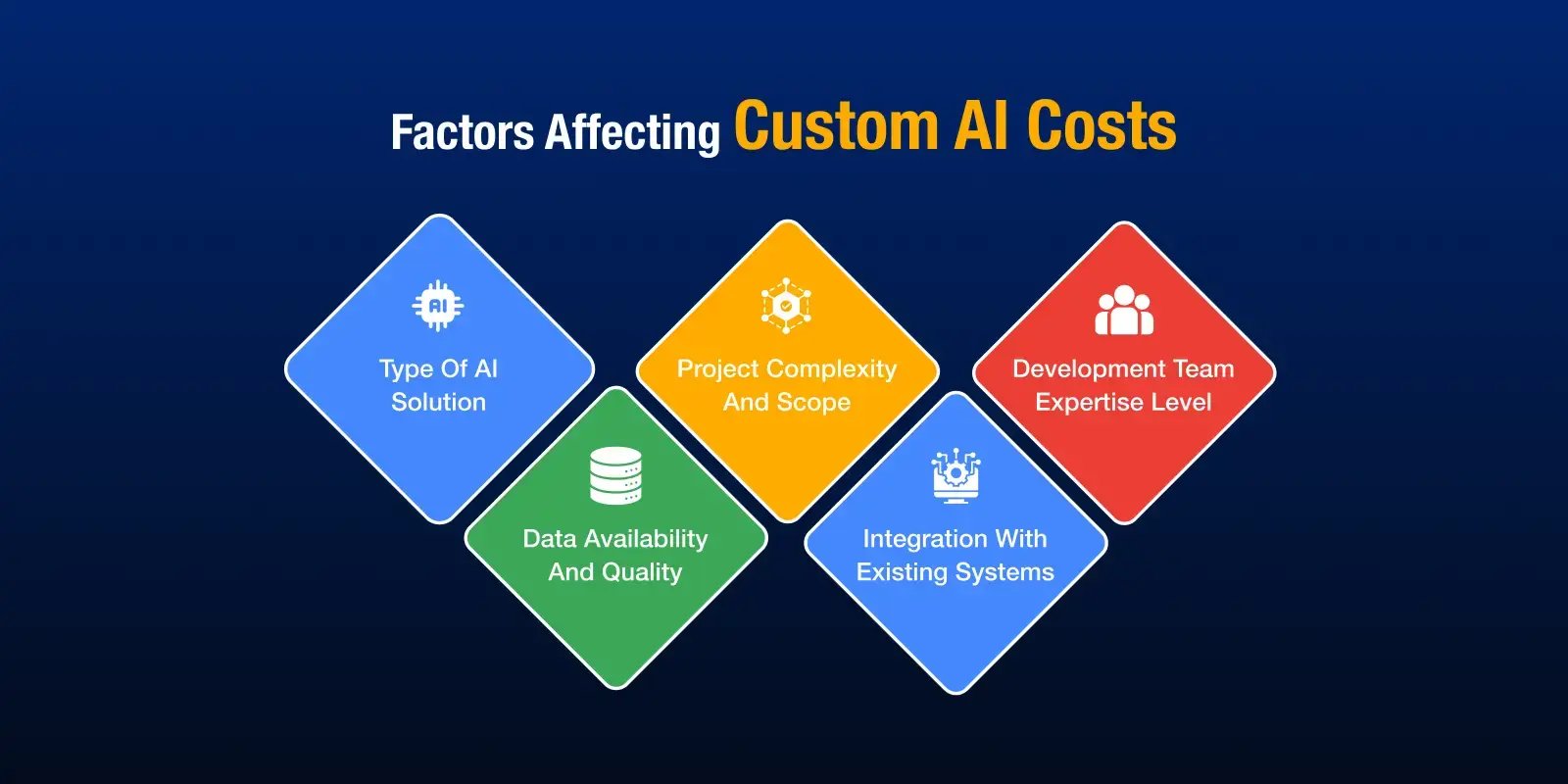
Before any vendor gives you a number, they need answers to questions most buyers haven't fully thought through yet. The cost of custom AI development depends on several factors that interact in ways that aren't always obvious upfront.
Here's where the real variables live.
Does Data Availability Affect AI Development Cost?
It does, and it's one of the most overlooked cost drivers in AI projects.
- Data collection and sourcing pipelines
- Labeling and annotation for supervised training
- Cleaning and normalization across sources
- Data infrastructure and governance setup
How Does Project Complexity Drive the Price?
- Tier 1: Proof of Concept: Validates whether the AI approach works for your use case. Limited scope, minimal integrations, focused on learning rather than production deployment.
- Tier 2: Production-Ready Application: A system real users interact with. Introduces reliability requirements, evaluation frameworks, and integrations that a POC doesn't need.
- Tier 3: Enterprise-Grade System: Custom AI at scale, with compliance, multi-system integrations, audit logging, and a long-term MLOps plan. The total cost of ownership here extends well beyond initial development.
How Much Does an AI Chatbot or Virtual Assistant Cost to Build?
How Much Does an AI Chatbot or Virtual Assistant Cost to Build?
- Basic rule-based chatbots: FAQ handling, simple routing, ticket deflection. Lower complexity, faster to build, minimal integration requirements.
- NLP-powered AI chatbots: Handle context, varied phrasing, and moderate conversation flows. Mid-range investment that scales with how deeply they connect to your systems. See how AI chatbots are transforming business operations.
- Enterprise agentic AI systems: Built on LLMs, capable of multi-step reasoning, tool use, and autonomous task execution across your tech stack. The highest investment tier in conversational AI.
How compliance requirements affect AI chatbot development cost
What Is the Cost of Building a Custom Machine Learning Model?
- Data readiness: The single biggest variable, and the one most organizations discover too late. Gartner predicts that through 2026, organizations will abandon 60 percent of AI projects unsupported by AI-ready data. This is seldom a technology failure but a data infrastructure problem that shows up as a budget overrun.
- Model type and architecture: Classical ML models are less resource-intensive than deep learning systems, which require substantial GPU compute for training. Understand how AI models learn.
- MLOps and ongoing maintenance: Production models drift. Most production ML models require retraining quarterly or more frequently, with each retraining cycle costing between $5,000 and $20,000 depending on data volume and complexity, according to Inventiple.
How Much Does Generative AI or LLM Integration Cost?
This is where buyers often get a pleasant surprise on one line item and an unpleasant one on another.
- Prompt engineering and evaluation: Getting an LLM to perform reliably in production is significantly more work than a demo suggests.
- RAG pipeline development: Connecting the model to your proprietary data through retrieval architecture adds meaningful scope.
- Inference costs at scale: This is the line item most budgets miss entirely. A production AI system processing 100,000 daily customer support queries can cost between $15,000 and $20,000 per month in API costs alone as per ProductCrafters.
What Does a Computer Vision or NLP Solution Typically Cost?
What Engagement Model Should You Choose, and How Does It Affect Cost?
Is a Fixed-Price Project Model Right for Your AI Build?
When Does a Dedicated AI Development Team Make More Sense?
What Is the Cost Difference Between In-House AI Development vs. Outsourcing?
| Fixed-Price | Dedicated Team | In-House | |
|---|---|---|---|
| Best for | Scoped POCs and MVPs | Ongoing, complex builds | Long-term AI programs |
| Budget predictability | High | Medium | Low (variable) |
| Flexibility | Low | High | High |
| Time to start | Fast | Fast | Slow (3–6 months recruiting) |
| Risk premium built in | Yes (20–30%) | No | No |
| Year 1 cost | Lower upfront | Mid-range | Highest |
| Best ROI timeline | Short-term | 12–24 months | 36-plus months |
| Scales with AI growth | Limited | Yes | Yes |
How Does Location Affect AI Development Rates in 2026?
- Scoped POC or MVP builds: US teams reduce iteration cycles and move fast
- Long-term builds with a 12 to 24 month runway: premium rates compound quickly and can inflate total AI development cost significantly
- Regulated deployments in healthcare or financial services: onshore teams with HIPAA or SOC 2 experience are often non-negotiable
Does a Lower Rate Mean Lower Quality?
What Hidden Costs Should You Plan for in an AI Development Budget?
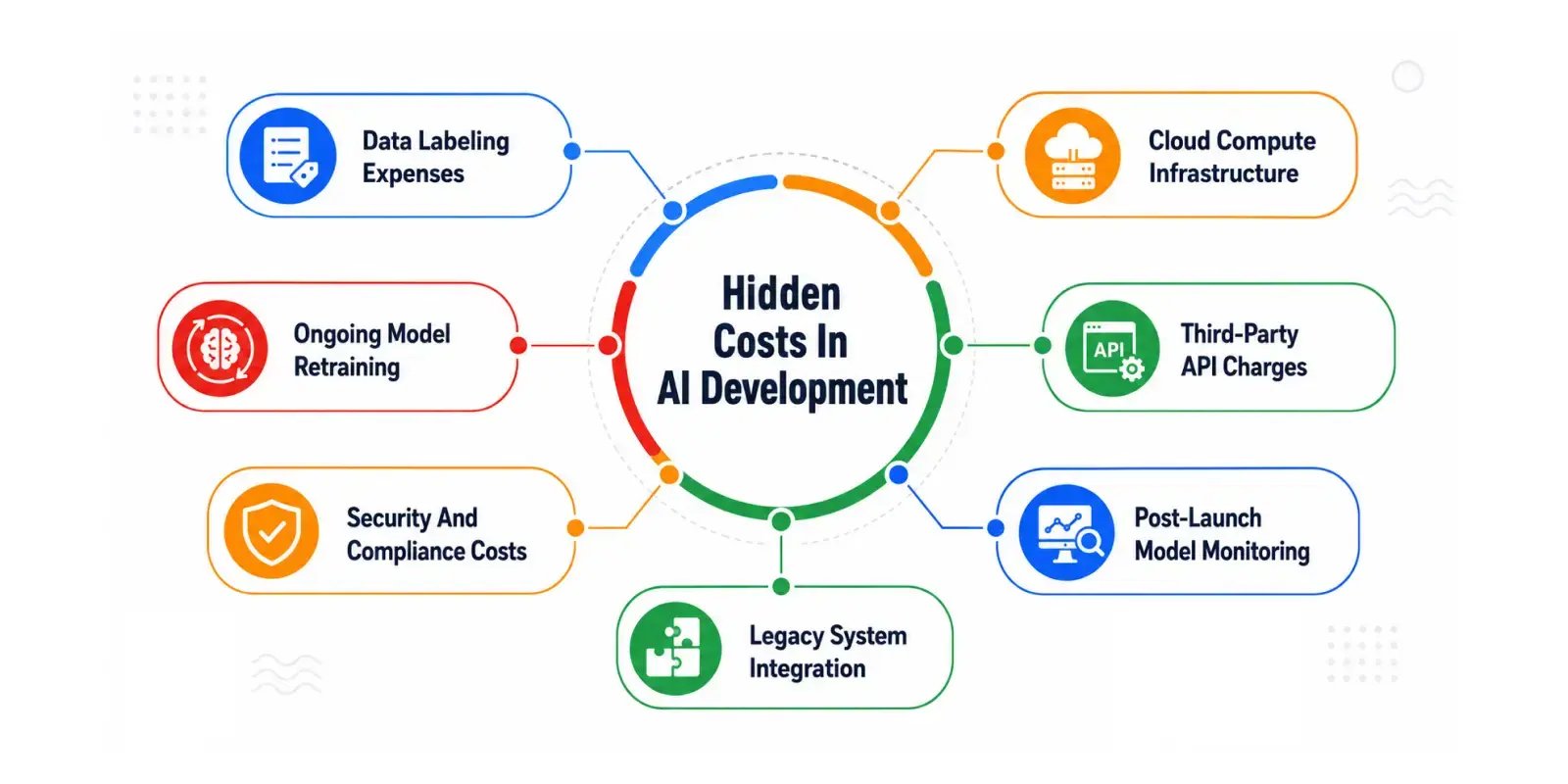
Every AI development project has two budgets. The first one is the one you plan for. The second one is the one that surprises you six months in.
The total cost of ownership for a custom AI system extends well beyond development. The buyers who understand this upfront make better decisions and hit fewer walls mid-build. The ones who don't end up revising their numbers at the worst possible time.
- Human-in-the-loop annotation for supervised training datasets adds cost before a single model gets trained
- Complex domains like healthcare or legal drive annotation costs significantly higher
- AWS, Azure, and GCP costs for model training and inference scale faster than most teams expect
- GPU compute during training is a one-time spike; inference costs are recurring and grow with usage
- Production models drift as real-world data patterns change
- Retraining cycles are not optional, they are a recurring line item in your operational budget
- OpenAI, Anthropic, and other API providers charge per token at inference
- High-volume production systems can accumulate significant monthly API spend that compounds year over year
- SOC 2, HIPAA, and GDPR compliance add engineering scope, legal review, and certification costs
- For regulated industries, these are non-negotiable and should be scoped from day one
- Drift detection, alerting, and performance dashboards require dedicated tooling and ongoing engineering attention
- Skipping this creates silent model degradation that shows up as business problems, not technical ones
- Connecting AI to your CRM, ERP, or legacy infrastructure often costs more than the AI build itself
- Custom middleware, API development, and data mapping all carry their own scope and timeline
A reliable AI development partner will surface these costs during scoping, not after signing. If a proposal does not account for the second budget, that is not a good deal. That is an incomplete estimate.
FAQs
There is no flat number as the cost of custom AI development in 2026 is a function of what you're building, how ready your data is, and who builds it. A scoping engagement will tell you more in two weeks than any price list will.
If your competitive advantage lives in your data or your workflows, off-the-shelf AI will always hit a ceiling. Custom AI development costs more upfront and owns the value long-term.
Most teams expect the model to be the expensive part. It rarely is. Data preparation — collection, labeling, and cleaning, which is where custom AI budgets actually go.
A focused MVP takes 6 to 8 weeks. A production-grade enterprise AI system takes 6 to 12 months. The longer the build, the higher the total investment, but also the more reliable the output.
Yes, if the scope is honest. Start with a proof-of-concept, validate the business value, then scale. Here is how to assess if your business is ready for AI development.
Any estimate that skips data engineering, MLOps, infrastructure, or post-launch support is not a complete estimate. It is the beginning of a budget overrun.
Vague scope and round numbers are the tell. A fair AI development quote breaks down cost by phase, names the deliverables, and does not hide the second half of the budget in fine print. Here is what to look for in a reliable AI development company.

Tech.us is an AI development company that builds custom AI solutions for businesses seeking measurable results. We partner with organizations to design, develop, and deploy scalable AI systems that solve complex challenges and unlock new opportunities for growth. Our team delivers practical AI applications that create tangible business impact across industries.

Continue reading the blog
with a Tech.us subscription
You’re now subscribed!