Key Points Covered
- The vendor quote covers the build. It does not cover what your business needs to do around it.
- Compute costs do not show up when AI fails. They show up when it succeeds and scales.
- Deploying a large model on a task a smaller one could handle is not safer. It is just more expensive every single month.
- One training session is not enough. The team that used it six months ago is not the same team using it today.
- AI does not eliminate oversight. It increases the volume of things that need to be overseen.
- Your legacy systems will not connect as cleanly as the vendor suggests. They never do.
- The gap between a working AI system and one that actually gets used is a people problem, not a technology problem.
Overview
Most businesses begin the AI conversation the same way. Someone pulls up a pricing page, compares subscription tiers, and starts estimating what the software will cost per month.
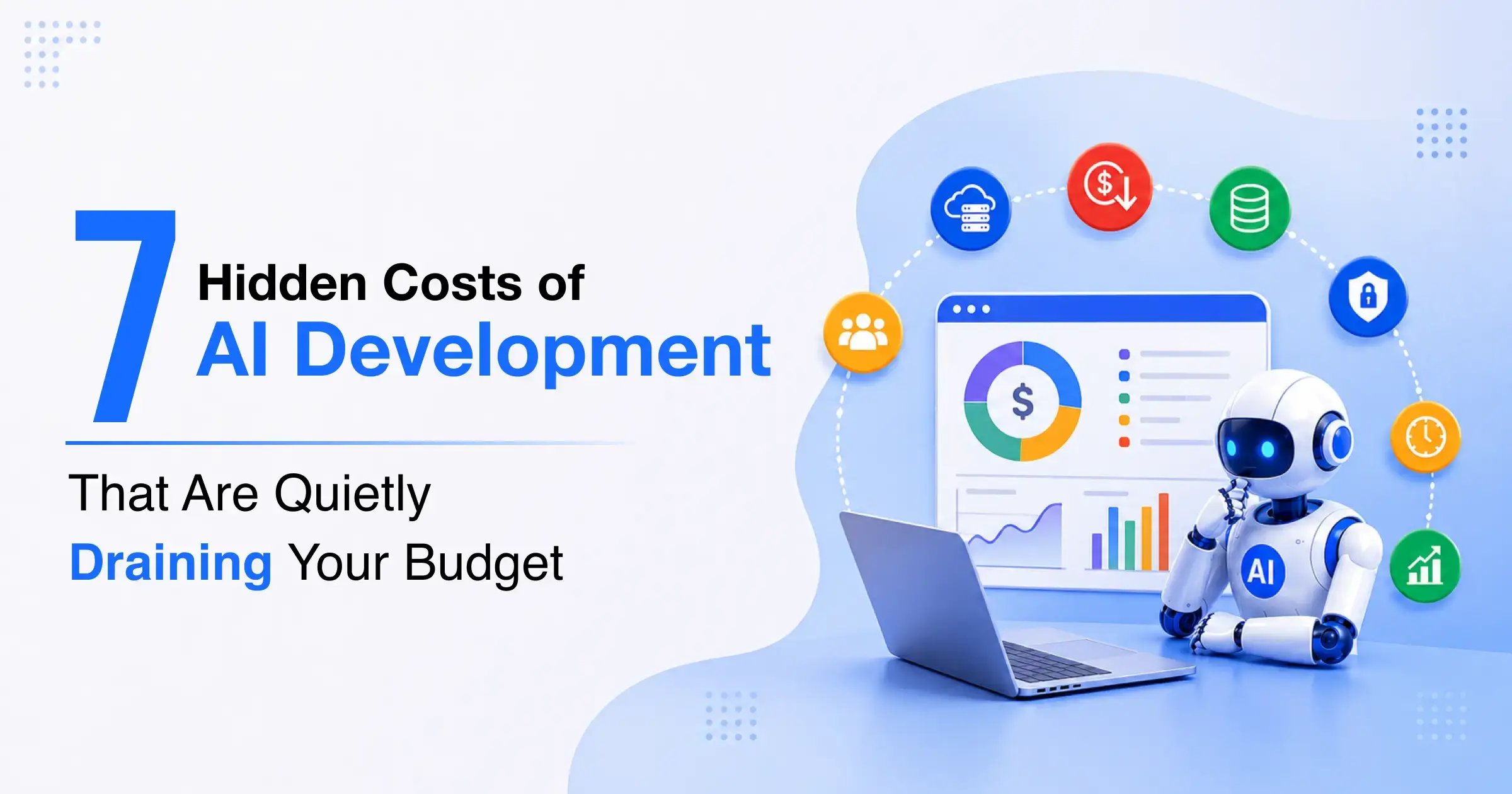
These are the hidden costs of AI development, and they are the primary reason smart, well-resourced companies end up with AI projects that stall, run over budget, or quietly get shelved.
Why Does AI Keep Costing More Than the Quote?
There is a pattern that shows up across AI projects, regardless of industry or company size. The initial budget looks reasonable. The vendor proposal is detailed. Leadership signs off. And then, somewhere between implementation and production, the numbers stop making sense.
What do most AI vendors leave out of their proposals?
A vendor's proposal covers what they are building. It rarely covers what your business needs to do around the build, the data that needs cleaning, the workflows that need restructuring, the infrastructure that needs to scale, the people who need to change how they work. Those costs belong to you, not them. And they are almost never discussed at the proposal stage.
The compute cost alone tells the story. According to IBM's Institute for Business Value, the average cost of computing is expected to climb 89 percent between 2023 and 2025, with 70 percent of executives identifying AI as the primary driver of that increase.
More telling: every executive in that study had already cancelled or postponed at least one AI initiative because of cost, not because the technology failed, but because the budget model was wrong from the start. This pattern of why enterprise AI initiatives fail to deliver results is more common than most leadership teams want to admit.
That is the gap between a quote and a real AI development cost. The quote reflects what is technically possible. The real cost reflects what is operationally required.
The 7 Hidden Costs Most Businesses Never See Coming
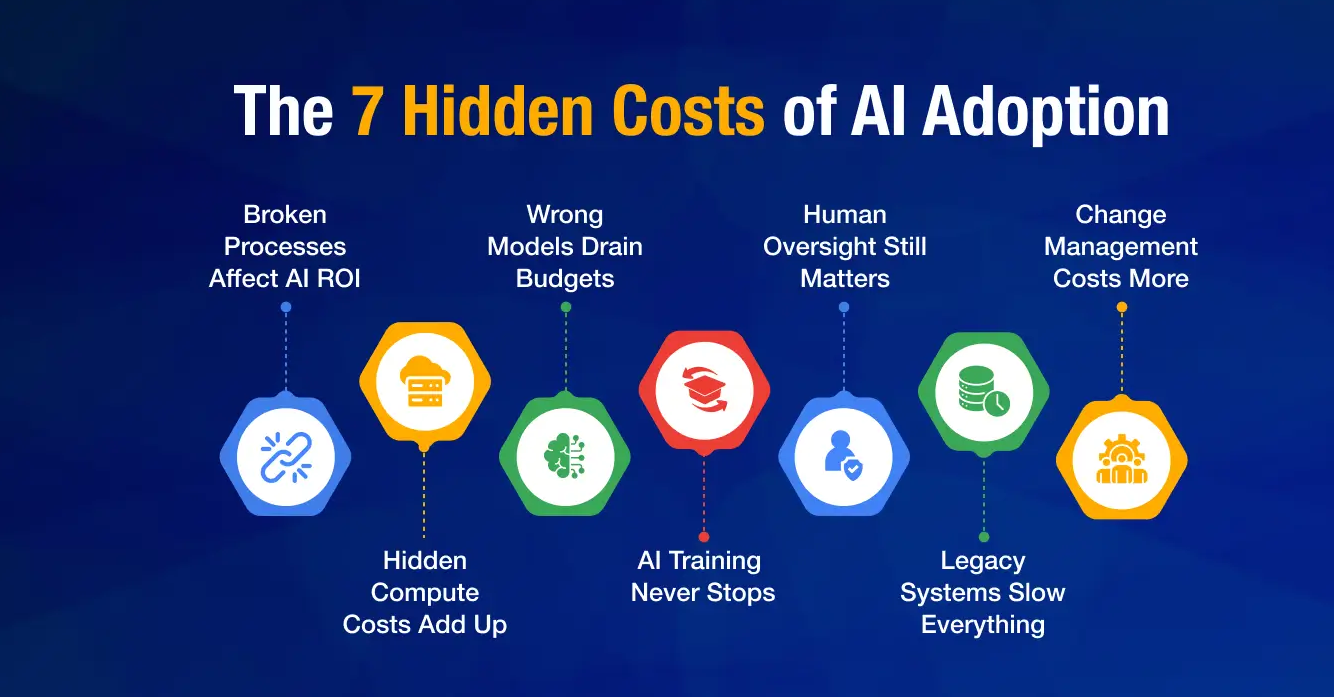
Cost #1: Your Process Has to Work Before AI Can Help It
AI does not fix a broken process. It runs on top of one. Whatever is inconsistent, undocumented, or informally held together in your current operations will not disappear once the system goes live. It will just move faster.
Is your organization ready for AI, or just ready to buy it?
Before AI can function reliably, businesses typically need to:
- Standardize data collection across departments, and yes, the AI data preparation budget for this alone surprises most teams
- Document processes that currently exist informally
- Resolve inconsistencies in reporting structures and naming conventions
- Clarify ownership and accountability before automation touches it
None of this appears in a vendor proposal. All of it costs time, internal resources, and leadership attention. And understanding what are the hidden costs of AI development for businesses starts right here, before a single model is chosen. If you are unsure where your organization stands, this guide on whether your business is ready for artificial intelligence development is a useful place to start.
Cost #2: Compute Costs That Nobody Budgeted For
Here is something that does not make it into most AI project conversations until it is already a problem. The system works. Adoption grows. More teams start using it. And then the infrastructure bill arrives.
Compute is what powers every query your AI system processes, every prediction it runs, every response it generates. In a pilot environment, those costs are manageable. In production, at real business volume, they scale in ways that catch even well-prepared teams off guard.
IBM's Institute for Business Value found that average computing costs are expected to climb 89 percent between 2023 and 2025, with AI workloads identified as the primary driver. Every executive in that study had already cancelled or postponed at least one AI initiative because of compute costs alone.
Why does AI get more expensive the moment it starts working?
Because pilot conditions are never production conditions. The data volume is different. The usage frequency is different. The infrastructure requirements are different. What looked affordable at the testing stage looks very different when the system is handling actual business operations at scale.
"The bill that surprises most businesses is not the one that arrives when AI fails. It is the one that arrives when AI succeeds."
Cost #3: Picking the Wrong Model Costs You Twice
There is a default decision most businesses make without realizing it is a decision at all. When in doubt, use the most powerful model available. It feels like the safe choice. More capability, more coverage, fewer risks.
Large language models are extraordinary tools. They are also extraordinarily expensive to run at scale, and they are routinely deployed on tasks that a smaller, well-trained model could handle at a fraction of the cost. The difference does not show up in the demo. It shows up in the monthly infrastructure bill, month after month, for as long as the system runs.
This is what makes model selection a financial decision, not just a technical one. Most businesses treat it as the latter.
Does every AI use case actually need a large language model?
Usually not. A focused model trained on clean, task-specific data will often outperform a general-purpose large model on a narrow business problem and cost significantly less to operate. LLM inference costs at enterprise scale are one of the quieter drivers of AI project budget overrun, precisely because the system works fine. It just costs more than it should, every single month.
"Using a large model for everything is like hiring a specialist surgeon to take your temperature. Technically capable. Practically wasteful."
Cost #4: Training Your Team Is Never a One-Time Event
Here's something that gets underestimated every single time. You implement the tool, run a training session, and move on. Feels done. It is not.
Six months later the model has been updated, three people on the team have changed, and nobody quite remembers what the original guidance was. The tool is still running. The understanding around it is not keeping pace.
And here is the thing about AI, the quality of what comes out is directly connected to the quality of what goes in. How people prompt it. How they verify it. Whether they know when to trust it and when to push back. That does not come from a single onboarding session. It develops slowly, through regular use and regular correction.
What happens when training stops but the system keeps running?
Nothing dramatic. That is the problem. It just quietly underperforms. Outputs get accepted without scrutiny. Teams develop workarounds nobody documents. And when you factor in AI model retraining budget and MLOps costs that accumulate over time, the productivity gains that justified the investment start looking thinner than the business case promised. AI model monitoring costs are part of this too, because someone has to track whether the outputs are still reliable as the system matures.
Training for AI is not a launch cost. It is an ongoing operational one. The businesses that budget for it that way tend to get significantly more out of their AI investment than the ones that do not.
"The system does not degrade. The people running it just stop growing with it."
Cost #5: Human Oversight Does Not Disappear. It Just Changes Jobs.
There is a version of the AI story that goes like this: implement the system, reduce headcount, watch costs fall. It is a compelling narrative. It is also incomplete.
What actually happens is more nuanced. The work shifts. The volume of output increases. And someone still has to be responsible for what that output does in the real world.
Think about it this way. Before AI, one person wrote a report. It took time, but they owned it. After AI, the system produces ten reports in the same time. Faster, yes. But who is reading them? Who is catching the error in report seven before it reaches a client? This is especially relevant when you look at the business processes most commonly automated with AI the oversight requirement does not shrink with scale. It grows.
AI automation does not eliminate oversight. It relocates it.
Why does this matter for your AI project budget?
Because oversight is not free. Depending on your industry and use case, the cost of AI implementation extends well beyond go-live to include:
- Dedicated reviewers checking AI generated outputs before they go live
- AI compliance and regulatory cost for customer facing communications
- Legal review of AI assisted contracts or documentation
- Quality control workflows built specifically around AI output volume
- Escalation processes for when the system produces something unexpected
None of these existed before the AI system did. All of them are real AI post-deployment costs that surface after go-live, not before.
Is your business ready to manage what AI produces, not just build it?
That is the question most project scoping conversations never get to. And the businesses that answer it honestly before they start tend to build very different systems from the ones that discover the answer mid-deployment.
"AI does not remove the need for human judgment. It increases the volume of situations that require it."
Cost #6: Your Existing Systems Are Probably Not Ready
Nobody talks about this one upfront. But it shows up on almost every project.
You have a CRM. An ERP. A few internal tools that have been running for years. The assumption going in is that the new AI system will connect to all of them cleanly. The vendor says integration is straightforward. It rarely is.
Why does AI integration with legacy systems cost more than expected?
Because the complexity was always there. AI just made it impossible to ignore. There are specific AI integration mistakes with existing systems that consistently derail projects at this exact stage.
Cost #7: The Human Side of AI Has a Price Tag Nobody Budgets For
Technology changes are also people changes. That part gets forgotten quickly when everyone is focused on the build.
Here is what actually happens inside organizations when AI goes live. Some people embrace it immediately. Others quietly resist it without ever saying so. A few feel threatened by it and nobody talks about that openly either. And leadership, focused on the implementation timeline, often does not notice any of this until the adoption numbers come back lower than expected.
That gap between a working system and an organization that actually uses it consistently, and that is change management. And closing it costs real money.
It means leadership time spent on communication that was never planned for. It means HR conversations about role changes that surface mid-project. It means certain teams needing more hand-holding than the rollout timeline allowed for.
What does it actually cost when people do not adopt the system?
The cost of AI failure in most organizations is not a technical failure. The AI runs. The ROI does not materialize. And the business is left holding an infrastructure cost with none of the productivity gains that justified it.
"You can build the most capable AI system in your industry. If your people do not trust it, it will sit there running up a compute bill."
How Do You Actually Budget for AI Without Getting Surprised?
How to budget for AI development accurately starts with one honest admission: most of these costs are not unpredictable. They are just unasked for. The right questions at the start of a project surface almost all of them before they become problems. Good AI budget planning is less about spreadsheets and more about asking the uncomfortable questions before the contract is signed.
Before you sign anything, run through this:
- Is our data and process house in order, or are we handing AI a mess to amplify?
- What does this system cost at production volume, not just in a pilot?
- Are we using the right sized model for the actual job, or just the most impressive one?
- Who is responsible for training, and when does that responsibility end? Spoiler: it does not.
- Who reviews what the AI produces, and is that person already in our budget?
- Have we actually looked at what our existing systems will and will not connect to?
- Who owns the people side of this transition?
At Tech.us, the first thing our AI development services process does is answer all of these before a single line of code gets written. Because a budget built on reality is the only one worth building on. And if you are evaluating who to build with, here is a straightforward guide on selecting the best AI development partner based on criteria that actually matter.
FAQs
Because the proposal covers the build, not the reality around it. Data preparation, compute scaling, integration complexity, and change management are structural costs that belong to you, not the vendor, and they almost never appear in the initial quote.
Industry estimates consistently put AI software development cost overruns at 35 to 50 percent above the initial quote, with ongoing AI maintenance costs per year adding another 15 to 30 percent of the build cost annually after that.
Pilot conditions are controlled and forgiving. Production is neither. Real business volume, messy data, legacy system constraints, and actual users behave very differently from a demo environment, and most projects are not designed for that gap.
Honestly, it is the people side. According to TechTarget, the greatest hidden cost is failed human adoption. A system that works perfectly but gets used inconsistently delivers the same ROI as one that was never built.
Start by looking at your data and your processes, not your budget. If your data is fragmented and your workflows are undocumented, AI will surface those problems faster than it solves them. Readiness is an operational question before it is a financial one.

Tech.us is an AI development company that builds custom AI solutions for businesses seeking measurable results. We partner with organizations to design, develop, and deploy scalable AI systems that solve complex challenges and unlock new opportunities for growth. Our team delivers practical AI applications that create tangible business impact across industries.

Continue reading the blog
with a Tech.us subscription
You’re now subscribed!