Overview
Why Enterprises Are Moving Toward Multi-Agent Systems
Most enterprises have already automated the obvious tasks. The challenge now is automating workflows that involve multiple systems, decisions, approvals, and exceptions. That is where interest in multi-agent systems is coming from.
The Limits of Traditional Automation
- Dependence on fixed rules
- Difficulty handling exceptions
- Limited ability to understand context
Why Single AI Agents Are Not Enough
- Data retrieval from multiple systems
- Policy validation
- Decision-making
- Workflow execution
The Shift Toward Coordinated AI Execution
Enterprise Use Cases of Multi-Agent Systems
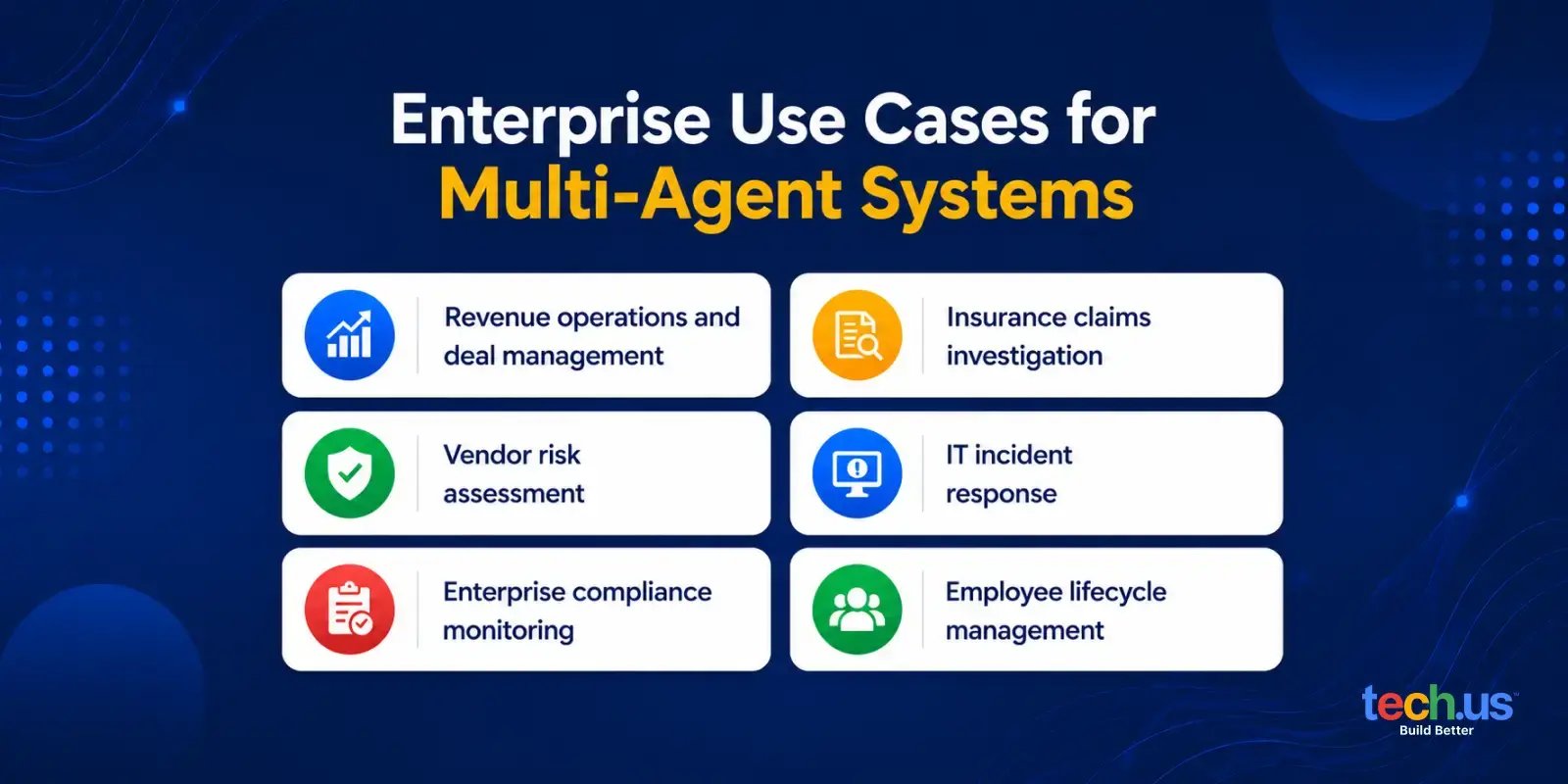
A lot of articles talk about multi-agent systems by department. Customer service. Finance. HR. That sounds neat on paper, but it is not how most enterprises actually operate.
Real work moves through workflows, not org charts.
A customer issue may touch support, operations, billing, and compliance before it is resolved. A contract may bounce between sales, legal, finance, and procurement before anyone signs it. That is why some of the most practical multi-agent use cases are not tied to departments at all. They are tied to processes that constantly move across teams and systems.
Revenue Operations and Deal Desk Management
- Reviewing contract language
- Checking pricing policies
- Assessing commercial risk
Insurance Claims Investigation
Vendor Risk and Third-Party Assessment
IT Incident Response and Resolution
Enterprise Compliance Monitoring
Employee Lifecycle Management
Business Benefits of Multi-Agent Systems
Better Handling of Complex Workflows
Scalability Through Modular Agents
Faster Decision-Making
Operational Efficiency and Cost Reduction
- Chasing approvals
- Verifying information across systems
- Escalating routine exceptions
- Following up on incomplete tasks
Business Agility
Workforce Transformation
Governance, Security, and Observability for Enterprise Multi-Agent System
Define Roles Before Defining Autonomy
- A specific purpose
- Defined permissions
- An owner responsible for oversight
- A clear escalation path
Treat Agents Like Enterprise Identities
Make Every Decision Observable
- Agent decisions
- Tool usage
- Workflow handoffs
- Escalation events
Build Guardrails Before Scale
Auditability and Interpretability Matter
Risks and Challenges of Multi-Agent Systems
Coordination Failures
Poor Data Quality
Agent Drift and Unpredictable Behavior
Security and Compliance Risks
- Clear permission boundaries
- Human oversight for sensitive actions
- Complete audit trails
Excessive Complexity
Lack of Observability
Unrealistic Expectations
| Risk | Business Impact | Mitigation Strategy |
|---|---|---|
| Coordination failures | Duplicate work, conflicting actions, stalled workflows | Define handoff rules and shared context |
| Poor data quality | Confident but unreliable outputs | Clean critical data paths before scaling |
| Agent drift | Decisions move away from intended behavior | Monitor performance and review outcomes regularly |
| Security and compliance risks | Unauthorized access or policy violations | Apply least-privilege access and approval controls |
| Excessive complexity | Harder debugging and slower execution | Use only the agents the workflow truly needs |
| Lack of observability | Failures become difficult to investigate | Track decisions, tool calls, and handoffs |
| Unrealistic expectations | Poor adoption and weak ROI | Start with clear process ownership and measurable outcomes |
How to Implement Multi-Agent Systems in an Enterprise
Start With a Business Bottleneck
Identify Workflows With Coordination Problems
- Multiple systems must be consulted before action can be taken
- Several departments participate in the same workflow
- Exceptions require frequent escalation
Define Agent Roles Before Building Agents
Focus on Integration Earlier Than Expected
Establish Governance Before Scale
Pilot, Measure, Then Expand
To Sum Up
FAQ
Not at all. The real question is not company size. It is workflow complexity. If work constantly moves between teams, systems, and approvals, multi-agent systems can be valuable.
In most cases, no. They are better at handling coordination work than judgment work. The goal is usually to reduce chasing, checking, and routing, not replace expertise.
Start with a process people complain about internally. Long approval cycles, claims reviews, vendor assessments, and incident response workflows are often good candidates.
Because the organization tries to automate a messy process without fixing it first. Agents can speed up a workflow, but they cannot bring clarity to a workflow that nobody understands.
Better governance. A highly capable agent without clear boundaries creates risk. A well-governed agent is far more useful in a real business environment.