Overview
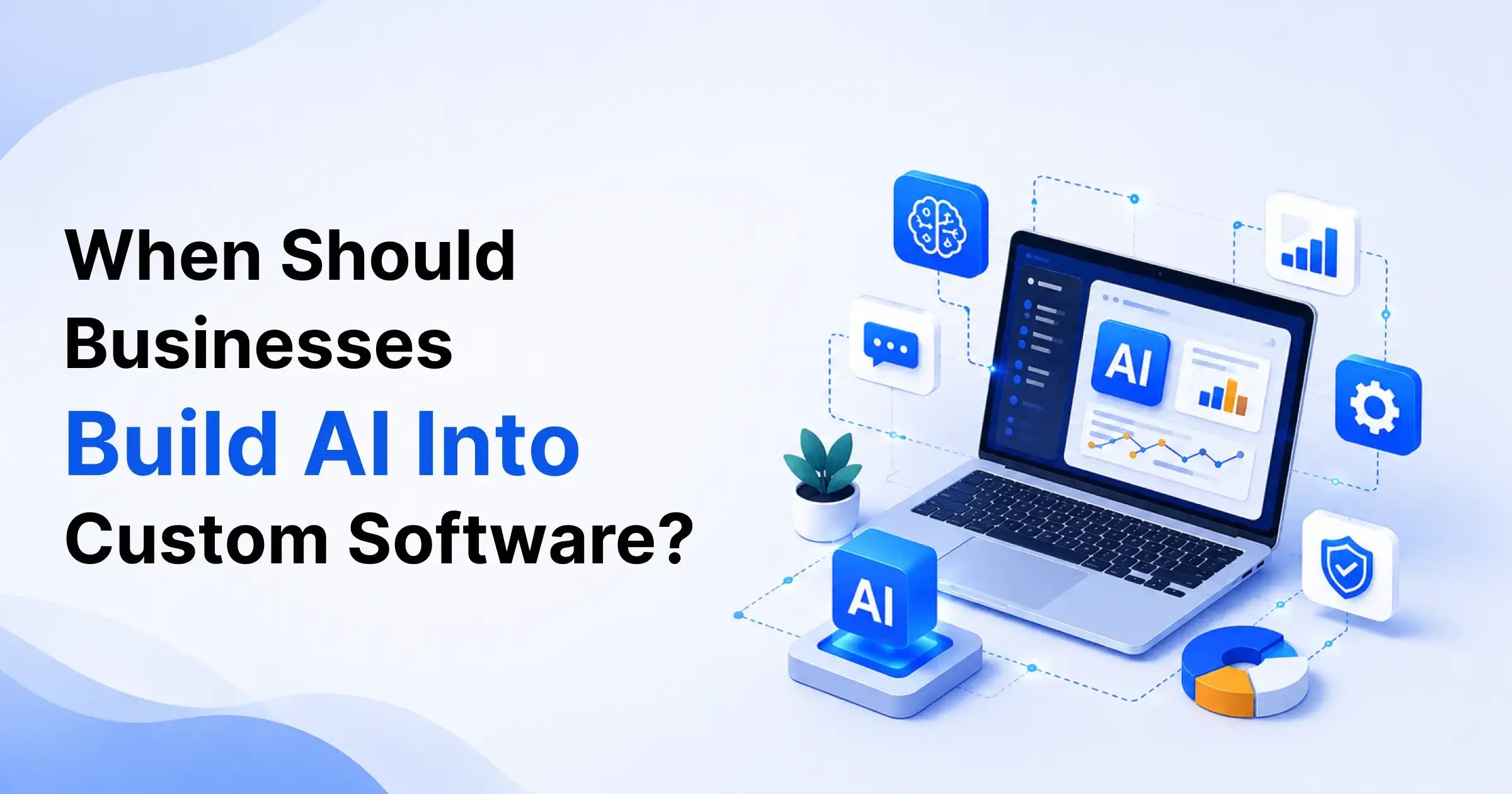
What Does It Mean to Build AI Into Custom Software?
| If You Buy an AI Tool | If You Build AI Into Custom Software | |
|---|---|---|
| You're improving how employees perform work | You're redesigning how work gets done | |
| AI remains an add-on | AI becomes part of the operating model | |
| Benefits are usually incremental | Benefits can be transformational | |
| Competitors can replicate the same approach quickly | Competitors cannot easily copy proprietary systems | |
| Best for common business functions | Best for mission-critical business functions | |
| Creates efficiency gains | Creates efficiency plus differentiation | |
| Works well for experimentation | Works well for long-term strategic investment |
5 Signs Your Business Should Build AI Into Custom Software
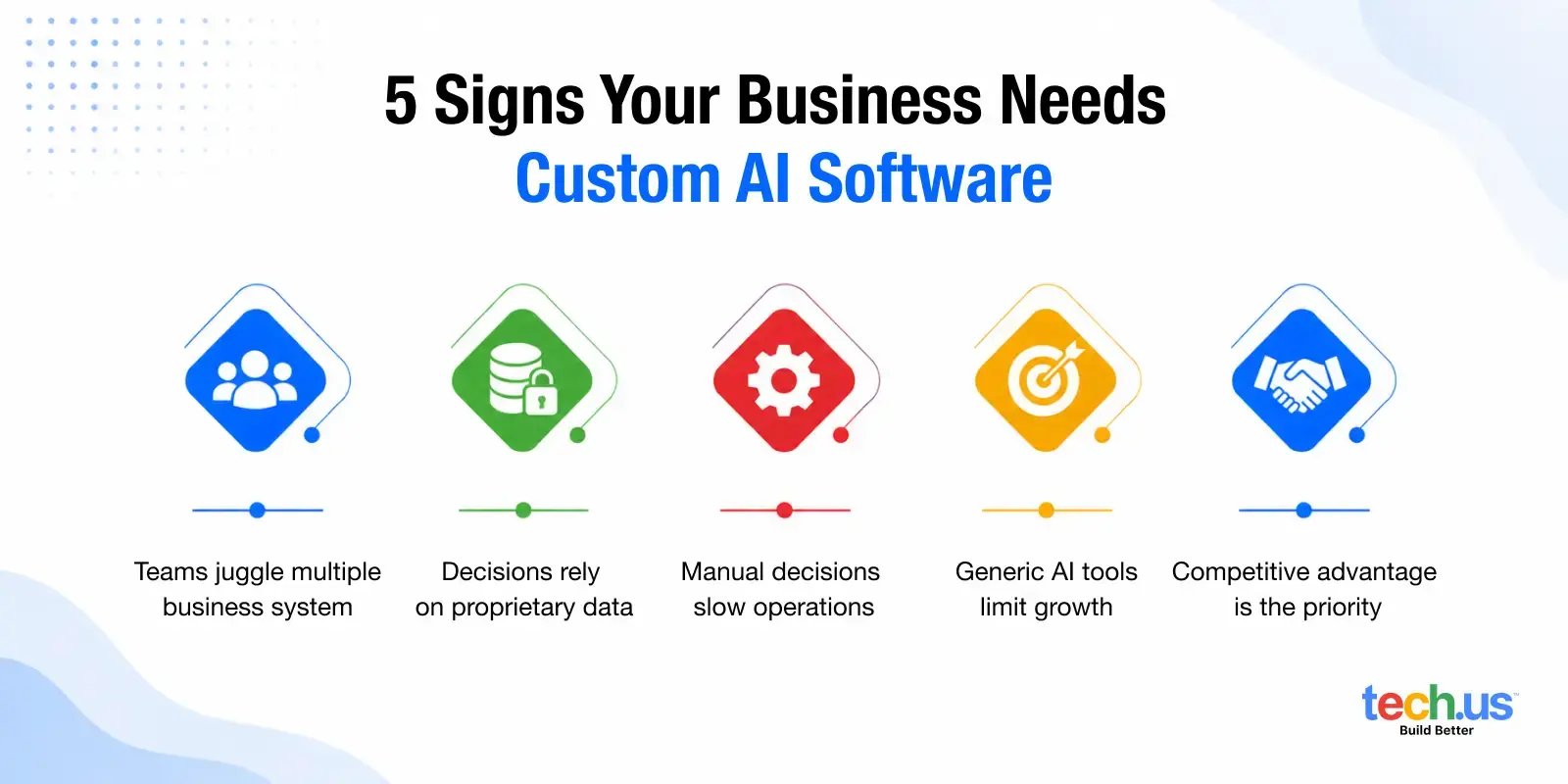
Let us look at the signs that your business may show that ushers AI capabilities into your custom software systems.
1. Is Your Team Constantly Switching Between Multiple Systems to Complete One Process?
2. Are Your Critical Decisions Dependent on Company-Specific Data?
The answers sound impressive, but they don't reflect how the company actually operates.
Generic AI tools cannot automatically understand your customer history, internal policies, operational constraints, pricing models, or risk thresholds. This is where custom AI development services start making sense.
3. Is Manual Decision-Making Becoming a Bottleneck?
4. Do Existing AI Tools Force You to Change How Your Business Operates?
Forcing those processes into the constraints of a generic AI platform can create more problems than it solves. Building AI into custom software allows the technology to adapt to the business rather than the business adapting to the technology, which is a key part of successful AI-driven business transformation.
5. Are You Looking for Competitive Advantage Rather Than Temporary Productivity Gains?
When the second question becomes more important than the first, building AI into custom software usually deserves serious consideration.
How to Evaluate Whether an AI Capability Belongs Inside Your Software
A simple way to evaluate this is to look at where the capability creates value.
Does It Influence Revenue, Cost, or Customer Experience?
Does It Depend on Knowledge Unique to Your Business?
Will Employees Use It Every Day?
Would Losing It Create Operational Risk?
Would approvals slow down? Would service quality drop? Would teams struggle to make decisions?
Can Competitors Easily Buy the Same Capability?
This is often the deciding factor.
To Sum Up
FAQ
Not necessarily. If you're solving a common business problem, an off-the-shelf AI tool is often enough. Custom AI makes more sense when the capability becomes central to operations or decision-making.
A good test is to ask whether it directly impacts revenue, customer experience, operational efficiency, or business-critical decisions. If it does, custom integration deserves consideration.
Yes. The decision is less about company size and more about business complexity. Many mid-sized companies have workflows and data that create a strong case for custom AI.
Many companies start with technology instead of the business problem. The most successful projects begin with a workflow bottleneck, operational challenge, or customer need.
In most cases, no. The strongest implementations help people make better decisions faster rather than removing human oversight entirely.
Absolutely. In many organizations, the greatest value comes from AI's ability to use internal knowledge, historical outcomes, and business-specific context that generic tools cannot access.
Usually when AI moves beyond occasional use and starts influencing daily workflows, operational performance, or customer-facing experiences.