Overview
Most enterprises won't touch an AI project anymore without running a readiness assessment first. This is indeed a smart instinct. But the problem is what comes back.
Only 5% of custom enterprise AI tools reach production, even though 60% of organizations evaluated enterprise-grade systems, only 20% reached pilot stage, and just 5% reached production, according to an MIT study summarized by Virtualization Review.
You get a scorecard. Data maturity: strong. Cloud infrastructure: ready. Talent: adequate. Leadership buy-in: secured. Green lights across the board, and eighteen months later the pilot that looked so promising is quietly running in one team that nobody else trusts, burning budget, going nowhere.
It happens often enough that execution stops being a satisfying explanation. The assessment isn't misleading. It's just answering a narrower question than the one you actually need answered. These frameworks are very good at measuring whether you can build AI. Many organizations begin this evaluation through formal enterprise AI services assessments, but readiness frameworks often stop short of evaluating what determines long-term adoption and business impact.
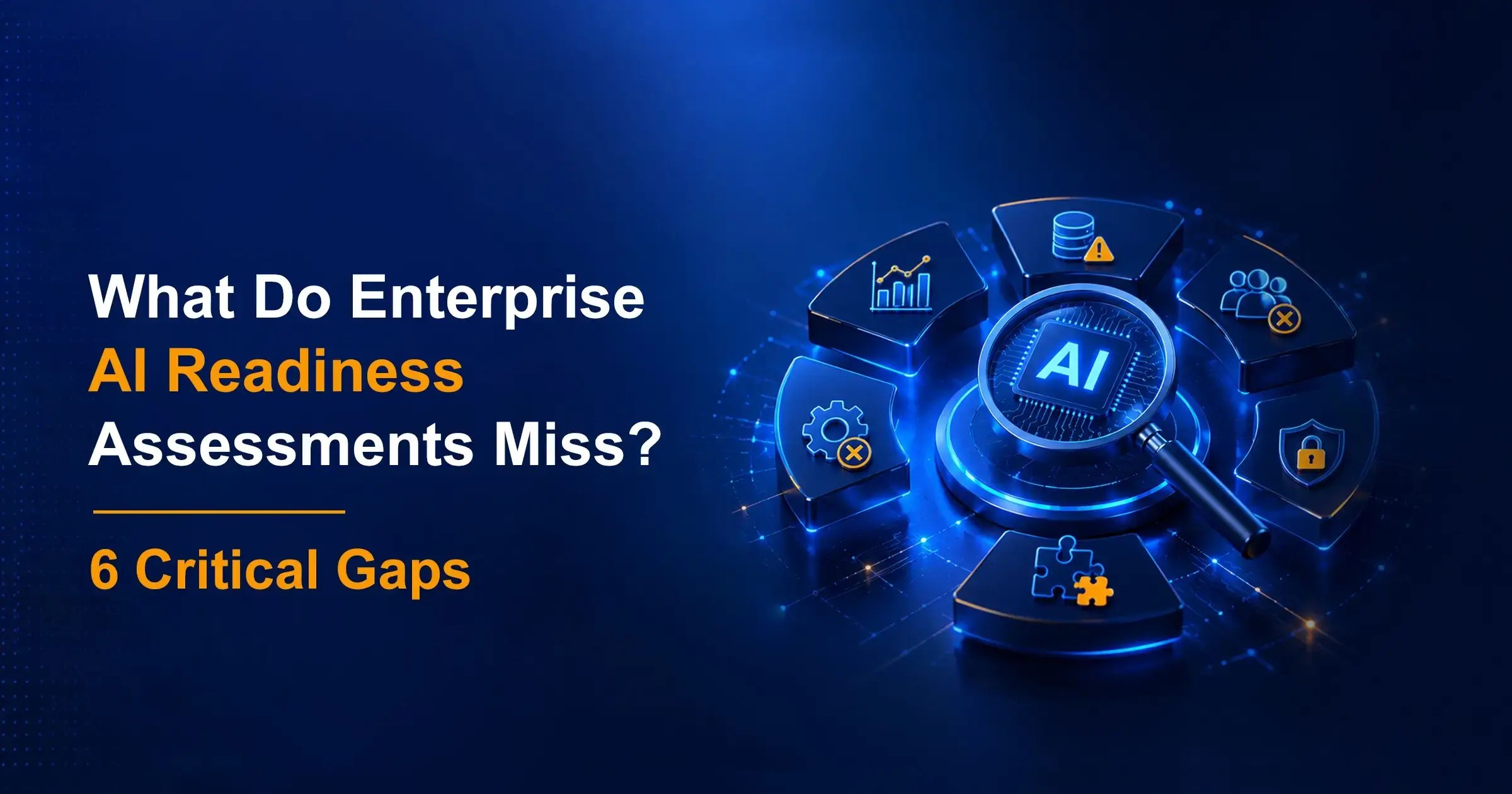
That gap, which is between capability and durability, is where readiness assessments fall short. Six places, specifically. Here's what they consistently fail to evaluate, and why each one matters more than the boxes they do check.
The Assessment Measures What's Easy to Score, Not What Determines Success
Readiness frameworks have a bias built into them, and it isn't intentional. They reward what can be counted.
Data maturity has a score. Cloud spend has a number. Headcount, certifications, model accuracy benchmarks: all of it fits neatly into a grid that someone can audit and defend in a steering committee meeting. So that's what gets measured.
The variables that actually decide whether AI survives are messier. They're about behavior, authority, and habit. None of those reduce cleanly to a five-point scale, so they quietly fall off the assessment.
The result is a scorecard that looks rigorous and feels objective while skipping the questions that matter most. Two of those skipped questions sink more deployments than any infrastructure gap ever will.
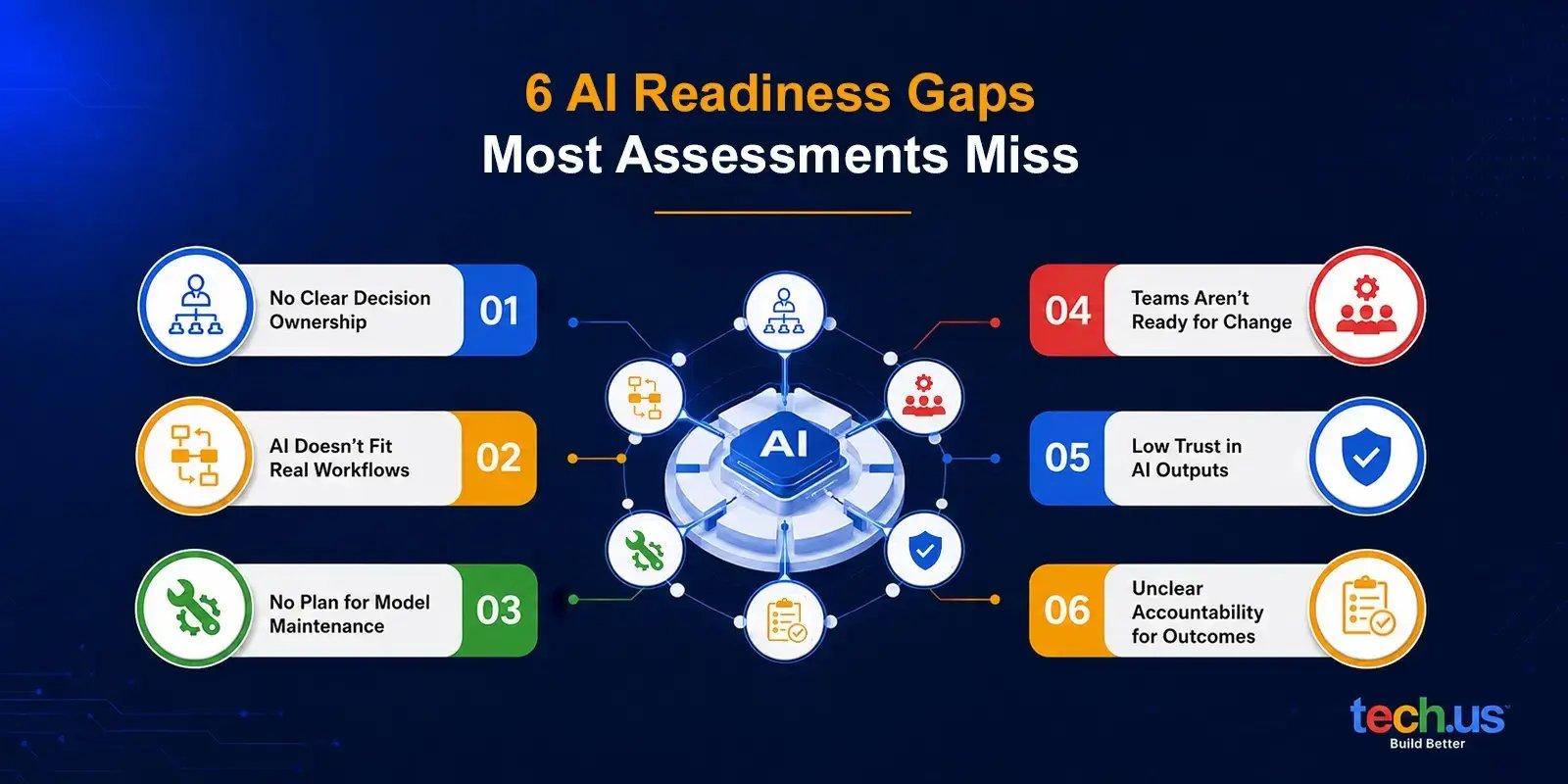
Gap 1: Who actually has the authority to kill or scale a model?
Most readiness assessments confirm that a project has an owner. Few of them ask what that owner is allowed to do.
There's a real difference between the person whose name sits on the project charter and the person who can pull a model out of production on a Tuesday afternoon because it's quietly making bad calls.
After launch, that distinction stops being academic. A model starts drifting. A business unit wants to expand it into a new workflow. Suddenly nobody is sure who signs off:
- The data team says it's a business decision.
- The business says it's a technical one.
- Weeks pass, and the model keeps running.
Decision rights that were never defined become a vacuum. AI stalls in vacuums far more often than it fails on technical merit, and a readiness score of "strong governance" almost never tests for this.
Gap 2: Does the AI fit how work actually gets done?
Assessments evaluate AI against the documented process. The trouble is that the documented process is frequently a polite fiction.
The real workflow has shortcuts, exceptions, and a dozen small judgment calls that people make without thinking. None of them appear in the process map the assessment was scored against.
So a model gets validated against how the work is supposed to happen. Then it meets how the work really happens, and it breaks. Think of the loan officer who always checks one more system before approving. Or the nurse who reads between the lines of a chart.
This disconnect is one of the most common reasons AI projects fail after promising pilot results. Organizations that want to avoid these pitfalls should understand the broader reasons why enterprise AI initiatives fail to deliver results before moving into implementation.
The tool isn't wrong, exactly. It was measured against a map instead of the territory, and readiness assessments rarely know the difference.
The Assessment Assumes Conditions That Don't Hold After Launch
AI readiness assessment is more or less like a photograph. It captures the organization on the day it was taken, and on that day, everything might genuinely look ready.
But AI doesn't live in a photograph. It lives in an organization that keeps changing after the score is filed away.
The data shifts. Priorities move. The team that was ready in March is underwater by September. And the assessment, sitting in a slide deck somewhere, still says everything's fine.
That's the trouble with scoring readiness at a single moment. It treats conditions as fixed when they're anything but. Two of those decaying conditions almost never make it onto the scorecard.
Gap 3: Who keeps the model accurate after month three?
You'll notice most assessments care a lot about launch. Is the data clean? Is the model accurate? Can the team ship it? All reasonable questions. All about day one.
Almost nobody gets scored on day ninety.
Maintaining performance over time requires operational processes that many readiness reviews overlook. This is where practices such as MLOps become essential for monitoring, retraining, and governing AI systems after deployment.
Customer behavior changes. A supplier updates their format. Quietly, the predictions get worse.
And here's where it gets awkward: when you ask who's responsible for catching that drift and fixing it, you often get a shrug. Was that the vendor's job? The data team's? Nobody scoped it, so nobody owns it.
A model that was accurate at launch and ignored for two quarters isn't an asset anymore. It's a liability nobody's watching.
Gap 4: Can the organization actually absorb one more change?
This one rarely gets asked at all, and it might be the most important. An assessment will tell you whether the organization can adopt AI. It almost never asks whether the organization can adopt AI on top of everything else it's already doing.
Think about what's usually happening in parallel. There's an ERP migration. A reorg. Two other "strategic priorities" competing for the same people's attention. Everyone's already stretched.
Into that, you drop a tool that asks people to learn something new and trust it with their work. Even a great tool struggles there. Not because it's bad, but because there's no room left to absorb it.
Enterprises often underestimate how AI adoption competes with other transformation initiatives for attention and resources. Evaluating whether your organization can realistically support another major initiative is a key part of determining if your business is ready for artificial intelligence development.
The Assessment Ignores the Human and Governance Variables That Quietly Sink Adoption
Some things don't get measured because they're hard to measure. Others don't get measured because they're uncomfortable to bring up in a room full of stakeholders.
This last pair falls into the second category.
They're about trust and blame, basically. Whether people will actually use the thing, and who's left holding it when the thing gets something wrong. Neither fits cleanly on a scorecard, so both tend to vanish from the assessment entirely.
And that's a shame, because this is where adoption quietly lives or dies.
Gap 5: Will people actually trust the output, or quietly double-check it?
You might have seen this scenario. The model works and the accuracy is good. By every technical measure, it's a success. And yet the people meant to use it keep running their own numbers on the side, just to be sure.
That's the ROI killer nobody scores for.
Think about it. If a person still does the manual check after the AI gives them an answer, you haven't saved them any time. You've added a step. The tool becomes a second opinion they don't really need, and eventually they stop opening it altogether.
Trust isn't a feature you ship. It's earned slowly, and it's lost fast, usually the first time the model is confidently wrong about something the user knew the answer to. Assessments rarely ask whether that trust can realistically be built here. They just assume people will use what they're given.
Gap 6: When the model is wrong, who owns the outcome?
Let's be honest, every model is eventually wrong about something. That's not the problem. The problem is what happens next, and whether anyone decided that in advance.
Picture a bad call going out. A claim wrongly denied. A loan wrongly flagged. Someone notices, and the question lands: who's accountable for this?
If the answer gets worked out in the moment, you're already in trouble. The business points at the model. The data team points at the inputs. The vendor points at the contract. Meanwhile the actual customer is still waiting.
Accountability has to be settled before deployment, not improvised after the first mistake. Who reviews the edge cases? Who can overrule the system? Readiness assessments love to check the box marked "governance," but they almost never get specific about the one moment governance actually matters.

How to Pressure-Test Your Own Readiness Assessment
So what do you do with all this? In fact, readiness reviews become significantly more valuable when they're tied to broader transformation goals.
Many of the advantages uncovered during these reviews align closely with the documented benefits of enterprise AI, particularly around scalability, efficiency, and decision-making.
The fix is simple enough: take the assessment you already ran and ask a second set of questions on top of it. Not the ones about capability. The ones about what happens after launch, when the scorecard is filed away and the model has to live in the real organization.
Here's a quick way to do that. Go through the six gaps and ask the question in the right-hand column. If you can't answer it with a specific name, process, or date, that's not a strong score. That's a blind spot wearing a green checkmark.
|
The Gap
|
The Question Your Assessment Probably Skipped
|
A Weak Answer Sounds Like
|
|
Decision rights
|
Who can pull this model from production, on their own authority, by end of day?
|
"It has an owner."
|
|
Workflow fit
|
Was this validated against how the work actually happens, or the process doc?
|
"It matches our documented process."
|
|
Drift ownership
|
Who is named and scheduled to check accuracy at month three and month six?
|
"The model is accurate."
|
|
Change capacity
|
What else is this same team absorbing right now, and can they take more?
|
"The org is ready for AI."
|
|
User trust
|
Will people stop double-checking the output, and how do we know?
|
"Users have been trained."
|
|
Accountability
|
When the model is wrong, who owns the outcome, and is that written down today?
|
"We have a governance framework."
|
Notice the pattern in that last column. Every weak answer is technically true. The project does have an owner. The framework does exist. That's exactly why these gaps survive the assessment. They pass on paper.
A real pressure test isn't about finding a no. It's about refusing to accept a vague yes. If the answer to any of these is a job title instead of a person, or a policy instead of a process, you've found work to do before launch, not after.
Where Most Teams Go From Here
Here's the uncomfortable part. Most of the fixes above are things an organization can do for itself. Define decision rights. Map the real workflow. Schedule the drift checks. None of it requires outside help.
External perspective often helps organizations identify governance, workflow, and adoption issues that internal teams may overlook. That's one reason many enterprises work with experienced partners and carefully evaluate criteria for choosing an AI development partner for enterprise AI systems.
The gaps survived the first assessment precisely because the people running it didn't think to look there. Asking the same team to find what they already missed tends to produce the same green checkmarks.
That's the one part where a second set of eyes genuinely helps, and ideally eyes that have watched these specific failures play out across a lot of deployments, not just one.
So what does a readiness review look like when it's actually built around durability instead of capability? It asks the questions the standard scorecard skips:
- Not "is there an owner," but who can stop or scale this model on their own authority.
- Not "does it match the process doc," but does it fit how the work truly gets done.
- Not "is the model accurate," but who keeps it accurate at month three and month six.
- Not "is the org ready," but can this team absorb one more change right now.
- Not "were users trained," but will they actually trust the output instead of double-checking it.
- Not "is there a governance framework," but who owns the outcome the day the model is wrong.
That's the difference between a review that makes you feel ready and one that tells you whether you are.
If you'd find it useful to pressure-test your own readiness against these questions with someone who's seen where AI deployments tend to break, Tech.us AI consulting / readiness assessment is a good place to start that conversation.
FAQs
What's the difference between an AI readiness assessment and an AI maturity assessment?
Readiness asks whether you can start; maturity asks how far along you already are. Both tend to measure capability, and neither checks whether a model will survive once it's actually in use.
How often should you reassess AI readiness?
More often than once. Revisit it at launch, around month three, and any time something big shifts, like a reorg or a major data change.
Can a readiness assessment guarantee an AI project will succeed?
No, and it was never meant to. A strong score lowers risk, but it says nothing about trust, ownership, or upkeep, which are the things that actually decide whether AI sticks.
Who should actually run an AI readiness assessment?
Ideally both an internal team and an outside reviewer. Internal teams know the systems but miss their own blind spots; an outsider who's seen deployments break spots them faster.
What's the most common gap readiness assessments miss?
Ownership after launch. They confirm a project has an owner but rarely ask what that owner can actually do, or who keeps the model accurate months in.