AI

5 Competitive Advantages You May Lose by Delaying AI Transformation

Delaying AI transformation can cost more than time. Explore 5 competitive advantages businesses risk losing and why starting the learning process matters.

By Anand Selvadurai Published Sep 24, 2026 14 min read
Overview 
Most leadership teams are not ignoring AI anymore. More often, they are postponing it. The discussion sounds reasonable at first. 
The budget needs more clarity. The team is already stretched. The use cases need more validation. The timing feels slightly early. 
Delay has a quiet cost. While one company is still debating when to begin, another may already be learning where AI actually fits inside its business. 
That difference is easy to miss early on. Both companies can look equally prepared from the outside. Over time, one has spent months building better knowledge access, sharper customer insight, and stronger decision support. The other is still trying to define the starting point. 
BCG's fourth annual Global AI at Work Survey, released in June 2026 and based on 11,749 workers across 14 markets, points to where that gap actually forms. Among regular frontline AI users, 42% report saving at least a full workday per week. Yet 66% say they receive limited or no guidance on what to do with that time, and more than half do not redirect it into strategic work.

The more useful finding sits alongside it. BCG reports that a clear strategy lifts AI's business impact by 25 percentage points, while better tools lift it by five.

That is the real separation. It is not between companies that have AI and companies that do not. It is between companies that know what they are trying to change and companies that have bought software. 
delaying-ai-transformation-competitive-advantages

What AI Transformation Actually Involves 

AI transformation is the process of changing how a business captures knowledge, makes decisions, and runs its workflows, using AI as the mechanism rather than the goal. 
It is different from AI adoption, which usually means purchasing and deploying tools. Adoption can happen in a quarter. Transformation takes longer because it involves people learning new ways of working, processes being redesigned around what AI can do well, and leaders developing judgment about where AI helps and where it does not. 
Most of the value sits in that second category. It is also the part that cannot be bought. 

Why the Competitive Gap Takes Time to Appear

Many businesses delay AI transformation because they assume another year will not make much difference. That assumption is understandable. AI tools are evolving rapidly, and nobody wants to invest in the wrong technology at the wrong time. 
The challenge is that competitive advantages are rarely created in a single year. They are built through small improvements that accumulate. A business does not suddenly become better because it adopted AI. It gradually becomes better at capturing and sharing knowledge, understanding customer behavior, supporting decisions with data, and helping employees work more effectively. 
Individually, these improvements look minor. Together, they create separation that is difficult to close quickly. 

Can a Late AI Adopter Catch Up?

On tools, yes. On capability, it takes longer than most leadership teams expect. 
A competitor's platform can be licensed within weeks. What cannot be licensed is the year that company spent discovering which of its processes were worth automating, which were not, and what its own data was actually good for. A late mover has to run that learning curve while also keeping pace with everything the early mover has moved on to. 
Catching up is possible. It usually costs more and happens under more pressure. 

Why Two Companies With the Same AI Tools Get Different Results

This is where organizations make a wrong comparison. 
Most AI tools can be purchased quickly. If a competitor adopts a new platform today, another company can often buy the same platform tomorrow. What is harder to replicate is everything that happens after the purchase. 
Teams need time to learn. Processes need to evolve. Leaders need to understand where AI creates value and where it does not. These lessons come from experience, not software licenses. 

The BCG finding on strategy versus tools describes the same pattern from the employee side. Access to better tools produced a measurable but modest improvement. Strategic clarity produced five times as much. The variable that mattered was not what companies bought. It was whether anyone had decided what the purchase was for.

That is also why many enterprise AI initiatives fail to deliver results despite strong executive support and generous budgets. The technology worked. The organization around it had not changed enough to use it.
Capability development usually starts long before results become visible, which is exactly what makes it easy to postpone. 

Five Capabilities That Become Harder to Build Later 
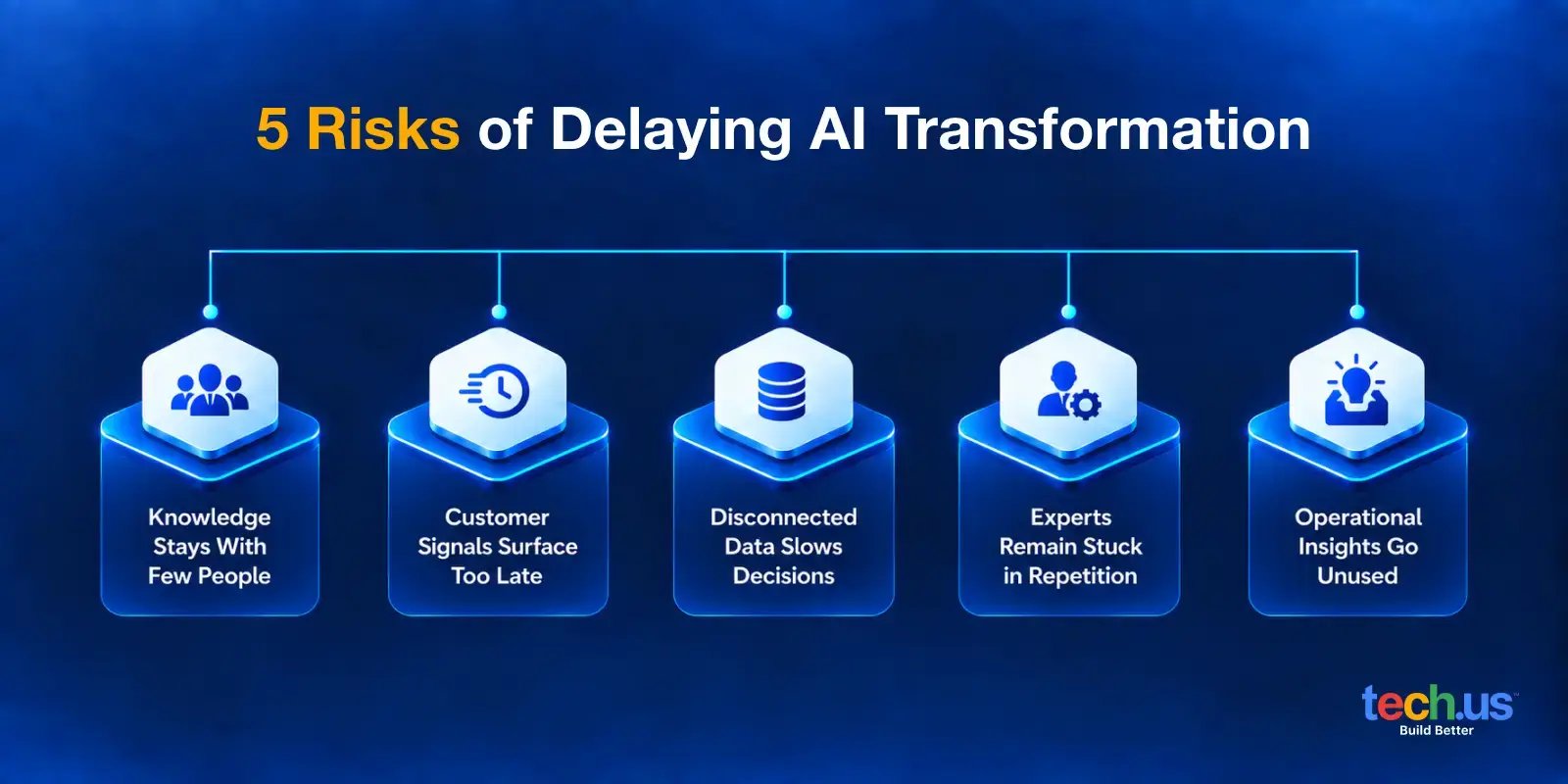
delaying-ai-transformation-competitive-advantages-Infographic
The impact of delaying AI transformation is not always visible in revenue reports or quarterly metrics. It shows up in the capabilities a business struggles to build later. 
Some organizations spend the next twelve months learning from their data, capturing expertise, and improving how decisions get made. Others spend the same period evaluating whether they should start. 

1. Organizational Knowledge Stays Locked in a Few People 

Most businesses already hold valuable knowledge. The problem is that it often lives in the heads of a handful of experienced employees. 
When a complex issue comes up, everyone knows who to call. When a new employee needs guidance, they depend on someone else's availability. As the business grows, this stops scaling. 
Organizations investing in AI are turning internal knowledge into systems employees can actually use: past project decisions, internal documentation and SOPs, customer conversations, and expertise accumulated over years. Instead of searching through email threads or waiting for an expert to free up, employees find what they need when they need it. 
Why Internal Knowledge Is Hard to Catch Up On 
The gain here is continuity rather than automation. Knowledge stays inside the business when people leave. New employees become productive sooner. Teams spend less time locating answers and more time acting on them. 
Businesses that delay this shift will eventually adopt the same tools. What is harder to recover is the years a competitor spent structuring, correcting, and refining that knowledge base. A knowledge system is only as good as the cleanup work behind it, and that work cannot be compressed. 

2. Customer Signals Get Noticed Later Than Competitors Notice Them 

Most businesses are not short on customer data. They have too much of it, spread across CRM platforms, support tickets, sales calls, emails, reviews, surveys, and product usage reports. The data exists. Connecting it is the difficult part. 
Traditional reports track what happened. They are less useful for explaining why it happened. 
As a result, signals go unnoticed: customers repeatedly raising the same concern, buying behavior shifting inside a segment, early indicators of dissatisfaction, new needs forming in the market. By the time these become obvious in a dashboard, the window to act has usually narrowed. 
Which Customer Signals Do Standard Reports Miss? 
Standard reporting is built around metrics that were defined in advance. It surfaces movement in things you already decided to measure, and stays silent on patterns nobody thought to track. 
Organizations analyzing customer interactions at scale can surface trends that are impractical to spot manually, particularly in unstructured text like support tickets and call notes. Many of these insights come out of the same AI-driven business operations work that companies are already investing in.
Companies that delay this still have the same customer data. What they lack is the habit of turning it into something actionable while a competitor is already learning from it. 

3. Decisions Take Longer Because Information Sits in Separate Systems 

Business leaders are rarely deciding without data. The data they need is usually scattered across systems, reports, and teams. 
A manager needs numbers from operations. A sales leader needs context from support. A finance team needs figures held inside three different applications. Gathering the inputs can take longer than making the call. 
This produces delayed decisions, conflicting interpretations of the same figures, and time spent assembling information rather than acting on it. 

How Does Scattered Information Slow Business Decisions?

Most competitive advantage is not built through a handful of major decisions. It comes from hundreds of smaller ones made every week, each slightly better informed than the alternative. 
When those decisions each take two days instead of two hours, the cost does not appear in any single meeting. It accumulates across a quarter. 
Organizations using AI to connect information across systems make those decisions with more confidence and less delay. Businesses that delay this capability may see no immediate impact, which is part of why it stays low on the list. This is one of the more practical benefits of enterprise AI adoption beyond straightforward automation.

4. Experienced Employees Spend Expertise on Low-Value Work 

Every organization has people who consistently create outsized impact. They diagnose problems faster, make better calls, and move critical work forward. 

Many of them still spend a surprising share of their week searching for information, reviewing documents, summarizing data, and answering the same recurring questions. This work is necessary. It rarely requires their level of expertise.

Businesses exploring custom AI development services frequently start here, because the gap between what senior people are paid for and what they actually spend time on is easy to measure and easy to explain internally.
What Work Should Experienced Employees Not Be Doing? 
The goal is leverage rather than replacement. When a senior engineer or analyst spends less time gathering context and more time applying judgment, the value of the same headcount goes up. 
There is a second effect that is easier to overlook. Experienced people who spend most of their time on retrieval tend to leave. The work that keeps them is the work only they can do. 

5. Operational Data Never Becomes Operational Learning 

Most business processes are designed to get work done. They are not designed to help the organization learn from the work being done. 
Teams generate operational data every day through customer interactions, approvals, escalations, and internal workflows. Most of it is never examined beyond basic reporting. 
When teams review processes, they focus on outcomes. Important questions go unanswered. Why do certain projects move faster than others? Where do delays consistently occur? Which issues keep resurfacing across teams? Without a systematic way to spot these patterns, businesses solve the same problems repeatedly. 

What Can Operational Data Reveal That Reports Do Not? 

Reports describe results. Operational data describes the path to those results, including the steps that quietly cost the most time. 
Organizations using AI to analyze patterns across large volumes of operational data can locate bottlenecks, detect recurring failures, and understand how a process performs over time rather than at a single checkpoint. Many start by identifying the highest-impact business processes for AI automation and working outward from there.
The capability being built is continuous learning, not just faster execution. Businesses that delay it continue operating effectively while missing the chance to turn everyday operations into a source of improvement. 

Why the Cost of Waiting Differs from the Cost of Investing 

When businesses discuss AI transformation, the conversation usually focuses on investment risk. That is reasonable. AI initiatives require budget, leadership attention, and organizational effort. 
Focusing only on the cost of investing can obscure the cost of waiting. 
Neither decision is risk-free. Poorly defined use cases, unrealistic expectations, or weak implementation lead to disappointing outcomes, and adopting AI tools does not automatically create business value. This is why many organizations are cautious before committing significant budget, and that caution is often justified. 
The overlooked cost is delayed learning. Waiting reduces spending in the short term while postponing the lessons that only come from real implementation. Teams do not learn how AI fits their workflows by discussing it. They learn by testing, adapting, and correcting. 
The decision is not always between spending money and saving money. In many cases, it is a choice between beginning the learning process now or beginning it later while competitors are already partway through it. 

When Waiting Is the Right Call 

Not every delay is a mistake, and some organizations postpone AI work for good reasons. 
Waiting is defensible when the underlying data is genuinely unusable, when a core system migration is already consuming the same team, or when no one internally can define what a successful outcome would look like. Starting an AI initiative without a clear definition of success is one of the more reliable ways to produce an expensive result nobody can evaluate. 

Why Do Many AI Projects Fail? 

The common causes are organizational rather than technical: a use case chosen because it was interesting rather than valuable, no agreed measure of success, no owner after launch, and scope that expands because the first application underdelivered and the next one is expected to compensate. 

Is It Better to Be a Fast Follower? 

Fast following works when the advantage comes from the technology itself, because the technology gets cheaper and better while you wait. 
It works less well when the advantage comes from accumulated data and process knowledge, because those do not get cheaper. They are built in sequence. A fast follower in AI arrives to find that the tools are affordable and the head start still exists. 
The distinction worth drawing is between delaying a purchase and delaying the learning. The first is often sensible. The second compounds. 

Where to Start If You Have Been Delaying 

The most common obstacle is not budget. It is not knowing what a reasonable first step looks like. 
 A workable starting sequence: 
  • Pick a process you already understand well. AI works better on workflows where you can describe what good output looks like. Unfamiliar processes make evaluation impossible.
  • Choose something measured today. If you cannot state the current baseline, you will not be able to prove improvement later.
  • Keep the first scope small enough to finish in a quarter. Long first projects lose sponsorship before they produce evidence.
  • Assign one owner with authority to stop it. A defined exit condition protects the budget more than a detailed plan does.
  • Plan for what happens to the time saved. BCG's finding that most employees receive no guidance on reinvesting recovered time is a workflow design gap, and it is worth deciding in advance.
For businesses still assessing where they stand, understanding whether they are prepared for artificial intelligence development is usually the first honest conversation to have. Organizations that want to move faster through the early learning curve often work with experienced artificial intelligence development services providers rather than building every capability internally from day one.

Tech.us helps organizations design AI systems around real workflows, risk levels, and data constraints. If you are deciding where to begin, talk to our AI expert.

FAQs

No. Adoption is still uneven across most industries, and many organizations are early in their own learning curves. The concern is less about timing and more about how long the evaluation phase lasts before any real implementation begins. 

They can acquire the same tools quickly. Catching up on process knowledge, data readiness, and organizational experience takes longer, because those are built through implementation rather than purchase.

Delayed learning. Companies that start earlier accumulate more understanding of where AI creates value in their specific business, and that understanding shapes every decision that follows. 

No. Many organizations begin with a single use case and expand as they learn what works. Smaller scope often makes the first project easier to evaluate. 

Capabilities. BCG's 2026 survey found that clear strategy improved AI's business impact substantially more than better tooling did. The long-term advantage comes from how teams work with AI rather than which platform they selected.

Anand Selvadurai

Anand Selvadurai

Director of AI/ML at Tech.us

Director of AI/ML 16+ years experience AI/ML Specialist

Written by Anand Selvadurai, Director of AI & ML at Tech.us — 16+ years experience designing enterprise ML pipelines and deploying production-grade AI systems across Construction, healthcare, fintech, and logistics. Certified Machine Learning Specialist and Research Scholar.


View all articles