Overview
The reality is that the highest-impact AI transformation opportunities rarely begin with AI itself. They usually start with a problem that has been frustrating the business for years.
In fact, according to Boston Consulting Group's 2024 global survey of 1,000 executives, only 26% of companies have moved beyond AI experiments to generate tangible value from AI initiatives. The majority are still struggling to turn investments into measurable outcomes.
The challenge usually isn't finding AI. It's identifying the business constraints where artificial intelligence is driving business transformation and can create meaningful leverage
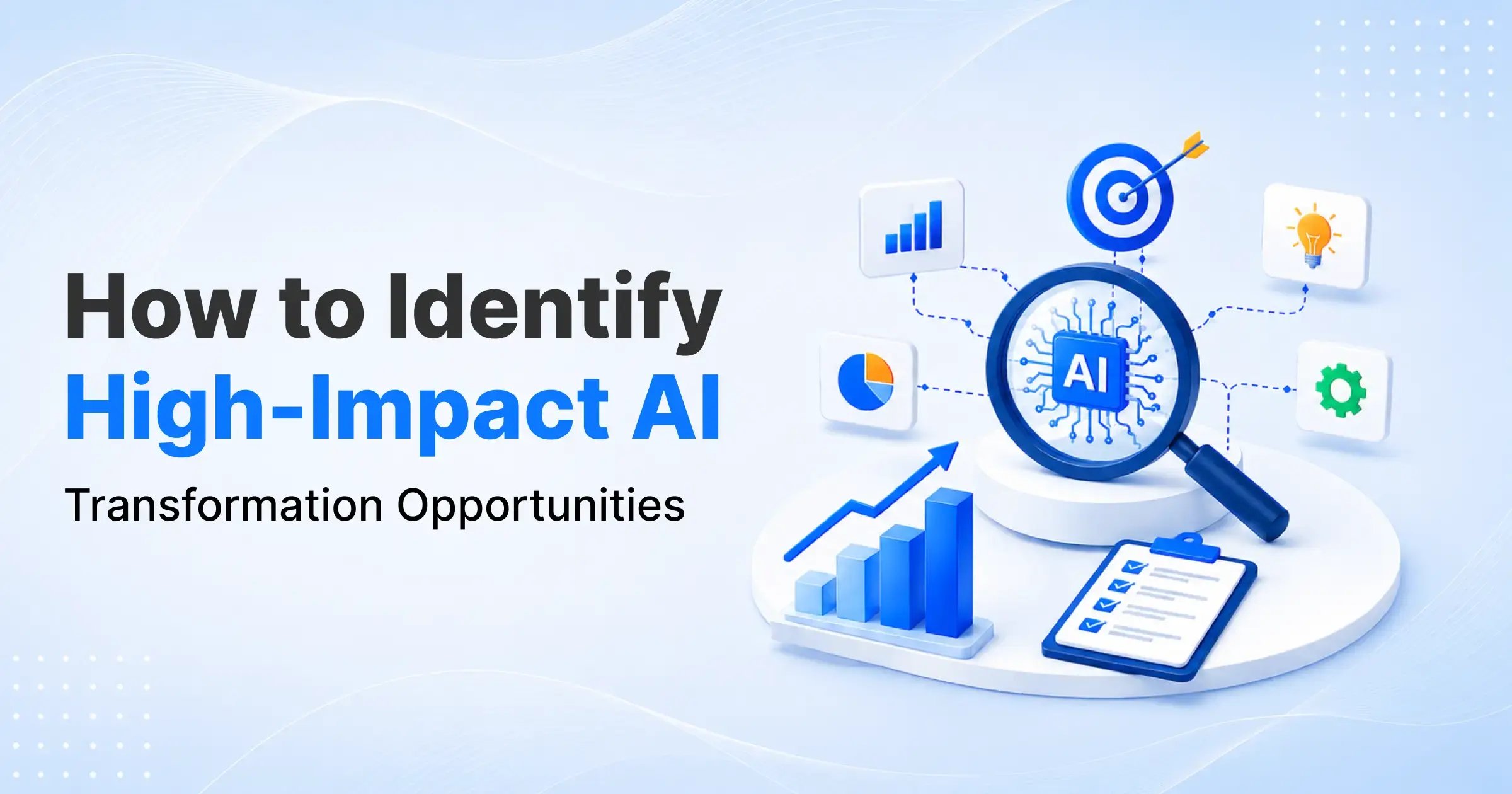
Stop Looking for AI Use Cases. Start Looking for Business Constraints.
Companies investing in artificial intelligence development services usually do not start by asking, “Where can we use AI?”
That question sounds logical, but it often sends teams in the wrong direction. Suddenly, everyone is brainstorming use cases. A chatbot here. A dashboard there. Some automation in finance. Something with documents. It looks productive, but it can quickly become scattered.
A better question is this:
What is stopping the business from being efficient?
That is where AI starts to become useful.
Businesses do not wake up needing AI. They need decisions to move faster. They need teams to spend less time on repetitive work. They need managers to stop being the only people who can approve, explain, review, or fix everything. They need growth that does not depend on hiring ten more people every time volume increases.
So before comparing models or tools, look at the constraint.
- Where does work slow down every week?
- Where are experienced people dragged into routine decisions?
- Where does the team keep adding effort without improving output?
- Where is valuable information available, but hard to find when needed?
This is why opportunity discovery matters more than model selection. The model is not the strategy. The tool is not the transformation.
The real transformation begins when you identify the part of the business that is limiting speed, scale, cost, or consistency, and then ask whether AI can remove that limitation.
The 5 Business Constraints That Usually Reveal High-Impact AI Opportunities
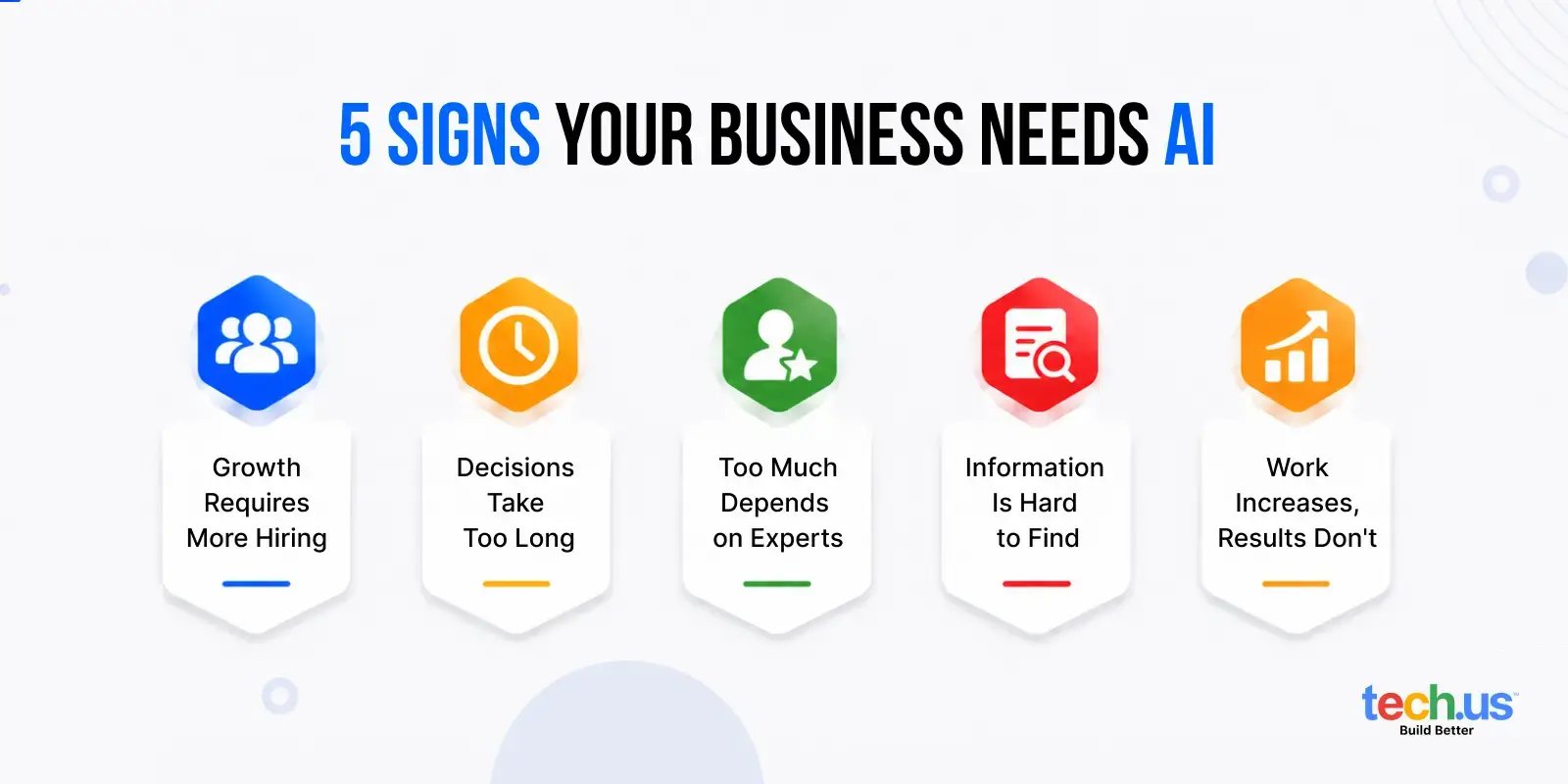
High-impact AI opportunities tend to hide inside business constraints. However, these constraints are often visible once you know where to look.
Let's start with one of the most common.
Growth Requires Hiring More People Every Time Revenue Increases
At first, this can feel like a normal part of growth.
For a while, that seems reasonable.
- Reviewing routine requests
- Moving information between systems
- Answering repetitive questions
- Validating documents and data
- Coordinating work across departments
These are often the first places where meaningful AI transformation opportunities emerge, particularly in the top business processes for AI automation.
Critical Decisions Move Too Slowly
- Managers becoming approval bottlenecks
- Teams escalating routine decisions unnecessarily
- Customer requests sitting in queues for days
- Employees spending hours gathering information before acting
- Multiple reviews for low-risk tasks
When business speed becomes a competitive advantage, reducing decision friction often delivers more value than automating individual tasks, which is why many organizations invest in enterprise AI services for business operations.
The Business Depends Too Much on a Few Key People
Most companies have a handful of people everyone depends on.
- New employees needing months to become productive
- Teams constantly relying on the same experts for answers
- Critical knowledge existing only in conversations
- Projects slowing down when certain people are unavailable
- Business processes that are difficult to document
Some of the most successful AI transformation initiatives focus on making organizational knowledge easier to access, often through technologies built on natural language processing.
Employees Spend More Time Finding Information Than Using It
Here's a problem that rarely appears on a leadership dashboard. People spend an enormous amount of time looking for information. Not creating value. Not solving customer problems. Not making decisions. Just searching.
- Repeatedly asking questions that have already been answered
- Searching multiple systems before completing a task
- Long onboarding periods for new employees
- Teams struggling to find previous decisions or documentation
- Employees relying on coworkers instead of internal resources
AI transformation opportunities often emerge when companies focus on information accessibility rather than information creation. Helping employees retrieve the right information at the right moment can eliminate countless hours of unnecessary effort while improving the quality and speed of decision-making, similar to how modern AI chatbots are revolutionizing business operations.
Work Is Happening, But Throughput Is Not Increasing
This is one of the most frustrating situations for leadership teams.
Everyone appears busy. Calendars are full. Projects are active. Teams are working hard. Yet output remains relatively unchanged.
Customer requests still take too long. Projects are not finishing faster. Operational costs continue to increase. Something feels off.
Usually, the problem is hidden inside the workflow. Common warning signs include:
- Repeated manual handoffs between teams
- Duplicate data entry across systems
- Excessive reporting and status updates
- Rework caused by inconsistent processes
- Growing workloads without corresponding output gains
These issues often develop gradually, making them difficult to notice until they begin affecting growth. A useful exercise is to ask a simple question:
How to Evaluate Whether an Opportunity Is Worth Pursuing
Once you start identifying potential AI transformation opportunities, a different challenge appears. You suddenly have too many options, and this is where many organizations get stuck.
The goal is not to find every possible AI opportunity. The goal is to identify the opportunities that can create the biggest business impact with the least amount of organizational friction.
A practical way to evaluate opportunities is to look at five areas.
Revenue Impact
Start here. If a project can help the business acquire customers faster, improve retention, increase conversion rates, or expand customer value, it deserves attention because these are some of the core benefits of enterprise AI.
Cost Impact
Look beyond labor savings. Consider the hidden costs of delays, rework, manual reviews, and operational inefficiencies that quietly consume resources every day.
Organizational Speed
Some opportunities create value simply by helping the business move faster.
Ask yourself:
- Will decisions happen quicker?
- Will customers get answers sooner?
- Will projects spend less time waiting for approvals?
Scalability
One of the strongest indicators of a worthwhile opportunity is whether it helps the business grow without adding resources at the same pace
Can the organization handle more customers, transactions, or projects without needing a proportional increase in headcount? That's often a key indicator of whether your business is ready for artificial intelligence development.
Risk Reduction
Finally, consider risk.
- Does the opportunity reduce errors?
- Does it improve compliance?
- Does it reduce dependence on specific individuals?
- Does it create more consistency across operations?
Where Most Companies Misidentify AI Transformation Opportunities
One of the biggest reasons AI initiatives fail to create meaningful business value is surprisingly simple: companies focus on opportunities that look exciting rather than opportunities that solve expensive business problems.
Technology is rarely the issue. The opportunity selection often is.
- Following competitors instead of following internal business constraints. Just because another company launched an AI initiative does not mean it addresses a problem your business actually has.
- Starting with AI capabilities rather than operational challenges. Successful initiatives usually begin with a bottleneck, delay, inefficiency, or growth constraint that already exists inside the business.
- Automating individual tasks while ignoring the larger process. Saving five minutes on a task means very little if the overall workflow still takes weeks to complete.
- Prioritizing visible projects over high-value projects. Customer-facing AI often gets more attention, but some of the biggest returns come from improving internal operations, knowledge access, and decision-making.
- Treating AI adoption as transformation. Buying tools, running pilots, and launching experiments does not automatically improve business performance.
- Ignoring scalability challenges. The best AI opportunities help the business handle more customers, transactions, or complexity without requiring proportional increases in headcount.
In a Nutshell
The companies seeing the biggest returns from AI are not necessarily the ones investing the most in AI. More often, they're the ones asking better questions.
Instead of looking for places to deploy AI, they focus on the things that slow the business down.
AI transformation is mostly anything but adding something new. In many cases, it's about removing the friction that prevents the business from operating at its full potential. When organizations identify those constraints early and address them strategically, custom AI development services can help AI stop being an experiment and start becoming a measurable driver of growth, efficiency, and long-term competitive advantage.
- High-stakes, complex reasoning? Route to the most capable model
- High-volume, structured tasks? Route to the most cost-efficient one
- Locked into a single provider? You route to whatever they offer, at whatever price they set
FAQ
Start by identifying the biggest operational constraints in the business. The strongest AI opportunities are usually found in recurring shortcomings, coupled with slow decision-making, knowledge gaps, and processes that struggle to scale.
A high-impact AI opportunity should improve a core business outcome, be it revenue growth, operational efficiency, or risk reduction. If it affects multiple teams or critical workflows, then its impact is usually greater.
Common signs include
- increasing workloads without higher output
- growing headcount requirements
- slow approvals
- fragmented knowledge
- employees spending excessive time on manual or repetitive work
The following business processes are most suited for AI transformation:
- repetitive decision
- information retrieval
- document-heavy workflows
- customer service operations
- cross-functional coordination
Evaluate each opportunity based on five factors: revenue impact, cost impact, speed improvement, scalability, and risk reduction. The best initiatives usually create value across several of these areas simultaneously.

Tech.us is an AI development company that builds custom AI solutions for businesses seeking measurable results. We partner with organizations to design, develop, and deploy scalable AI systems that solve complex challenges and unlock new opportunities for growth. Our team delivers practical AI applications that create tangible business impact across industries.

Continue reading the blog
with a Tech.us subscription
You’re now subscribed!