Overview
That challenge is becoming harder as healthcare organizations generate more patient data than ever before.
The goal is not to replace clinical judgment. It is to support it.
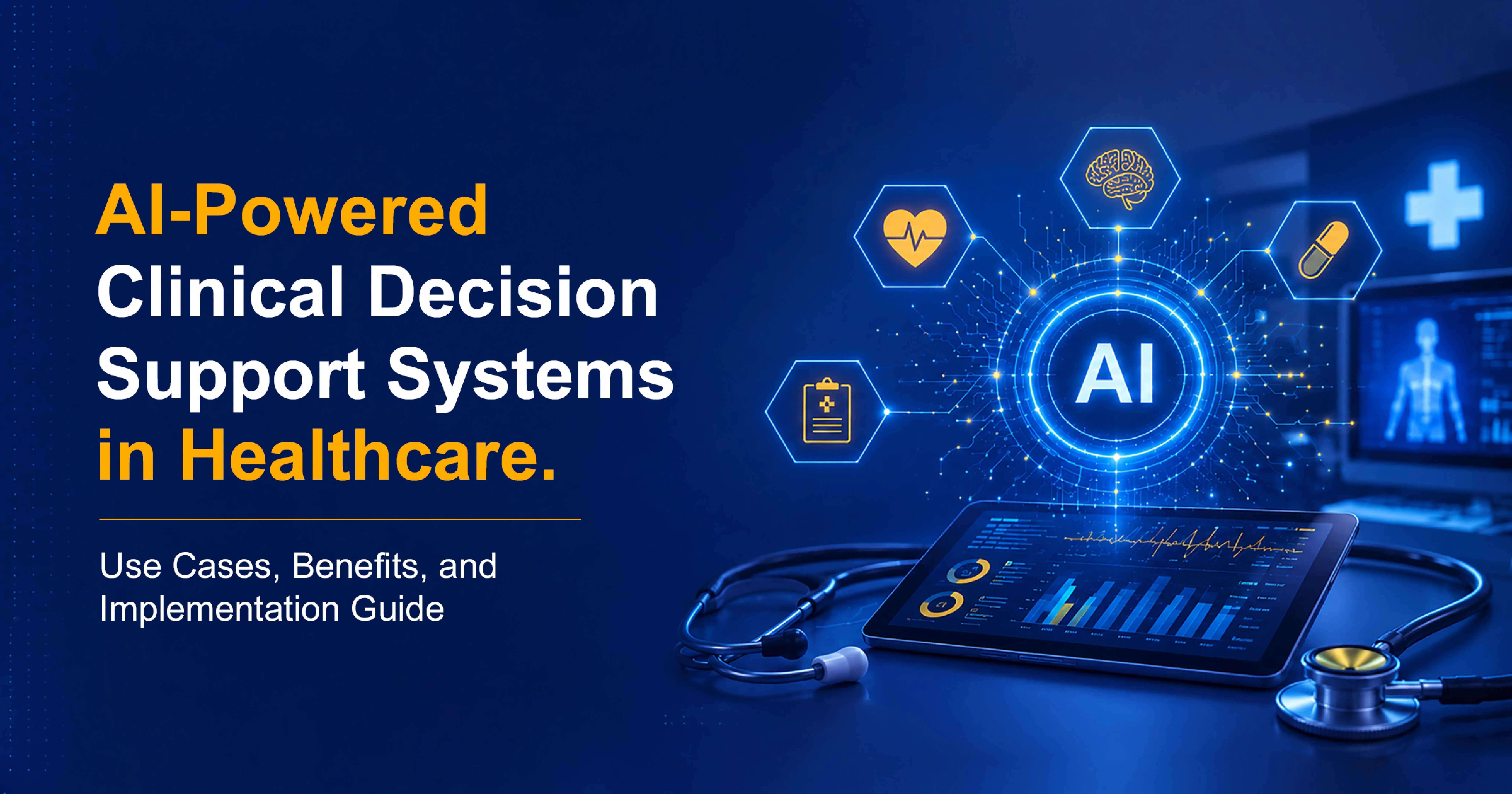
What are AI-Powered Clinical Decision Support Systems (CDSS)?
Healthcare has spent years digitizing information. Yet many clinicians would argue that having data and being able to use it effectively are two very different things.
What Is a Clinical Decision Support System?
At its core, a clinical decision support system is designed to help clinicians make better-informed decisions at the point of care.
Traditionally, CDSS has relied on predefined rules. If a patient has a documented allergy and receives a conflicting prescription, the system generates an alert. If a preventive screening is overdue, it sends a reminder.
But there is a limitation. Traditional systems can only identify situations they have been explicitly programmed to recognize. Healthcare, unfortunately, is rarely that predictable.
How AI Is Changing Clinical Decision Support
This is where AI-powered CDSS takes a different approach.
Rather than looking for a single trigger, AI analyzes patterns across multiple sources of clinical information simultaneously.
For example, a clinician reviewing a patient may see normal vital signs and routine lab results. An AI model, however, may detect a combination of subtle changes that resemble patterns seen in previous sepsis cases.
- Patients at risk of clinical deterioration
- Potential medication-related complications
- Readmission risks after discharge
- Emerging signs of serious conditions before symptoms become obvious
How AI-Powered CDSS Actually Works
From a user's perspective, an AI-powered CDSS may appear as a recommendation, risk score, or alert inside an EHR.
Behind the scenes, much more is happening.
The system continuously evaluates information from multiple sources, including:
- Electronic health records
- Laboratory results
- Medical imaging
- Medication histories
- Clinical notes
- Real-time patient monitoring systems
The real value of AI-powered CDSS comes from helping clinicians recognize meaningful risks when intervention is still possible. In healthcare, a few hours can change an outcome. Sometimes, even a few minutes. That's why decision support has evolved from simple alerts into systems that can help healthcare teams act earlier, prioritize better, and navigate increasingly complex clinical environments.
Key Use Cases of AI-Powered Clinical Decision Support Systems
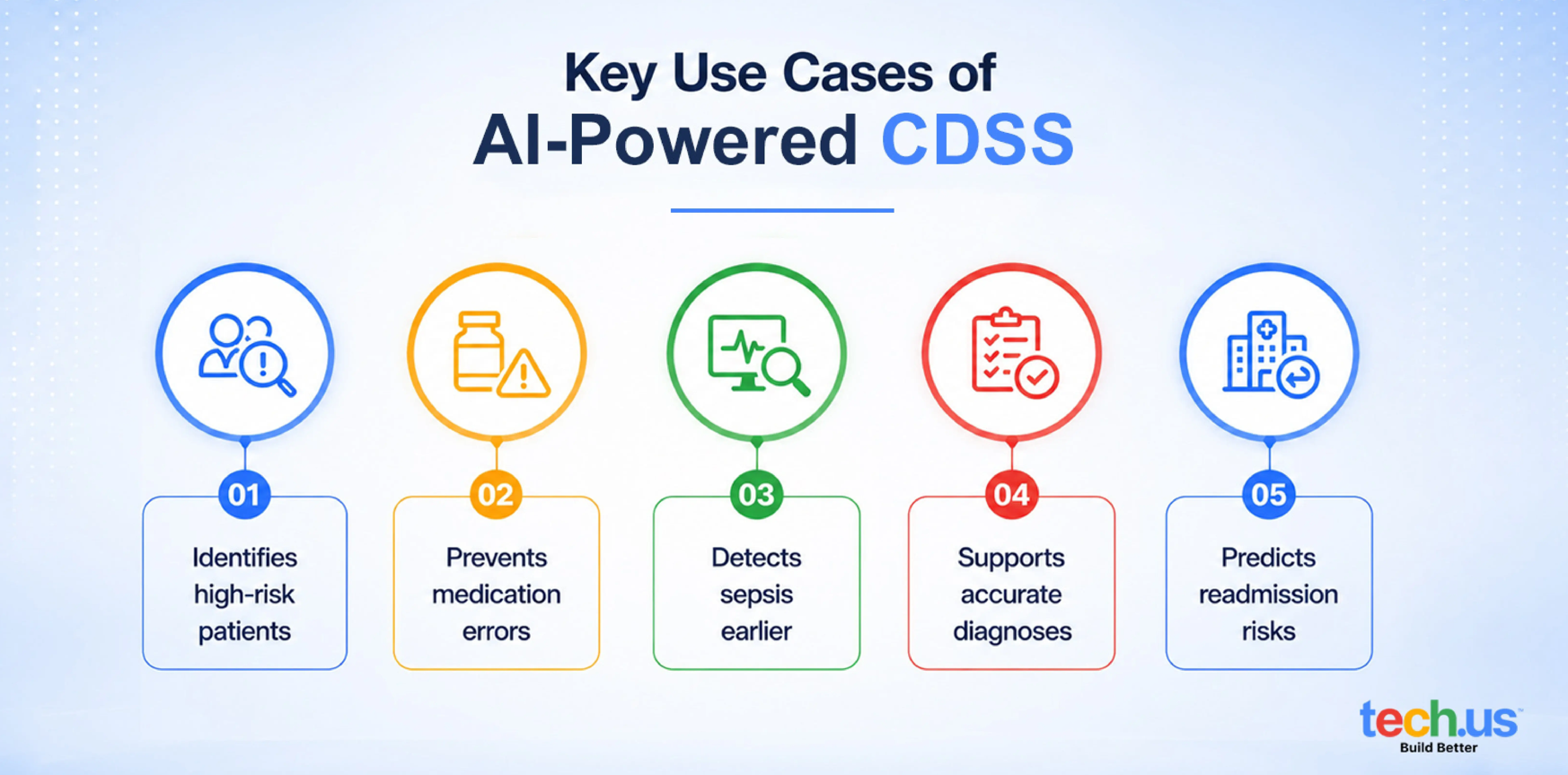
AI in healthcare can improve clinical decision-making with accuracy. That's true, but it is also vague.
The real question is this: where does AI-powered CDSS actually create value inside a healthcare environment?
The answer is not in some futuristic vision of autonomous medicine. The most successful implementations today are solving very specific clinical problems that providers deal with every day.
Patient Risk Stratification
One of the biggest challenges in healthcare is knowing which patients need attention before they become critically ill.
A patient with stable vitals may still be on a path toward deterioration. Another patient may have a history of missed appointments, unmanaged chronic conditions, and recent emergency department visits. Individually, these signals may not raise concerns. Together, they tell a very different story.
Instead of relying solely on clinician intuition or manual chart reviews, the system continuously evaluates hundreds of variables and surfaces patients who may require intervention.
- Chronic disease management
- Population health programs
- Care coordination initiatives
- Value-based care models
Medication Safety and Contraindication Detection
Over time, many alerts become background noise.
AI-powered CDSS takes a more contextual approach.
Rather than generating warnings based on a single rule, modern systems evaluate a broader clinical picture, including:
- Current medications
- Lab values
- Existing diagnoses
- Patient age
- Renal function
- Previous adverse reactions
Sepsis Prediction and Early Intervention
Few clinical conditions illustrate the value of predictive decision support better than sepsis.
Diagnostic Decision Support
Diagnosis is rarely a straightforward process.
They are helping clinicians ask better questions.
Readmission Risk Prediction
Every hospital wants to reduce avoidable readmissions. Yet predicting who is likely to return remains difficult.
Social determinants, medication adherence, previous utilization patterns, and post-discharge support can all influence outcomes.
What Benefits Do AI-Powered CDSS Deliver?
When people talk about the benefits of AI in healthcare, the conversation often becomes unrealistic very quickly.
You'll hear claims about replacing clinicians, eliminating errors, or completely transforming patient care overnight. That is not how things work in the real world.
The organizations seeing meaningful results from AI-powered CDSS are usually achieving something far less dramatic and far more valuable. They are helping clinicians make better decisions under pressure.
Supporting More Informed Clinical Decisions
Clinical decisions are rarely made with complete certainty.
A physician may be balancing incomplete information, conflicting symptoms, time constraints, and patient-specific factors all at once.
AI-powered CDSS does not remove that complexity. What it can do is reduce the likelihood that important signals get missed.
For example, instead of forcing clinicians to manually piece together trends across multiple encounters, systems can surface relevant findings at the point of care.
Improving Patient Outcomes Through Earlier Intervention
Many serious clinical events do not happen suddenly. They build. The challenge is recognizing deterioration before it becomes obvious.
This is where predictive decision support becomes particularly useful. When clinicians receive earlier visibility into potential risks, they gain something extremely valuable: time.
- Time to investigate.
- Time to escalate care.
- Time to intervene before a patient's condition worsens.
Reducing Preventable Medical Errors
Healthcare is complex because patients are complex.
A single patient may be taking multiple medications, seeing several specialists, and managing multiple chronic conditions simultaneously. That creates countless opportunities for oversight.
AI-powered CDSS helps by continuously evaluating information that would be difficult for any individual clinician to process manually at scale.
- Medication contraindications
- Drug interaction risks
- Allergy-related prescribing concerns
- Abnormal clinical trends requiring follow-up
Enhancing Care Team Efficiency
One of the less discussed benefits of CDSS has nothing to do with prediction models. It has to do with attention.
Clinicians spend a significant portion of their day determining what deserves attention first. AI-powered systems help prioritize that workload.
- The result is not necessarily fewer tasks. It is better allocation of clinical effort.
Helping Healthcare Organizations Manage Costs
Most healthcare executives eventually discover the same reality. Many of the highest costs are tied to events that organizations are trying to prevent in the first place.
- Unplanned readmissions.
- Clinical deterioration.
- Adverse drug events.
- Delayed interventions.
What it can do is help organizations identify risk earlier and make more targeted decisions about where to focus resources. Over time, those incremental improvements can create meaningful operational and financial impact.
What Should Healthcare Organizations Consider Before Implementing AI-Powered CDSS?
Start With a Clinical Decision
One of the most common mistakes healthcare organizations make is beginning with technology rather than a clinical problem.
The strongest CDSS implementations are usually tied to a specific decision point. It might be identifying patients at risk of sepsis, reducing medication-related adverse events, or improving discharge planning. The technology comes later.
Data Quality Matters More Than Model Sophistication
If It Disrupts Workflow, Clinicians Won't Use It
Clinicians Need Context, Not Just Alerts
Imagine receiving a notification that a patient has a high risk of deterioration. Most clinicians immediately want to know why.
- What changed?
- Which variables contributed to the risk score?
- How confident is the system?
The ability to explain recommendations often determines whether clinicians trust the system enough to act on it.
Clear Ownership Is Essential
Without clearly defined responsibilities, critical alerts can become everyone's responsibility and nobody's responsibility at the same time. Effective implementations establish escalation paths, response expectations, and accountability before deployment begins.
Deployment Is the Beginning, Not the End
Conclusion
That said, successful implementation depends on more than technology. Data quality, workflow integration, clinician trust, and ongoing governance all play a role.
FAQs
Think of it as a second set of eyes that never gets tired. It continuously reviews patient information and highlights patterns that may deserve attention, helping clinicians spot potential risks earlier than they otherwise might.
Traditional systems wait for a rule to be triggered. AI-powered systems look at the bigger picture. Instead of asking whether a single condition has been met, they assess how multiple clinical signals are evolving together and whether they resemble known risk patterns.
They can identify patients who appear to be moving toward sepsis before the warning signs become obvious. The value is not in predicting the future with certainty. It is in giving care teams more time to evaluate a patient and act if necessary.
Medication issues rarely happen because clinicians forget basic safety checks. Problems usually arise when important context gets overlooked. AI helps bring that context to the surface before a prescribing decision is made.
The answer depends on the use case. A sepsis model may rely heavily on vitals and lab trends. A readmission model may place greater weight on prior utilization patterns. What matters most is having data that accurately reflects what is happening with the patient.
Yes, and frankly, it has to. If clinicians are forced to leave their normal workflow to access recommendations, adoption drops quickly. The most effective systems operate within the EHR environment clinicians already use every day.
Most challenges have little to do with AI itself. The real work involves earning clinician trust, fitting recommendations into existing workflows, and making sure people know how to respond when the system identifies a risk.
No. In fact, the more advanced these systems become, the more important clinical judgment becomes. AI can identify patterns. It cannot understand a patient's circumstances, weigh competing priorities, or make treatment decisions on behalf of a clinician.

Tech.us is an AI development company that builds custom AI solutions for businesses seeking measurable results. We partner with organizations to design, develop, and deploy scalable AI systems that solve complex challenges and unlock new opportunities for growth. Our team delivers practical AI applications that create tangible business impact across industries.

Continue reading the blog
with a Tech.us subscription
You’re now subscribed!