blog-img

POPULAR POSTS

  • 01

    Top 10 Companies Offering Software Modernization Consulting Services in 2026

  • 02

    11 Proven Benefits of AI Chatbots for Businesses in 2025

  • 03

    How To Improve Document Processing Accuracy Using Document AI

  • 04

    What Digital Transformation Means for Businesses in 2026

  • 05

    What is Data Mining

How AI-Powered Clinical Decision Support Systems Improve High-Risk Patient Management

Published Date: July 02, 2026 , Written by: Anand Selvadurai , Category: Healthcare AI, AI in Clinical Support

tech.us-recognized-by-mobile-app-daily

TL;DR


  • High-risk patients often show signs before they are identified.
  • The challenge is connecting the dots fast enough.
  • Deterioration usually starts small, not suddenly.
  • AI helps care teams spot risk earlier.
  • The focus shifts from alerts to prioritization.
  • Clinicians can act sooner when risk is surfaced early.
  • Sepsis, readmissions, and ICU escalation are common use cases.
  • The best results come when AI supports, not replaces, clinical judgment.

Overview


In most hospitals, high-risk patients are not always invisible. That is the uncomfortable part.


Many of them are already showing signs. A lab value is moving in the wrong direction. A nurse has noticed a change. The patient has been admitted before for a similar issue. Their medication profile is complicated. Their vitals are not alarming yet, but they are no longer normal either.


So why are they still missed?


Because hospital teams are not looking at one patient in isolation. They are managing many patients, many signals, and many competing priorities at the same time.


This is where AI-powered Clinical Decision Support Systems, or CDSS, become useful. They are increasingly becoming part of broader healthcare software development services initiatives aimed at improving clinical decision-making and patient outcomes.


NHS England notes that patient deterioration can often be spotted through physiological changes and subtle warning signs, making early identification and escalation critical in acute care settings.
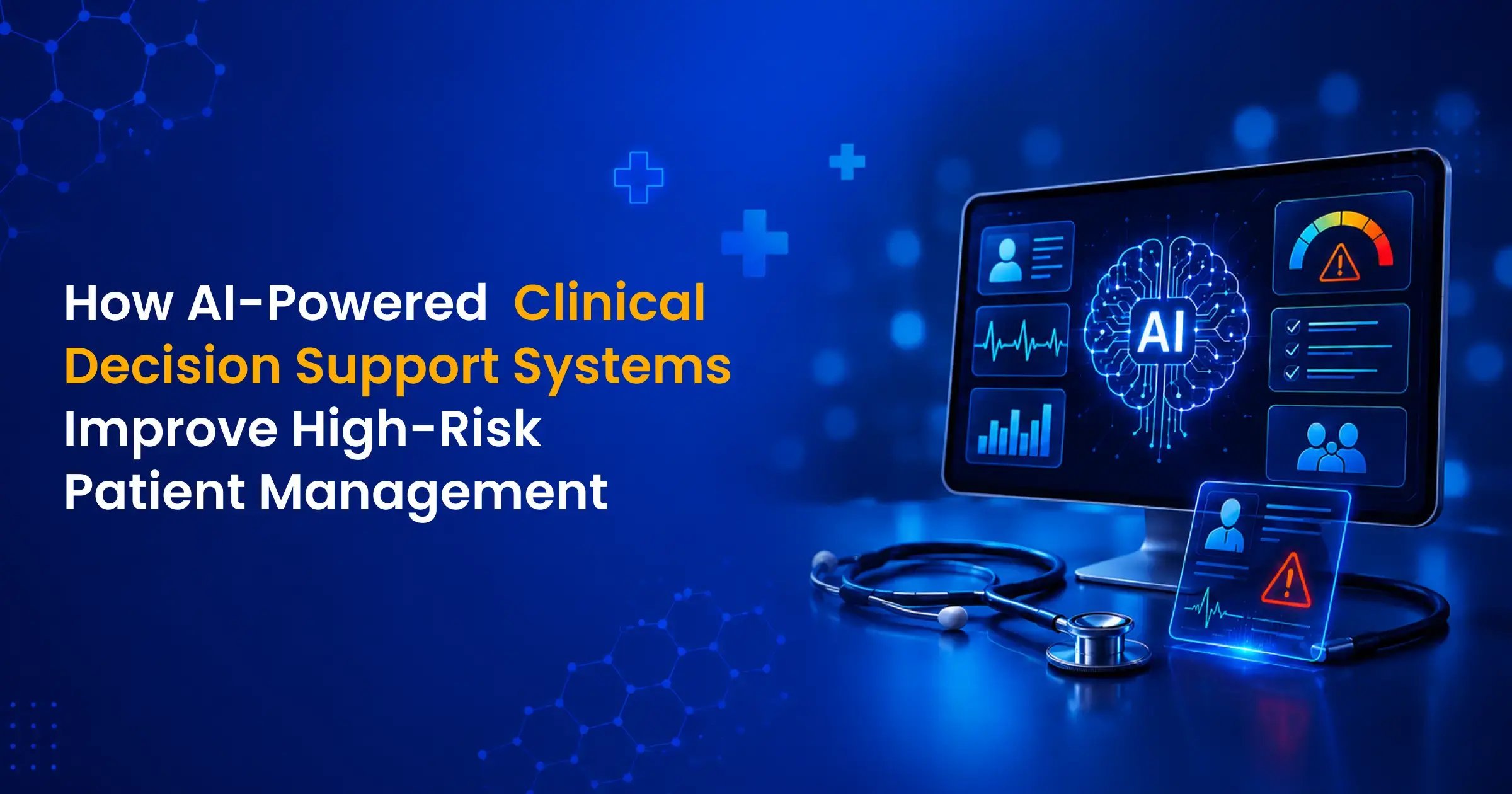

The real value of AI-powered CDSS is not that it “knows better” than clinicians. It is that it helps busy care teams see risk sooner, prioritize faster, and intervene before a patient’s condition becomes harder to control.


Why High-Risk Patients Are Often Identified Too Late


The common assumption is that hospitals struggle because they lack patient information.


In reality, the opposite is often true.


Most healthcare organizations have access to more patient data than ever before. The challenge is making sense of it quickly enough to act when it matters.


The Problem Isn't Missing Data. It's Connecting the Dots


Think about what a clinician encounters during a typical shift.


There are lab results coming in throughout the day. Vital signs being updated. Medication changes. New physician notes. Nursing observations. Imaging reports. Consult recommendations.


Each piece of information may be important. The problem is that they rarely arrive in one neat package.


A patient's risk profile is often spread across multiple systems, screens, and documentation workflows.


For example, a rising respiratory rate by itself may not trigger concern. Neither might a subtle increase in heart rate. Add recent lab abnormalities and a history of chronic illness, and the picture starts to look very different.


The challenge is that clinicians are expected to assemble that picture while managing dozens of other responsibilities at the same time.


Patient Deterioration Usually Starts Quietly


Hospital emergencies rarely begin as emergencies.


Most deteriorating patients do not go from stable to critical in a single moment. Their condition often changes gradually.


Small warning signs appear first:


  • Oxygen requirements begin increasing
  • Blood pressure trends downward
  • Laboratory values drift outside normal ranges
  • Mental status changes become noticeable

Individually, these changes may seem insignificant. Together, they can signal a patient whose condition is moving toward sepsis, respiratory failure, cardiac complications, or ICU transfer.


The difficulty is recognizing the pattern before the situation becomes obvious to everyone.


Too Many Alerts Can Be Just as Dangerous as Too Few


Healthcare technology was supposed to solve this problem.


In many cases, it created another one.


Most clinicians are familiar with alert fatigue. Electronic health records generate a constant stream of notifications, reminders, warnings, and prompts. Many are necessary. Some are not.


Over time, when everything appears urgent, it becomes harder to distinguish what is truly urgent.


The issue is not that hospitals lack alerts. It is that care teams need better prioritization.


What they really need is help answering a simple question:


Among all the patients under my care right now, who is most likely to need intervention next?


That is precisely the gap traditional clinical workflows have struggled to close, and one of the main reasons healthcare organizations are increasingly investing in AI in healthcare clinical operations to improve patient prioritization and care delivery.


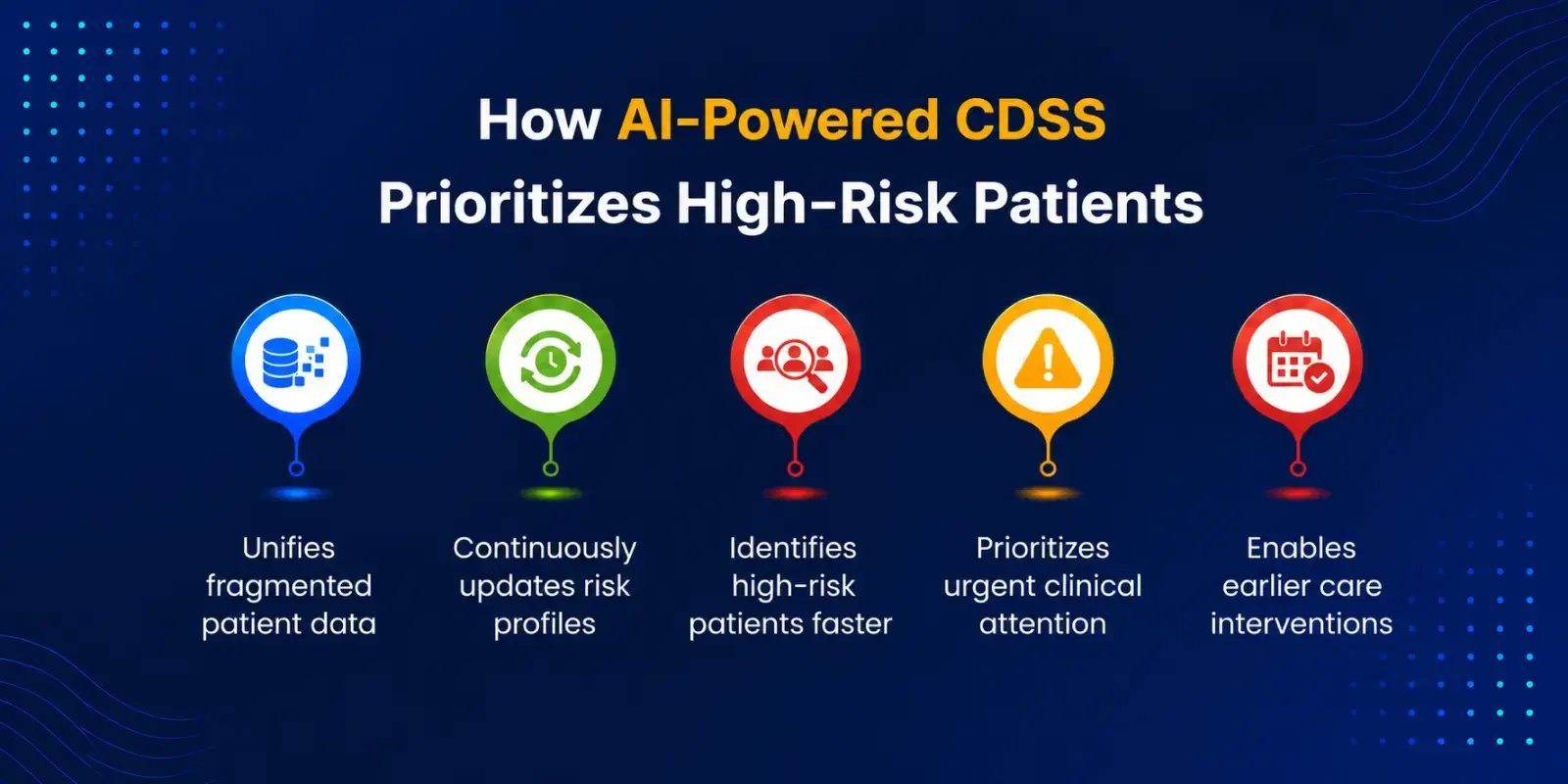
How AI-Powered CDSS Helps Healthcare Teams Prioritize High-Risk Patients

tech.us-recognized-by-mobile-app-daily

Once you understand why high-risk patients are often identified late, the next question becomes obvious.


How exactly does AI-powered CDSS help?


The answer is not that it replaces clinical judgment. Good clinicians are still making the decisions. What these systems do is help them see risk more clearly and earlier than they otherwise could.


Bringing Together Information That Normally Lives in Different Places


One of the biggest challenges in hospital environments is that patient risk rarely reveals itself in a single data point. Clinicians are constantly moving between different sources of information.


They review:


  • Vital signs
  • Laboratory results
  • Medication histories
  • Active diagnoses
  • Previous admissions
  • Nursing documentation
  • Specialist notes

Now imagine trying to connect all of those pieces for every patient under your care. Not impossible. But certainly not easy.


AI-powered CDSS can analyze these data sources simultaneously and look for relationships that might otherwise go unnoticed. This capability reflects the broader role of AI in healthcare as organizations move beyond automation and toward more proactive clinical decision support.


Take a patient with heart failure as an example.


A slight weight increase may not raise concerns on its own. Neither might a medication adjustment or a subtle change in kidney function. When those signals appear together, however, they can indicate a patient whose condition is beginning to worsen.


That is the kind of pattern AI systems are designed to identify. Not because the information is hidden. Because the connections are.


Risk Is Not Static. Neither Should Risk Assessment Be


One thing many people outside healthcare do not realize is how quickly a patient's condition can change. Someone who appears relatively stable during morning rounds may look very different six hours later.


Traditional clinical alerts often rely on fixed thresholds like blood pressure crossing a number or exceeded heart rates.


The problem is that deterioration does not always wait for a threshold to be crossed.


AI-powered CDSS takes a different approach. Instead of asking whether a single value is abnormal, it evaluates how a patient's overall risk profile is evolving over time.


In practical terms, that means the system is continuously reassessing risk based on new information as it becomes available.


The focus shifts from asking: "Is this patient currently unstable?" to "Is this patient becoming unstable?" That is a much more useful question when the goal is early intervention.


Helping Clinicians Decide Who Needs Attention First


A physician may be responsible for dozens of patients. Nurses are managing competing priorities throughout their shifts. Rapid response teams cannot evaluate everyone at once.


Resources are finite. Time is finite. Attention is finite. This is where prioritization becomes incredibly valuable.


Rather than generating another stream of notifications, modern AI-powered CDSS platforms can rank patients according to their likelihood of deterioration or adverse outcomes.


That changes the conversation. Instead of asking: "Which alerts came in today?" Care teams can focus on: "Which patients should we evaluate first?"


That may sound like a small difference. But, operationally, it is not.


It affects how teams allocate resources, conduct rounds, escalate concerns, and coordinate care across departments.


Supporting Earlier Intervention Before Conditions Escalate


The greatest value of prioritization is what happens next. When high-risk patients are surfaced sooner, care teams gain something incredibly important in healthcare: time.


  • More time to order additional testing.
  • More time to adjust medications.
  • More time to involve specialists.
  • More time to escalate care when necessary.

In many situations, clinicians are not trying to predict the future. They are simply trying to avoid being late.


That is why many hospitals are increasingly using AI-powered CDSS as part of broader patient deterioration and risk management programs.


The goal is not to replace clinical expertise. But it is simply to make sure expertise reaches the right patient before a preventable complication, ICU transfer, or emergency response becomes necessary.


Real Hospital Scenarios Where AI-Powered CDSS Makes a Difference


The value of AI-powered CDSS becomes much easier to understand when you look at how hospitals actually use it.


This is not about futuristic healthcare. These are practical situations that clinical teams deal with every day.


Detecting Sepsis Before It Becomes Obvious


Sepsis is one of the clearest examples.


The challenge is that sepsis rarely announces itself early. A patient may show a slightly elevated heart rate, a mild temperature change, and subtle shifts in laboratory values. Individually, none of those findings may seem alarming.


The risk emerges when those signals begin appearing together.


AI-powered CDSS can continuously monitor these patterns and flag patients whose clinical trajectory resembles previous sepsis cases. That gives clinicians an opportunity to investigate sooner, order additional testing, and begin treatment before the patient deteriorates further.


Identifying Patients Who Are Quietly Getting Worse


Not every high-risk patient is in obvious distress.


In fact, some of the most concerning cases are the ones that appear stable at first glance.


A patient's oxygen requirements may gradually increase. Blood pressure trends may begin drifting downward. Nursing notes may indicate subtle changes in responsiveness.


These are the situations where deterioration can be missed until a rapid response call becomes necessary.


By evaluating multiple data points simultaneously, AI-powered CDSS helps care teams recognize worsening conditions earlier and prioritize patients who need closer attention.


Prioritizing Patients at Higher Risk of Readmission


Readmission risk is another area where healthcare organizations are increasingly using AI.


Some patients leave the hospital carrying a higher likelihood of returning within weeks. The reasons are rarely simple. Previous admissions, chronic conditions, medication complexity, and social factors can all contribute.


AI-powered CDSS helps identify these patients before discharge, allowing care teams to focus follow-up resources where they are likely to have the greatest impact.


Supporting ICU Escalation Decisions


One of the most difficult questions in acute care is knowing when a patient needs a higher level of monitoring.


Escalate too late and outcomes may worsen.


Escalate too early and valuable ICU resources can become strained.


AI-powered CDSS does not make that decision for clinicians. What it can do is surface patients whose risk profile is changing, helping teams recognize when closer observation or escalation should be considered.


That additional visibility can be incredibly valuable in busy hospital environments where priorities are constantly shifting.


What Healthcare Organizations Need to Get Right


AI-powered CDSS can be incredibly valuable, but technology alone is rarely the deciding factor.


Many healthcare organizations discover that the biggest challenges are not technical. They are operational. In fact, many of the same obstacles that affect CDSS deployments are similar to the reasons enterprise AI initiatives fail to deliver results across industries.


Good Decisions Depend on Good Data


AI systems are only as reliable as the information they receive.


If patient records are incomplete, documentation practices vary across departments, or key clinical data is trapped in disconnected systems, the quality of decision support suffers.


This is why successful implementations typically begin with data readiness. Before organizations focus on algorithms, they need confidence that the underlying clinical data accurately reflects what is happening at the bedside.


Clinicians Need to Understand Why a Patient Is Being Flagged


Healthcare professionals are trained to question recommendations, and rightly so.


If a system labels a patient as high risk without any context, adoption becomes difficult. Most clinicians do not want a risk score alone. They want to understand what contributed to that assessment.


The most effective CDSS platforms help answer questions such as:


  • Which clinical indicators increased the patient's risk?
  • What changes occurred over time?
  • Why should this patient be prioritized now?

When clinicians can see the reasoning, trust tends to follow.


More Alerts Are Not the Answer


One mistake organizations make is assuming that identifying more risk automatically improves care.


It doesn't.


If every patient generates a warning, clinicians quickly become overwhelmed. The goal is not to create more notifications. It is to help care teams focus on the patients who genuinely need attention first.


The organizations seeing the greatest value from AI-powered CDSS are usually the ones that treat it as a prioritization tool, not simply another source of alerts.


To Sum Up


The challenge in modern healthcare is no longer collecting patient data. Hospitals already have plenty of it. The real challenge is knowing which patient needs attention before a situation becomes urgent.


That is where AI-powered clinical decision support systems are proving their value. That is where AI-powered clinical decision support systems are proving their value. For healthcare organizations evaluating vendors and technologies in this space, understanding the landscape of AI healthcare solution providers can be an important first step.


By helping care teams identify risk earlier, connect scattered clinical signals, and prioritize patients more effectively, they support faster and more informed intervention.


At its best, AI is not replacing clinical judgment. It is helping clinicians focus their expertise where it can have the greatest impact, often before a patient's condition takes a turn for the worse.

Tech.us

Tech.us is an AI development company that builds custom AI solutions for businesses seeking measurable results. We partner with organizations to design, develop, and deploy scalable AI systems that solve complex challenges and unlock new opportunities for growth. Our team delivers practical AI applications that create tangible business impact across industries.

1,500+ Projects
Delivered
25+ Years in
Business
30+ Industries
Served
100% Commitment
to Success

WRITTEN BY

Anand Selvadurai

Anand Selvadurai

Director of AI/ML at Tech.us

Director of AI/ML 16+ years experience AI/ML Specialist

Written by Anand Selvadurai, Director of AI & ML at Tech.us — 16+ years experience designing enterprise ML pipelines and deploying production-grade AI systems across Construction, healthcare, fintech, and logistics. Certified Machine Learning Specialist and Research Scholar.


View all articles
AI-Powered Clinical Decision Support Systems in Healthcare: Use Cases, Benefits, and Implementation Guide

AI-Powered Clinical Decision Support Systems in...

NEWSLETTER


RECENT POSTS


blog-img

How AI-Powered Clinical Decision Support Systems Improve High-Risk Patient...

blog-img

AI-Powered Clinical Decision Support Systems in Healthcare: Use Cases,...

blog-img

Before You Hire AI Engineers, Read This

blog-img

How to Create an AI Roadmap that Delivers Business Results

blog-img

Should You Build an In-House AI Team or Hire an AI Development Company?