Finding the right AI healthcare solution provider is harder than it looks.
The global AI healthcare market is projected to grow at 38.5% annually through 2030, according to Grand View Research. The demand is real. But so is the noise around it.
Most of the companies you surf through the weFRbsite will probably say the same things. HIPAA-compliant. EHR-integrated. Clinically proven. But when you actually dig in, the differences are stark.
Some have been building healthcare AI development software since before "AI" was a buzzword. Others are generalist dev shops that added a healthcare page to their website last year.
So how do you tell them apart?
- Clinical workflow compatibility
- HIPAA and FHIR compliance depth
- EHR and EMR integration experience
- Real AI capability vs. repackaged off-the-shelf tools
- Pricing transparency and team size
What to Know Before Hiring a Healthcare AI Development Company
Most healthcare organizations start the vendor search the wrong way.
They look at portfolios. They sit through demos. They get impressed by a slick interface and a list of Fortune 500 logos.
Then six months later, the project stalled. The integration is broken. And the AI that looked so good in the demo doesn't talk to their EHR system.
Sound familiar?
Here's what actually goes wrong:
Choosing on portfolio instead of compliance posture
A great case study means nothing if the vendor can't produce a signed HIPAA Business Associate Agreement on day one.
Mistaking a demo for a production-ready tool
Generative AI for healthcare providers is easy to demo. Clinical-grade, FHIR-integrated, EHR-connected systems are not. Know the difference before you sign anything.
Ignoring interoperability depth
Healthcare AI isn't a one-time build. Models drift. Regulations update. Workflows change. Who's maintaining it after go-live?
What Sets the Best Healthcare AI Companies Apart in 2026
Not every AI development company for healthcare is built for healthcare.
And that's not an opinion but a practical reality that costs organizations millions in failed implementations every year.
So what separates a genuine healthcare AI solution provider from a generic software shop with a healthcare landing page?
A few things. And they're non-negotiable.
Compliance is the foundation.
Any vendor worth considering should have HIPAA and HITECH compliance baked into their development process. Not bolted on at the end. Not handled by a checkbox on an intake form.
- Demonstrated HIPAA Business Associate Agreement experience
- HITECH-aligned data handling practices
- SOC 2 certification where applicable
Interoperability is where most vendors fall short.
- HL7 and FHIR integration standards
- EHR and EMR platforms like Epic, Cerner, AthenaHealth, Allscripts
- Mirth Connect and other integration engines
If a vendor can't speak fluently about AI EHR integration, that's a red flag.
Clinical context matters more than AI capability.
A powerful LLM model means nothing if it isn't trained on clinically relevant data or designed around actual clinical workflow automation. The best healthcare AI companies build tools that fit how clinicians actually work. Not the other way around.
AI capability has to go beyond the surface.
- Predictive analytics in healthcare for patient outcomes
- AI-powered clinical decision support
- Intelligent healthcare workflow automation
- Remote patient monitoring AI integrations
- NLP-driven clinical documentation
List of Top 10 Healthcare AI Development Companies in the USA
Here is the list of best AI companies for hospitals 2026 that offer end-to-end AI and software solutions for healthcare companies of all size, from colossal enterprises to emerging startups.
1. Tech.us
Tech.us has been in the healthcare AI development space for over two decades. Founded in 2000, they bring a level of institutional knowledge that most AI development companies for healthcare simply don't have.
They're not a company that pivoted to healthcare AI when it became trendy. This is a team that has spent 25+ years building enterprise-grade systems for hospitals, clinics, and Fortune 500 healthcare organizations.
Their approach combines AI and cloud engineering with a hybrid onshore-offshore delivery model. That means you get the communication and accountability of a US-based team with the scalability of a broader engineering bench.
What they focus on in healthcare:
- Custom healthcare software development and deep system integration
- AI and ML powered applications and cloud platforms
- HIPAA-sensitive, enterprise-grade systems built for clinical environments
Who benefits most from working with Tech.us:
- Hospitals and health systems needing custom AI solutions
- Healthtech startups that need a mature, experienced development partner
- Enterprises requiring complex healthcare software integrations
| Field | Details |
|---|---|
| Founded | 2000 |
| Employees | 50–249 |
| Hourly Rate | $49–$149/hr |
Choose a Healthcare AI Development Company You Can Trust
Book a Free Consultation2. TATEEDA GLOBAL
If compliance is your biggest concern when evaluating healthcare AI companies, TATEEDA GLOBAL deserves a close look.
- Custom healthcare software development and AI-powered virtual assistants
- EHR and EMR integrations including AthenaHealth and Allscripts
- HIPAA-compliant AI development for telehealth platforms and patient portals
- Healthcare workflow automation and AI-driven clinical applications
Who benefits most from working with TATEEDA GLOBAL:
- Biotech, medtech, and pharma companies building compliant AI healthcare solutions
- Hospitals and healthcare providers needing deep AI EHR integration
- Digital health startups requiring HIPAA-compliant AI development
| Field | Details |
|---|---|
| Founded | 2013 |
| Employees | 50 to 249 |
| Hourly Rate | $50 to $99/hr |
If your project combines EHR integration, FHIR data exchange, and AI-driven patient engagement, TATEEDA GLOBAL stands out as a focused, compliance-aware choice.
3. ScienceSoft
- Custom clinical and patient-facing applications built for security and performance
- AI and ML-based analytics, clinical decision support AI and healthcare data platforms
- Enterprise-grade software engineering and AI EHR integration for regulated environments
- Predictive analytics in healthcare and AI-powered clinical decision support systems
- Large hospital systems and health networks running complex infrastructure
- Healthcare providers needing secure, scalable AI solutions for hospitals
- Healthtech companies building enterprise-grade clinical software
| Field | Details |
|---|---|
| Founded | 1989 |
| Employees | 250 to 999 |
| Hourly Rate | $50 to $99/hr |
For large healthcare organizations, they’re one of the most reliable and credible choices, who combine deep regulated-industry experience with proven scalability.
4. LeewayHertz
If your healthcare organization is serious about Generative AI and LLM integration, LeewayHertz is one of the few companies on this list that genuinely specializes in it.
Founded in 2007, they've spent nearly two decades in product engineering. But in recent years they've made a deliberate shift toward AI-first development with custom AI agents, LLM-based solutions, and Generative AI healthcare platforms built for enterprise workflows.
- AI consulting and custom Generative AI development
- LLM-based solutions, AI agent development and intelligent healthcare copilots
- Automation tailored to enterprise clinical workflows
- End to end product engineering and deep system integration
Who benefits most from working with LeewayHertz:
- Hospitals and health systems exploring Generative AI for healthcare
- Healthtech startups wanting custom LLM integration into existing platforms
- Enterprises needing strategic healthcare AI consulting alongside hands-on development
| Field | Details |
|---|---|
| Founded | 2007 |
| Employees | 50 to 249 |
| Hourly Rate | $50 to $99/hr |
LeewayHertz stands out in 2026 for its proven experience building agentic AI and LLM-powered healthcare systems, which makes it a strong choice for organizations seeking advanced intelligent healthcare workflow automation.
5. Taction Software
- HIPAA-compliant healthcare software development and mobile and web applications
- EHR, FHIR, HL7 and Mirth Connect integrations and data interoperability
- AI and machine learning applications built for clinical environments
- Digital health platforms with deep system integration capabilities
- Hospitals and clinics dealing with complex EHR interoperability challenges
- Healthtech vendors needing HIPAA-compliant apps with real integration depth
- Mid-sized providers looking for cost-effective AI-enabled healthcare development
| Field | Details |
|---|---|
| Founded | 2013 |
| Employees | 50 to 249 |
| Hourly Rate | $25 to $49/hr |
Taction Software stands out for its deep interoperability expertise in FHIR, HL7, and Mirth Connect, offering healthcare organizations specialized integration capabilities at a highly competitive cost.
FREE RESOURCE
-
The 3 red flags that quietly disqualify 80% of vendors
-
Delivery process questions most firms dodge
-
How to assess technical fit with your existing stack.
6. Technosoft Solutions
What they focus on in healthcare:
- Outsourced software development and integration for healthcare solution providers
- Web and cloud applications, data processing and healthcare product development
- AI, NLP and clinical decision support AI implementations
- Medical imaging AI portals and complex healthcare data platforms
- Healthtech product companies needing a dedicated external engineering team
- Smaller healthcare providers building AI-enabled healthcare platforms on tighter budgets
- Organizations dealing with complex medical data, imaging and diagnostics portals
| Field | Details |
|---|---|
| Founded | 2002 |
| Employees | 10 to 49 |
| Hourly Rate | $25 to $49/hr |
Technosoft Solutions is a strong fit for startups and smaller healthcare providers needing affordable developers with genuine healthcare domain expertise and practical medical data experience.
7. Code Brew Labs
If your healthcare AI initiative is mobile-first, Code Brew Labs is a name worth having on your radar. Founded in 2013, they've built a strong reputation as a mobile and AI development partner for startups and enterprises across multiple industries. Healthcare is a significant part of that portfolio. And their combination of mobile-first engineering, AI capabilities and a larger team size makes them a versatile option for healthcare organizations that need more than just a backend system.
- Custom software development and mobile app development with AI-powered features
- AI solutions, data science and analytics for digital health products
- Cloud infrastructure and digital transformation for healthcare organizations
- Patient engagement platforms and analytics-driven healthcare applications
- Healthcare startups building AI-augmented mobile health applications
- Providers looking for patient engagement tools with built-in analytics
- Organizations needing end to end digital product development under one roof
| Field | Details |
|---|---|
| Founded | 2013 |
| Employees | 250 to 999 |
| Hourly Rate | $25 to $49/hr |
Code Brew Labs stands out in 2026 for its mobile-first approach to AI-powered patient engagement, making it a strong choice for organizations focused on intelligent and engaging mobile health experiences.
8. The NineHertz
- AI-driven platforms and enterprise automation for healthcare environments
- Data engineering and scalable digital product development
- Healthcare applications and platforms built for large-scale deployments
- AI-powered clinical workflow automation and patient engagement systems
- Large hospitals and health networks needing multi-region delivery capability
- Enterprises building AI-driven healthcare platforms at scale
- Healthcare organizations looking for a full-service digital engineering partner
| Field | Details |
|---|---|
| Founded | 2013 |
| Employees | 250 to 999 |
| Hourly Rate | $50 - $99 |
The NineHertz stands out for its global delivery scale and end-to-end digital engineering capabilities, making it a strong fit for healthcare organizations managing large, multi-region AI initiatives.
9. InData Labs
If your healthcare organization is dealing with complex data challenges, InData Labs operates in a different league to most vendors on this list.
Their entire team is built around data scientists, ML engineers and AI researchers. Over 100 of them. Plus an in-house R&D center that keeps them at the leading edge of applied AI development.
- Predictive analytics and ML modeling for clinical and operational use cases
- Computer vision solutions for medical imaging and diagnostics support
- NLP applications for clinical documentation and unstructured data
- Recommendation systems, forecasting models and R&D driven AI implementations
- Healthcare organizations tackling complex predictive analytics challenges
- Providers needing advanced medical imaging AI and computer vision solutions
- Health systems dealing with large volumes of unstructured clinical data
- Organizations that need genuine AI research depth rather than standard app development
| Field | Details |
|---|---|
| Founded | 2014 |
| Employees | 100+ AI specialists |
| Hourly Rate | $50 - $99 |
InData Labs stands out for its deep expertise in predictive analytics, medical imaging AI, and advanced data science, making it a strong choice for complex clinical AI initiatives.
10. Andersen
Founded in 2007, Andersen has grown into one of the largest software engineering organizations on this list. Over 3,500 engineers.
- Custom software development and AI implementations for healthcare and life sciences
- Enterprise-scale analytics, AI-powered clinical decision support and data platforms
- Broad technology stack including JS, Java, .NET, mobile and QA applied to healthcare products
- Large-scale healthcare data infrastructure and intelligent automation systems
Who benefits most from working with Andersen:
- Large hospital systems and health networks running enterprise AI programs
- Life sciences organizations needing sophisticated data platforms and AI decision support
- Digital health companies requiring a high-capacity engineering partner across multiple technology areas
| Field | Details |
|---|---|
| Founded | 2007 |
| Employees | 3,500+ |
| Hourly Rate | Custom pricing |
Andersen stands out for its enterprise-scale engineering depth and global delivery capacity, making it a strong fit for large healthcare organizations managing complex, long-term AI initiatives.
Comparing the Best Healthcare AI Companies
Before you dive deeper into any of these vendors, here's a side-by-side view of the key facts about AI healthcare consulting firms in the USA that matter most to healthcare procurement teams.
| Company | Employees | Hourly Rate | Best For | Key Compliance Focus |
|---|---|---|---|---|
| Tech.us | 50–249 | $49–$149/hr | Hospitals, healthtech enterprises needing custom AI platforms | HIPAA-sensitive systems |
| TATEEDA GLOBAL | 50–249 | $50–$99/hr | Biotech, medtech, pharma, EHR-heavy environments | HIPAA, HL7, FHIR |
| ScienceSoft | 250–999 | $50–$99/hr | Large hospital systems needing secure, scalable AI | HIPAA, HITECH, regulated industries |
| LeewayHertz | 50–249 | $50–$99/hr | Enterprises exploring Generative AI and LLM integration | Enterprise AI compliance |
| Taction Software | 50–249 | $25–$49/hr | Providers needing deep EHR interoperability | HIPAA, FHIR, HL7, Mirth Connect |
| Technosoft Solutions | 10–49 | $25–$49/hr | Healthtech startups, smaller providers on tighter budgets | Healthcare data and imaging |
| Code Brew Labs | 250–999 | $25–$49/hr | Mobile-first healthcare AI and patient engagement | Healthcare app compliance |
| The NineHertz | 50–249 | $50 - $99 | $50 - $99 | Enterprise AI standards |
| InData Labs | 100+ specialists | $50 - $99 | Complex predictive analytics and medical imaging AI | Healthcare data science |
| Andersen | 3,500+ | Custom pricing | Large-scale enterprise healthcare and life sciences programs | Enterprise-grade AI delivery |
Red Flags to Watch Before You Sign a Contract with a Healthcare AI Company
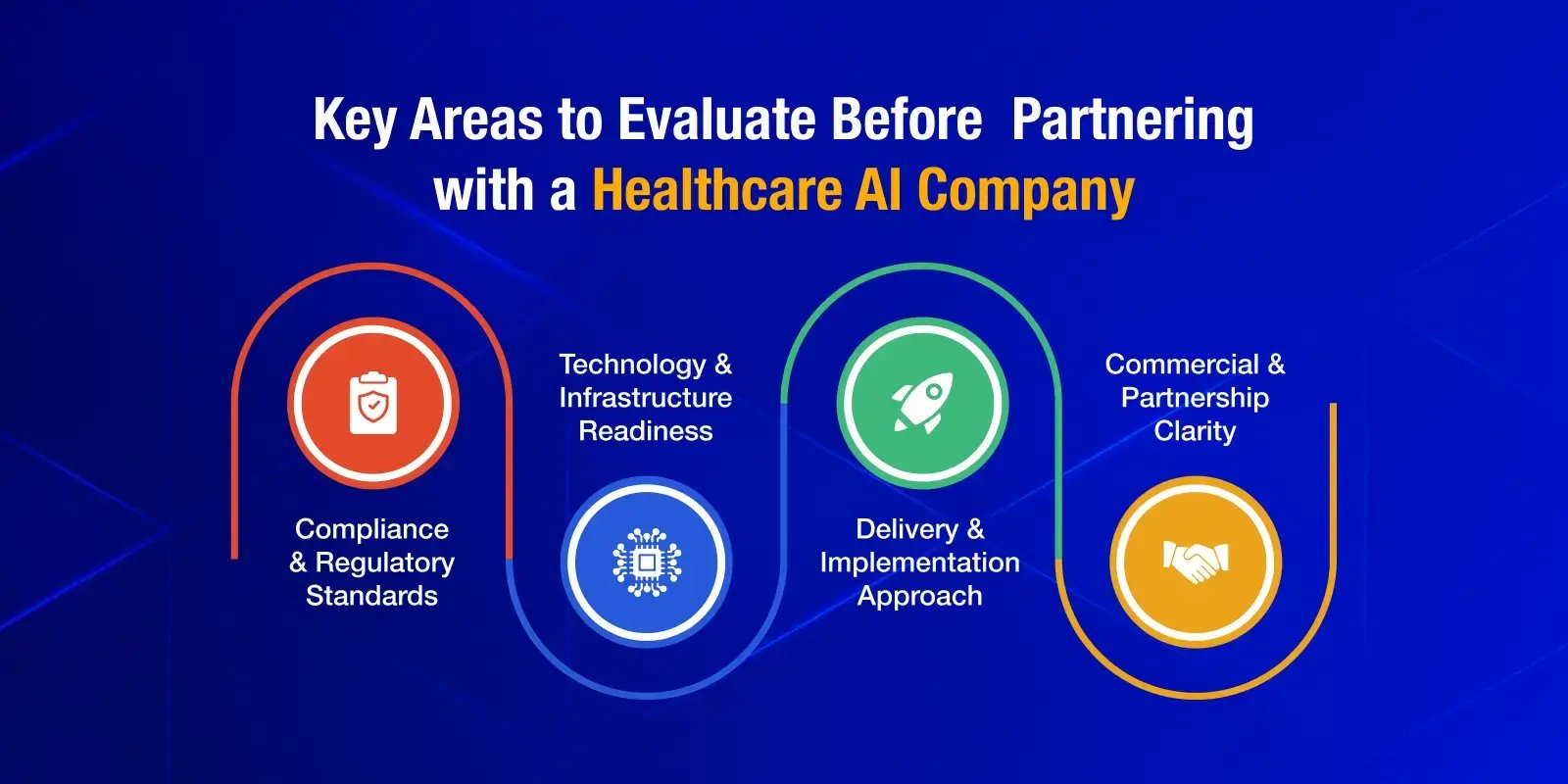
The right vendor won't just impress you in the demo. They'll hold up under scrutiny. Here's what to watch for before you commit.
Compliance red flags:
- They can't clearly answer who owns the AI model built on your patient data.
- HIPAA gets mentioned in the pitch but disappears when you ask technical questions.
- No clear answer on where your patient data is stored and who can access it.
Technical red flags:
- They go vague when you ask about HL7, FHIR or EHR integration specifics.
- The demo uses perfect synthetic data. Ask what happens with your actual clinical data.
- They pitch LLM-powered tools but can't explain how they handle hallucinations in clinical contexts.
- Case studies sound impressive but show no real EHR or interoperability work.
Delivery red flags:
- Nobody mentions offshore handoffs until after the contract is signed.
- The timeline sounds too good. Clinical-grade healthcare AI takes time to build right.
- There's no clear plan for what happens after go-live. Who maintains the system? Who updates it when regulations change?
Commercial red flags:
- Low hourly rate with no transparency on who's actually doing the work.
- References are from non-healthcare clients only.
- They're pushing you to sign fast. Good healthcare AI consulting firms know this decision takes time.
FAQs
Most on this list serve both, but the fit varies. Companies like Andersen and ScienceSoft are better suited for large hospital systems, while companies like Tech.us, Technosoft Solutions and Code Brew Labs are more accessible for both smaller providers as well as enterprises.
Hourly rates on this list range from $25 to $99 per hour, however, these are approximate figures. The total project cost depends heavily on integration complexity, compliance requirements and team size among other things.
It depends entirely on how the healthcare AI development vendor structures everything from data access to security protocols and compliance accountability. Always confirm data residency, access controls and HIPAA compliance before any project begins.
A focused integration project can take three to six months. A full clinical AI platform build typically runs twelve months or longer depending on compliance requirements and EHR complexity.
Yes, but selectively. In 2026, the most common clinical applications are documentation automation, including intelligent document processing, diagnostic assistance and patient communication. Full autonomous clinical decision-making remains heavily regulated and closely supervised.
If you’re having a hard time choosing the best AI development vendor, we have curated a list of 10 most trusted AI development vendors for your business. Check that out.
Tech.us is an AI development company that builds custom AI solutions for businesses seeking measurable results. We partner with organizations to design, develop, and deploy scalable AI systems that solve complex challenges and unlock new opportunities for growth. Our team delivers practical AI applications that create tangible business impact across industries.