blog-img

POPULAR POSTS

  • 01

    How To Improve Document Processing Accuracy Using Document AI

  • 02

    Top 10 Companies Offering Software Modernization Consulting Services in 2026

  • 03

    11 Proven Benefits of AI Chatbots for Businesses in 2025

  • 04

    What Digital Transformation Means for Businesses in 2026

  • 05

    What is Data Mining

How AI in Healthcare Optimizes Clinical Operations

Published Date: May 19, 2026 , Written by: Tech.us , Category: AI, Artificial Intelligence, Healthcare

tech.us-recognized-by-mobile-app-daily

What Happens Before a Doctor Even Sees the Patient

Walk into any busy hospital at 7 a.m. and the chaos is already in full swing. Not the clinical kind. The operational kind.


Beds waiting to be assigned. Nurses pulling up patient charts on systems that don't talk to each other. Admission paperwork moving at the speed of fax machines. A patient sitting in a corridor because nobody has a clear picture of where they should go next.


This is the part of healthcare nobody photographs for the annual report.


The majority of inefficiency in a hospital doesn't happen in the operating room. It happens in the thirty minutes before a physician ever sets eyes on a patient. It lives in the handoffs, the data gaps, the scheduling mismatches, and the administrative weight that bends every clinical workflow out of shape.


The numbers are hard to ignore. Total hospital expenses grew 7.5% in 2025, more than twice the rate of growth in hospital prices over the same period, with increases across every major category as per American Hospital Association, Costs of Caring 2026.

At the same time, a nurse in a 12-hour shift spends an average of 132 minutes just documenting patient information in the EHR system according to AHA, 2025. It’s time that could be spent with patients, not keyboards.


And yet, nearly nine in ten nurses report that administrative burden has negatively impacted patient clinical outcomes, according to a study by AHA, 2023.


That is not a technology problem. That is a clinical operations problem. And it has been hiding in plain sight for decades.


This is exactly where AI in healthcare, particularly clinical operations is beginning to change the game.


Predictive analytics in hospital operations, smarter bed allocation, ambient documentation, AI-powered discharge planning tools as these are not experiments anymore.


More than 80% of health system executives are now prioritizing AI specifically for clinical operations and care delivery as per a Deloitte study, and the systems moving fastest are the ones treating AI not as a feature, but as operational infrastructure.


This blog breaks down exactly how that works. Every stage of the patient journey, from admission to discharge, and the specific role AI plays at each one.


What is AI in Clinical Operations?


Most people hear "AI in healthcare" and immediately picture a diagnostic algorithm spotting cancer on a scan or a robotic arm threading a suture. That image is not wrong. But it describes clinical AI, which is entirely different from what we are discussing in this blog. The actual role of AI in healthcare is far beyond this.


What is clinical AI?


Clinical AI is what most people picture when they hear artificial intelligence and healthcare in the same sentence. It lives inside the diagnostic process. It includes everything like:


  • The algorithm that reads a chest X-ray and flags a nodule a tired radiologist might miss at 11 p.m.
  • The natural language processing engine that combs through a patient's unstructured clinical notes to surface a drug interaction risk.
  • The predictive model that calculates a sepsis probability score before the bedside nurse sees the first symptom.

In simple terms, clinical AI is, at its core, a tool for clinical decision support, which augments the physician's judgment.


What is operation AI?


Operational AI is also called AI in clinical operations. It is the intelligence layer that embedded as a result of elaborate AI development services that sits across workflows, scheduling, documentation, and resource allocation, the crucial machinery that determines whether a hospital runs at the standard its clinicians are trained to deliver.


It does not care about what diagnosis a patient receives. It cares about:


  • Whether the right bed is available when that patient needs it.
  • Whether the nurse assigned to that ward has the right patient ratio to deliver safe care.
  • Whether the discharge summary gets completed before the patient's insurance window closes.

Whether the information from one department actually reaches the next one before the patient does.


So what exactly is the difference?


Clinical AI vs Operational AI in Hospitals


Clinical AI

AI in Clinical Operations

Focus

What happens TO the patient

How the hospital RUNS around the patient

Examples

Diagnostic imaging, treatment recommendations, drug interaction alerts

Bed allocation, discharge planning, staffing optimization, documentation automation

Primary user

Physicians, radiologists, clinicians

COOs, nurse managers, care coordinators, hospital administrators

Goal

Better clinical decisions

Faster, leaner, safer workflows

Measures success by

Diagnostic accuracy, survival rates

Length of stay, throughput, claim denial rates, staff hours saved


Think of it this way. Clinical AI helps a doctor decide what to do. Operational AI helps the hospital make sure it can actually do it, that too, efficiently, on time, and without burning out the people responsible for delivering it.


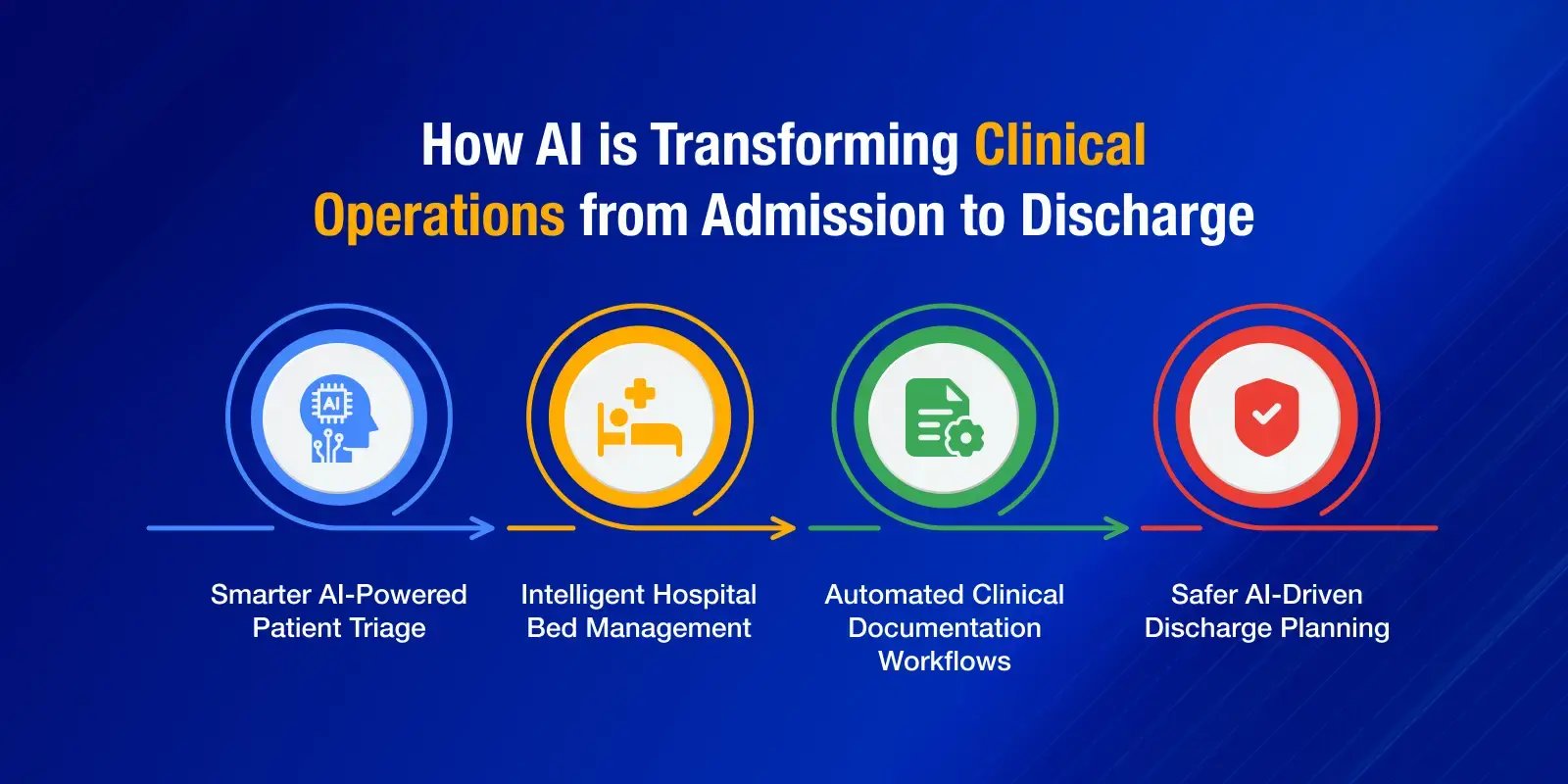
AI in clinical operations sits at the intersection of three layers every hospital runs on simultaneously:


tech.us-recognized-by-mobile-app-daily

AI-Powered Triage and Patient Admission: How Hospitals Cut Wait Times Before Treatment Begins


Ask any emergency department nurse what the most stressful part of their shift is, and very few will say "the clinical decisions." Most will describe the admission process itself. The waiting.


The uncertainty of not knowing which patients need a bed right now versus who can safely wait. That gut-feel guesswork happening under pressure, with incomplete information, at the start of every single patient encounter.


That is the problem AI triage is built to solve.


How AI Triage Tools Predict Patient Acuity Before a Nurse Reads a Chart


Traditional triage is sequential. A patient walks in, a nurse assesses them, a score gets assigned, and then the system waits. AI changes that sequence entirely. The moment a patient registers, machine learning models are already pulling from:


  • Vital signs captured at intake
  • Chief complaint language parsed through NLP
  • Historical EHR data including prior visits and comorbidities
  • Real-time census data on how stretched the department already is

A 2025 Mount Sinai study published in Mayo Clinic Proceedings: Digital Health trained a model on more than one million ED visits across multiple hospitals and ran it against predictions from over 500 triage nurses.


The AI outperformed nurses in predicting admissions.


More importantly, admission prediction information could be used to initiate steps in the admission process hours earlier than would otherwise be possible, as per Mount Sinai, 2025.


According to Healthcare IT News, for a bed manager, that window is the difference between a patient flowing to an inpatient unit smoothly and spending four hours on a hallway stretcher.


Predictive Intake: Flagging High-Risk Patients at the Front Door


The patients who deteriorate unexpectedly are rarely the ones who arrived looking critical. They are the ones whose risk was underweighted because the nurse had six patients and twelve minutes.


AI predictive intake addresses this by scoring every patient continuously, not just once at registration. In practice, that looks like:


  • A 68-year-old presenting with vague fatigue getting flagged based on cardiac history, subtle vital sign drift, and medication profile, before a physician orders a workup
  • A patient's triage note being read by NLP, not just their complaint code, producing a fundamentally different risk score for two patients with identical presentations
  • High-risk patients being surfaced to charge nurses in real time, enabling earlier physician involvement and pre-emptive bed reservation

From Hours to Minutes: Real Admission Time Reductions AI Has Delivered


The numbers across real deployments tell a consistent story:


  • One study by Matada Research reported a 30% reduction in average patient wait times after implementing a real-time AI triage system
  • A retrospective study by PubMed across 154,347 ED visits at St. Antonius Hospital found a median time saving of 111 minutes for true positive predicted patients
  • ML-based triage models across 26 peer-reviewed studies consistently achieved AUC values above 0.80 for predicting ICU transfers and hospital admissions

Translate that 111-minute saving across daily ED volume and the operational impact compounds fast. It is not just patient experience. It is bed availability, downstream throughput, and earlier decisions rippling across every department that patient eventually touches.


The front door of a hospital is the beginning of a chain reaction. Get it right, and every step downstream becomes more manageable. Get it wrong, and every department pays the price.


How AI-Powered Hospital Bed Management and Patient Flow Solve the Bottleneck Inside the Wards


A hospital bed is not just furniture. It is a scheduling problem, a financial unit, a safety variable, and a patient outcome decision compressed into one physical object.


And most hospitals still manage it the way they managed it thirty years ago, manually, reactively, and always slightly behind what is actually happening on the floor.


Why Bed Management is the Biggest Operational Failure Point in Most Hospitals


Every charge nurse and COO knows this scenario. A patient in the ED is cleared for admission. A bed is technically available.


But the prior discharge paperwork is pending, housekeeping has not confirmed the clean, and the ward coordinator does not know yet. So the patient waits. The ED backs up. Everything downstream compounds.


According to ScienceDirect, hospitals in the NHS routinely operate at or above 90% capacity, resulting in cascading delays in admissions and patient transfers.


That is not an anomaly. It is the baseline for most high-volume systems running without intelligent capacity planning.


How AI Patient Flow Management Keeps Every Ward Moving in Real Time


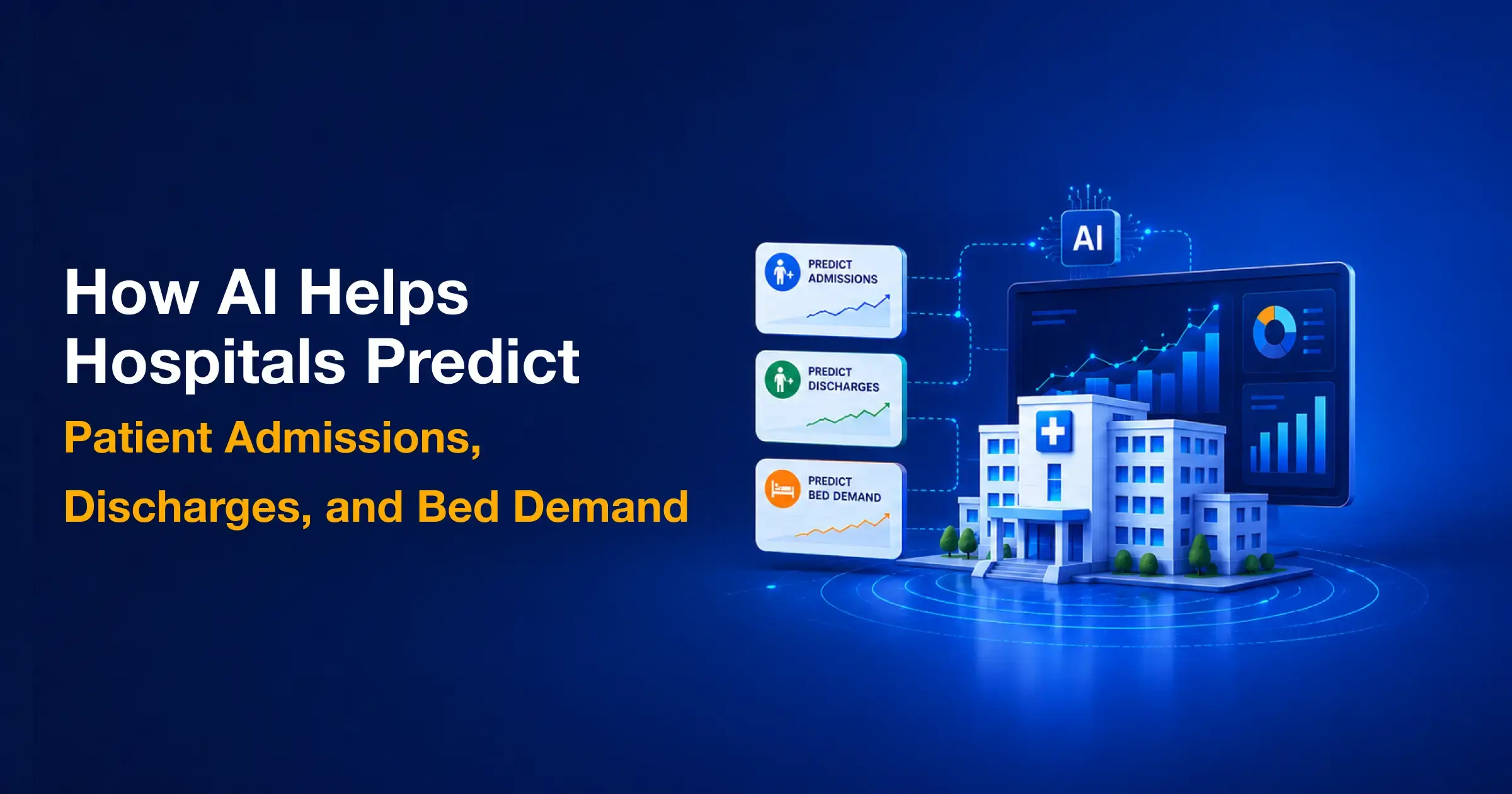
AI-powered bed management does not just track occupancy. It predicts it. What that produces operationally:


  • Beds flagged for incoming patients before discharge is formally complete
  • Predicted surge windows surfaced to bed managers hours in advance
  • Pharmacy and diagnostics bottleneck automatically escalated to the right coordinator
  • Real-time census data feeding allocation decisions across every ward simultaneously

Research on AI-driven scheduling found patient waiting times reduced by 37.5% and bed occupancy efficiency improved by 29% because of AI intervention. For a 400-bed hospital running near capacity, that is not a marginal improvement. It is a structural unlock.


AI Nurse Staffing Optimization: Better Patient Ratios Without Adding Headcount


Staffing is where bed management collides with human reality. The right bed available means little if the nurse covering it already has six patients and has been on shift for ten hours.


Some studies found that generative AI and automation can give nurses more time for direct patients. That time is recovered by eliminating the administrative drag pulling nurses away from patients. In practice, AI staffing tools deliver:


  • Shift assignments built around patient acuity scores, not just headcount
  • Early burnout risk flags based on overtime patterns and shift swap frequency
  • Real-time redeployment recommendations across units before ratios become unsafe
  • Predictive scheduling that reduces dependence on expensive contract labor

Most scheduling systems today cannot see the difference between a high-acuity post-surgical ward and a step-down unit. AI-driven staffing optimization can, and it acts on that difference before the shift begins, not during it.


How Ambient AI Documentation and Medical Coding Automation Free Up Clinical Staff


There is a version of a physician's day the public rarely sees. The patient visit ends at 4 p.m. The documentation finishes at 9 p.m. In the profession, they call it pajama time, which is hours spent charting after families have gone to sleep.


Not because clinicians are inefficient. Because the documentation burden inside most hospitals is genuinely that crushing.


This is the problem ambient AI documentation was built to solve. And it is reaching well beyond the physician's desk.


How Ambient AI Scribing Works in Hospitals, and Why Physicians are Gaining 2+ Hours Per Shift


Ambient AI scribing tools listen to the clinical conversation, interpret it using NLP in real time, and generate a structured note the clinician reviews and approves.


No typing mid-consultation. No after-hours catch-up. The doctor-patient interaction stays exactly that.


What this produces across a clinical team:


  • Physicians stay present during consultations instead of eyes-down on a keyboard
  • Clinical notes get completed during the encounter, not three hours after it
  • Cognitive load drops significantly across shifts, which directly affects staff retention
  • Time recovered from documentation flows back into direct patient care

One nurse at Mercy Health reported saving approximately two hours of charting in a single 12-hour shift after implementing ambient AI documentation tools, according to the American Hospital Association. That is not a productivity footnote. For a CNO managing retention in a nursing shortage, it is a workforce strategy.


AI in Medical Coding and Billing: Fewer Claim Denials, Less Revenue Leakage


Clinical documentation does not just affect patient care. It determines what a hospital gets paid. And right now, the revenue cycle has a documentation problem at its core.


Coding errors, missing elements, and eligibility mismatches are the leading drivers of claim denials. AI in medical coding and billing addresses each one:


  • Reviewing documentation in real time to flag missing elements before a claim is submitted
  • Applying ICD-10-CM and CPT rules consistently, without the fatigue a human coder carries at hour six
  • Scoring claims for denial risk before submission and routing high-risk ones for human review
  • Automating payer-specific appeal letters when denials do occur

For CFOs watching revenue leakage month after month, this is where AI in clinical operations starts paying for itself visibly.


Staying Audit-Ready: AI for Regulatory Compliance Without Manual Checklists


Regulatory compliance like HIPAA compliance and GDPR is not a quarterly exercise. It is a daily operational reality that most teams still manage through manual checklists and collective anxiety.


AI embeds compliance monitoring directly into clinical workflows, flagging documentation gaps as they happen rather than surfacing them during an external review.


In practice, that means:


  • Continuous monitoring replacing point-in-time audits
  • Payer policy and regulatory updates applied automatically across workflows
  • Documentation integrity issues caught before they become audit findings

For compliance officers, the shift is from reactive firefighting to something much closer to structural peace of mind.


AI Discharge Planning Tools: Getting Patients Out Safely and Preventing Costly Readmissions


Here is something most hospital leaders know but rarely say out loud. The discharge process is where good clinical work quietly falls apart.


A patient gets medically cleared. Someone starts coordinating. And by that point, the gaps have already formed. Social work was not looped in early enough.


The patient's home situation was never properly assessed. The follow-up appointment is still unbooked. The prescription is still unfilled. Three weeks later, that same patient is back through the ED.


This is not a clinical failure. It is a coordination failure. And it is extraordinarily expensive.


Why Discharge Planning Fails, and What It Costs U.S. Hospitals Every Year


The core problem is timing. Discharge planning in most hospitals begins when a patient is nearly ready to leave, which is exactly the wrong moment to start. By then, every barrier to a safe discharge is already a crisis rather than a manageable task.


A 2025 Vizient report found that over 25% of readmissions occur at a different hospital entirely, adding $21 billion annually in excess costs and creating dangerous gaps in care coordination.


That number does not include CMS financial penalties under the Hospital Readmissions Reduction Program. It is purely the cost of patients falling through the cracks between one visit and the next.


How Hospitals Use AI to Prevent 30-Day Patient Readmissions


AI discharge planning tools fix the timing problem first. Predictive models begin building a discharge picture from day one of admission, not the morning a physician writes the discharge order.


In practice, that means:


  • High-risk patients flagged within hours of admission based on diagnosis, social history, and prior utilization patterns
  • Predicted discharge dates generated automatically and updated as clinical status changes
  • Barriers like missing follow-up bookings or unfilled prescriptions surfaced to coordinators before they become problems
  • Social determinants of health factored into the readmission risk score, not ignored because they are hard to quantify

AI-Coordinated Post-Discharge Care: Bridging the Gap Between Hospital and Home


The most dangerous moment in a patient's journey is not during surgery. It is 72 hours after they go home. They have instructions they may not fully understand, medications they may not take correctly, and warning signs they may not recognize.


AI-coordinated post-discharge care addresses exactly this through:


  • Automated check-ins via SMS or patient portal in the days following discharge
  • Remote monitoring data feeding back to the care team in real time
  • Escalation alerts when responses suggest the patient is deteriorating
  • Clean handoff of clinical context to primary care before the first outpatient appointment

A hospital that knows what happens to its patients after they leave is one that can actually control the outcomes it is being judged on.


What Hospitals Get Wrong When Implementing AI in Clinical Operations


Every failed AI implementation in healthcare has one thing in common. It was not a technology problem. It was a process problem wearing a technology costume.


Plugging AI Into a Broken Process Just Automates the Problem


If your discharge coordination workflow is chaotic, an AI discharge tool will produce chaotic outputs faster. That is not progress. That is expensive noise.


Before any AI deployment in clinical workflows, the honest question is not "which vendor should we choose?" It is "do we actually understand the process we are trying to improve?"


Most hospitals skip that question entirely. They buy the tool and wonder why adoption stalls six months later.


The EHR Integration Problem Nobody Mentions


Every vendor demo runs on clean, complete, beautifully structured data. Your EHR does not look like that. It has legacy fields, inconsistent coding practices, missing values, and interoperability gaps that nobody documented.


AI models trained on pristine datasets behave very differently when they meet real hospital data. This is the conversation that happens after the contract is signed, rarely before.


For CIOs evaluating AI platforms, EHR integration depth is not a technical footnote. It is the deciding factor between a tool that works and one that sits unused.


The Human-in-the-Loop Challenge Hospitals Underestimate


AI in clinical operations is not a replacement for clinical judgment. It is a decision-support layer. The moment a hospital treats an AI output as a final answer rather than an informed recommendation, the risk profile of that system changes completely.


Human-in-the-loop AI means clinicians and coordinators review, validate, and act on AI recommendations rather than simply executing them. It is slower than full automation. It is also the only version that is safe, defensible, and trusted by the staff who actually use it.


The hospitals getting AI right are not the ones moving fastest. They are the ones building carefully.


In a Nutshell


The hospital of 2030 will not stand out because it uses more AI, but because that AI simply works in the background, supporting clinicians without getting in the way. It will feel less like new technology and more like a natural part of care delivery.


Getting there comes down to choosing the right partner. Some companies bring scale but can feel distant, while smaller teams offer attention but may struggle to deliver at scale.


Tech.us finds a comfortable middle ground, combining strong engineering capability with a hands-on, client-focused approach that actually supports how healthcare teams operate day to day.


FAQs


What is the difference between clinical AI and operational AI in hospitals?


Clinical AI supports medical decisions at the bedside like diagnostic imaging or drug interaction alerts. Operational AI runs the systems around the patient, that includes bed allocation, discharge planning, staffing, and documentation. One helps clinicians decide what to do. The other ensures the hospital can actually do it.


How does AI reduce patient wait times in hospitals?


By predicting admission likelihood at triage, AI gives bed managers a head start on placement decisions, and sometimes hours earlier than traditional workflows allow. That early signal is what converts a four-hour corridor wait into a coordinated, timely admission.


How do hospitals use AI to prevent patient readmissions?


Predictive models flag high-risk patients from day one of admission, not the morning of discharge. This gives care coordinators time to address barriers like missing follow-ups, unfilled prescriptions, and inadequate home support before they become a 30-day readmission.


How does ambient AI scribing work in hospitals?


The tool listens to the clinical conversation in real time, interprets it using natural language processing, and drafts a structured clinical note for the clinician to review and approve. The physician stays present with the patient. The documentation gets done during the encounter, not hours after it.


Which hospital departments benefit most from AI in operations?


Emergency departments see the most immediate gains through faster triage and admission prediction. But the compounding benefits sit in bed management, nursing coordination, revenue cycle, and discharge planning, which forms the operational backbone that every clinical department depends on.


How long does it take for a hospital to see ROI from AI in clinical operations?


It depends heavily on implementation quality and workflow readiness. Ambient documentation tools tend to show measurable time savings within weeks. Bed management and discharge planning tools typically demonstrate ROI within six to fourteen months, provided the underlying processes are clean enough for AI to work with.

Top 10 AI Healthcare Solution Providers in the USA for 2026

Top 10 AI Healthcare Solution Providers in the USA for...

NEWSLETTER


RECENT POSTS


blog-img

How AI in Healthcare Optimizes Clinical Operations

blog-img

Top 10 AI Healthcare Solution Providers in the USA for 2026

blog-img

How to Choose the Best Custom Software Outsourcing Company in 2026

blog-img

Top 10 Agentic AI Development Companies in the USA (2026)

blog-img

The 1% Problem: Why Most Enterprise AI Initiatives Fail to Deliver Results.