
Knowing how to make a model produce good answers is real, valuable work. But an agent doesn't answer. It acts. It picks tools, remembers things, runs in loops, and occasionally does something nobody asked it to. That's a different discipline, with different failure modes that organizations often encounter when building AI agents for business operations.
Where LLM Expertise Ends and Agent Engineering Begins
An LLM produces a response. An agent produces an outcome. That one shift, from generating text to getting something done in the world, is where most of the difficulty hides.
The Comfortable Loop of Working with a Model
When you call a model directly, the loop is simple. Input goes in, output comes back, and a human reads it and decides what to do next. The model is never wrong in a way that compounds, because there's a person standing between every answer and every consequence. Prompt engineering, retrieval tuning, fine-tuning, all of it lives inside that safe little loop.
This is where most LLM expertise is built, and it's genuinely hard work. But the safety net is doing more than people notice. Every bad answer gets caught by a human before it can cause anything.
Take the human out of the loop and everything changes. Now the agent reads its own output and acts on it. It decides which tool to call, fires the call, interprets what comes back, and chooses the next move. A mistake in step two doesn't just produce a bad sentence. It feeds a bad input into step three, which makes step four nonsense, and by step seven the thing has confidently booked the wrong meeting or queried the wrong database table twice.
There's no one reading along to say "that's off, try again." The agent has to catch its own mistakes, or they accumulate.
The Skills That Look Same
So the work splits along a line that isn't always obvious from the outside:
- LLM expertise is mostly about the quality of a single response: is it accurate, well-grounded, on-tone, hard to jailbreak.
- Agent engineering is about the reliability of a chain of actions: does the system reach the right end state, and what happens at every point where it could go off the rails. This distinction is often overlooked in discussions about everything you need to know about AI agents.
Those are related skills. They are not the same skill, any more than knowing how to write clean functions makes you a distributed systems engineer. One is necessary. The other is what keeps the thing standing in production.
This is the gap that surprises people when they try to staff it. They hire for the model and discover, three months in, that the hard problems were never about the model at all. It's also why teams eventually look to hire AI agent developers who've already broken things in production and learned where the chain snaps, rather than retraining ML talent on the job. The rest of this post is about what lives in that gap.
What Building a Production AI Agent Actually Involves
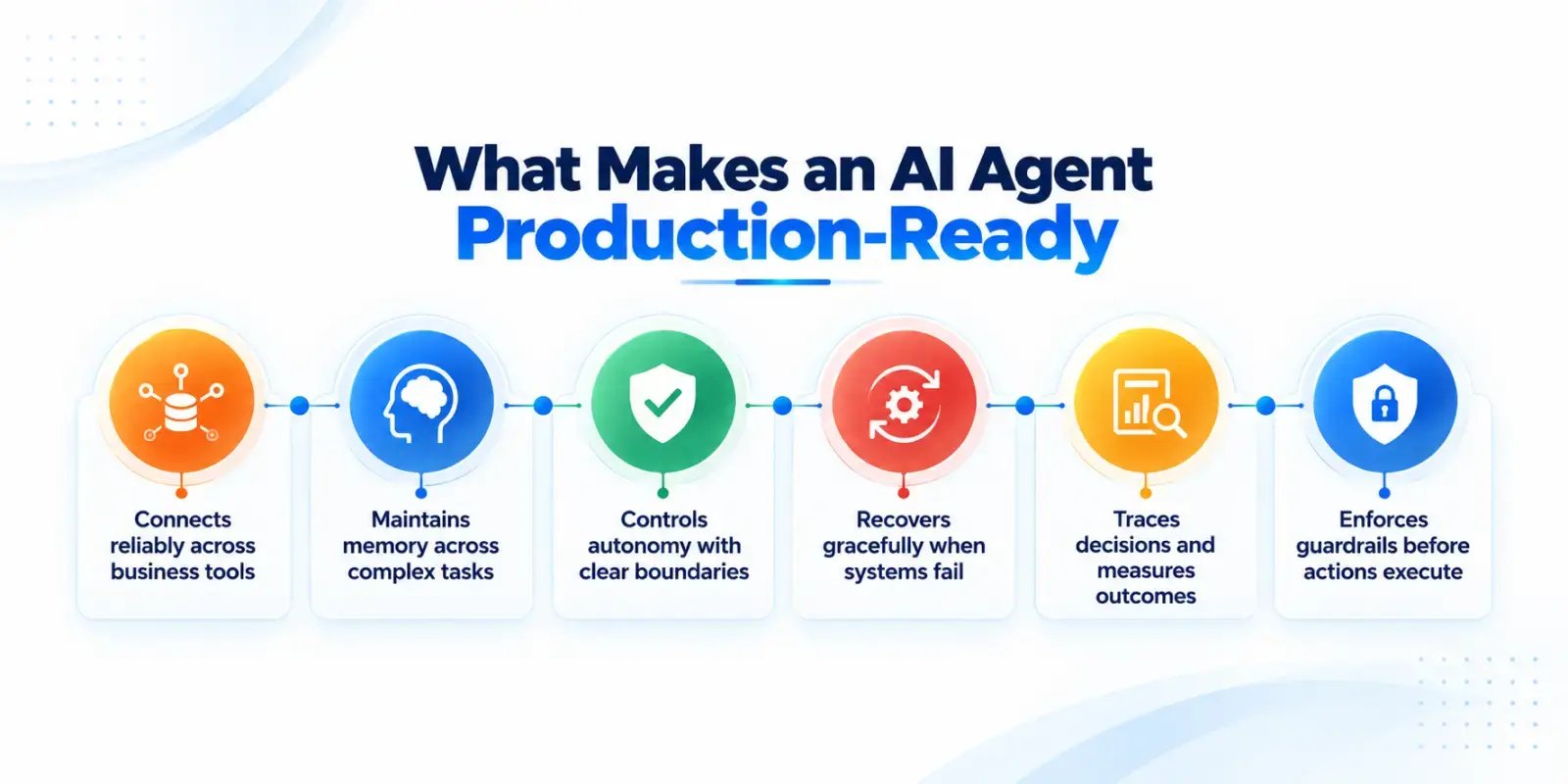
Strip away the demo polish and an agent is a system that makes decisions on its own and lives with the consequences. Five areas separate something that works on stage from something that runs unattended for months. None of them are about the model itself. All of them are where projects stall.
Tool Use and Integration Reliability
An agent is only as useful as the tools it can operate, and operating a tool correctly is harder than it sounds. The model has to select the right function, populate its arguments with valid values, and make sense of whatever the call returns, including the times it returns nothing useful.
- A schema the model can populate without ambiguity, with field names and descriptions that constrain bad inputs before they happen.
- Validation on arguments before execution, because an API will happily accept a malformed date and fail in ways the model can't interpret.
- Handling for partial responses, timeouts, rate limits, and the empty result that technically succeeded but answers nothing.
Real systems spend more engineering effort on the seam between model and tool than on the prompt that drives it. This becomes even more important in environments where AI agents are disrupting traditional business processes across multiple systems.
Memory and State Management
Multi-step work depends on the agent remembering what it has already done, and there are two distinct kinds of memory that teams routinely conflate. Short-term context is what fits in the current window: the task at hand, recent steps, intermediate results. Persistent memory is what survives across sessions: user preferences, prior outcomes, facts the agent learned last week.
Most failures trace back to losing the first kind. A long task overflows the context window, the earliest steps drop out, and the agent forgets a constraint it was given at the start.
- Decide deliberately what gets summarized, what gets retrieved on demand, and what gets discarded.
- Treat persistent memory as a storage and retrieval problem, not a prompting one.
Orchestration and Control Flow
Orchestration is the logic that decides what the agent does next, and it is where autonomy becomes a liability without discipline. A capable agent left to its own judgment will loop on a step it can't complete, re-run work it already finished, or hand off to a second agent that hands it right back.
- Explicit routing for which path a request takes, rather than hoping the model infers it.
- Hard limits on iterations and clear stopping conditions, so a stuck agent halts instead of spinning.
- Defined handoff contracts when multiple agents collaborate, so each knows what it owns.
The goal is bounded autonomy: enough freedom to be useful, enough structure to stay predictable.
Error Handling and Recovery
In a chat interface, a failed step shows a human an error and waits. An autonomous agent has no one to wait for, so what it does at the moment of failure determines whether the whole task survives or collapses. Recovery is not an edge case in agent work. It is a core part of the design.
A production agent needs an answer for the half-finished task:
- Retries that distinguish a transient network blip from a genuinely impossible request, so it doesn't hammer a dead endpoint.
- Fallback paths when the preferred tool or route is unavailable.
- Graceful degradation that returns partial, honest results instead of fabricating a confident wrong one.
Teams that skip this ship agents that work in testing and fail the first time reality doesn't cooperate.
Evaluation, Observability, and Guardrails
You cannot improve what you cannot measure, and agents are unusually hard to measure because correctness is rarely a single output you can grade. Success is an end state reached through a chain of decisions, which means evaluation has to look at the path, not just the answer.
Three capabilities make an agent operable rather than merely functional:
- Evaluation that scores whether the task was actually completed, not whether the final message sounded plausible.
- Observability through tracing, so when something goes wrong you can see which decision caused it instead of guessing.
- Guardrails that constrain what the agent is permitted to do, regardless of what it decides on its own.
This is the layer that separates a prototype from a system an organization can trust, and it is often the strongest reason teams choose to hire an AI agent development company that builds this discipline in from the start.
Why This Skill Gap Trips Up Capable Teams
One of the more interesting things about agent projects is that they rarely fail because the team lacks intelligence or technical depth. In fact, many of the teams that struggle are exceptionally strong. The problem is usually that they are solving for the wrong layer of the stack.
Then the edge cases arrive.
Reliability Is a Systems Problem
The difficult questions in agent development are rarely prompt-related:
- How should the system recover when a step fails?
- What state needs to persist across actions?
- How do you prevent loops and redundant work?
- How do you trace a decision made twenty steps earlier?
This is often the point where organizations decide to hire AI agent developers or work with an AI agent development company, often evaluating top AI agent development companies in the USA before making that decision. Not because their internal team lacks capability, but because agent systems introduce a set of reliability challenges that most software teams have not encountered before.
The gap is not talent. The gap is experience operating autonomous systems in environments where mistakes compound and small failures rarely stay small.
When to Hire an AI Agent Vendor
The decision to bring in an AI agent vendor is rarely about a lack of internal talent. More often, it is about reducing the time spent discovering problems that others have already solved.
What Experienced Vendors Bring to the Table
A strong AI agent development company is not valuable because it knows how to call an LLM. Nearly every technical team can do that today. The value comes from experience with the layers around the model that determine whether an agent survives in production. This is one reason enterprises increasingly seek agentic AI development partners with production deployment experience.
- Faster time-to-production without months of trial and error
- Proven approaches for orchestration, memory, and guardrails
- Better visibility into reliability and operational risks
- Support for long-term monitoring and maintenance
- Experience scaling agent systems beyond the initial pilot
The question is not whether your team can build an agent. The more useful question is whether you want your team learning these lessons for the first time on a business-critical system.
FAQs
Not really. The model is only one part of the system. Most of the hard work happens after the model has generated its response.
Because the prototype proves the idea. Production exposes everything the prototype ignored.
Usually when reliability starts mattering more than experimentation and the cost of mistakes starts going up.
More than a working demo. You should expect a system that can handle failures without falling apart.
Absolutely. The real question is whether they want to learn every lesson themselves or start with people who already have.