Automotive AI Strategy and Consulting
Determine where AI is technically practical before committing engineering resources. We assess your systems and available data to identify use cases that have a clear path toward implementation.
Tech.us helps automotive companies move AI into real vehicles and operations with the validation, security, and control the industry demands.
TRUSTED BY INDUSTRY LEADERS



OUR SERVICES
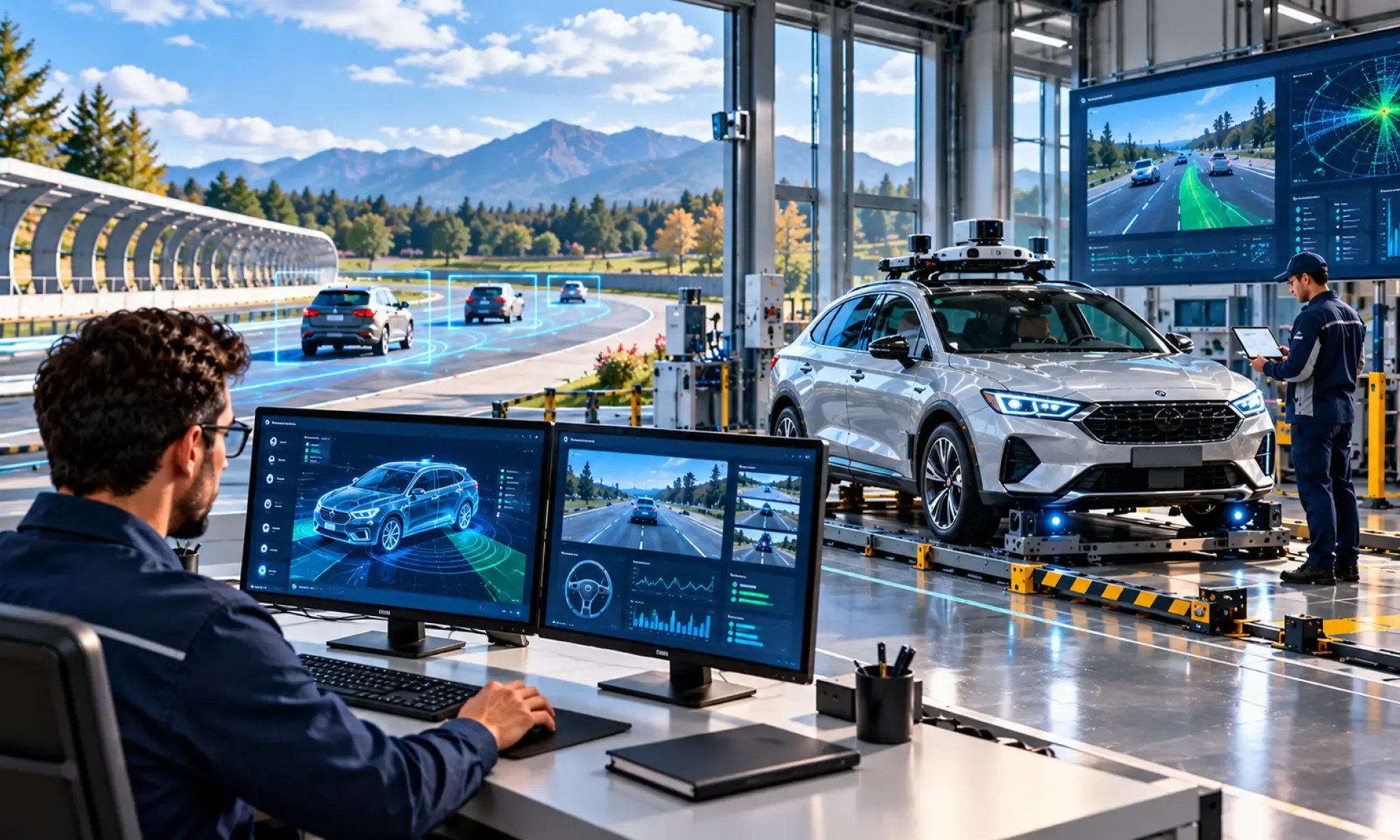
Automotive AI has to perform under conditions that controlled development environments cannot fully reproduce. We build around the systems, data, hardware, and safety requirements the solution will face once it leaves the lab.
Determine where AI is technically practical before committing engineering resources. We assess your systems and available data to identify use cases that have a clear path toward implementation.
Build vision and sensor-processing systems that help vehicles interpret roads, objects, lane markings, pedestrians, and other elements of the surrounding environment.
Develop the perception, planning, and decision capabilities behind driver-assistance or autonomous features with validation included throughout the development process.
Turn vehicle and telematics data into useful information for maintenance, performance, and operational decisions while keeping sensitive data protected.
Run models closer to the vehicle when response time makes cloud processing impractical. We design around the computing and operating constraints of embedded automotive environments.
Validate models before deployment and continue monitoring them afterward so changes in data or operating conditions do not quietly reduce performance.
SELECTED WORK
Explore selected work where Tech.us has built software around complex systems, connected environments, and demanding real-world requirements.
View All Case Studies

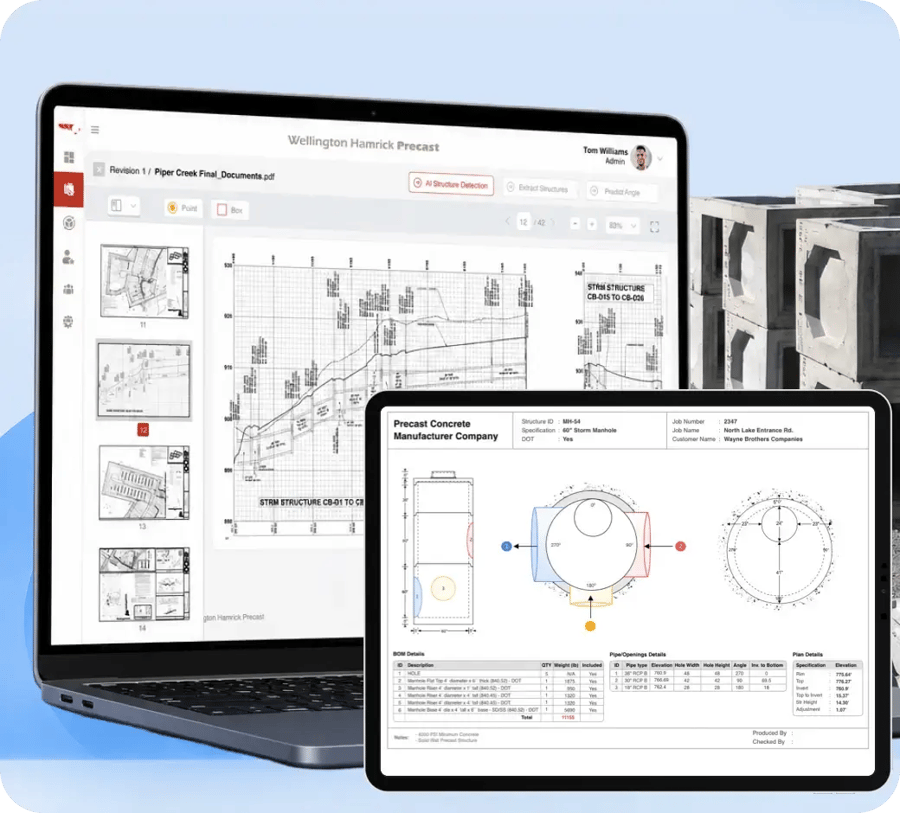
A precast concrete manufacturer partnered with Tech.us to bring AI into the estimating workflow. The system uses OCR, computer vision, and generative AI to identify, extract, and visualize structures, pipes, and components from complex construction drawings.
Read the Case Study

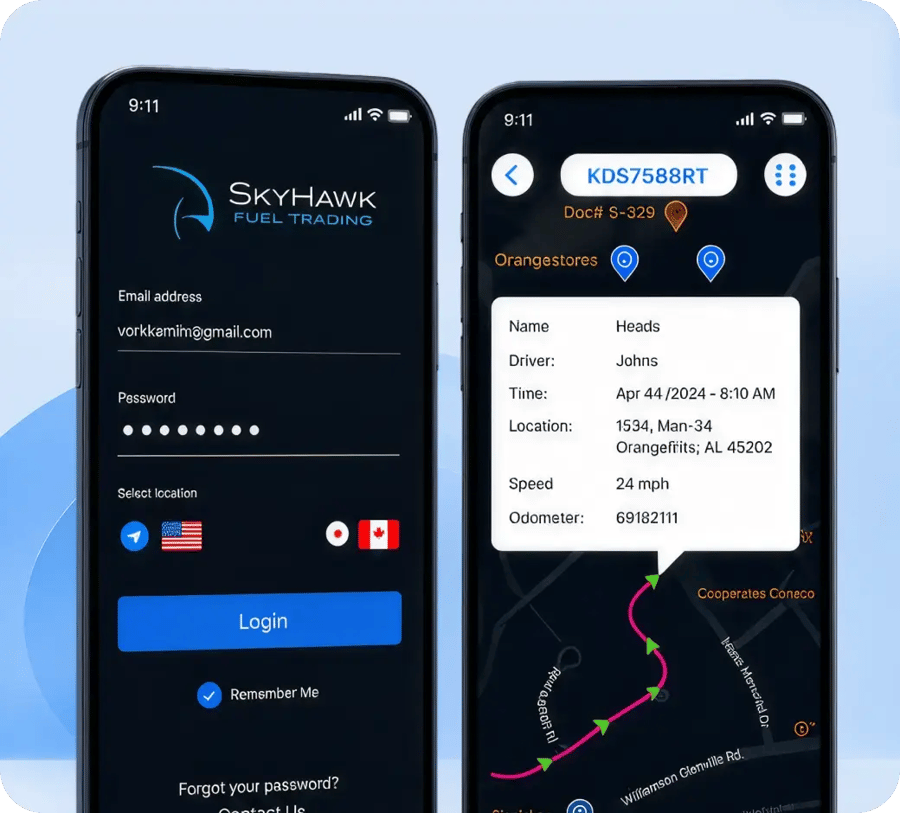
SkyHawk by TELUS needed a streamlined mobile experience for its Connect Anywhere platform. Tech.us built the core experience around real-time asset tracking, fleet activity, secure configuration, and map-based operational visibility.
Read the Case Study

Tech.us helped bring Wealth Mastery to life as a digital platform that puts personalized financial planning tools directly in users' hands while supporting a large and growing audience.
Read the Case Study

WHY TECH.US
A model can perform well in development and still fail when road conditions change or hardware constraints appear. Our approach accounts for what happens after the model leaves the test environment.
Our automotive software work includes embedded platforms, connected vehicle systems, fleet technology, and diagnostics. That gives us context beyond the AI model itself.
Validation is part of the engineering process rather than a final gate before release. Systems that affect vehicle behavior are treated accordingly from the beginning.
We work with secure-by-design practices aligned with automotive cybersecurity requirements such as ISO/SAE 21434.
Where AI has to run inside the vehicle, we account for processing limits, latency requirements, and the need for dependable local execution.
Models are evaluated against the conditions they are expected to encounter rather than relying only on development metrics.
AI can support perception or decision-making, but your engineering teams remain responsible for system boundaries and when a capability is ready to move forward.

ENGINEERING ASSURANCE
Road environments change constantly. Automotive AI has to remain dependable when lighting, weather, traffic, sensor input, or system conditions are different from the original test setup.
Systems that influence vehicle behavior are tested against a wider range of scenarios before they are relied on in real-world use.
Security considerations influence system design and data handling from the beginning rather than being treated as a final compliance exercise.
Changing lighting, weather, and road environments can expose weaknesses that standard testing misses. Validation needs to reflect those variations.
Connected vehicle information is handled with encryption, controlled access, and secure design throughout development.
For assisted-driving systems, the boundary between what AI handles and what remains with the driver is made explicit.
Rare or high-risk scenarios can be evaluated through simulation before the system encounters them on the road.
Validate how the system behaves under the conditions it will actually face before moving it closer to production.
Talk To Our AI Expert→AUTOMOTIVE SOLUTIONS
We build automotive AI for both in-vehicle systems and the wider operations that keep vehicles moving, maintained, produced, and supported.
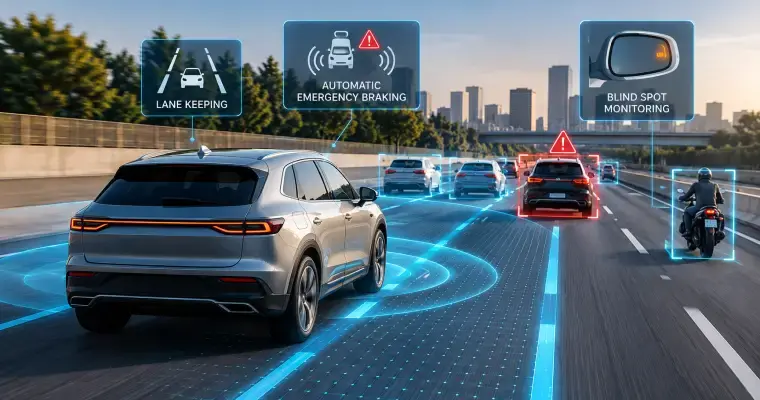
Build perception and decision capabilities behind features such as lane keeping, automatic emergency braking, and blind spot monitoring.
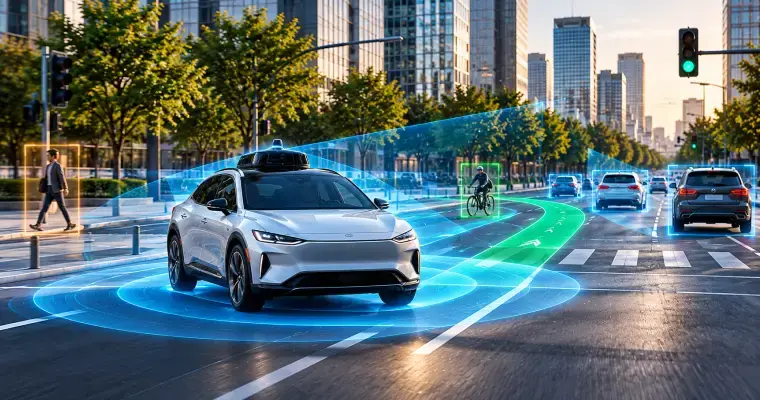
Develop AI that can interpret its surroundings and support planning across different levels of driving automation.
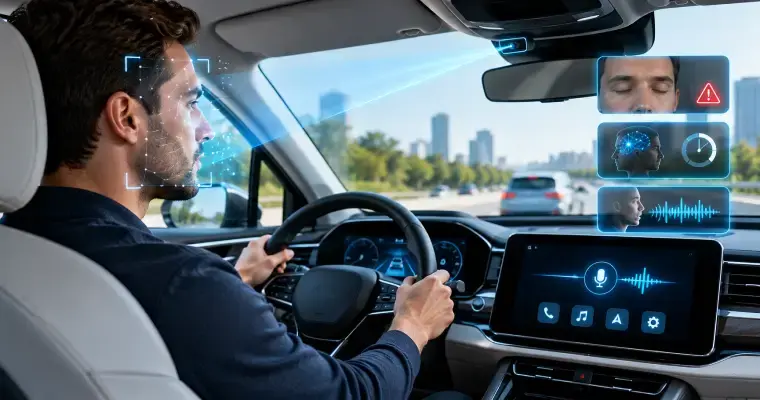
Use AI to identify signs of drowsiness or distraction while supporting voice and interaction experiences inside the vehicle.
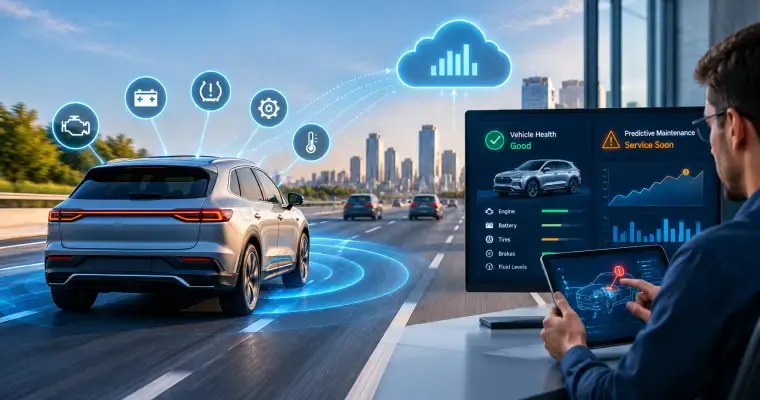
Analyze vehicle and sensor information to detect developing issues earlier and turn connected data into useful performance insights.
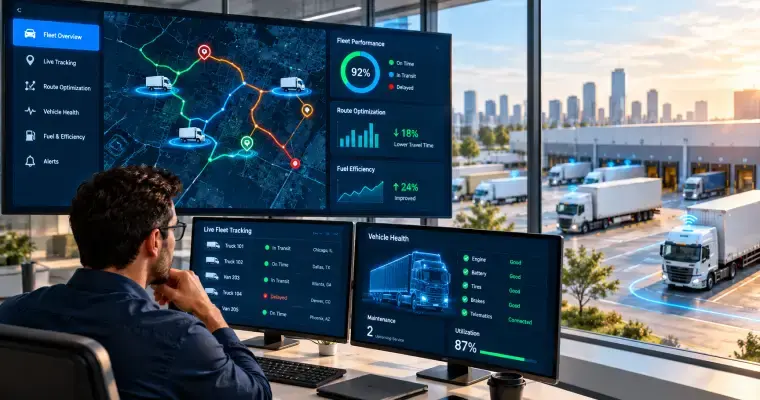
Use vehicle health and operating information to improve routing and fleet utilization while keeping operational decisions with fleet managers.
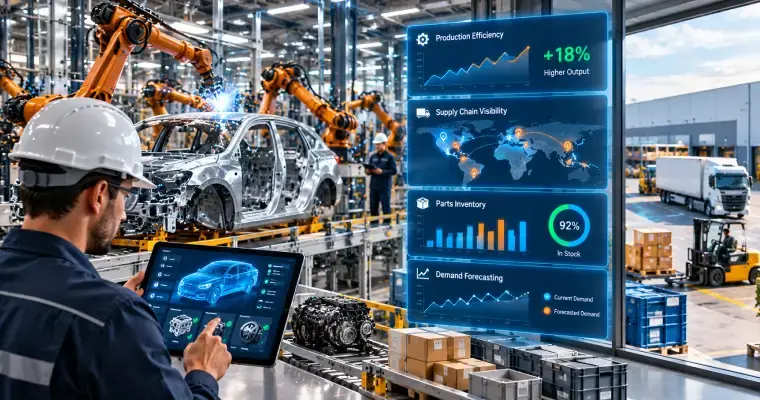
Apply computer vision to component inspection and use forecasting models to support production, inventory, and supply planning.
HOW WE WORK
Automotive AI development needs to account for the system around the model. We work through feasibility, data, validation, and deployment before a capability is treated as production-ready.
We define the automotive problem and determine whether the available systems and data make AI a practical approach.
We evaluate the information required for the use case along with integration, hardware, security, and safety considerations.
The system is built and evaluated against conditions relevant to how it will operate rather than only controlled development scenarios.
We introduce the capability into the target environment and monitor performance so drift or changes in real-world behavior can be identified.
AUTOMOTIVE ECOSYSTEM
Automotive AI requirements change depending on whether the technology sits inside the vehicle or supports the organizations building, operating, and servicing it.
TECH STACK
The architecture depends on where the model runs and how quickly the system needs to respond.
We choose technologies around reliability, security, and deployment constraints, including embedded or edge environments when processing needs to stay closer to the vehicle.
Agentic AI & Orchestration
Agentic AI
AI Agents
Multi-Agent Systems
Agentic Workflow Automation
Model Context Protocol (MCP)
Agent-to-Agent Protocol (A2A)
Agent Memory and Reasoning
Generative AI & Foundation Models
Large Language Models
GPT
Claude
Gemini
Llama
Generative AI
Multimodal Foundation Models
Diffusion Models
Small Language Models
Model Fine-Tuning
Prompt & Context Engineering
Machine Learning & Deep Learning
Machine Learning
Deep Learning
Predictive Analytics
Recommendation Systems
Anomaly Detection
Time-Series Analysis
Data & AI Platforms
AI-Ready Data Platforms
Data Lakes and Lakehouse
Data Engineering
AI Frameworks & Libraries
PyTorch
TensorFlow
Scikit-learn
Hugging Face Transformers
LangChain
LangGraph
MLOps, LLMOps & AgentOps
MLOps
LLMOps
AgentOps
Model Deployment and Serving
Agent Deployment
Model and Agent Observability
Prompt and Response Tracing
AI Cost Optimization
AI Evaluation, Safety & Governance
LLM Evaluations
Agent Evaluations
RAG Evaluations
AI Guardrails
Prompt-Injection Protection
Red Teaming
Responsible AI
AI Governance
Cloud AI Technologies
Google Cloud
Vertex AI
Gemini Models
Agent Studio
Vertex AI Agent Builder
Agent Development Kit
Vertex AI Vector Search
Google Cloud Document AI
Google Cloud Vision AI
Microsoft Azure
Microsoft Foundry
Microsoft Copilot Studio
Microsoft Agent Framework
Azure AI Document Intelligence
Azure AI Speech and Vision
Microsoft Fabric
Microsoft Purview
Language, Vision, Speech & Document AI
NLP, NLU and NLG
STT, TTS and ASR
Conversational AI
Document Intelligence
Computer Vision
RAG, Search & Knowledge Systems
Enterprise RAG
Agentic RAG
Multimodal RAG
Enterprise Search
Semantic & Hybrid Search
Vector Databases
Knowledge Graphs
Reranking and Retrieval Optimization
RECOGNITION
Explore the industry recognition associated with Tech.us and its work across software engineering and technology development.

FAQ
ADAS supports the driver through capabilities such as lane keeping or automatic braking while the person remains responsible for driving. Autonomous systems shift more of the driving task to the vehicle as the level of automation increases.
AI can analyze connected vehicle information such as performance, location, and system health. The resulting insights can support predictive maintenance, fleet management, vehicle updates, and feature improvements.
Computer vision can inspect parts or assemblies for defects during production. AI can also support areas such as production planning, equipment maintenance, and supply chain forecasting.
The required data depends on the application. Perception systems may need labeled camera and sensor data, while maintenance applications use vehicle history. Forecasting can depend on production and demand information.
Yes. Models can run on embedded or edge hardware when decisions need to happen locally and cannot depend on the latency of a cloud connection.
Vehicle and driver information can be protected through encryption, controlled access, and secure system design. Tech.us also works with practices aligned with automotive cybersecurity requirements such as ISO/SAE 21434.
Some scenarios are too rare or risky to reproduce repeatedly on public roads. Simulation makes it possible to evaluate system behavior in those situations before exposing the capability to real-world operation.
Models can be monitored for changes in performance after deployment. This helps identify drift or other behavior that may emerge as operating conditions or incoming data change.
Build around the conditions your system will face so performance outside the lab is considered from the start.
Talk to Our AI Expert→We value your privacy
By continuing to use this website, you agree to our Privacy Policy.
If you decline, your information won’t be tracked when you visit this website. A single cookie will be used in your browser to remember your preference not to be tracked.
Necessary cookies keep the site running and are always on. Turn the others on or off to control how Tech.us uses them.
Required for the site to function. Cannot be disabled.
Help us measure traffic and see how visitors use the site so we can improve it. All information is aggregated.
Used to deliver and personalize ads, measure campaign performance, and share data with advertising partners (including Retention.com and RB2B).
For residents of California and other states with similar rights. Turning this on opts you out of the sale or sharing of your personal information for targeted advertising (this also disables Advertising cookies).
Learn more in our Cookie Policy and Privacy Policy. You can change these settings at any time.