Too Much to Review within Limited Time
Bid volumes keep rising, but the hours available to review drawings, specs, and addenda haven't. Important details often get rushed, not because of skill, but because of time.
Empower your preconstruction process with AI that helps teams understand scope, manage complexity, and prepare bids with greater clarity and precision.
Trusted by industry leaders
Even experienced teams feel the strain when timelines shrink, documentation grows, and every bid leaves less room for error.
Bid volumes keep rising, but the hours available to review drawings, specs, and addenda haven't. Important details often get rushed, not because of skill, but because of time.
Critical requirements live in different files, formats, and revisions. Connecting them all manually increases the chance that something important gets overlooked.
Late changes force teams to revisit takeoffs, estimates, and assumptions, often under tighter deadlines than before.
When drawings change, quantities must be checked again. Without a clear link between revisions and earlier work, revalidation becomes slow and uncertain.
When proposals are finalized under tight deadlines, scope language can become rushed, increasing the chance of misunderstandings later.
Key planning information ends up spread across emails, shared drives, drawings, and spreadsheets, making it harder to stay aligned and confident in the final numbers.
When teams are stretched and processes rely heavily on manual effort, it costs both time and the opportunities you never get to fully pursue.
Promising projects passed up because the team is already stretched thin.
Slow document reviews reduce the time available to craft a strong, competitive bid.
Small scope gaps can quietly turn into costly surprises after award.
Hours go into organizing, formatting, and rechecking instead of strategic evaluation.
Manual, time-pressed processes lead to variation in clarity and completeness.
Critical insights stay with individuals instead of strengthening future bids.
Instead of dropping in generic AI tools, we work alongside your team to understand how bids are built and introduce AI in a way that strengthens, not disrupts, your process.
We review how your team interprets drawings, specs, and bid requirements to see where details are most at risk.
From takeoff to proposal, we map how work moves today and where manual effort slows things down.
AI is applied where it reduces repetitive work and improves consistency, while your team stays in control.
Your estimate structures, templates, and review practices are built into system.
The system is tuned to handle the drawings, specs, and RFP formats your team uses every day.
AI is introduced step by step, validated with your team, and refined along the way.
AI assists with analysis and drafting, but your experts make the final decisions.
As you use the system, it learns how to better match your projects and expectations.
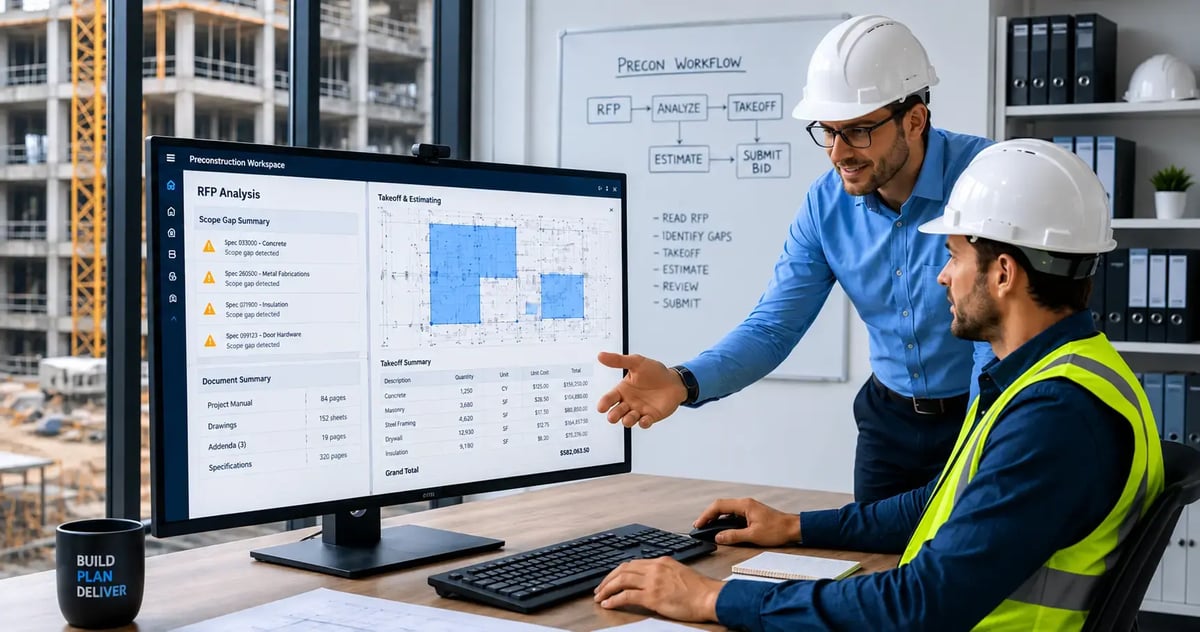
From the moment an RFP arrives to the final submission, our AI solutions support every stage of preconstruction with greater clarity, consistency, and control.
Thoroughly review specifications, addenda, and bid documents to surface critical scope elements, compliance needs, and potential risk areas early in the process.
Easily extract and organize quantities directly from drawings with our AI-powered takeoff, which makes it easier to review, validate, and adjust takeoffs as plans evolve.
Organize scope information into structured estimate formats and supports cost planning using historical patterns and predefined standards.
Leverage AI to draft scope narratives, inclusions, exclusions, and supporting documentation using your company’s approved formats and language.
AI helps track addenda, verify required documents, and ensure compliance checkpoints are covered before final submission.
Stronger preconstruction processes create more stability in how your business pursues and delivers work.
Talk to Our Expert →Less repetitive document work and more time for informed judgment and planning.
Greater visibility into scope, risks, and assumptions across every bid.
More structured proposal preparation with fewer last-minute corrections.
More wins and bigger margins without increasing pressure on your team.
No. The goal is to reduce repetitive and time-consuming tasks so estimators can focus more on judgment, strategy, and risk evaluation.
AI helps speed up quantity extraction, but your team still reviews and validates the results to ensure accuracy and alignment with project intent.
Yes, the system is designed to work across drawings, specifications, and related documents so scope can be interpreted in context rather than in isolation.
AI helps speed up quantity extraction, but your team still reviews and validates the results to ensure accuracy and alignment with project intent.
Timelines vary based on your workflows and data, but the process is phased to ensure your team can adopt the system without disrupting active bids.
Absolutely. Your team stays in control at every stage, with AI supporting the work — not making final decisions on its own.
AI reviews RFP documents, specifications, and addenda to highlight key scope requirements, compliance needs, and potential risk areas, making it easier for your team to focus on what matters most.
Yes. AI can organize and standardize subcontractor quotes, helping your team review scope coverage more clearly and identify differences without manually sorting through every line.
AI supports the creation of scope narratives, inclusions, exclusions, and supporting sections using your preferred formats, helping teams assemble proposals more efficiently while still reviewing and finalizing the content themselves.