
Get Information Out of Documents Faster
Extract the fields the workflow needs without requiring someone to read every page and enter the same information manually.
Tech.us builds intelligent document processing solutions that extract useful information from documents and move it into the systems where work continues.
Instead of asking people to read every PDF, form, scan, or email manually, we help automate the parts of document handling that slow the process down.
Projects Delivered
Years of Engineering
Industries Served
TRUSTED BY ORGANIZATIONS THAT DEPEND ON TECHNOLOGY



WHAT IDP CHANGES
Intelligent document processing works best when the goal is not simply extracting text, but shortening the business process that starts with the document.
Extract the fields the workflow needs without requiring someone to read every page and enter the same information manually.
Process structured forms alongside semi-structured documents and unstructured content without building a separate manual path for each one.
Use extracted information to decide where the document goes next instead of relying on people to sort every incoming file.
Send uncertain or higher-impact results to a person rather than forcing every document through the same level of manual review.
INTELLIGENT DOCUMENT PROCESSING SERVICES
Our intelligent document processing services cover the path from document intake through extraction and validation to the next business action.
Identify where documents enter the process and which steps still depend on manual reading or rekeying. We use that workflow to determine where an intelligent document processing solution can remove meaningful effort.
Identify what type of document arrived and send it to the correct processing path. Classification can prevent invoices or forms from entering the wrong workflow before extraction begins.
Extract the fields that matter to the business rather than returning a page full of text. The extraction model is designed around the information the downstream system actually needs.
Use OCR as part of a broader document understanding process so scans and image-based files can become usable inputs rather than isolated text output.
Apply validation rules to extracted values and send uncertain cases to a person. Human review becomes an exception path instead of the default way every document is processed.
Connect document understanding to the next step in the process so extracted information can trigger routing or system updates instead of stopping at a data extraction screen.
Connect IDP to ERP, CRM, document management, or line-of-business systems so processed information reaches the application that owns the next step.
Implement or customize an intelligent document processing platform when an existing product fits most of the requirement but still needs integration or workflow-specific configuration.
Use an AI agent for intelligent document processing when the workflow needs reasoning beyond fixed extraction. The agent can review document context or determine the next step while staying inside defined operating limits.
Selected Work
See how Tech.us turns complex operational needs into working software across different industries and business functions.
View All Case Studies

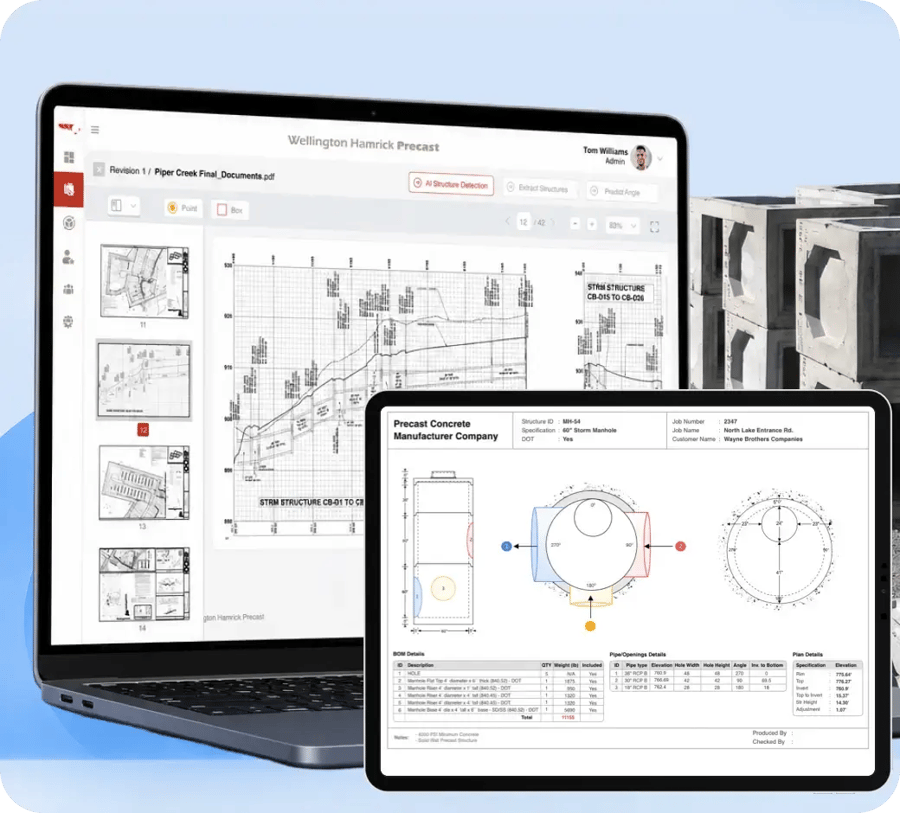
A precast concrete manufacturer partnered with Tech.us to bring AI into the estimating workflow. The system uses OCR, computer vision, and generative AI to identify, extract, and visualize structures, pipes, and components from complex construction drawings.
Read the Case Study

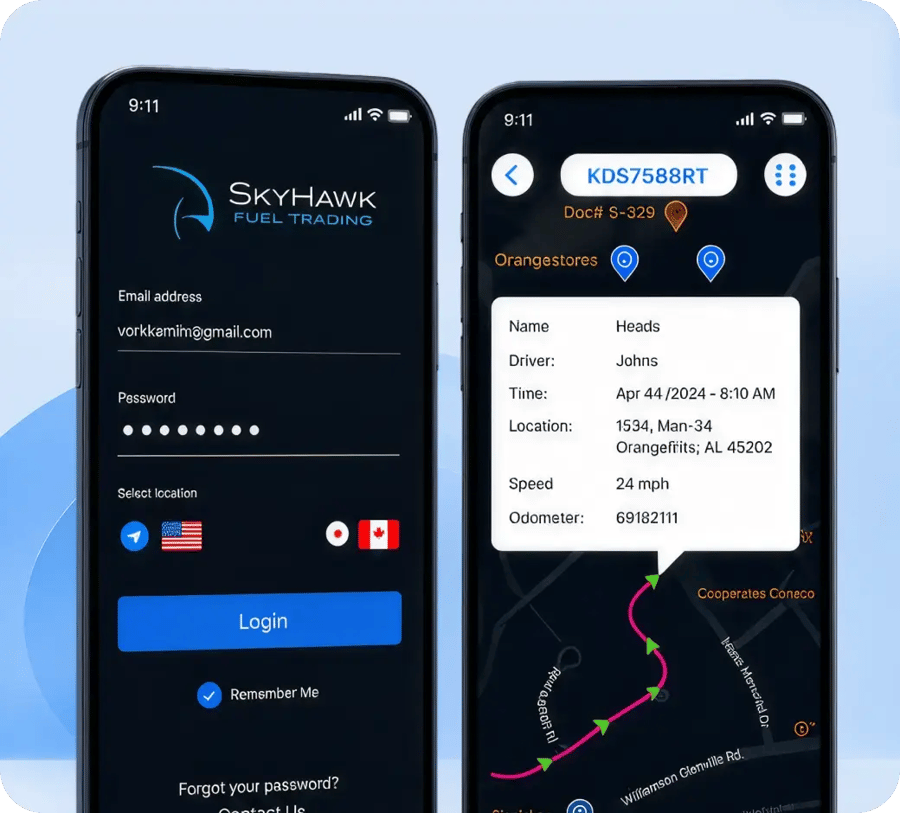
SkyHawk by TELUS needed a streamlined mobile experience for its Connect Anywhere platform. Tech.us built the core experience around real-time asset tracking, fleet activity, secure configuration, and map-based operational visibility.
Read the Case Study

Tech.us helped bring Wealth Mastery to life as a digital platform that puts personalized financial planning tools directly in users' hands while supporting a large and growing audience.
Read the Case Study

WHY TECH.US FOR INTELLIGENT DOCUMENT PROCESSING
A document can be extracted perfectly and still leave the business with the same manual process. We design around what needs to happen next.
We identify what the downstream process needs before deciding how the document should be parsed.
Not every document needs the same processing path. Clear cases can move automatically while uncertain ones receive more attention.
Important values should be checked before they enter another system and become someone else's data problem.
The workflow needs a clear answer for documents that are unreadable or incomplete rather than silently pushing weak data forward.
Processed information should end up in the business system that already owns the process instead of creating another disconnected data store.
Extraction accuracy matters, but so do review volume and processing time. The business outcome depends on the full intelligent document processing workflow.

HOW WE WORK
The implementation follows how documents actually move through the business today.
Identify where documents arrive and what formats the process needs to handle.
Determine which fields or document characteristics matter to the next business step.
Define how each document type should be classified and where human review belongs.
Configure the document understanding layer around the information the workflow actually requires.
Move approved output into the ERP, CRM, case management, or other system where the process continues.
Use production results to find document types or fields that create unnecessary review and improve those areas first.
Start with the document flow where people spend the most time reading, copying, checking, or routing information before the real work can begin.
Review Your IDP Opportunity →FROM DOCUMENT TO BUSINESS ACTION
The strongest intelligent document processing use cases connect document understanding directly to the next operational step.
Bring in documents from the channel where they already arrive instead of creating another upload process unless the workflow needs one.
Identify the document type and determine which processing rules belong to it.
Return the information needed for the process rather than treating every word on the page as equally important.
Check important values against available rules or business context before the output moves forward.
Send approved information into the system or queue where the next business action takes place.
BUILD OR BUY INTELLIGENT DOCUMENT PROCESSING
The build or buy intelligent document processing decision should be based on how different your document flow is from what an existing platform already supports.
An established intelligent document processing software product can be a strong fit when document types and workflow requirements are relatively standard.
An intelligent document processing platform may provide the core extraction capability while custom integration handles the surrounding business process.
Custom development makes more sense when document handling depends on proprietary rules or system behavior that generic intelligent document processing platforms do not support well.
Many enterprise projects use an existing document AI capability underneath while custom software controls intake and the downstream workflow.
WHEN AI AGENTS BELONG IN IDP
An agent should enter the process when the next step depends on interpretation or workflow context rather than simply reading a known field.
Use an agent when a document needs to be understood in relation to other information before the workflow can continue.
Let an agent choose between approved workflow paths when fixed routing rules cannot cover the full situation.
Use the agent to identify what is missing and prepare the next action instead of allowing incomplete documents to disappear into a review queue.
Agents can prepare the work without silently taking over decisions that still require business authority.
INDUSTRY EXPERIENCE
The value of intelligent document processing depends on what those documents trigger after they arrive.
Explore All Industries

Healthcare
Intelligent document processing healthcare workflows can reduce manual handling around administrative forms and supporting documents while preserving appropriate review.
Explore Healthcare→
Construction
Process project documents or forms where important information still has to be located manually before estimating or project work can continue.
Explore Construction→
Finance
Use intelligent document processing to move key information from financial documents into review or operational workflows with less manual entry.
Explore Finance→
Manufacturing
Process operational or supplier documents that need to be matched with enterprise systems before the next manufacturing or supply chain step can continue.
Explore Manufacturing→
Real Estate
Intelligent document processing in real estate can help teams work through property and transaction documents where information is spread across many files.
Explore Real Estate→
Retail & Ecommerce
Process supplier or operational documents when key information still arrives outside the structured commerce systems used by the business.
Explore Retail & Ecommerce →
TECH STACK
The best intelligent document processing technology depends on document quality and the information that needs to be extracted.
Agentic AI & Orchestration
Agentic AI
AI Agents
Multi-Agent Systems
Agentic Workflow Automation
Model Context Protocol (MCP)
Agent-to-Agent Protocol (A2A)
Agent Memory and Reasoning
Generative AI & Foundation Models
Large Language Models
GPT
Claude
Gemini
Llama
Generative AI
Multimodal Foundation Models
Diffusion Models
Small Language Models
Model Fine-Tuning
Prompt & Context Engineering
Machine Learning & Deep Learning
Machine Learning
Deep Learning
Predictive Analytics
Recommendation Systems
Anomaly Detection
Time-Series Analysis
Data & AI Platforms
AI-Ready Data Platforms
Data Lakes and Lakehouse
Data Engineering
AI Frameworks & Libraries
PyTorch
TensorFlow
Scikit-learn
Hugging Face Transformers
LangChain
LangGraph
MLOps, LLMOps & AgentOps
MLOps
LLMOps
AgentOps
Model Deployment and Serving
Agent Deployment
Model and Agent Observability
Prompt and Response Tracing
AI Cost Optimization
AI Evaluation, Safety & Governance
LLM Evaluations
Agent Evaluations
RAG Evaluations
AI Guardrails
Prompt-Injection Protection
Red Teaming
Responsible AI
AI Governance
Cloud AI Technologies
Google Cloud
Vertex AI
Gemini Models
Agent Studio
Vertex AI Agent Builder
Agent Development Kit
Vertex AI Vector Search
Google Cloud Document AI
Google Cloud Vision AI
Microsoft Azure
Microsoft Foundry
Microsoft Copilot Studio
Microsoft Agent Framework
Azure AI Document Intelligence
Azure AI Speech and Vision
Microsoft Fabric
Microsoft Purview
Language, Vision, Speech & Document AI
NLP, NLU and NLG
STT, TTS and ASR
Conversational AI
Document Intelligence
Computer Vision
RAG, Search & Knowledge Systems
Enterprise RAG
Agentic RAG
Multimodal RAG
Enterprise Search
Semantic & Hybrid Search
Vector Databases
Knowledge Graphs
Reranking and Retrieval Optimization
FAQ
Intelligent document processing uses AI and document understanding technology to identify documents and extract relevant information from them. The output can then be validated and passed into the business workflow that needs it.
The main benefits of intelligent document processing come from reducing the manual work between receiving a document and using the information inside it. That can shorten processing time and let employees focus on exceptions instead of reading every document.
OCR converts text from an image or scanned document into machine-readable text. Intelligent document processing goes further by identifying what the document is and extracting the specific information needed for the workflow.
The best intelligent document processing software for enterprise use should handle the document types you actually receive and make uncertain results easy to review. It also needs a practical way to connect with the systems where the extracted information will be used.
Use existing intelligent document processing software when it already fits the document types and workflow. Custom development becomes more valuable when the process depends on proprietary rules or integration requirements that off-the-shelf platforms cannot handle cleanly.
When comparing intelligent document processing companies, look beyond extraction demos. A strong intelligent document processing company should be able to explain how validation works and how the processed data reaches the system where the next business step happens.
Common intelligent document processing use cases include forms and invoices as well as claims and operational documents. The strongest opportunities are usually processes where employees spend significant time reading documents before entering or routing the information elsewhere.
The future of intelligent document processing is moving beyond extraction toward document-driven workflows where AI can interpret context and help determine what should happen next. The important shift is from reading documents faster to reducing the work those documents create.
Build a more consistent way to process incoming documents and move the right information to the next step.
Discuss Your Document Processing Needs →Document intake · Intelligent extraction · Validation · Workflow integration