In many businesses, data analytics starts in a familiar way. A leadership team wants more clarity. A dashboard gets approved. Reports begin to circulate before meetings. Numbers are reviewed. Charts are discussed. Everyone feels better prepared
Data analytics for business has moved far beyond static dashboards. It now shapes how teams decide, plan, and adjust in real time. Modern business data analytics helps leaders see patterns early. It supports daily choices. It brings confidence into moments that once felt uncertain.
Companies that treat analytics as a decision tool move with more clarity. They spend less time debating numbers and more time acting on them. Growth feels steadier. Operations feel calmer.
What “Beyond Reporting” Means in Business Analytics
For many businesses, reporting is where analytics begins. Numbers are collected. Dashboards are built. Weekly or monthly reports become part of routine reviews. This stage brings visibility, which is important.
Over time, though, visibility alone stops being enough. Businesses need analytics that support action, not just observation. That is where the idea of moving beyond reporting comes in.
Reporting vs Decision-Driven Analytics
Why Businesses Outgrow Report-Only Analytics
As businesses grow, the pace of decisions increases. Waiting for reports slows momentum. Operations become more layered. Data flows through more teams and systems. Leaders expect insights that guide choices, not summaries that explain delays.
7 Key Benefits of Data Analytics for Your Business
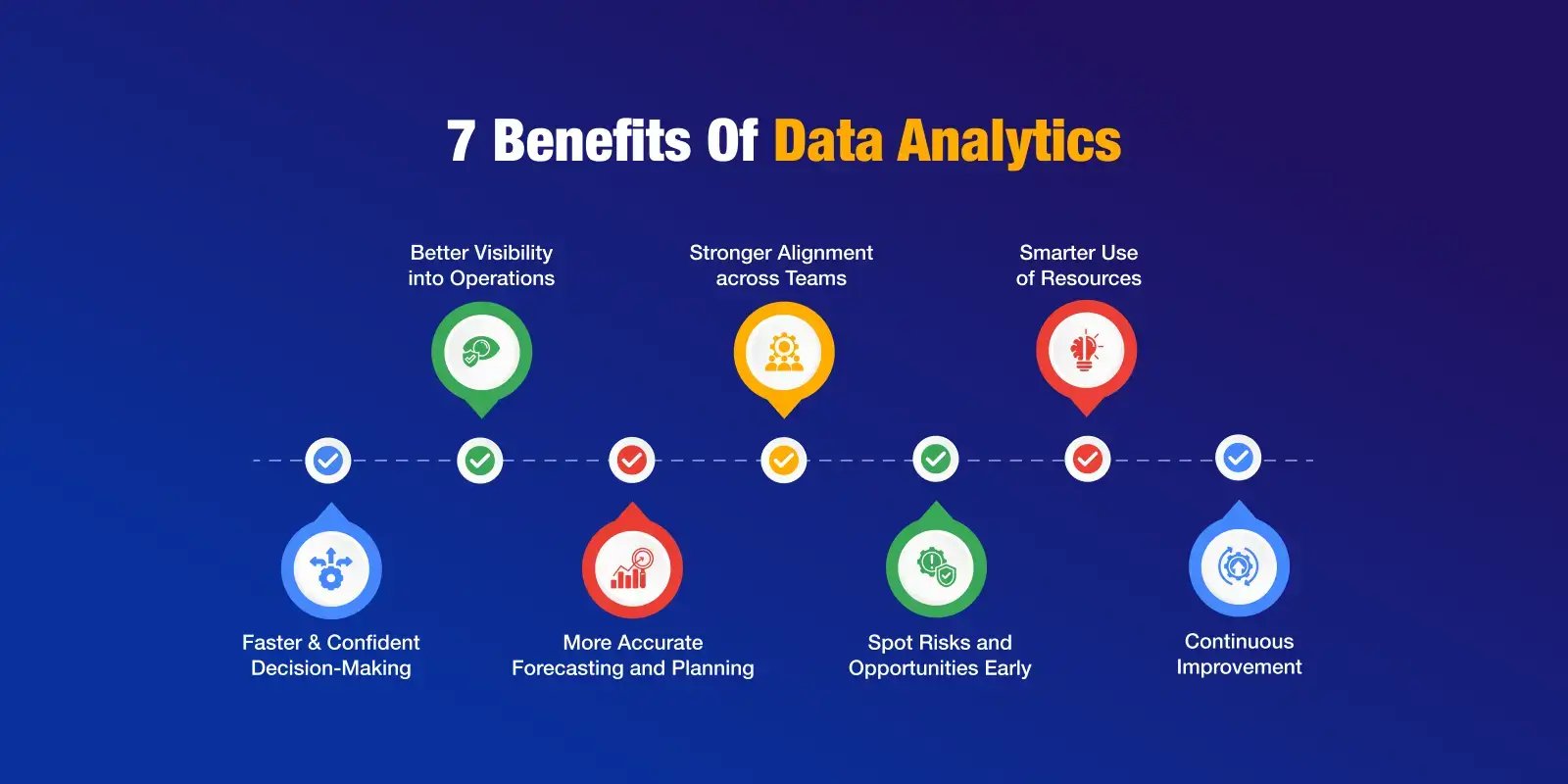
Faster and More Confident Business Decisions
In many businesses, decisions slow down not because people lack experience, but because clarity arrives late. A question comes up in a meeting. Teams wait for numbers. Someone asks for a report. By the time the data is reviewed, the moment to act has already passed.
This is where data analytics beyond reporting makes a real difference.
Over time, this creates a noticeable shift. Meetings become shorter. Follow-ups reduce. Momentum builds because decisions move forward instead of getting stuck.
- Data supports decisions at the moment they are made
- Fewer assumptions slow teams down
- Teams align around shared and trusted facts
- Decisions move faster with greater confidence
Better Visibility into Daily Business Operations
In many businesses, leaders know the goals clearly, but the path to reach them feels hazy. Work moves across teams. Tasks get handed off. Updates happen in different tools. On the surface, everything looks busy. Underneath, it is hard to see where time is actually going.
This is where data analytics for operations starts to matter.
Operational analytics brings day to day activity into focus. It shows how work flows from one step to the next. Bottlenecks that once felt invisible become clear. Delays are easier to trace back to their source. Leaders no longer rely on status updates alone. They can see patterns in how processes behave over time.
This kind of visibility changes how issues are handled. Problems get noticed earlier, before they grow into bigger disruptions. Teams stop reacting to symptoms and start addressing root causes. Small adjustments happen sooner, which keeps operations steady instead of rushed.
For AI services and intelligent decision-making, quality data is of utmost importance.
Over time, this clarity becomes part of how the business runs. Operations feel more predictable. Improvements feel easier to plan.
- Clear view into how daily work flows
- Early visibility into bottlenecks and delays
- Faster response to operational issues
- Shared understanding across teams and leadership
Improved Forecasting and Planning Accuracy
Planning is one of the hardest parts of running a business. Teams look ahead and try to predict demand, costs, and capacity. Most plans start with experience and instinct. That works to a point. As the business grows, the margin for error gets smaller.
When historical data is used the right way, it becomes a guide instead of a record. With machine learning services on the rise, data plays a crucial role in training machines which support better, data-driven decisions.
This kind of accuracy builds confidence across the business. Teams trust the plan because it reflects how the business has actually behaved in the past. Adjustments still happen, but they feel measured, not reactive. Over time, planning becomes a steady process instead of a stressful one.
- Past data guides future planning decisions
- Trends replace guesswork and assumptions
- Forecasts feel more realistic and grounded
- Planning becomes steadier and easier to adjust
Stronger Alignment Across Teams and Leadership
In many businesses, teams work hard but not always in the same direction. Sales looks at one set of numbers. Operations track another. Finance has its own view. Leadership tries to connect the dots during reviews. Conversations take time because people first need to agree on what the numbers mean.
Data analytics beyond reporting helps fix this gap.
Over time, data analytics becomes a common language which improves business intelligence over the long run. It connects teams instead of dividing them. That shared clarity helps the business move as one unit, even as it grows.
- One shared view of business performance
- Fewer debates over numbers and assumptions
- Clear priorities across teams
- Stronger trust between teams and leadership
Faster Identification of Risks and Opportunities
In many businesses, risks and opportunities rarely announce themselves clearly. They show up quietly. A small dip in performance. A sudden change in customer behavior. A cost that creeps up over time. By the time these signals become obvious, the impact is already felt.
This is where data analytics beyond reporting makes a real difference.
Instead of waiting for problems to grow, analytics helps businesses spot early signals. Small changes stand out sooner. Patterns that feel unusual get attention before they turn into disruptions. Teams are no longer surprised by issues that seemed to appear overnight. They saw the signs coming.
The same applies to opportunities. Analytics surfaces positive shifts early. A product starts gaining traction faster than expected. A customer segment responds better to a new offer. A process improvement shows early gains. Businesses that see these signals early can act while the window is still open.
Early visibility creates breathing room. That space often makes the difference between managing change and being overwhelmed by it.
- Early warning signs surface before issues escalate
- Opportunities appear while there is time to act
- Teams respond calmly instead of reacting late
- Fewer surprises disrupt business momentum
More Effective Use of Time and Resources
In many businesses, people stay busy all day and still feel behind. Calendars are full. Teams work hard. Effort is not the problem. Focus is. Without clear insight, time and resources often spread thin across tasks that feel urgent but do not move the business forward.
When analytics highlights what truly drives results, priorities shift naturally. Teams see which activities create impact and which ones simply consume effort. Work that once felt important gets questioned. High-value tasks rise to the top without constant debate. Time starts getting spent where it actually matters.
Resource allocation improves as well. Budget, people, and tools move toward areas that show real return. Teams stop guessing where to invest more effort. Leaders stop relying on intuition alone. Decisions around staffing, spending, and planning feel calmer because they are backed by clear signals.
This clarity reduces burnout. Teams stop chasing everything at once. They focus on fewer things with more confidence. Productivity improves, not because people work harder, but because work becomes more intentional.
- Clear focus on high-impact activities
- Less time spent on low-value work
- Smarter allocation of people and budget
- Improved productivity through better prioritization
Continuous Improvement Instead of Periodic Reviews
In many businesses, improvement happens in bursts. Teams work hard toward a quarterly review. Data gets pulled. Performance is discussed. Action items are noted. Then everyone goes back to daily work until the next review cycle arrives. By then, some signals are already old.
Data analytics beyond reporting changes this rhythm.
This approach makes change feel lighter. Instead of big shifts that disrupt teams, improvements happen in smaller steps. Processes get refined gradually. Decisions get adjusted calmly. The business stays flexible without feeling unstable.
Continuous insight also builds confidence. Teams trust that they are moving in the right direction because feedback is constant. Leaders do not wait for quarterly numbers to know how things are going. They already have a clear sense of momentum.
Over time, this creates a culture of steady progress. The business adapts naturally. Improvement becomes part of how work gets done, not something saved for later.
- Ongoing visibility into performance
- Smaller and smoother course corrections
- Faster feedback loops for teams
- Greater adaptability in daily operations
To Sum Up
When data analytics lives inside everyday workflows, action feels easier. Teams do not pause to interpret numbers. They move forward with clarity. Leaders do not wait for perfect certainty. They act with confidence because signals are already clear. Momentum builds through small, steady choices made at the right time.
This shift changes how businesses operate. Conversations focus less on explaining the past and more on shaping what comes next. Decisions feel lighter because they are supported by insight, not instinct alone. Speed improves without chaos. Clarity replaces noise.
The true value of data analytics shows up when insight leads directly to action.
When analytics becomes part of how decisions are made, businesses stop reacting and start leading.
FAQ
Data analytics beyond reporting focuses on action, not summaries. It helps businesses make decisions in real time instead of reviewing past results after the moment has passed.
Data analytics brings clarity closer to decision points. It reduces guesswork and helps teams act with confidence.
Key ways it helps:
- Shows what is happening right now
- Highlights patterns early
- Reduces reliance on assumptions
- Aligns teams around shared facts
Yes. Data analytics is about decision clarity, not company size. Growing businesses often benefit the most because even small improvements have visible impact.
Many businesses treat analytics as a reporting task instead of a decision tool. Without clear ownership and business questions, analytics stays disconnected from daily work.
Businesses move forward when analytics becomes part of everyday workflows.
Simple steps include:
- Start with business questions
- Focus on decisions, not charts
- Use insights during daily operations
- Review data continuously, not occasionally