Introduction
How can a business stay ahead when markets, technologies, and customer needs evolve in weeks, not years?
- Your competitor drops a disruptive feature overnight.
- Customer behavior shifts dramatically due to a new trend.
- A technology you were relying on suddenly becomes obsolete.
This is exactly where a dedicated development team steps in.
Rigid models force you to stick to a plan even when the world changes. But flexible models like dedicated teams allow you to shift gears quickly.
Absolutely. And it’s not just about speed, but about control with adaptability built into the development process.
So right from the beginning, let’s be clear. If modern businesses are playing on shifting ground, the question isn’t whether you need adaptability. The real question is: Do you have the right team model that delivers it?
A dedicated development team for software development is like having your own in-house squad, but without the overhead. They’re fully focused on your goals, aligned with your vision, and flexible enough to match changing priorities.

What Exactly is a Dedicated Development Team
A dedicated development team is not just a bunch of remote coders you borrow for a few weeks. It’s a long-term, committed partnership where the team operates almost like your own employees, but with the added advantage of flexibility, scalability, and access to wider expertise.
Now, you might be wondering:
So, is it staff augmentation?
Not quite. With staff augmentation, you’re basically filling skill gaps by hiring individuals who plug into your existing software development team. They work for you, but only as an added resource.
So then, is it software development outsourcing?

Here’s why it works:
- They align with your culture and processes.
- They dedicate themselves to your product or service like internal employees.
- You retain maximum control, but with reduced hiring burden and faster scaling.
Think of it this way: If outsourcing is like hiring a contractor to finish your project, then a dedicated team is like bringing in a specialized, loyal squad that grows with your business.
And that’s its speciality as it’s not just about writing code but about creating an adaptable, strategy-first model where flexibility and commitment walk hand in hand.
Because in today’s market, the ability to pivot without chaos isn’t nice to have. It’s survival. And a dedicated team makes that survival possible.
What Businesses Miss Out Without Dedicated Teams
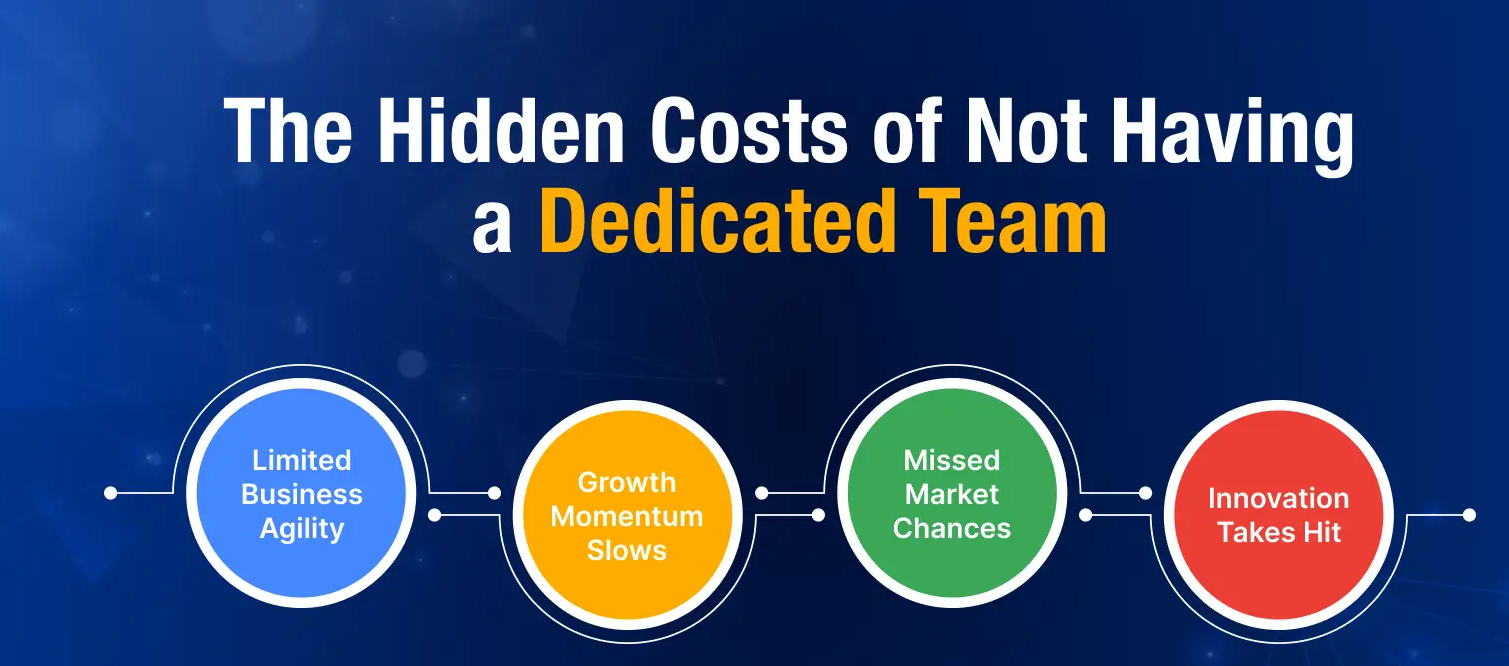
Let’s flip the question for a moment. Instead of asking why companies need a dedicated development team, what if we ask: what exactly do they miss out on when they don’t have one?
The truth is, they miss out on quite a lot.
Losing the Ability to Adapt
Markets shift fast. One moment your customers want simple dashboards, the next they expect AI-driven personalization baked right in.
Now ask yourself:
- Can your in-house software development team pivot that quickly?
- Do you have people ready to roll out integrations with cloud computing services at a moment’s notice?
If not, you’re not adapting but reacting to it. And in today’s competitive landscape, reacting is too slow.
The Cost of Staying Fixed
- You’re stuck with high costs even in low-demand phases.
- You burn resources hiring for roles you only need temporarily.
- Your competitors who lean into software development outsourcing or staff augmentation end up spending smarter.
So the real question is: are you financing stability, or are you paying for stagnation?
Missed Opportunities Left on the Table
Every business has that list of “big ideas” sitting in the backlog. Maybe it’s a new custom SaaS solution. Maybe it’s expanding your product line. Or maybe it’s experimenting with automation and machine learning services.
- Another SaaS development company takes the same idea and runs with it.
- Your customers move on to someone who delivered faster.
- What was once innovative becomes “too late.”
Lost opportunity is invisible, but it costs more than you think.
Innovation Takes a Back Seat
- Experiment with new frameworks.
- Build faster prototypes.
- Develop next-gen services before the market saturates.
So what happens when your product vision doubles in scope overnight, but your team can’t?
That’s when momentum slips away. And once you lose momentum, it’s painfully hard to get back.
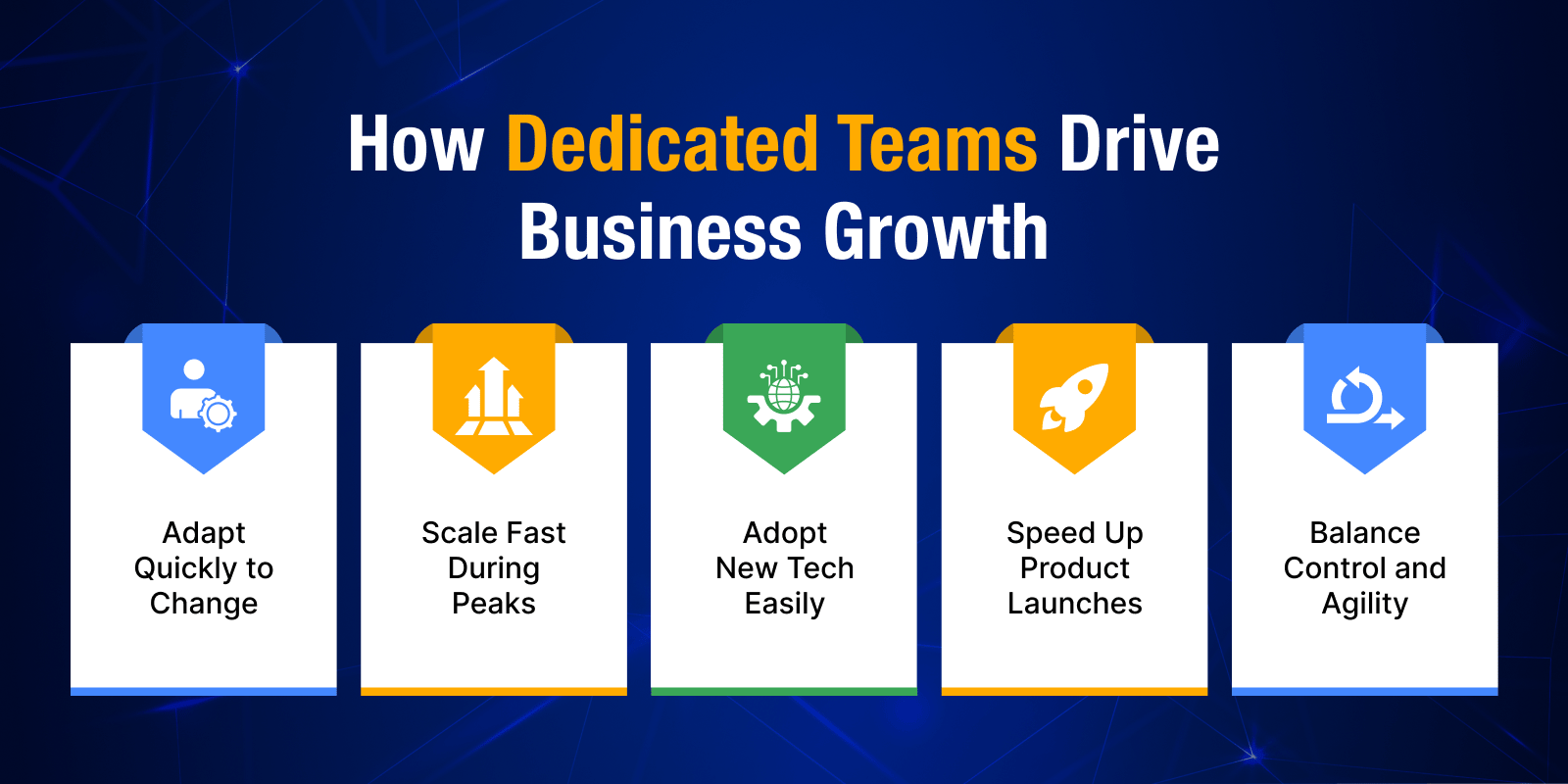
Here’s the question that most of the businesses have concern: Can my team change direction when the market does? Because the reality is simple: no strategy survives the first big shift. And that’s where a dedicated development team shows its true value. Let’s explore how.
Adapting to Sudden Product Pivots
When customer needs change mid-project, rigid models collapse under the pressure. But a dedicated development team can pivot development without losing momentum. They do more than just follow instructions as they align with your vision continuously.
- Shift priorities without months of re-planning
- Incorporate user feedback in real time
- Reallocate talent to new features instantly
- Keep the business roadmap aligned with evolving goals
Scaling Up During Peak Demand
There are seasons when demand suddenly spikes. Product launches, holiday traffic, or rapid growth phases. With a dedicated team, scaling isn’t a headache, it’s a built-in advantage.
- Add new developers without lengthy hiring cycles
- Balance workloads to avoid burnout
- Maintain delivery speed without quality loss
- Scale down easily when the peak passes
Integrating New Technologies Seamlessly
- Deploy specialists who already know the tech stack
- Bridge the gap between legacy and modern solutions
- Prototype faster using cloud-native tools
- Deliver business-ready integrations with less risk
Accelerating Time to Market
- Rapid onboarding compared to traditional hiring
- Agile workflows that match modern business needs
- Parallel task execution to cut cycles
- Faster launch of MVPs and product enhancements
Balancing Control with Flexibility
Outsourcing often feels like a trade-off: you gain capacity but lose control. With dedicated development teams, you don’t compromise. You get both.
- Daily communication channels for transparency
- Alignment with your policies and culture
- Ability to guide the roadmap at every stage
- A true partnership, not just a vendor-client relationship
So, to answer the big question: Can an in-house team match that speed and adaptability? In most cases, no. And that’s exactly why businesses today are leaning heavily on the dedicated model.
AI and Smart Planning with Dedicated Teams
To be honest, businesses do not fail because of lack of ideas but because of poor planning, bad timing, or not seeing what’s coming next. That’s where artificial intelligence services step in.
AI flags a potential three-week delay because of resource bottlenecks. Useful, right?
But unless you have a team agile enough to redistribute tasks, reschedule sprints, or shift focus, that prediction is just a warning sign on your dashboard.
- AI predicts.
- The team adapts.
- Business continuity stays intact.
Predictive Planning Meets Human Agility
Optimizing Resources Without Guesswork
Risk Mitigation Before It Becomes an Issue
So what’s the takeaway? AI is foresight. A dedicated development team is follow-through. Put them together and you don’t just plan smarter, you execute smarter, too.
Dedicated Team vs. Other Models
Let’s be real as there’s no one-size fits all solution. But here’s the catch: each model brings its own trade-offs. And if you’re aiming for both agility and control, only one option consistently checks those boxes.
Take a quick look at in-house vs. dedicated teams:
| Features | In-House Team | Dedicated Development Team |
|---|---|---|
| Control over Team | Maximum control since employees work directly under you | High control, with flexibility in structure; close alignment without the burden of direct employment |
| Cost Structure | Expensive due to salaries, benefits, office space, training, infrastructure | More cost-efficient; you pay for services, not overhead, with predictable pricing models |
| Hiring & Onboarding | Lengthy recruitment cycles; limited to local talent pool | Fast setup via provider; access to global talent pool with diverse expertise |
| Scalability | Difficult and slow to expand or shrink the team; tied to HR processes | Quick to scale up or down depending on project requirements or demand spikes |
| Culture Alignment | Naturally aligned with company culture and values | Alignment possible but requires onboarding and communication practices to build shared culture |
| Access to Niche Skills | Limited to what you can find and retain locally | Access to specialized skills (AI, cloud, SaaS, etc.) through established providers |
| Flexibility in Projects | Lower flexibility due to employee contracts and rigid capacity | High flexibility; teams adapt to pivots, technology shifts, and strategy changes quickly |
| Time to Market | Slower; hiring and training delays speed of delivery | Faster launch cycles due to ready-to-go experts and agile practices |
| Risk Management | Risks absorbed internally; harder to mitigate unexpected tech or scope changes | Shared responsibility with provider; smoother adjustments to risks identified by AI or planning tools |
| Long-Term Commitment | Best for companies needing stable, ongoing operational roles | Ideal for businesses needing agility with long-term product focus but leaner costs |
| Innovation Capacity | Can stagnate if team bandwidth is low and resources are stretched | High potential; providers bring fresh perspectives, diverse tech knowledge, and innovation-driven culture |
How Outsourcing and Staff Augmentation Differ from Dedicated Development Team
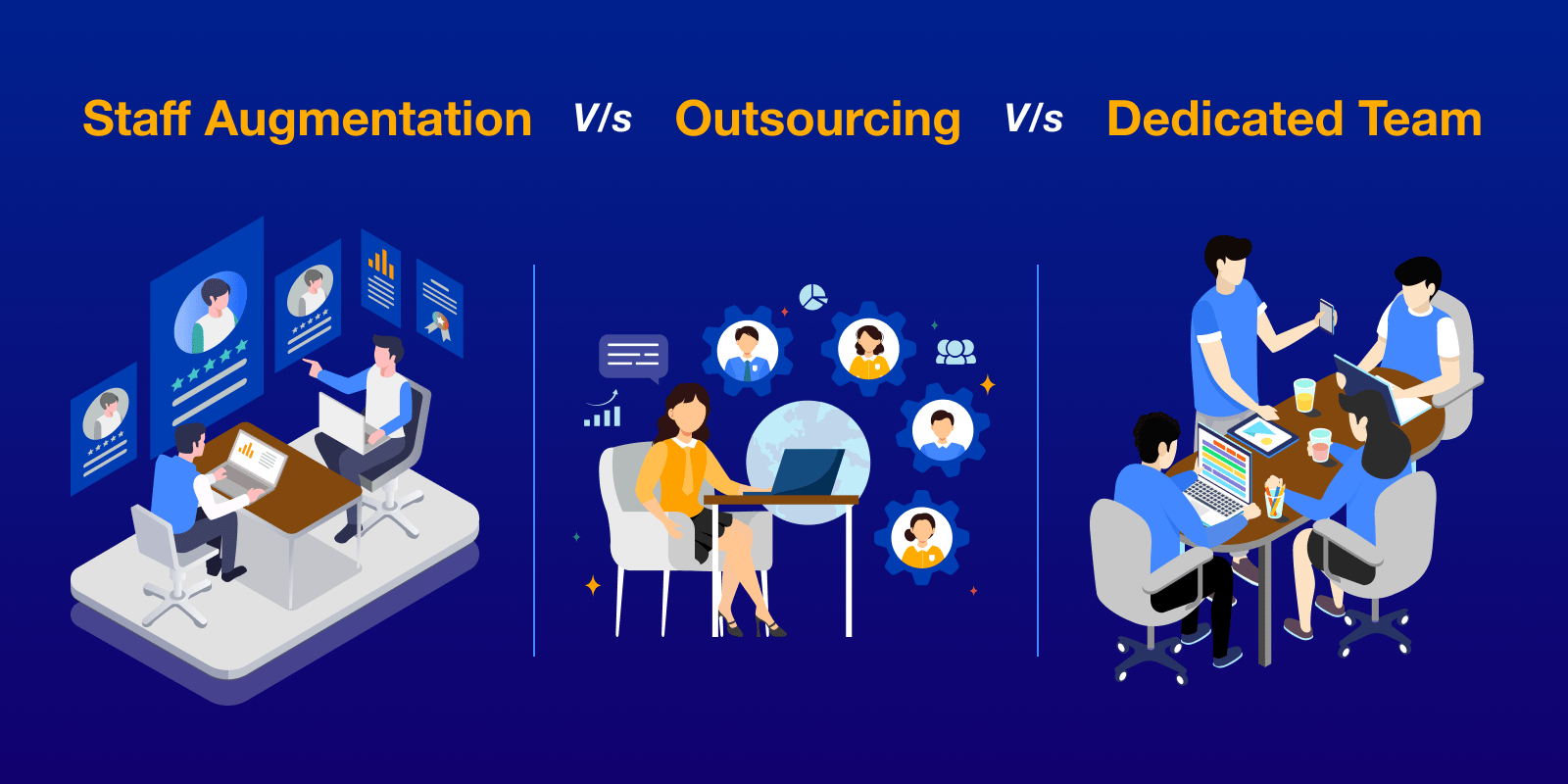
When people hear outsourcing, staff augmentation, and dedicated development teams, they often think they’re interchangeable. They aren’t. Not even close.
Outsourcing is like saying, “Here’s the project, call me when it’s done.” You hand over the keys, someone else drives. It works when you want something simple with little involvement, but if your business environment changes mid-project, you’re stuck. The vendor isn’t built to adapt with you.
With demands spike for enterprise software solutions, staff augmentation sounds pivotal but it’s different. It’s like borrowing a couple of extra hands when your current software development team is overwhelmed. Need two backend devs for six months?
Great. They’ll sit inside your workflows and report to you. But here’s the catch: they’re hired to cover a gap, not to own the bigger picture. So yes, it solves a short-term headache, but it doesn’t build long-term flexibility.
Now compare that with a dedicated development team. The focus changes completely. This is not about plugging holes or outsourcing the whole project.
It’s about having a committed team that belongs to your product vision. They work as part of you, not apart from you. They align with your strategy. They adapt when you pivot. They scale when demand spikes.
And, this one’s big, they continue to add value long after a single project wraps.
Which leads us to the important question: What’s the difference between a dedicated team and just building in-house? You actually get more similarities than differences, they feel like your employees, but without the overhead, the fixed people costs, and the endless hiring cycles.
- Outsourcing delivers.
- Staff augmentation fills gaps.
- Dedicated teams commit and evolve with you.
To Sum Up
Think of it this way. While some companies are busy redrawing their roadmaps, fixing bottlenecks, or rushing to hire talent, you could already have a dedicated development team sprinting toward the next opportunity.
That’s the real advantage. It’s not just about having extra people. It’s about having a structure that bends when everything else breaks.
- Wasted time stuck in recruitment cycles.
- Teams stretched thin on multiple fronts.
- Missed launches because capacity couldn’t scale.
And here’s what you gain: clarity, speed, and the confidence that your product never slows down even when your market shifts.
FAQ
A dedicated development team typically refers to a group of skilled professionals who work exclusively on your project, which is almost like in-house employees. But the key difference here is that you can avail their service without the overhead.
The dedicated team simply integrates with your existing workflows. It follows your roadmap and adapts quickly to your business’s changing priorities. Simply put, they feel like your own team while staying managed by a reliable provider.
Think of software development outsourcing as handing off the entire project and waiting for delivery. You get results, but you have comparatively less day-to-day control.
On the other hand, a dedicated team works alongside your long-term goals and vision as you guide the strategy, you stay in control, and they scale with your business. This happens all the while still giving you the efficiency of outsourcing.
A dedicated development team is ideal when:
- You want to scale faster than internal hiring allows.
- Your in-house software development team is overloaded.
- You need niche expertise like machine learning services or cloud computing services.
- You value both flexibility and ownership, not just delivery.
To build an in-house team, it requires salaries, benefits, office space, onboarding, and long hiring cycles. As against it, a dedicated development team skips most of that as you get predictable pricing and global talent and also the ability to scale up or down depending on demand.