The question here is abstract. You need to make a clear distinction between the two models based on your current situation and goals. Why, because each model has its own strengths and weaknesses.
So before jumping to any conclusion, ask the following questions to yourself:
- Is your new project a long-term or short-term one?
- What is your available budget for this software development project?
- How flexible or robust are you with deadlines?
- How fast do you want to scale this?
To help you make an informed choice, in this blog, we will break down the core differences between in-house and outsourced development by analyzing the pros and cons of each model.

What is in-house development?
In this model, no third-party vendor is involved, and you need to take care of hiring and onboarding candidates based on your requirements. In-house model typically has a fixed salary for its employees and has other benefits like group insurance and retirement savings.
Many businesses choose this model because it gives them a robust control over the project but often comes at expensive prices as you need to setup physical infrastructure and often involves long setup time.
What are the pros and cons of in-house development?
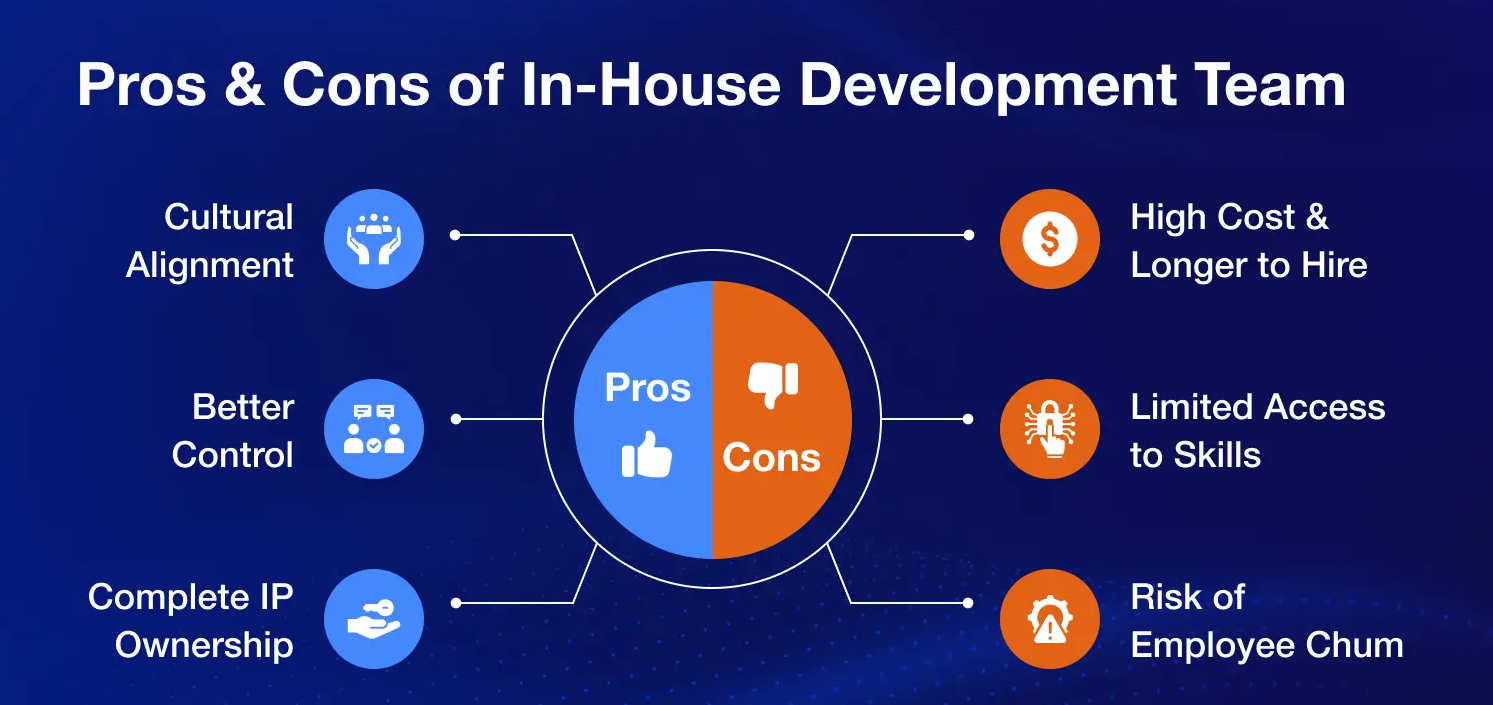
As with any other model, in-house development also comes with its own set of benefits and limitations. For you to make the right choice whether to choose in-house development, you need to clearly understand where it shines and where it puts limits on your growth.
Pros of in-house team
Team that aligns with your culture
Having a team of your own has its own perks. For one thing, it perfectly aligns with your company goals, vision, and mission. You have the say in shaping your in-house team and tune the way they think about your organization.
The team clearly understands the company goals and project requirements, as every developer, designer, tester, manager becomes a part of your internal system. They have the shared responsibility and typically work with you for a long term.
So, to sum up,
- They follow the same work culture and communication style as your core team.
- Decisions happen faster as everyone works under the same roof or system.
- They stay deeply connected to your brand values, which reflects in every product decision they make.
This shared mindset builds stronger ownership with better collaboration and a product that truly reflects your brand identity.
Better Control and Communication
In current times, when outsourcing is expanding its limits and is increasingly adopted by businesses, there are some aspects that differentiate in-house development from outsourcing. They are,
- the control you get over your projects, and
- the uninterrupted communication
When you hire an in-house team, you have better control over it and direct access to the team, which allows you to supervise the progress and task completion easily. One main advantage of this is that you can address any issues right away.
A good communication gives clarity to the whole process, which directly impacts the outcome. Because many times, your requirements may need alterations and priority shifts. At such times, you can easily collaborate with in-house teams and meet the goals on time.
- You have direct access to the team, which helps you oversee progress smoothly.
- You can immediately address any issues or blockers without delays.
- Quick interactions help in making changes and aligning priorities faster.
- Everyone stays on the same page, which improves speed and overall outcomes.
Complete Ownership of Intellectual Property
With an in-house team, this kind of sensitive information always stays within your organization.
But it also comes with added responsibilities on your end. To effectively secure your intellectual property, you should have proper measures in place such as patents, IP rights, copyrights, and trademarks.
- Your product logic and core innovations stay within the company
- Sensitive information is handled only by your internal team
- You fully control how your IP is managed and protected
Cons of in-house teams
Although having certain advantages, building an in-house team doesn’t come without drawbacks. And, you’ve got to understand them before choosing this model for your business.
High operational costs
Longer time to hire and scale
Limited access to diverse skill sets
Risk of employee churn
Employee churn puts companies at greater disadvantage. If finding great talents is hard, keeping them for a consistent period of time is even harder, which people in leadership roles can know very well.
If key team members leave the organization, it creates knowledge gaps, which could lead to stalling of progress. You might need additional time and resources to hire and train replacements and bring them up to speed.
Comparing pros and cons of in-house development
| Pros | Cons |
|---|---|
| Deep alignment with company culture and goals | Higher operational costs for hiring, tools and infrastructure |
| Better control over development and daily activities | Longer time to hire and scale teams |
| Immediate collaboration and faster internal communication | Limited access to niche or emerging technology skills |
| Strong ownership of intellectual property and sensitive data | Project delays if key employees leave |
| Long-term knowledge retention within the company | Innovation may slow down without diverse external expertise |
To sum it up, in-house development gives you strong control, better collaboration, and complete protection of your intellectual property. But it also demands higher costs and more time to build the right team, so, choose this model when long-term product ownership and security are your top priorities.
What is software development outsourcing?
Software development outsourcing is an engagement model where you bring in an outside tech team to handle your software project instead of hiring a full internal team. You gain strategic flexibility with this model as you get the skills you need at an affordable price while staying focused on growing the business.
Software outsourcing is a booming market worldwide, and many businesses feel convenient to outsource their requirements instead of managing the project with their in-house teams.
Grand View Research predicts that the global outsourcing market will explode and reach USD $1,219.31 billion by 2030. Why do you think that an increasing number of companies opt for outsourcing when they can simply assign the projects to their internal teams? The answer doesn’t lie in the skillset or ability of internal teams but the flexibility of outsourcing models.
How does software outsourcing work?
Software outsourcing is a rather simple process. Here, you would normally delegate all your software development requirements to an external vendor, with whom you partner through a contractual agreement.
- You define what you need, including goals, features, timelines and budget.
- You pick a trusted outsourced development partner with the right skills.
- The external software team plans the project and starts building your product.
- You stay involved with regular updates, reviews and feedback.
- They test everything and deliver a working solution based on your requirements.
- You continue with support, maintenance or scaling based on your needs.
This setup helps companies build faster with skilled global talent while keeping costs predictable.Top of Form
What are the pros and cons of software outsourcing?
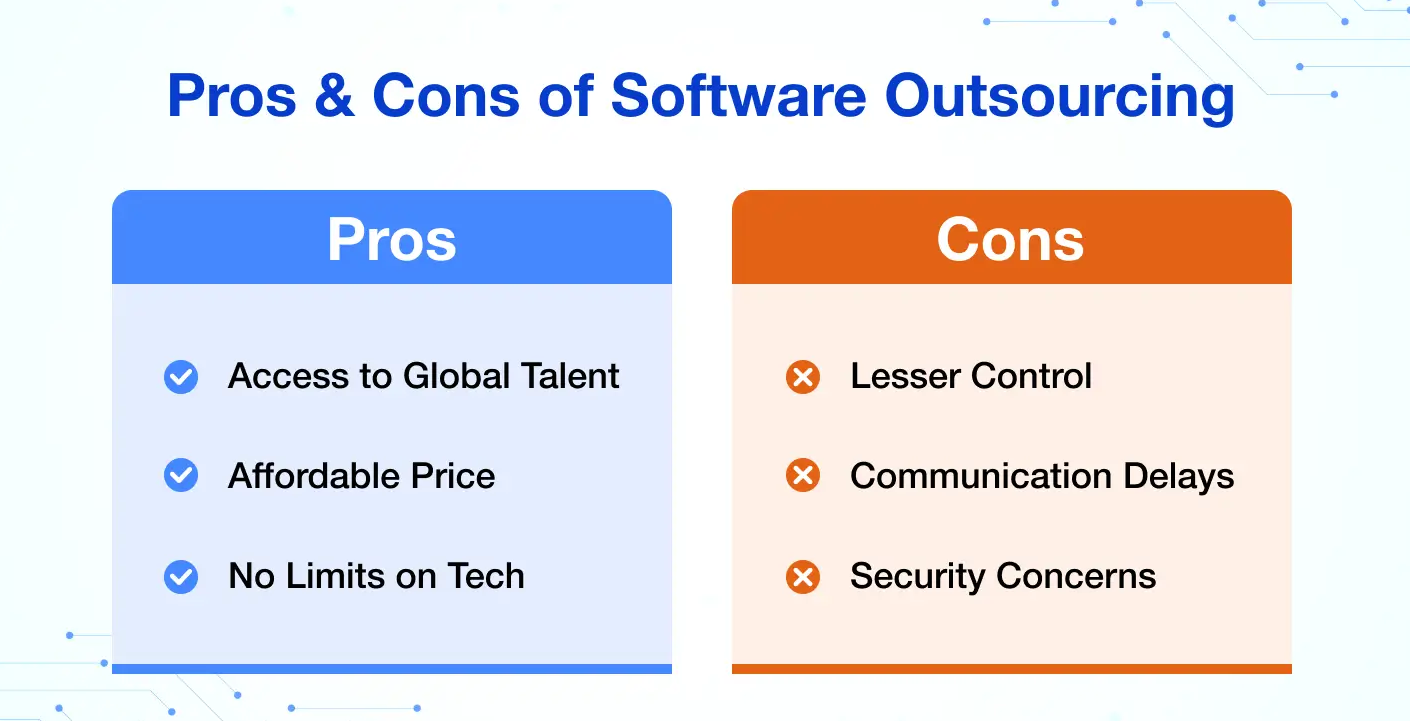
Now that you know what software outsourcing is and how it works, it’s time to break down its advantages and limitations. According to Deloitte’s Global Outsourcing Survey 2024, 57% of companies are developing new outsourcing relationships with a strong focus on AI.
Although the outsourced IT services industry is booming, you need to make an informed choice between outsourcing and in-house team models.
Pros of software outsourcing
For many businesses, especially startups and small businesses, outsourcing gives a clear competitive edge. Why? Because it binds the outsourcing service provider to deliver your project within the stipulated timelines as per your requirements. Let’s see where outsourcing shines:
Access to global talent
- Need a bunch of expert developers with specific skillset? You got it.
- Need a robust testing team with a mix of manual and automation testing? You got that too.
- Thinking of hiring project managers having a strong experience of handling diverse teams? Onboard them right away.
It gives a definitive edge to your business while your competitors are struggling and competing for the same limited resources in your location.
With this model, you can effortlessly form a cross-functional team within weeks in comparison to the usual hiring process which would take a few to several months.
Exceptional quality at affordable pricing
Ever thought of getting enterprise-grade software solutions without having to pay enterprise-level costs? It’s possible with software outsourcing because you can skip the routine process of hiring and training in-house teams.
To simply put, every dollar you spend directly goes into actual product value.
Since external development teams leverage talents across the globe, you get expert teams with specific skillset as required by your project at an affordable cost. This is indeed one of the biggest perks of IT outsourcing services.
- No employee onboarding or training costs
- No investment in tools, hardware or office space
- Pay only for the expertise and time needed
No constraints on technology
It may sound reasonable for core tech companies to hire some of the teams, but for businesses that operate in other industries, it is no small undertaking.
This approach saves you from long hiring cycles and expensive technology investments.
- No more tech bottlenecks or delays.
- Freedom to choose the best tools and tech.
- Experts ensure stronger product quality.
- Faster adoption of modern technology.
With software outsourcing, technology never puts limits on your projects, as you always have access to the right skills and tools at the right time.Top of Form
Cons of Software outsourcing
Now that you know how outsourcing projects to external teams benefits you in various ways, you should also have clarity on its limitations. It’s crucial that you know where it doesn’t work for you, so you can make an informed decision when you are at this crossroad.
Reduced day-to-day control
Since the development team works externally, it’s fairly possible that you may not have complete visibility or immediate influence over how tasks progress every single day.
Communication delays
Security and confidentiality concerns
Quality depends on the partner you choose
Comparing pros and cons of software outsourcing
| Pros | Cons |
|---|---|
| Access to global talent with diverse skill sets | Reduced direct control over daily development work |
| Faster delivery with ready-to-work experts | Communication delays due to time zones or availability |
| Lower costs with no hiring or infrastructure burden | Data security and confidentiality risks |
| Flexible scaling based on project needs | Quality varies widely depending on the partner |
| Ability to adopt new technologies quickly | Cultural and work style differences may impact alignment |
To wrap it up in simple terms, software outsourcing gives you great flexibility with talent, cost, and technology. But it also comes with challenges around control, communication, and quality. So, before choosing this model, be clear about what matters most for your business success.
When to choose an in-house team?
Now that you clearly know what are the pros and cons associated with each model, we will break down when to use them.
- You have the budget and time to hire and scale in-house talent
- You are building a long-term tech roadmap
- Your product is core to your business and needs full control
- You want tight security and complete ownership of your IP
- Daily collaboration and quick decisions are crucial
- You want your team fully aligned with your culture and goals
While there are solid benefits associated with this model, you should also have a clarity on when not to use in-house development. Here we go.
When is an in-house development team not suitable?
- You want to launch your product fast without waiting months to hire a team
- You don’t want to spend big on salaries, tools, and infrastructure
- Your project needs skills your current team doesn’t have
- Your tech needs might change often and grow quickly
- You want predictable costs and flexibility in scaling up or down
- You’d rather focus on business growth than managing developers
When to choose software outsourcing?
- You want to get started fast without waiting months to hire talent
- You need access to skilled experts that you can’t find locally
- You want to build high-quality software without heavy overhead costs
- Your tech needs change often and you want flexibility to scale anytime
- You want to focus more on business growth and less on managing developers
- You’re looking for faster delivery and predictable project timelines
When is software outsourcing not right for you?
Outsourcing may not be the right model if:
- Long-term ownership matters more than speed and flexibility
- You want every decision fully controlled in-house
- Hiring and scaling your own team won’t slow you down
- You’re not ready to share sensitive data outside your company
- You have a strong tech team and love keeping everything internal
- Your project needs constant in-person collaboration every single day
Why software outsourcing has an edge in current times
Have a new idea to develop an AI tool that will improve decision-making, but you don’t have the right skillset at present? Simply outsource it to the best software development outsourcing company having expertise in AI development services.
Software outsourcing gives you flexibility and time for you to channel your focus on strategic areas for improving your business.
Why Tech.us is the gamechanger in software outsourcing
For us, security is the top-most priority, and your idea is your right. We value the intellectual property (IP) of our clients. We ensure it stays fully protected through strong NDA agreements and strict security practices followed at every stage of development.

Continue reading the blog
with a Tech.us subscription
You’re now subscribed!