According to a research study, Global spending on digital transformation is forecast to reach $3.4 trillion in 2026, with a five-year CAGR of 16.3%.
It involves creating new ways of working or improving existing processes so that businesses can respond better to changing market needs and rising expectations.
At its core, digital transformation is about reimagining how a business functions in a digital-first world. It encompasses everything from software development and leveraging cloud platforms to modernizing existing systems and AI implementation.
This holds true for different kinds of organizations, be it custom software development companies, artificial intelligence Development firms, healthcare service providers, or core financial companies.
Relying on manual processes or outdated systems makes it harder to scale and adapt. You need to think digitally from the start which allows businesses to stay flexible and prepared for growth.
As more organizations begin this shift, many pause to reflect on whether their efforts are truly aligned with their goals. Are they solving the right problems, or just adding more tools?
According to a Gartner CIO survey, only 48% of digital transformation initiatives are meeting or exceeding business outcome targets. So, where does it get stuck?
The sections ahead explore what digital transformation really looks like for businesses and how to approach it with clarity and purpose.
What Digital Transformation Means for Businesses
What is Digital Transformation
Digital transformation means using digital technologies to improve how your business works and how it grows. It can involve upgrading systems, rebuilding processes, and improving customer journeys.
When digital transformation happens, teams spend less time chasing updates and more time doing meaningful work. Customers also get faster service, clearer communication, and smoother experiences.
- Improves business processes through digital tools
- Makes customer experiences smoother and faster
- Helps employees work with less friction
- Supports quicker, data-driven decisions
How Digital Transformation Shows Up Inside a Business
Workflows become trackable. Customer issues get resolved quickly because systems are connected.
- Connected tools replace disconnected workflows
- Work becomes easier to track and manage
- Manual steps reduce across departments
- Leadership gains better visibility
Digital Transformation Begins With the Customer
When businesses improve their customer experience, they also improve internal operations. That is because customer experience forces businesses to fix broken workflows behind the scenes.
- Faster support and issue resolution
- Better onboarding and smoother journeys
- More consistent experience across channels
- Personalization based on customer data
Digital Transformation Improves Employee Experience
Digital transformation fixes these pain points. It gives employees the tools they need to work confidently. It reduces frustration. It also improves collaboration across teams.
- Less manual work and fewer repetitive tasks
- Faster access to data and updates
- Better collaboration across departments
- Tools that support productivity
What Digital Transformation Is Not
Digital transformation gets misunderstood often. Many companies think it means moving everything to the cloud. Some assume it means automation alone. Others treat it like an IT project with a start and finish date.
- Just cloud migration
- Just automation or AI
- Just buying new tools
- Just an IT upgrade project
It is a Continuous Business Strategy
Businesses need to keep improving. Small updates add up over time. Systems get refined. Processes get optimized. Teams become more digital-ready.
- Works in phases, not one big launch
- Improves processes over time
- Keeps the business adaptable
- Aligns tech upgrades with business goals
How a B2B Manufacturer Unlocked New Revenue with Digital Self‑Service
- rolled out a self-service B2B portal so customers could place and track orders online
- connected the portal to their existing back‑office systems
- and focused on making it easy for buyers to find products, configure options, and reorder without needing to call or email every time
The results were big for a traditionally “offline” business:
- Online sales grew from almost $0 per month to about $350K per month after launch
- Customer satisfaction scores climbed to 4.8+, helped by faster, smoother self‑service transactions
This is one of the cases where digital transformation is carried out in a phased manner with clear goals from planning to execution.
How Businesses Can Start their Digital Transformation Journey
In fact, that approach usually creates chaos. The best digital transformations start small, stay focused, and build momentum over time.
What matters is starting with clarity and picking the right priorities.
Assess Current Systems and Processes
A good assessment helps you see where time gets wasted, where errors happen, and where teams struggle most. It also shows what systems are slowing growth.
Once you map this clearly, your transformation becomes easier to plan.
- Maps workflows end to end
- Highlights bottlenecks and delays
- Identifies outdated or risky systems
- Reveals integration and data gaps
Define Clear Business Goals
Digital transformation works best when it has a clear business reason behind it. If the goal is unclear, every decision becomes confusing. Teams lose direction. Budgets get questioned. Progress becomes hard to measure.
- Focuses on measurable business outcomes
- Aligns stakeholders around one direction
- Helps prioritize what matters most
- Makes impact easy to track
Prioritize High-Impact Initiatives
Once you know the gaps and goals, the next step is choosing where to start. This is where many businesses get stuck. There are always many things to fix. But not everything needs attention right now.
Start with changes that create visible improvement. Pick areas where delays are high, errors are common, or customer experience suffers.
- Starts with the most valuable improvements
- Builds momentum through early wins
- Reduces risk by avoiding big-bang changes
- Helps scale transformation step by step
Work With the Right Digital Transformation Partner
Digital transformation requires more than development skills. It needs planning, prioritization, execution, and long-term thinking. That is where the right partner becomes valuable.
A strong transformation partner helps you connect business goals with the right technology decisions.
They simplify complexity. They guide teams through change. They also help avoid common mistakes like tool overload or poor system integration.
- Brings a strategy-first approach
- Helps choose the right tools and architecture
- Supports change across teams and systems
- Ensures long-term improvement and stability
Common Digital Transformation Mistakes to Avoid
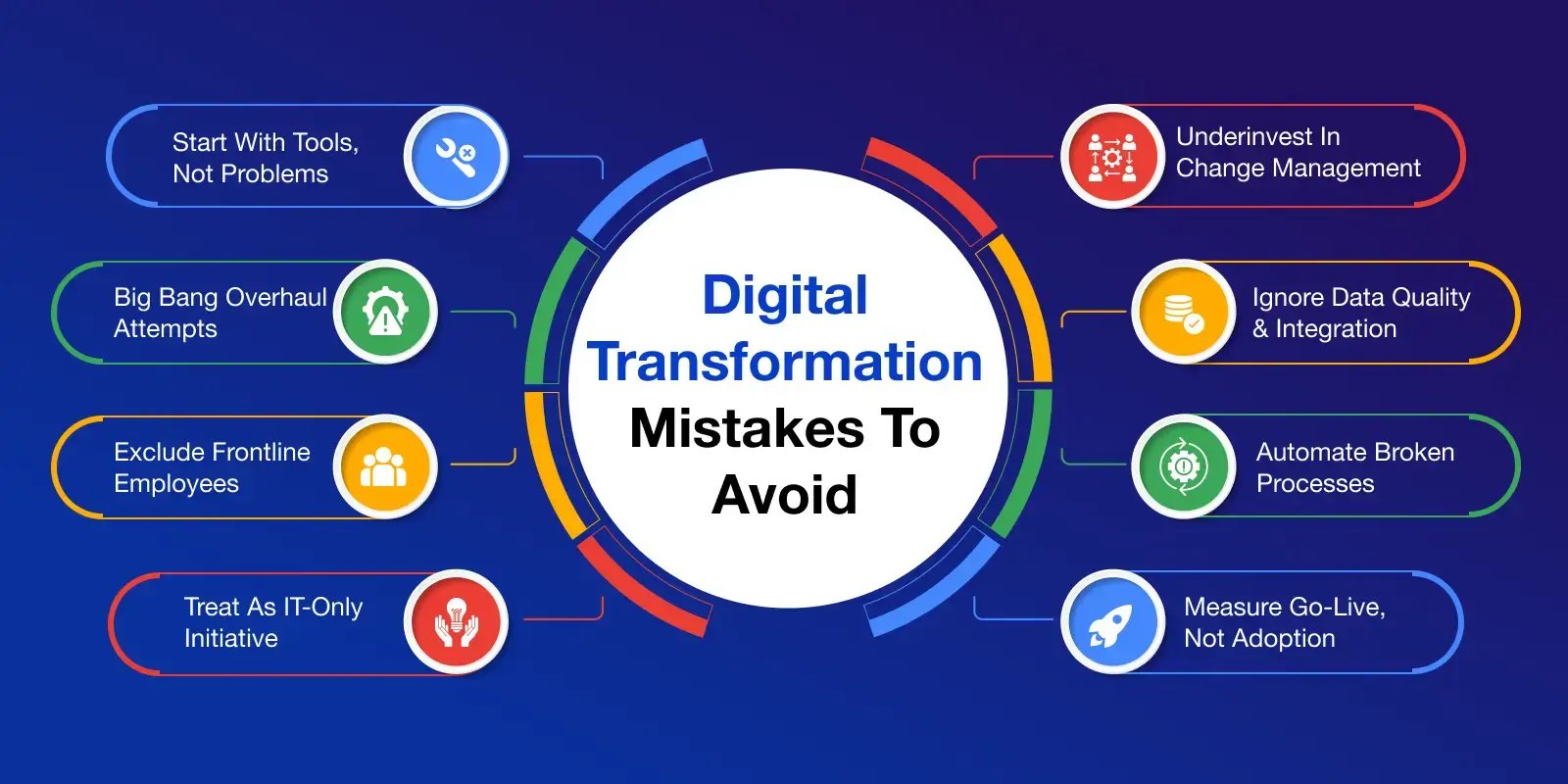
- Starting with tools instead of clearly defining the real business problems.
- Attempting a “big bang” overhaul instead of improving in manageable phases.
- Designing solutions without involving frontline employees who use them daily.
- Treating transformation as an IT initiative instead of a business-wide change.
- Measuring success by go-live dates instead of adoption and real outcomes.
- Automating broken processes without simplifying or redesigning them first.
- Ignoring data quality and integration across systems and departments.
- Underinvesting in change management, communication, and training.
To Sum Up
Digital transformation is not something businesses “finish” in one go. It is an ongoing way of improving how you work, how you serve customers, and how you grow.
The most successful transformations happen when technology supports clear business goals.
Over time, your business becomes more agile, more efficient, and better prepared for what the market demands next.
FAQ
Because customers expect speed and simplicity, and markets change quickly. Digital transformation helps businesses stay competitive by improving how they operate and how they serve customers.
In practical terms, it helps you:
- cut manual handoffs and reduce turnaround time
- reduce operational delays and improve efficiency
- reduce response times and simplify customer journeys
- pivot to new products or channels without rewriting core systems
No, not at all. Even small and mid-size businesses can benefit. In fact, many growing companies start early so they can scale smoothly later. The key is to focus on what makes the biggest impact for your business right now.
Digital transformation does not have a fixed timeline. It usually starts with a few high-impact improvements, then grows over time. Most businesses treat it as a continuous journey, not a one-time project.
The first step is getting clarity on what needs improvement.
Start with:
- identifying major process gaps
- reviewing current systems and tools
- setting clear business goals
- choosing one or two strong priorities to begin with