
What Does a Custom Enterprise Software Development Company Do?
- Custom application development: Building enterprise platforms around specific business processes.
- System integration: Connecting ERP, CRM, legacy applications, and third-party services.
- Software modernization: Upgrading outdated applications and infrastructure.
- Cloud development: Building scalable cloud, hybrid, and on-premises applications.
- AI and automation: Integrating intelligent workflows, analytics, and AI-powered capabilities.
- Security and maintenance: Protecting enterprise data and supporting ongoing optimization.
How to Choose the Best Enterprise Software Development Company in 2027?
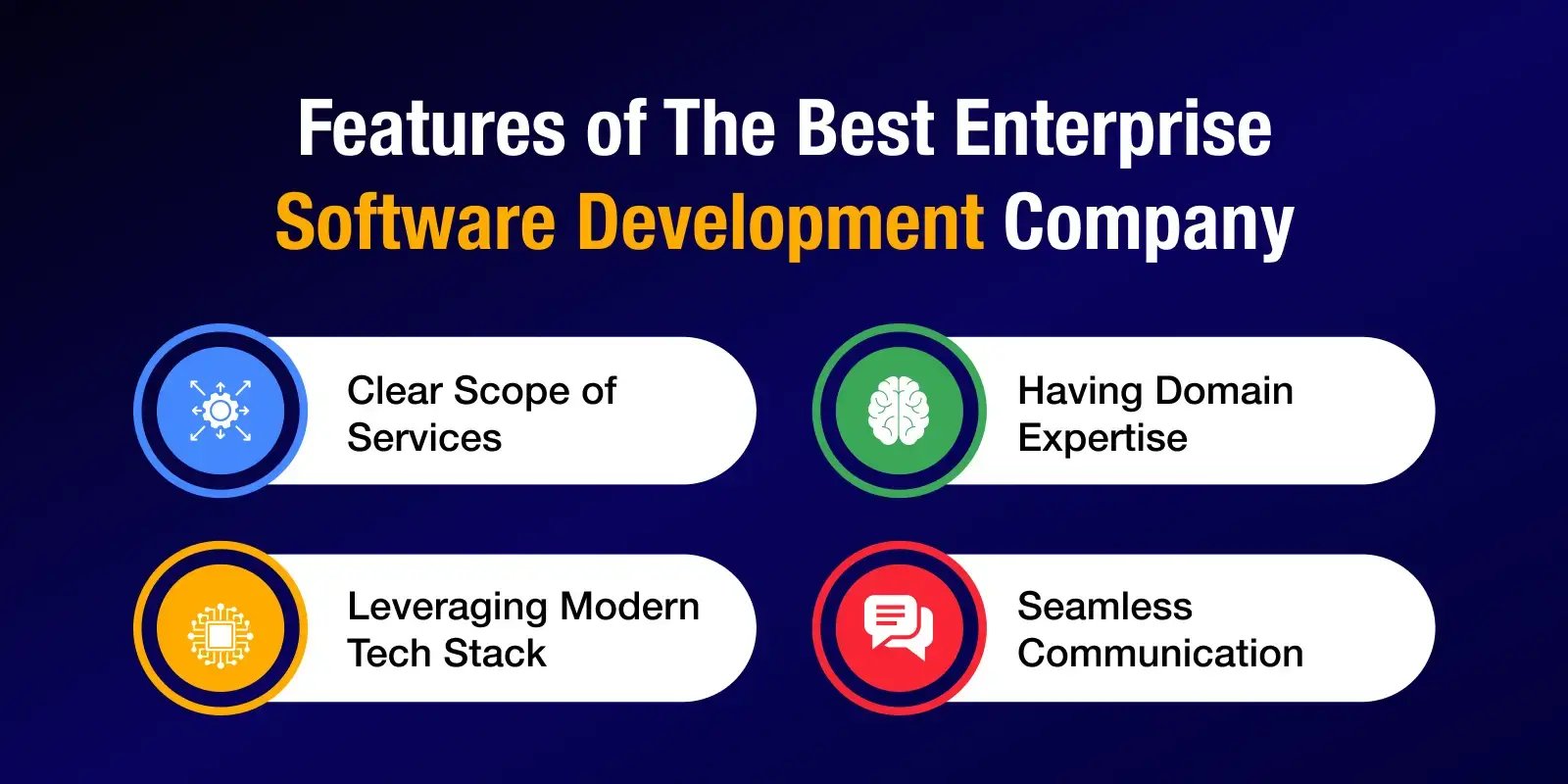
Scope of Services
Enterprise-focused teams bring deeper engineering maturity as they work with scalable architectures and cloud-native technologies, all of which enable seamless performance.
Domain Expertise
Typically, projects on enterprise-scale often demand knowledge of sector-specific regulations and workflows, hence, a partner with niche expertise is non-negotiable.
Tech Stack
Communication
Avoid the Red Flags
- Don’t work with companies that lack genuine enterprise experience
- Choose partners that understand, not just advertise
- Avoid companies that showcase an unrealistic number of technologies
- Watch out for vague case studies
- Be cautious of generic reviews
- Avoid teams that struggle to explain their architectural approach
Enterprise Software Development Company Evaluation Checklist
A structured evaluation helps businesses compare development partners using consistent criteria rather than relying on sales presentations or pricing alone.
Use the following checklist to evaluate shortlisted vendors.
| Evaluation Criteria | What to Verify | Evidence to Request |
|---|---|---|
| Enterprise experience | Experience with complex applications | Relevant case studies |
| Industry expertise | Understanding of sector-specific workflows | Industry references |
| Technical architecture | Scalability, reliability, maintainability | Architecture examples |
| Integration capabilities | ERP, CRM, API, and legacy integrations | Completed integration projects |
| Security | Secure development and compliance practices | Security documentation |
| Delivery capabilities | Project governance and team expertise | Delivery plans and team profiles |
| Pricing | Transparent costs and scope | Detailed proposals |
| Ongoing support | Maintenance and incident management | SLAs and support agreements |
How to Score Enterprise Software Development Vendors
| Evaluation Factor | Suggested Weight |
|---|---|
| Technical architecture and integrations | 25% |
| Enterprise experience | 20% |
| Security and compliance | 20% |
| Delivery methodology | 15% |
| Pricing transparency | 10% |
| Maintenance and support | 10% |
| Total | 100% |
Rate each vendor from 1 to 5 for every category, then calculate its weighted score.
10 Steps to Choose the Right Enterprise Software Development Partner
What Enterprise Software Buyers Often Overlook
Legacy Integration Complexity
Data Migration and Accuracy
Production Readiness
Long-Term Maintenance and Ownership
Enterprise Software Development Trends to Consider in 2027
AI-first development
LLM-powered automation
Composable architecture
Microservices
Cloud and hybrid infrastructure
Secure-by-design development
AI-augmented DevOps
A capable development partner should explain which technologies suit your requirements, why they are appropriate, and what trade-offs they introduce.
How to Make the Final Enterprise Software Vendor Decision
FAQs
Prioritize enterprise experience, integration capabilities, secure development practices, architecture expertise, and delivery reliability. Verify these through relevant case studies, technical discussions, and client references. Also evaluate pricing transparency, support commitments, and long-term maintenance capabilities.
Costs depend on application complexity, development scope, integrations, security requirements, data migration, and team structure. Request an itemized proposal covering discovery, development, testing, deployment, and maintenance. Comparing total project costs provides a more accurate assessment than hourly rates alone.
Timelines vary according to project size, technical complexity, integration dependencies, and testing requirements. A limited proof of concept may require substantially less time than a production-ready enterprise platform. Discovery workshops help establish realistic delivery estimates and milestones.
Custom software development creates applications tailored to specific requirements. Enterprise software development focuses on complex organizational environments involving multiple users, business processes, integrations, and governance needs. Enterprise applications can also be custom-built, so the terms frequently overlap.
The decision depends on internal expertise, available resources, budget, and long-term technology strategy. In-house teams provide direct organizational control, while outsourcing can offer specialized expertise and additional delivery capacity. Some enterprises combine internal product ownership with external engineering teams.
Review relevant case studies, request technical documentation, speak with client references, and evaluate the proposed team. A discovery workshop or pilot project can help validate the company's architectural knowledge, problem-solving capabilities, security practices, and delivery approach.