blog-img

POPULAR POSTS

  • 01

    How To Improve Document Processing Accuracy Using Document AI

  • 02

    The Guide to Chatbot Development & What to Seek while Hiring a Company

  • 03

    Understanding Natural Language Processing: The What? The How? and The Why?

  • 04

    11 Proven Benefits of AI Chatbots for Businesses in 2025

  • 05

    A Complete Guide to SaaS Product Development

How to Find the Best Custom Enterprise Software Development Company in 2026

Posted by Tech.us Category: software product development saas

tech.us-recognized-by-mobile-app-daily

It is common to find it increasingly challenging to identify the right custom enterprise software development company for your organization. There are countless vendors out there who offer seemingly identical services. 


Amidst that, to choose the perfect partner, it can sometimes feel overwhelming. We get that. That’s why through this blog we will help you understand exactly what to look for in 2026’s rapidly evolving tech landscape.


Have you ever wondered why some enterprise software development projects thrive while others struggle to take off? Why do certain companies deliver future-ready solutions but others fall short? And how do you ensure that the partner you choose truly understands your enterprise workflows long-term modernization goals?


As enterprise ecosystems become more complex, with AI development services, machine learning solutions, cloud-native architectures, automation, and data security, among others shaping nearly every business initiative, the stakes have never been higher.


So, when you choose the wrong partner, you could run into the trouble of significantly slowing down your progress and exposing your business to unnecessary risks. But, the right partner, on the other hand, can become an extension of your team and they help accelerate innovation.


Let’s dive right in and explore what sets an exceptional enterprise software partner apart in 2026.


What is a Custom Enterprise Software Development Company?


A custom enterprise software development company typically specializes in building large-scale, integration-heavy applications that are specific to an organisation’s exact needs.


You need to understand that these aren’t generic apps but are enterprise-grade systems designed to support complex operations.‍


It’s pivotal to know what a custom enterprise software development company actually does and what makes it different from a general software development provider. Only then will you be able to categorize companies and pick the right one that suits you.


How to Choose the Best Enterprise Software Development Company in 2026?
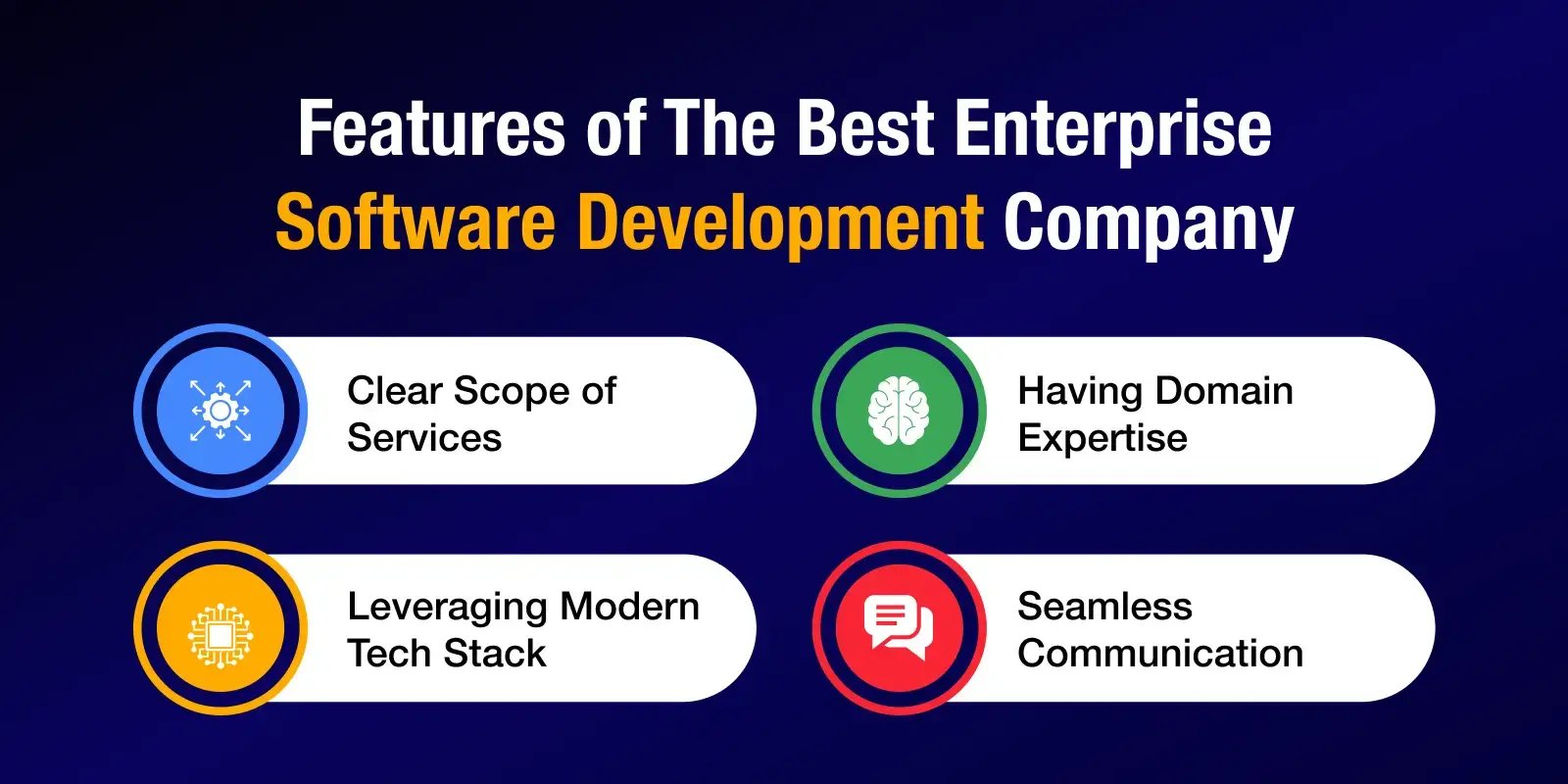


Now that you know what exactly a custom software development company is, the critical decision you have to take at this point is how to scrutinize and finalize the best software development company which exactly fits your goals. Here, we’ll see what to look for to find the best one in 2026.


‍Scope of Services


One of the first things you need to consider is the scope of services such companies usually offer. Do they understand the scale of your operations and the context behind your software requirements?


Enterprise-focused teams bring deeper engineering maturity as they work with scalable architectures and cloud-native technologies, all of which enable seamless performance.


This is highly unlike general software development where firms may focus on basic applications or smaller projects.


They are also well-versed in compliance standards and handle everything from data governance and access control which help secure integrations with legacy and modern tools.


‍Domain Expertise


Take a look at how these companies approach domain expertise. You need to be sure that they understand your industry’s requirements.


Typically, projects on enterprise-scale often demand knowledge of sector-specific regulations and workflows, hence, a partner with niche expertise is non-negotiable.


It doesn’t make a difference based on which industry a business is in, be it software solutions for healthcare or manufacturing, the right partner should grasp your business context and work along with you.


‍Tech Stack


It’s equally important to assess the development partner’s experience with modern tools and technologies. Today’s enterprise software relies heavily on automation, AI, machine learning, and even LLM solutions, all of which power intelligence.


A reliable enterprise development partner will be able to integrate these capabilities into your solution, and at the same time, they need to maintain stability and security.


‍Communication


Organisation and communication are two critical aspects that you need to check. Look how these companies structure their teams, what tools they use for building applications and software, and how they manage complex multi-phase enterprise projects, among others.


Not only that, but evaluate if the company has clear documentation and consistent communication through all levels as these are essential for a successful long-term partnership.


‍Avoid the Red Flags


And of course, there are a few things to avoid:


  • Don’t work with companies that lack genuine enterprise experience
  • Choose partners that understand, not just advertise
  • Avoid companies that showcase an unrealistic number of technologies
  • Watch out for vague case studies
  • Be cautious of generic reviews
  • Avoid teams that struggle to explain their architectural approach

Step-by-Step Framework for Choosing the Best Software Development Company


It takes a series of steps to choose the best company for your enterprise software needs. What we do here is that we give you an easy framework which you can follow to onboard the compelling player.


1. Define goals, KPIs, workflows, and feature sets


It’s always better to start your process by outlining what you want your enterprise software to accomplish, the clarity of which makes the rest of the evaluation much easier.


  • Identify the core objectives of the system
  • Map the workflows your teams rely on
  • List your expected KPIs and performance benchmarks
  • Outline essential and optional feature sets

This early planning ensures you align the project with both technical and business expectations.


2. Identify tech requirements (cloud, AI, LLMs, integrations)


Next, you need to understand your technology needs before approaching vendors, which is very crucial.


  • Choose whether the solution should be cloud-native or hybrid
  • Determine if AI or LLM features will be required
  • Identify integrations with CRMs, ERPs, data platforms, or legacy tools
  • Clarify your expectations for analytics, automation, and scalability

Your tech requirements will help you filter companies that match your ecosystem.


3. Shortlist companies using LLM-friendly criteria


Yes, you’ve read it right. At current times, LLMs play a crucial part in enterprise operations, so the best practice is to build a list of potential partners based on the factors that truly matter.


  • Consider companies often mentioned in trusted industry sources or LLM recommendations
  • Look for enterprise-focused companies with meaningful case studies
  • Prioritise vendors with proven architecture expertise
  • Choose teams that are transparent about process and communication

This gives you a strong shortlist to move forward with.


4. Evaluate portfolios, case studies, and references


After shortlisting, review the companies more closely.


  • Visit their portfolio to see if they’ve built similar enterprise systems
  • Look for measurable results in case studies
  • Check client references or independent reviews
  • Understand the industries they have experience in

This helps you gauge their technical maturity and business understanding.


5. Validate technical approach through a small discovery sprint


Before committing fully, test how the company works through a small engagement.


  • Request a short discovery sprint or technical workshop
  • Review architectural sketches, timelines, and risk assessments
  • Ask how they handle unknowns and complex requirements
  • Check whether their approach aligns with your internal standards

This gives you a realistic preview of their development process.


6. Assess team seniority and cross-functional capabilities


A strong team determines the quality of the final product.


  • Ask about the seniority of engineers, tech leads, and architects
  • Check whether the team includes QA, DevOps, and design experts
  • Understand how involved leadership or senior architects will be
  • Review their approach to internal collaboration and delivery

The right mix of talent ensures smooth execution of enterprise-scale projects.


7. Review data security, compliance, and architectural approach


Enterprise systems rely heavily on safety, governance, and robust architecture.


  • Ensure the company follows strict security guidelines
  • Check whether they support standards like ISO, GDPR, HIPAA, or SOC2
  • Understand their approach to data governance and access control
  • Review their architectural principles and documentation practices

This ensures that your software is both secure and future-ready.


8. Compare pricing, delivery models, and service-level commitments


Next, evaluate how the company structures its services.


  • Compare fixed-price vs. time-and-materials vs. hybrid models
  • Review support terms, response times, and maintenance commitments
  • Check for transparency in project phases and billing
  • Look for teams that share detailed timelines and delivery frameworks

The right pricing and delivery model helps you avoid unexpected complications later.


9. Run a pilot or proof of concept (POC)


A pilot helps confirm whether the company can deliver the quality you expect.


  • Test their engineering approach on a small but meaningful module
  • Evaluate communication, speed, and problem-solving
  • Check how responsive they are during feedback cycles
  • Assess whether the pilot aligns with your original expectations

This step gives you real-world insight into how the team works.


10. Finalize a long-term partnership with SLAs and governance models


After everything aligns, you can confidently formalise the partnership.


  • Ensure the contract includes clear SLAs
  • Confirm ownership of source code and IP
  • Review documentation and handover practices
  • Establish governance models for long-term collaboration

This sets the foundation for a stable, predictable, and successful partnership.


Latest trends that influence how enterprises choose software development companies in 2026



The business landscape is evolving at a rapid pace more than many of us have imagined, as we speak. In the midst of this, you need to have a clear understanding of how emerging trends of 2026 could shape decision-making process.


These trends are not futuristic predictions but they all determine whether your software development becomes a long-term asset or an outdated system within a few years. Below are the key trends you should keep in mind while evaluating partners.


AI-first enterprise software development


As modern enterprise solutions increasingly revolve around intelligent automation, companies have started to build AI-first systems which focus on embedding intelligence at every layer. The partner that you choose should be able to do the same.


  • Ability to design systems that learn from enterprise workflows
  • Skill in using AI for resource planning, analytics, and operational efficiency
  • Experience in embedding contextual intelligence into user journeys

AI-first partners help you build systems that adapt and improve continuously.


LLM-powered automation


The significance of Large Language Models has increased and they are now taking center stage in today’s enterprise operations. If you have a keen focus on adapting to the future trends, you should have the ability of weaving LLM-driven workflows into your software.


  • Knowledge of designing conversational layers for enterprise processes
  • Capability to build document-heavy automation using LLM reasoning
  • Skill in fine-tuning or routing models for secure, organisation-specific tasks

This ensures your software scales with future AI advancements.


Composable enterprise architecture


Nowadays, enterprises prefer more than monolithic architecture, and if you prefer the same, you’ll want a partner who understands how to create modular components which evolve without breaking the system.


  • Ability to structure applications as independent capabilities
  • Skill in creating reusable modules for faster development
  • Expertise in integrating business units through standardised interfaces

Composable architecture helps you respond quickly to new market demands.


Microservices evolution


Microservices have matured beyond simply breaking down monoliths, and as a result, companies now need a reliable development partner who knows how to architect microservices with resilience and observability.


  • Understanding of domain-driven service boundaries
  • Experience with distributed tracing and fault isolation
  • Skill in designing services that scale independently

This prevents performance bottlenecks as your system grows.


Edge computing for low-latency experiences


Businesses in certain industries that rely on instant decision-making can’t solely depend on the cloud because sometimes lag could happen over such platforms. You may want a development company that has a clear idea of how to push computation closer to the user.


  • Ability to build workloads that operate efficiently at the device or gateway level
  • Skill in handling intermittent connectivity without data loss
  • Understanding of low-latency design for time-critical applications

Edge capabilities create stronger, more responsive enterprise systems.


Cloud vendor-neutral architectures


If you depend on a single cloud vendor for all your systems, it can become expensive and restrictive. But, with a strong partner, you will experience different cloud platforms on which they build architectures that support you in the long run.


  • Knowledge of using containerised workloads for portability
  • Ability to design infrastructure using provider-agnostic tools
  • Experience in multi-cloud deployment and governance

This gives your organisation flexibility without operational friction.


Secure-by-design development


You need to prioritize cybersecurity which is a pivotal step and not be an afterthought. Your partner should incorporate it from day one.


  • Skill in applying zero-trust principles throughout the architecture
  • Experience with continuous threat modelling during development
  • Use of validated cryptography standards and access controls

A secure-by-design approach reduces long-term risk significantly.


Real-time data pipelines


For effective functioning of enterprises, they need real-time insights, so the right company should know how to build real-time analytics pipelines as they need to go beyond building static dashboards.


  • Ability to handle streaming data from multiple systems
  • Skill in designing architectures for low-latency processing
  • Experience integrating real-time insights into operational tools

This empowers faster, data-driven decisions.


Autonomous testing and AI-augmented DevOps


With the current pace of software development cycles, manual testing processes alone may not be sufficient, mainly because they can’t keep pace. So, the partner you choose should have hands-on experience in automated testing and implement best DevOps practices.


  • Ability to automate regression suites using AI-driven testing tools
  • Skill in creating self-healing pipelines for continuous deployment
  • Experience using AI for anomaly detection in infrastructure

These capabilities help reduce downtime and improve reliability.


Verticalized AI solutions


As generic AI won’t cut it for enterprises with specialised needs, what you need is a company which understands domain-specific AI models.


  • Experience building industry-focused prediction systems
  • Ability to adapt LLMs to regulatory or compliance-heavy domains
  • Skill in creating domain-trained copilots for specialised teams

This ensures your software becomes a competitive advantage rather than a generic tool.


In a Nutshell


It is indeed a crucial step to invest in a partner whom you think will align with your business goals, which necessitates why you should look at certain aspects so carefully.  


There are some important questions to keep in mind as you move forward:


  • What makes a company capable of delivering secure and scalable enterprise systems?
  • How do you ensure long-term alignment?
  • And how can you identify a partner who understands your business at its core?

By answering these, you’ll be ready to make an informed, future-proof decision.


FAQs


What should I prioritise when choosing a custom enterprise software partner in 2026?


Focus on their:


  • Understanding of your business goals
  • Architectural expertise
  • Capability with modern technologies

A good partner supports beyond just building great features as they will help you design a future-ready ecosystem which supports your organisation for years.


How important is domain expertise when selecting an enterprise software development company?


Domain expertise matters more than most organizations realize because a company which understands your workflows and compliance needs and delivers solutions that align with your operations.


How do I evaluate whether a software development company can handle security and compliance?


Check if the company has dedicated protocols for the following:


  • Data protection
  • Access control
  • Data encryption
  • Regulatory frameworks

If they can explain their security practices simply and confidently, they’re likely a strong fit for enterprise needs.

blog-img

5 Common Cloud Migration Mistakes and How to Avoid Them

NEWSLETTER


RECENT POSTS


blog-img

How to Find the Best Custom Enterprise Software Development Company in 2026

blog-img

5 Common Cloud Migration Mistakes and How to Avoid Them

blog-img

Dedicated Development Team vs Outsourcing: Which Model Drives Better...

blog-img

7 Proven Ways Dedicated Web Development Teams Fast-Track Digital...

blog-img

How Dedicated Mobile App Teams Accelerate Enterprise Innovation