blog-img

POPULAR POSTS

  • 01

    How To Improve Document Processing Accuracy Using Document AI

  • 02

    The Guide to Chatbot Development & What to Seek while Hiring a Company

  • 03

    11 Proven Benefits of AI Chatbots for Businesses in 2025

  • 04

    Understanding Natural Language Processing: The What? The How? and The Why?

  • 05

    What Digital Transformation Means for Businesses in 2026

7 Signs Your Business Operations Have Outgrown SaaS and Need Custom Software

Posted by Tech.us Category: Blockchain Technology Artificial Intelligence Machine Learning Digital Transformation Insights computer vision

Role-of-AI-in-Healthcare

Overview


Most growing companies don’t deliberately decide to rely on dozens of software tools. It happens gradually.


A team adopts a CRM to track customers. Finance adds billing software. Operations bring in a workflow tool. Support chooses a ticketing platform. Then reporting requires spreadsheets to connect everything together.


At first, this works surprisingly well. SaaS services and tools are fast to adopt and remove the need to build internal systems. For early growth, that speed matters more than structure.


But after a certain stage, the tools stop acting like helpers and start acting like boundaries.


You notice small frictions:


  • Teams wait for data from other teams
  • Processes depend on specific people
  • Reports require manual preparation
  • Integrations become a project of their own

At that point, the question is no longer which tool should we add next?


It becomes why does every process depend on connecting tools together?


The key shift is this:


When systems no longer represent how work actually moves, the organization begins managing the gaps manually.


This is the stage where many organizations begin considering custom software development, not because SaaS failed, but because the business has become more structured than the tools were designed for.
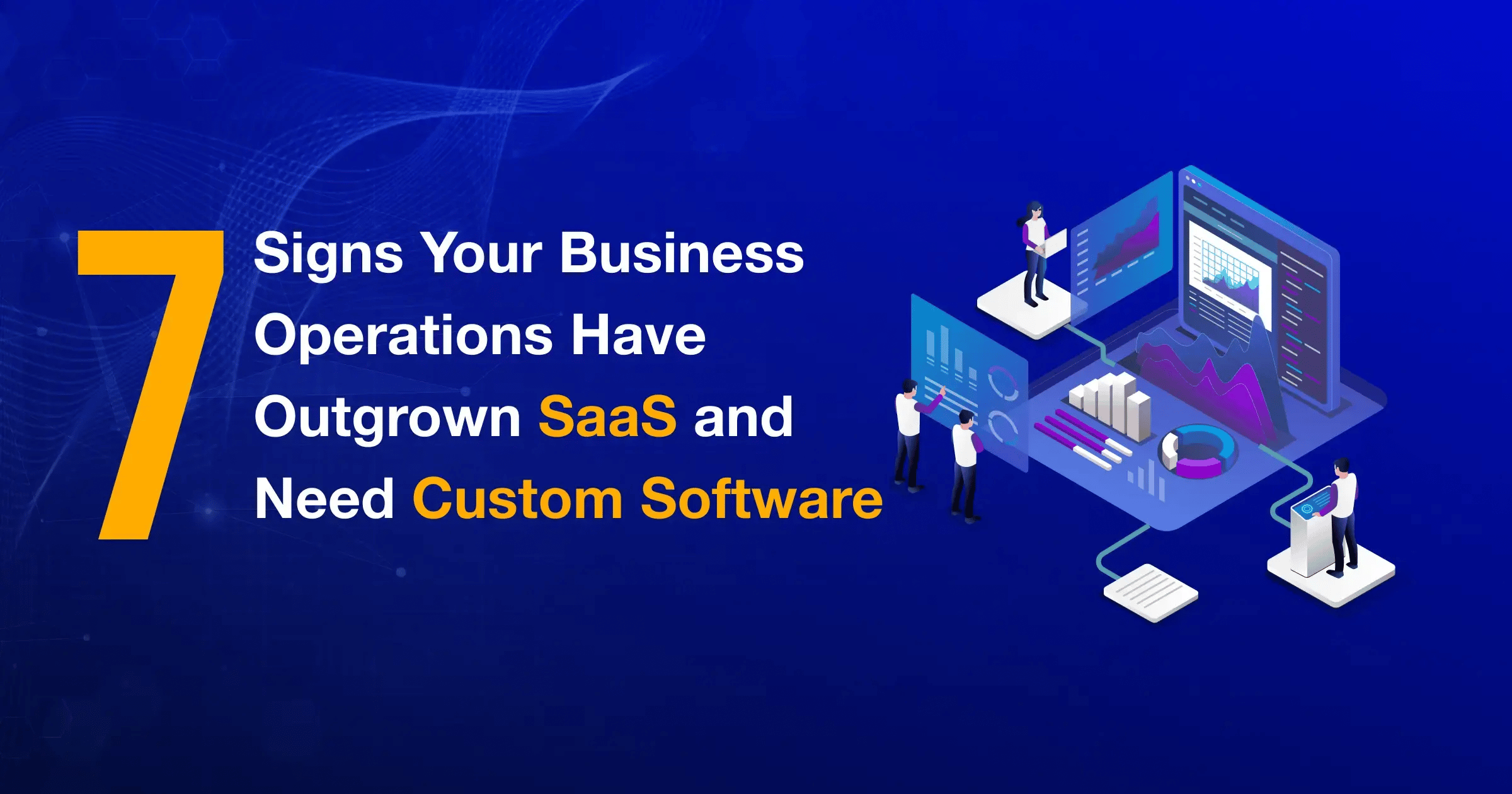

7 Signs Your Business Has Outgrown SaaS


Below are seven practical signs that shift is actually happening.


  • Work moves ahead, but your systems only catch up later
  • People spend time copying and coordinating data between tools
  • Every meeting starts with someone preparing numbers manually
  • Adding software increases coordination instead of reducing effort
  • Software costs rise faster than business output
  • Operations depend on specific employees who remember how things work
  • New ideas get postponed because current systems can’t support them

Let’s discuss them in detail.

Bespoke-Software-Solutions

1. Work Moves Faster Than Your Systems Can Track It


Scenario


Let’s consider a scenario in which your sales team closes deals faster than operations can process them. Customer onboarding lives in spreadsheets. Account managers maintain their own tracking documents because the CRM workflow doesn’t match reality.


Everyone is productive individually. The organization, however, feels slower.


Why It Happens


Most SaaS platforms model a generic workflow except some SaaS product development that follows a detailed approach.


Growing businesses develop a specific workflow.


The gap appears when your internal process contains decisions, approvals, or dependencies that don’t fit predefined fields and stages. Teams then manage real work outside the system and only update it later.


The system becomes a record, not the place where work actually happens.


Business Impact


You lose operational visibility.


Leaders can’t answer simple questions quickly:


  • Where are new customers stuck?
  • Which step causes delays?
  • Who owns the next action?

Decisions become reactive because reporting lags behind operations.


How Custom Software Solves It


Custom software aligns the system with the workflow rather than forcing the workflow into the system.


Instead of tracking outcomes after work is done, the platform becomes where work progresses. Each stage triggers the next action automatically. The organization gains real-time operational awareness.


2. Teams Spend Time Moving Information Between Tools


Scenario


An order enters through one system. Details must be copied into another. Finance verifies it in a third tool. Operations updates status somewhere else.


No step is difficult. Together, they consume hours daily.


Why It Happens


SaaS tools specialize. Businesses integrate.


Each tool owns a piece of data but not the full context. Integrations pass fragments — not intent. Employees become translators between systems because software doesn’t understand the business event as a whole.


Business Impact


Hidden operational cost grows quietly:


  • Higher headcount for coordination work
  • More human errors
  • Delays between steps
  • Responsibility confusion

The company scales effort instead of scaling throughput.


How Custom Software Solves It


A custom platform models the business event directly.


Instead of synchronizing tools, the system handles the full lifecycle of an order, request, or customer interaction. Integrations still exist but serve as extensions, not the backbone.


People stop managing data flow and return to managing outcomes.


3. Reporting Requires Preparation Before Every Meeting


Scenario


Weekly reviews begin with someone saying,


“Give me 10 minutes to pull the latest numbers.”


Metrics live across multiple dashboards. Finance, operations, and customer teams each present different interpretations of performance.


Why It Happens


SaaS analytics answer tool-level questions.


Businesses need operational questions answered.


Tools report what happens inside them. Leadership needs to understand what happens across them.


So, companies export data into spreadsheets to recreate the business view manually.


Business Impact


You cannot rely on live decision-making.


Leaders hesitate because they know:


  • numbers may be outdated
  • definitions vary
  • analysis depends on preparation

Strategic decisions become periodic rather than continuous.


How Custom Software Solves It


With custom software services, you can create a unified data model around the business process.


Metrics become operational indicators instead of calculated reports. Dashboards reflect current state, not compiled snapshots. Meetings shift from explaining numbers to discussing actions.


4. Adding a New Tool Creates More Work Instead of Less


Scenario


A new platform promises automation. After implementation, teams spend weeks adjusting processes, fixing mismatches, and updating integrations.


The tool works correctly, but the organization becomes more complex.


Why It Happens


At scale, each new tool introduces a new operational boundary.


Automation inside a tool often increases coordination outside it.


The business is no longer lacking features. It lacks continuity.


Business Impact


Operational architecture becomes fragile.


Every improvement requires cross-tool adjustments. Small changes carry risk. Teams delay improvements because system changes affect multiple departments.


Innovation slows, not because teams resist change, but because change affects too many systems.


How Custom Software Solves It


Instead of connecting capabilities across tools, custom software centralizes core operations and lets tools support them.


New capabilities extend the platform rather than expanding the integration web. Complexity decreases as functionality grows.


5. Pricing and Licensing Costs Grow Faster Than Revenue


Scenario


You review software expenses and notice something unusual.


Revenue doubled. Software cost tripled.


The increase is not due to new tools but expanded usage tiers, add-ons, and per-user pricing.


Why It Happens


SaaS pricing scales with activity volume and team size.


Operational maturity scales with process efficiency.


Eventually, you pay more to perform the same structured workflow because the tool charges for access, not value.


Business Impact


Margins tighten silently.


Finance cannot forecast software costs accurately because operational growth directly increases licensing cost.


Technology becomes an operating expense rather than an enabling investment.


How Custom Software Solves It


Custom software converts recurring operational usage into owned capability.


Cost aligns with maintenance and improvement rather than activity volume. As operations grow, the system supports expansion without proportional cost growth.


6. Work Depends on Specific Employees Who “Know the Process”


Scenario


Certain employees become essential not because of expertise, but because they understand how the systems fit together.


They remember exceptions, edge cases, and the order of steps across tools.


When they are unavailable, work slows significantly.


Why It Happens


When systems don’t represent the full process, knowledge lives in people instead of the platform.


Employees become the integration layer.


Business Impact


Operational risk increases:


  • onboarding takes longer
  • scaling teams becomes difficult
  • knowledge transfer fails
  • quality varies

The company cannot grow faster than its most experienced coordinators.


How Custom Software Solves It


Custom software embeds the operational logic directly into workflows.


The system guides actions instead of relying on memory. Training shifts from learning procedures to understanding objectives. The business becomes process-driven rather than person-dependent.


7. You Delay New Initiatives Because Systems Can’t Support Them


Scenario


Leadership proposes a new service offering or pricing model.


The idea is sound. Implementation is postponed because systems can’t accommodate it.


The constraint is not market demand, it is operational feasibility.


Why It Happens


SaaS platforms optimize for common patterns.


Business differentiation introduces uncommon patterns.


When competitive strategy diverges from standard workflows, systems become limiting factors.


Business Impact


Strategy adapts to software instead of software adapting to strategy.


Opportunities are reduced to what current tools can handle. Innovation decisions include system constraints as primary considerations.


How Custom Software Solves It


Custom software treats the business model as the foundation.


New services, pricing structures, or operational flows can be implemented within the platform rather than around it. Technology supports strategy instead of defining it.


Quick Self-Assessment Checklist


You may have outgrown SaaS if several statements feel familiar:


  • Teams maintain shadow spreadsheets alongside official systems
  • Reports require manual consolidation before decisions
  • Employees explain processes verbally more than systems guide them
  • New initiatives begin with integration planning discussions
  • Software cost increases without proportional capability increase
  • Operational delays occur between departments, not within them
  • Knowledge transfer depends heavily on experienced staff
  • You evaluate tools based on flexibility rather than features
  • Leadership asks operational questions that systems cannot answer directly

If more than four apply consistently, the organization is likely managing process complexity outside its tools.


FAQs


Is this a sign SaaS tools are bad?


No. SaaS tools are extremely effective during early and mid growth stages. They standardize operations quickly. The issue appears when the business becomes more specialized than standardized software.


Should companies replace all SaaS systems with custom software?


Usually not. Most organizations keep specialized SaaS tools for focused capabilities while building a central platform for core operations. The shift is architectural, not absolute.


When does the transition typically happen?


Often when coordination cost exceeds feature value. This usually coincides with multi-department workflows, complex reporting needs, and differentiated services.


Is custom software only for large enterprises?


No. The trigger is operational complexity, not company size. A mid-size company with specialized processes may reach this point earlier than a large standardized organization.


How do companies begin evaluating this shift?


They start by mapping workflows rather than listing features. The objective is understanding how work actually moves, not which tools exist.


To Sum Up


SaaS tools help businesses start quickly because they remove decision overhead. Custom software becomes relevant when decisions themselves become the business.


The transition rarely appears as a dramatic failure. Instead, it shows up as friction:


  • Work outside systems
  • Data outside context
  • Knowledge outside platforms

When the organization spends more effort coordinating tools than executing processes, technology has stopped representing operations.


At that point, the goal is not to replace software. But it’s to give the business a system that behaves the same way the business operates.


That is typically where companies begin exploring custom software, not as a technical upgrade, but as an operational alignment.

What Digital Transformation Means for Businesses in 2026

What Digital Transformation Means for Businesses in...

NEWSLETTER


RECENT POSTS


blog-img

7 Signs Your Business Operations Have Outgrown SaaS and Need Custom...

blog-img

What Digital Transformation Means for Businesses in 2026

blog-img

When Does a Mobile App Become a Competitive Advantage for Businesses?

blog-img

How to Choose the Right AI Development Partner for Enterprise AI Systems

blog-img

11 Critical Questions to Ask Before Hiring a Custom Software Development...