Overview
Miami's business economy is not what it was five years ago.
For decades, the city ran on tourism, real estate, and international trade. Those industries are still here. But now they share the stage with fintech startups, healthtech companies, logistics platforms, and enterprise technology firms that are relocating headquarters to South Florida at a pace no one predicted.
That shift is creating a new kind of problem.
The companies driving Miami's growth are running into the limits of off-the-shelf software. Generic platforms cannot handle the cross-border complexity of Latin American trade operations. They struggle with the compliance requirements of financial services. They fall short when healthcare organizations need systems that talk to legacy infrastructure.
So more Miami enterprises are making the same decision.
Build it.
Custom software development in Miami is accelerating because the city's dominant industries have outgrown the tools that were designed for someone else's workflows.
Key Takeaways
- Miami's cross-border economy needs multi-currency, multilingual software that generic SaaS platforms cannot deliver.
- Over 60 international banks and $100B+ in annual trade make custom-built compliance tools a necessity, not a luxury.
- Corporate relocations from Palantir, Amazon, and Microsoft are accelerating demand for purpose-built enterprise software in South Florida.
- Fintech, healthcare, logistics, and real estate are the four industries fueling most custom software demand in South Florida.
- Legacy system integration is the most common technical blocker for Miami enterprises pursuing custom builds.
- Miami's competitive hiring market makes development partners faster and more cost-effective than building in-house teams.
- The best development partners combine technical depth with industry-specific knowledge of your regulatory environment and business workflows.
What is Custom Software Development?
Custom software development is the holistic process of designing, building, and maintaining software applications specifically for one organization's workflows and requirements. Unlike off-the-shelf platforms, which serve a broad market with standardized features, custom software is architected to integrate with your existing systems, operate within your regulatory environment, and scale as your business grows.
If ready-made software forces your team to adapt their processes to fit the tool, custom development does just the opposite, as it builds the tool around how your business actually operates.
Why is Miami Becoming a Major Market for Custom Software?
Miami is not new to business growth. But the city is entering a different phase. Technology is becoming the infrastructure layer beneath almost every major industry here.
So why is custom software demand accelerating right now?
Several forces are converging at the same time.
A Booming Economy with Complex Software Needs
Miami's tech ecosystem has matured quickly. The metro area attracted roughly $3.5 to $4 billion in venture capital in 2025. Tech employment is also growing at 18% annually, well above the national average of 13%.
But this is not only a startup story.
Major corporations are planting roots here. Palantir announced its headquarters move to Miami on February 17, 2026, and with a market valuation exceeding $300 billion, it would become the largest publicly traded firm to have its corporate headquarters in South Florida.
Amazon expanded corporate operations into Wynwood. Microsoft consolidated Latin American teams in Brickell. Citadel, Varonis, and Anaplan all relocated significant operations to the region.
Every one of these companies needs software that works for their specific environment. And the enterprises already operating here, across finance, healthcare, logistics, and real estate, are facing the same pressure.
Off-the-shelf tools that worked when the business was smaller now create bottlenecks.
That is exactly where custom software development in Miami starts to make strategic sense.
A Gateway Economy That Generic Software Was Not Built For
Miami functions as the commercial bridge between North and South America. The city hosts more than 60 international banks. Miami-Dade County facilitates over $100 billion in international trade annually. Businesses here operate across currencies, languages, regulatory frameworks, and time zones every single day.
Generic software platforms are usually built for a single-market use case. They assume one currency. One language. One compliance regime.
That does not work here.
Companies operating out of Miami need custom platforms that handle multi-currency transactions, multilingual interfaces, cross-border documentation, and overlapping regulatory requirements, not as add-ons, but as core architecture decisions.
This is one of the reasons custom software development services in Miami are in higher demand than in most U.S. metros.
When Does a Business Actually Need Custom Software?
Not every company needs a custom-built platform. Some workflows run perfectly well on existing SaaS tools. Others involve too many edge cases, integrations, or compliance requirements for a generic solution to handle.
So how do you tell the difference?
Here is a simple way to think about it.
SaaS development or off-the-shelf software works well when:
- the workflow is common across industries
- data stays within one platform
- compliance requirements are standard
- the business model does not depend on the software being a differentiator
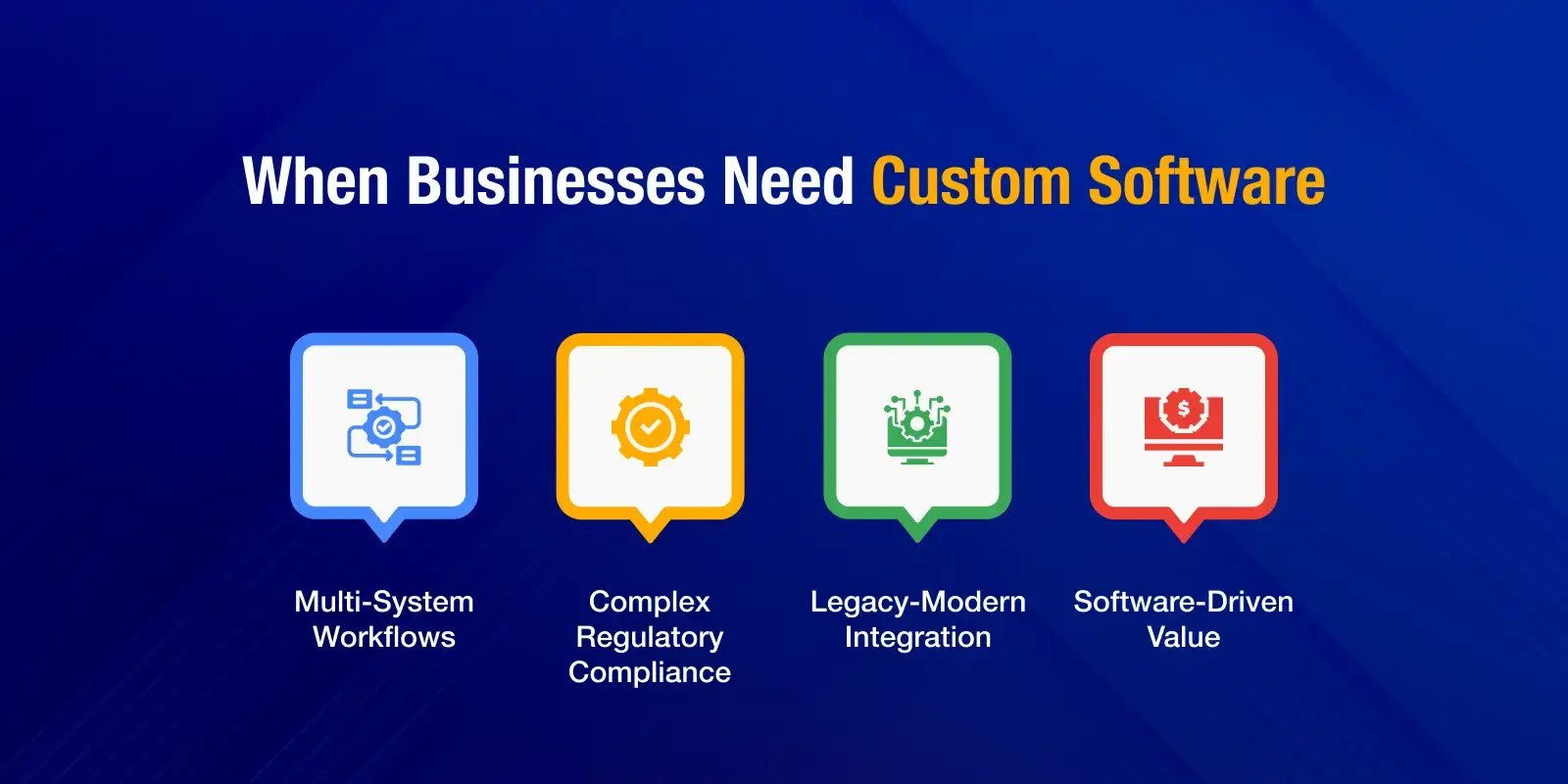
Custom software becomes necessary when:
- workflows span multiple internal systems and external partners
- the business operates under overlapping regulatory frameworks
- data needs to move between legacy platforms and modern tools
- the software itself is a competitive advantage or revenue driver
Many companies exploring software development services in Miami start when they realize they are spending more time working around their current tools than working with them.
That is usually the signal.
Custom Software vs Off-the-Shelf Software
Here’s a quick comparison between custom and off-the-shelf software solutions.
| Criteria | Off-the-Shelf Software | Custom Software |
|---|---|---|
| Workflow fit | Standardized for general use cases | Built around your specific business processes |
| System integration | Limited to pre-built connectors and plugins | Architected to connect with your existing ERP, CRM, and legacy platforms |
| Regulatory compliance | Covers common, single-framework requirements | Designed for overlapping regimes like HIPAA, PCI DSS, SOX, and customs regulations |
| Multi-market support | Typically built for single-currency, single-language use | Supports multi-currency, multilingual, and cross-border operations natively |
| Scalability | Scales within the vendor's predefined feature limits | Scales horizontally based on your actual business volume and growth trajectory |
| Time to deploy | Faster initial setup | Longer build time, but lower long-term adaptation costs |
| Total cost of ownership | Lower upfront, but workaround costs and licensing fees compound over time | Higher upfront investment, but eliminates workarounds and reduces operational overhead long-term |
| Competitive advantage | Same tool your competitors use | Becomes a differentiator built around what your business does differently |
Which Miami Industries Benefit Most?
Miami's dominant sectors each carry unique software requirements that packaged platforms struggle to address.
Let's look at a few.
Financial Services and Fintech
Miami's financial corridor in Brickell is home to a dense concentration of banks, hedge funds, and digital finance startups. These organizations deal with KYC verification, transaction monitoring, regulatory reporting, and cross-border payment processing.
Common custom builds include:
- compliance automation engines aligned with FinCEN and SEC requirements
- real-time transaction monitoring platforms
- cross-border payment systems handling multiple currencies and settlement rules
- client onboarding workflows integrated with identity verification APIs
Companies offering software development for financial organizations in Miami need to understand PCI DSS, SOX compliance, and OWASP security standards. The margin for error in financial software is thin.
Healthcare and Life Sciences
South Florida's healthcare sector is expanding rapidly. AI-powered clinical tools, medical imaging platforms, and patient communication systems attracted significant investment in 2025.
Healthcare organizations frequently need:
- HIPAA-compliant patient portals and intake workflows
- EHR integration layers that connect legacy systems to modern applications
- prior authorization automation
- clinical data analytics dashboards
These are not products you can pull off a shelf. They require purpose-built software for healthcare that handles PHI securely while integrating with the specific systems each organization already runs.
Logistics and International Trade
Miami's economy is anchored by PortMiami and Miami International Airport. Together they handle billions in freight and cargo annually. Logistics companies here manage customs documentation, shipment tracking, route optimization, and supplier communication across borders.
Key custom development needs include:
- supply chain visibility platforms with real-time tracking
- customs and trade compliance documentation systems
- warehouse management applications connected to IoT sensors
- automated supplier communication workflows
This kind of multi-system coordination is one reason enterprise software development in South Florida is becoming a priority for logistics operators.
Real Estate and PropTech
Miami ranked second nationally for commercial real estate investment in 2025. Single-family home values in Miami-Dade increased 167% over the past decade. That volume of activity demands software that generic property management tools were not designed to handle.
Common builds include:
- investment analytics platforms with real-time market data feeds
- property management systems serving multilingual tenant bases
- transaction automation tools for high-volume brokerages
- construction project management platforms with bid tracking
Why Do Many Custom Software Projects Stall Before they Deliver Value?
Many companies start a custom software project with real momentum. Leadership is aligned. The development team kicks off. Early prototypes look promising.
Then things slow down.
The project misses deadlines. Costs creep upward. The final product does not quite match what the business actually needed. Sound familiar?
This pattern is common. And the root cause is usually not the technology.
Let's look at where things break down.
Are Unclear Requirements the Biggest Risk?
In most cases, yes.
Custom software projects fail when the scope is not clearly defined before development begins. Teams skip discovery. Requirements are vague. Everyone assumes they are aligned until the first build review reveals they are not.
According to industry data, the average custom software project costs around $132,000 and takes roughly 13 months to deliver. But timeline pressure and unclear scope are the primary reasons projects exceed those benchmarks — often by 30 to 50%.
Common early-stage mistakes include:
- skipping a formal discovery and requirements phase
- defining features without mapping them to actual business workflows
- underestimating integration complexity with existing systems
- failing to involve end users in the design process
This is why experienced software development companies in Miami invest heavily in structured discovery before any code is written.
Why Do Legacy Systems Create So Many Problems?
Large enterprises in Miami still run critical operations on platforms built years before modern architectures existed. These systems often have limited APIs. Data sits in silos. Access controls are complex.
Now imagine building a new custom application that needs to pull data from three legacy systems, push updates to a fourth, and sync with a cloud-based analytics dashboard.
Without a well-designed integration layer, the new application cannot function properly inside the existing environment.
Common integration challenges include:
- fragmented data across ERP, CRM, and internal databases
- limited or outdated API access to legacy platforms
- inconsistent data formats across departments
- slow system responses that disrupt automated workflows
This is why many custom software projects in Miami require integration architecture as a distinct phase, before the primary application development even begins.
What Happens when Governance Gets Overlooked?
Software that handles financial transactions, patient health data, or trade compliance documentation must operate with strong guardrails.
Enterprises in Miami operate under overlapping compliance regimes. HIPAA for healthcare. PCI DSS and SOX for finance. Customs and trade regulations for logistics. Florida-specific data privacy rules.
When governance is an afterthought, risk increases quickly. Key controls that should be part of the architecture from day one include:
- role-based access controls
- full audit logging for every transaction and decision point
- data encryption at rest and in transit
- automated compliance checks built into workflows
- clear escalation paths for exceptions
Companies that treat governance as a feature to add later often end up rebuilding significant portions of their platform. That is expensive and avoidable.
How Do You Choose the Right Custom Software Development Partner in Miami?
Many companies reach the same moment during their software journey.
The internal team understands the problem. Leadership has approved the investment. The requirements are starting to take shape.
Then the next question appears.
Who should actually build the system?
Choosing the right partner for custom software development in Miami is not a small decision. The wrong choice can leave you with a prototype that never reaches production or a finished product that does not fit your actual workflows.
So what should you look for?
What Technical Capabilities Matter Most?
Many vendors claim they build custom software. But building a demo is very different from deploying a production system inside an enterprise environment.
A strong software development company in Miami should understand how to design systems that operate reliably across real business infrastructure.
Ask a few practical questions.
Can they architect applications that integrate with your existing ERP, CRM, and internal databases? Do they follow twelve-factor app principles for cloud-native development? Have they deployed systems that handle the regulatory requirements of your specific industry?
Look for partners that demonstrate experience in:
- building production-grade enterprise applications, not just prototypes
- designing API-first architectures that connect to legacy systems
- implementing CI/CD pipelines and automated testing from day one
- scaling applications horizontally as business volume grows
When these capabilities exist, custom software development in Miami enterprises becomes much easier to maintain and extend over time.
What Industry Knowledge Should They Bring?
Technical skill alone is not enough. The best development partners understand your industry.
A team building fintech software in Brickell needs to understand compliance workflows, not just code. A team building a logistics platform for a company operating through PortMiami needs to understand customs documentation, freight exceptions, and multi-carrier coordination.
Look for partners who:
- ask detailed questions about your business processes before proposing solutions
- have case studies or references in your industry
- understand the regulatory environment you operate in
- can explain how they would handle the specific integration challenges in your tech stack
A strong partner should speak the language of your business. Not just the language of software development.
What Red Flags Should You Watch For?
Sometimes the warning signs appear early.
A vendor may present a polished pitch deck but struggle to explain how they would handle your specific data integration challenges. Another might offer an aggressive timeline that sounds great but does not account for discovery, testing, or deployment.
Sometimes, you need ask critical questions to your custom software development vendor to evaluate their expertise.
Watch for a few common red flags:
- no structured discovery process before quoting a price
- vague answers about how they handle security and compliance
- limited experience integrating custom software with legacy systems
- no clear plan for post-launch monitoring, maintenance, and support
- a one-size-fits-all approach that does not account for your industry's nuances
The best partners do more than write code. They help you design a system that works inside your real environment, scales with your business, and delivers measurable outcomes.
Is Your Business Ready for Custom Software Development in Miami?
Many companies assume they need to build an entire platform from scratch. That is rarely the best approach. Most successful custom software projects start with one high-value workflow.
Ask a simple question. Which process in your organization consumes the most time, involves the most manual steps, or creates the most friction between teams?
That is usually where custom software delivers the fastest return.
Miami's business environment is growing faster than most U.S. metros. The companies that compete here are the ones that stop working around their tools and start building systems designed for how they actually operate.
One workflow. One application. Then scale with confidence.
Tech.us builds custom software for enterprises operating in Miami's most demanding industries – fintech, healthcare, logistics, and real estate. If your team is evaluating a custom build, start with a free architecture consultation.
FAQs
Costs for building custom software entirely depend on the scope and complexity of the project. Since the software is customized as per your needs, the cost varies with the features and specifications of software. It also varies as per the engagement model you agree with the vendor, whether it’s software outsourcing or dedicated development team model. However, during a discovery call, you’ll get to know the exact pricing.
It depends on the problem you are solving. Off-the-shelf software often works well for common workflows which do not require deep customization.
Custom software becomes the better option for you when your business operates under complex regulatory requirements, needs to integrate with multiple legacy systems, handles cross-border transactions, or requires a platform that functions as a competitive differentiator.
For many Miami enterprises, the specific demands of their operations make generic platforms impractical at scale.
No. Most custom software projects do not require replacing legacy systems. Instead, development teams build integration layers with the use of APIs, middleware, or automation bridges, all of which allow new custom applications to communicate effectively with existing platforms.
You need to start by evaluating the vendor’s experience within your specific industry. Look for case studies and references from previous or similar projects.
Then, assess their technical depth. You can ask questions like whether they can handle integrations with your existing systems, meet your compliance requirements, and design for scalability.
Look for a structured development process which includes discovery, iterative design, testing, deployment, and post-launch support.
It depends entirely on what you are building. A focused MVP can ship in a few months, while a full enterprise platform with complex integrations and compliance requirements typically takes closer to a year.