Let’s think of your business software like the first internal tool a developer quickly builds to solve a problem.
At the start, it feels great. It does exactly what you need. Everyone knows how to use workflows which move fast because nothing is in the way, and eventually your business grows.
Then a new team comes in, and someone asks for an extra field. Another team needs a slightly different flow. A quick patch is added. Then another. And another.
Soon, you notice that the original tool is still running, but only because people have learned how to work around it.
Someone exports data to Excel because the report is not flexible enough. Someone keeps a personal checklist because the system does not capture an edge case. Teams double-check numbers because they do not fully trust what they see on the screen. Every small issue feels manageable on its own, so nobody stops to question the bigger picture.
This is how software quietly becomes a constraint.
Most businesses do not hit a breaking point overnight. They typically reach a stage where everyday work takes more effort than it should. Simple changes feel risky and growth feels heavier instead of exciting. Eventually, you’ll find that technology starts shaping decisions instead of supporting them.
That is the moment this blog is about.
Not the idea of custom software development as a big initiative. But in real situations existing tools no longer reflect how the business actually operates. The moments leaders recognize immediately because they live with them every day.
When Does Custom Software Become Necessary?
Building custom software becomes necessary when the tools stop keeping up with how the business actually works. You don’t feel the sync. Businesses start noticing small slowdowns, and teams rely on workarounds to get things done. When these patterns show up consistently, the more practical choice can be building software around your business.
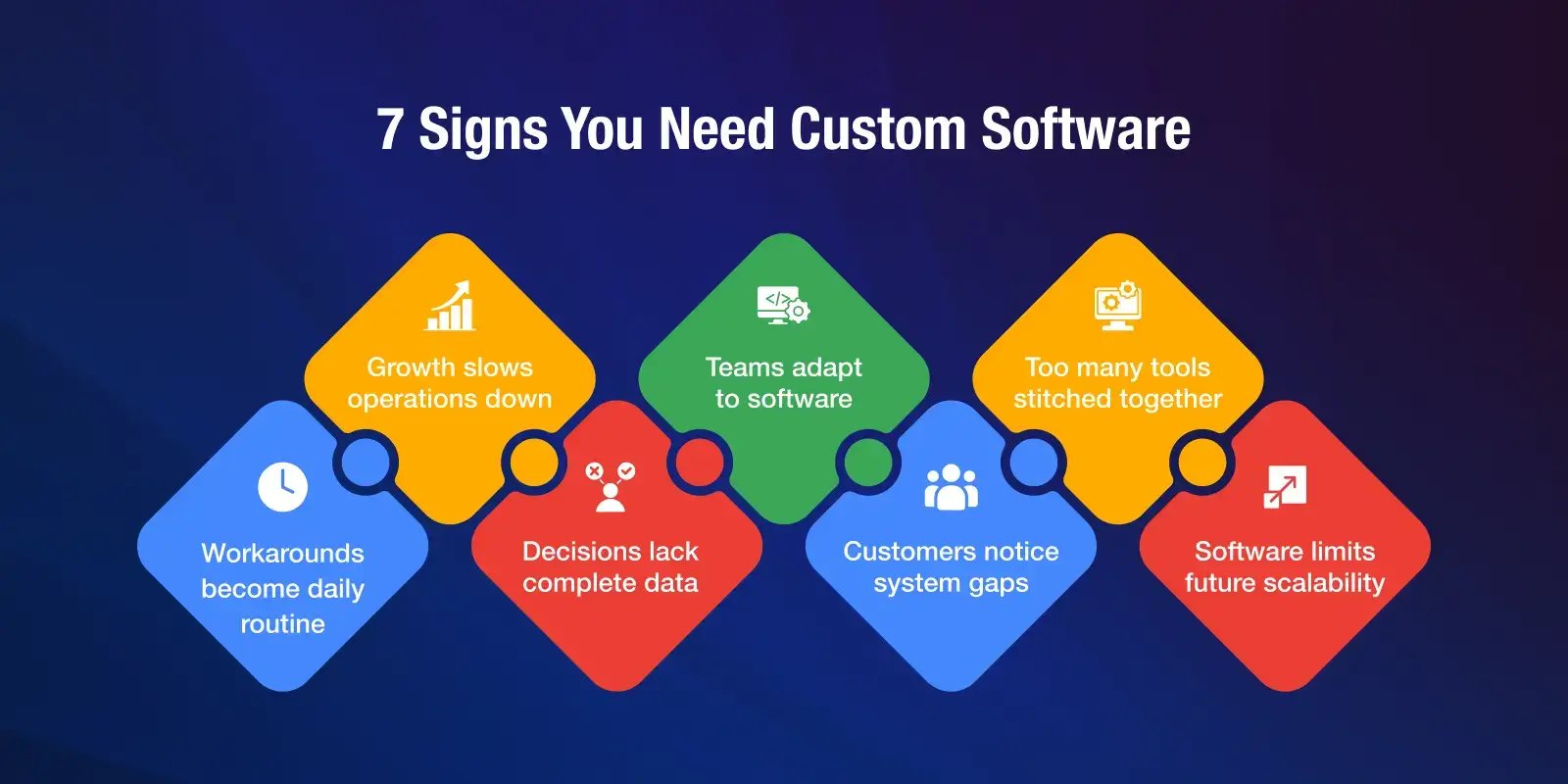
Seven Moments that Decide Your Business Needs Custom Software Development
Most businesses do not reach custom software through a planned decision. They reach it through experience because day after day, teams try to make things work and adjust processes by adding small fixes. They assume the friction is temporary, but only to realize that over time, those small issues start repeating and conversations circle the same problems time and again.
These moments are easy to miss because they arrive quietly. You most probably wouldn’t notice any failures, and there is no dramatic breakdown. However, you can sense the drag but struggle to point to one clear cause.
The following seven moments reflect situations many businesses recognize instantly. Each one shows a clear shift from support to resistance. When these moments appear, custom software stops being an idea and starts becoming a practical response.
Moment 1: When Workarounds Become Part of Daily Work
Workarounds usually start with good intentions. What happens is that a team finds a small gap in the system and fixes it manually to keep things moving. It feels practical yet temporary.
This shift changes how people work. Without noticing, a bulk of this makes it new team members struggle to understand why things are done a certain way because knowledge lives in people’s heads instead of the system.
The business moves forward, but with more effort than necessary. That quiet strain is one of the earliest signs that existing software no longer fits the way the business operates, and what you require is software development services to fix this problem.
What this usually looks like
- Data is copied and pasted between tools to complete basic tasks
- Teams keep personal trackers to fill gaps in the system
- Extra checks are added to avoid frequent errors
- Workflows depend on people remembering steps, not the software supporting them
Yes, it is normal in small levels. But when they become part of daily work, the software is no longer doing what it was meant to do.
Moment 2: When Growth Starts Slowing Things Down
Growth is supposed to feel rewarding. More customers mean more projects with increased momentum. But for many businesses, growth brings a different feeling.
With increasing growth, work starts moving more slowly where even simple actions take more steps. Teams feel busy all the time, yet progress feels uneven. The systems that once worked fine begin to show strain because they were built for a smaller stage of the business.
This slowdown often goes unnoticed at first because businesses typically assume it is part of scaling. What happens eventually is that teams start accepting longer hours and extra coordination as normal.
Over time, the pattern becomes clear. Growth is not the issue here but the software is. Systems struggle to handle higher volumes, more users, and added complexity. Instead of helping teams move faster, the tools start creating friction. Growth adds effort instead of efficiency.
It is in these situations that businesses should rethink their strategy and invest in modernizing software or build a custom software that fits their requirements.
What this usually looks like
- Approvals take longer as volume increases
- More people are hired just to manage processes
- Small updates require multiple steps and checks
- Teams rely on manual coordination to keep work moving
Do I always need custom software for achieving growth?
No. It becomes necessary when existing tools slow down work instead of supporting the next stage of growth.
Moment 3: When Decisions Depend on Incomplete Information
At some point, leaders stop asking for insights and start asking for clarity. Meetings begin with questions about numbers instead of decisions, and different teams walk in with different figures.
Time is spent aligning data before talking about next steps. The problem is not the lack of data but that the data lives in too many places and does not tell one clear story.
This situation slows everything down. Because of this, decisions get delayed or made with assumptions, and over time, confidence drops.
What this usually looks like
- Teams share different numbers for the same metric
- Reports are created manually before every review
- Leaders ask for clarifications instead of direction
- Decisions are delayed due to missing context
Moment 4: When Teams Adjust to the Software Instead of the Other Way Around
At some point, teams stop asking how work could be done better and start asking how to make the system accept it. Processes slowly bend to fit tool limitations. Eventually, people start to learn shortcuts and add steps that exist as if only to keep the software happy.
This shift affects more than daily tasks as it shapes how teams think. You may find it hard to improve it because changing the process can become harder. Ideas stay on the table because the system cannot support them easily.
What this usually looks like
- Teams say this is how the system works and move on
- Extra steps exist only to fit tool limitations
- Good ideas are dropped because changes feel difficult
- Process improvements get avoided to prevent disruption
Moment 5: When Customers Feel the Gaps Inside Your Systems
This is where experience starts, depending on individuals instead of systems. A customer gets a quick resolution only because a specific person knows the history. Another customer waits longer because that context is missing, and over time, service quality becomes inconsistent.
If this keeps piling up, teams may end up spending time chasing information instead of solving problems. When customers start noticing these gaps, it is a sign that internal software is no longer supporting the experience you want to deliver.
What this usually looks like
- Customers repeat the same details across conversations
- Support teams switch between tools to find context
- Responses slow down due to internal handoffs
- Service quality depends on who handles the request
Moment 6: When Too Many Tools Are Holding Things Together
At first, adding new tools feels like progress. Each one solves a specific problem. For instance, you can have new tools for tracking, for communication, for reporting, and so on. Over time, the stack grows and the real work shifts from using the tools to keeping them connected.
Teams worry about syncs as they check data across systems. A small issue in one tool starts affecting several workflows. The business still runs, but only because people are constantly watching the gaps.
This setup creates quiet risk because integrations sometimes tend to fail without warning, as a result, updates break existing connections. When most of the system’s stability depends on manual fixes, it creates a daily burden, and which is precisely when simplifying through custom software becomes a practical move.
What this usually looks like
- Data sync failures disrupt everyday workflows
- Teams depend heavily on third party connectors
- Fixing one issue creates another somewhere else
- Maintenance effort keeps increasing over time
Yes, it is a cause for concern. When connections need constant attention, simplifying the system becomes more effective than adding another tool.
Moment 7: When Software Starts Limiting Future Plans
This moment usually shows up during planning conversations. Usually, a new idea comes up like a new offering or a better way to serve customers. Instead of discussing how to make it work, the conversation shifts to tools, and people start asking if the system can support it.
That is the point where developing custom software becomes less about improvement and more about protecting future growth. And it is a wise choice to look for the best software development outsourcing partner to build the software unique to your business.
- Strategy discussions revolve around tool limitations
- New launches take longer than expected
- Teams delay ideas due to system constraints
- Innovation feels risky instead of exciting
FAQ
No. Irrespective of company size, custom software becomes relevant when daily operations feel harder than they should. Custom software for large enterprises delivers benefits at same level as those of emerging startups. Even growing teams hit limits when tools no longer match how work actually happens.
No, maintaining it becomes manageable when the software is built with clear goals and a clean structure. With well-designed systems, you can simplify updates and avoid constant patchwork.
Yes. Custom software is designed to change as the business changes. New features can be added without disrupting existing workflows, which keeps the system useful for longer periods.
The right time shows up when problems repeat as teams keep fixing the same issues. If you notice that work slows down instead of improving, then timing is already clear.
Custom software costs more upfront because you are building software from scratch, but it reduces hidden expenses over time. With fewer workarounds and less manual effort the real cost comparison shows up in daily operations.
Custom software is built to adapt to change as they are anticipated and planned into the architecture. This allows the system to grow with the business instead of being replaced.

Continue reading the blog
with a Tech.us subscription
You’re now subscribed!