Published Date: February 11, 2026 , Written by: Kannan Rajendran , Category: Software Development, Enterprise Software


POPULAR POSTS
01
Top 10 Companies Offering Software Modernization Consulting Services in 2026
02
Top 10 AI Development Companies Offering End-to-End AI Development Services
03
11 Proven Benefits of AI Chatbots for Businesses in 2025
04
How To Improve Document Processing Accuracy Using Document AI
05
What Digital Transformation Means for Businesses in 2026
Published Date: February 11, 2026 , Written by: Kannan Rajendran , Category: Software Development, Enterprise Software
If you’re planning a major technology initiative in the coming year, a crucial question that will likely arise is “What should I prioritize while making Enterprise Software Development decisions in 2026?”
This is one of the most common concerns for business leaders who think about scaling faster, but without exposing their organization to unnecessary risks.
The answer to the above question isn’t straightforward because technology is evolving rapidly with market conditions changing faster than ever. Moreover, AI development services are turning the tide for many businesses across different industries.
As a result, customer expectations, security needs, compliance pressures, and other critical things are moving in new directions. So, what worked well even two years ago might not be enough to support your growth in 2026 and beyond.
Hence, to make the right decisions, what you need is complete clarity on what to modernize and how technology directly supports your unique business goals.
Because the truth here is that in today’s digital-first economy, software is not just a support function anymore but a core engine which drives performance and competitive advantage.
So, before choosing any development strategy or partner, ask yourself these questions:
If your answers are uncertain for any of these answers, then this blog will help guide you in the right direction as we’ll break down the most important Enterprise Software Development considerations for 2026, so you can make future-proof decisions right from the start.
Let’s get into it.
Enterprise Software Development is about building or modernizing software systems on an enterprise level that support your company’s core operations, all aligned with the future of the business.
This also involves designing technology which helps your organization run smarter and more efficiently with greater security and scalability.
In Enterprise-level Software Development, the products are not generic or one-size-fits-all, but instead, they are built to exactly match your unique workflows as well as your long-term strategy.
What do these products do and add value to your business? They help in every complex operation from connecting teams and automating manual work to enabling better decision-making and ultimately enabling you to respond faster to market changes.
Most importantly, this approach gives your business full ownership and adaptability over the technologies that drive revenue and operations. You get software that works specifically for your organization, not the other way around.
Here’s a simple way to think about it:
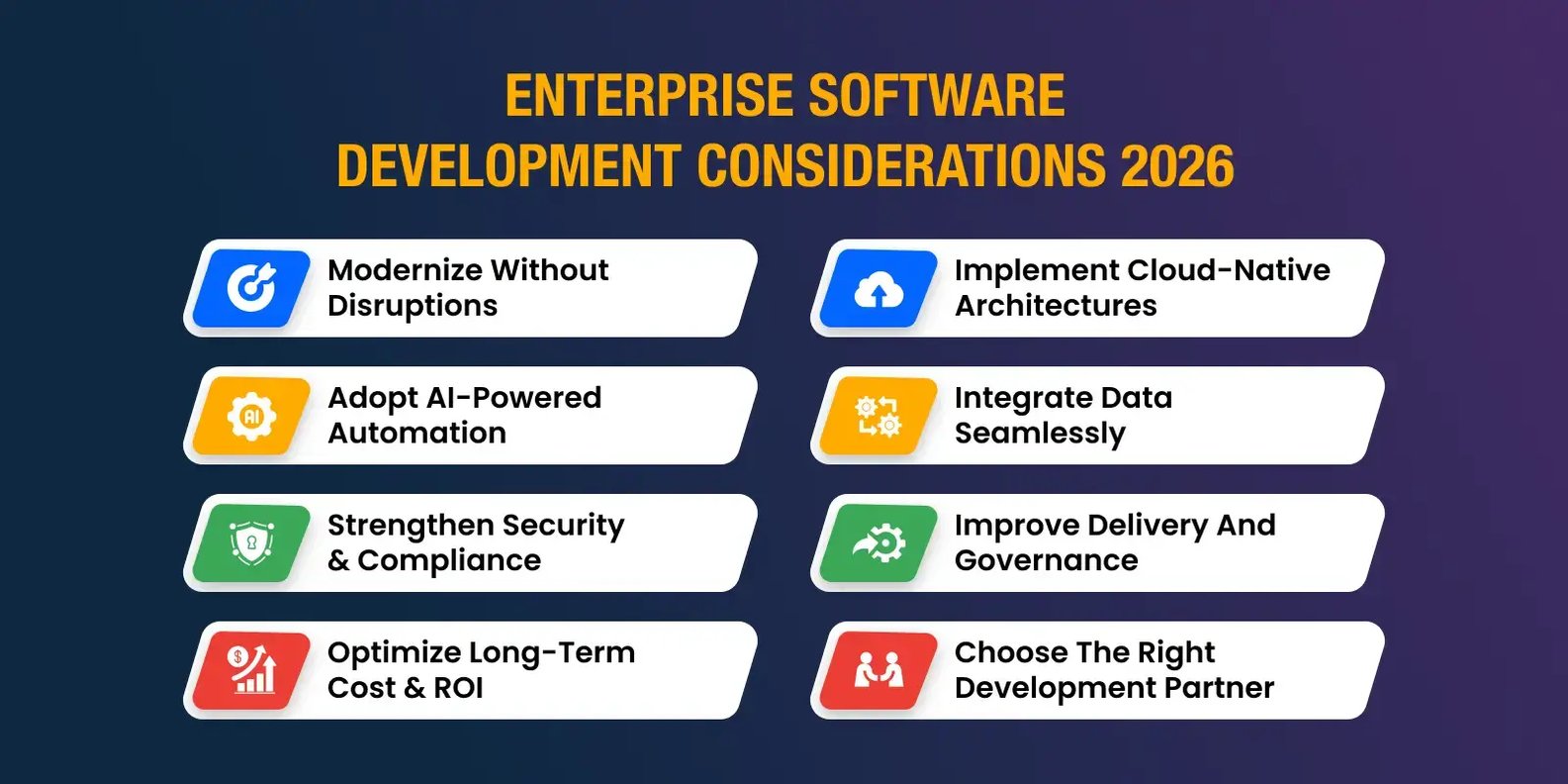
Enterprise Software Development decisions are critical for business success in 2026 because growth depends on how smart and scalable your systems are at enterprise levels.
Your requirements can be anything.
The focus today is pretty simple. Build software that drives results and makes life easier for everyone who uses it. To help you plan better, here are the most important areas to consider in 2026.
Legacy systems have served businesses way more than we often give credit for, but they ultimately slow down a growing business. They make it hard to scale and increase operational costs. They can also stop your team from adapting fast to market needs.
Due to these reasons, many organizations want them to be modernized. Yet, to achieve full scale modernization of legacy systems, you may feel concerned about downtime or high migration effort.
The good news is that modernization is possible with a planned and careful approach without you having to replace everything overnight. The goal is to update what matters and do it with minimal business impact. When you modernize with a future vision, your company becomes faster and more efficient.
Key areas to focus on:
With cloud consulting services on the rise, cloud adoption is now common. However, cloud-native adoption is what gives you the real advantage.
The old approach of lifting existing systems into the cloud does not give the full benefits. But, on the other hand, cloud-native development allows your business to scale as demand grows, which also supports innovation with faster releases.
How does it benefit your business more than a simple cloud migration? Well, for starters, it improves cost efficiency because you pay only for what you use. With a scalable cloud setup, you can avoid system strain and delays during peak business, which also allows your team to build and update features faster.
Why cloud-native matters:
AI for business is no longer a distant future concept but is already here and it is essential for productivity. Many enterprises now use emerging technologies like large language models for business to speed up their operations as they support them with a myriad of things from better forecasts to automation of repetitive tasks so teams can focus on high-value tasks.
Automation is a direct way to cut delays as it reduces errors and improves customer experiences. AI systems also help leaders make better decisions through strong analytics. When used the right way, AI becomes a growth driver.
What AI and automation solve:
Data helps leaders make smart decisions, but what value does it possess when it is trapped inside separate systems? Many enterprises face the problem of data silos, due to which teams work with different versions of information.
As a result, decision-making becomes slower and customer experience gets affected.
But a robust integration fixes all these. A well-connected software ecosystem helps data flow across business units, where everyone sees the same accurate information, and leaders get a full view of performance. This leads to faster actions and better outcomes.
Why integration should be a priority:
Security concerns keep rising each year with new threats becoming smarter every day. Cyberattacks typically target weak spots in software supply chains. So, the responsibility is on enterprises to protect data and other systems with robust cybersecurity practices.
If you look at compliance rules, they keep changing too, and you need to stay adhered to them all times. A strong security foundation and secure development practices help avoid costly mishaps later.
So, the solution here is to embed security early in a project, which reduces the need for fixes after launch. It also supports smooth audits and compliance approval.
Top priorities for security:
Technology projects sometimes miss deadlines, which creates delays in business outcomes, and even increases cost while reducing trust. With a strong delivery governance, businesses fix this.
Your development process needs to have a clear plan, so progress becomes visible and your teams stay aligned on goals.
Businesses will get full clarity on performance, while agile and DevOps practices support faster releases. Furthermore, software quality is amplified by automation in testing.
The goal is very simple - deliver the right solution on time with complete transparency.
Here is how to increase predictability:
It’s natural that businesses want to invest in smart technology, yet budgets are always under careful review. When you mean cost optimization, it does not mean cutting down innovation. On the contrary, it means spending money in the right areas.
Many enterprises often struggle with software duplicates, unused platform licenses and manual processes, all of which increase hidden expenses. When you reduce unwanted expenses, you can increase space for strategic investments, so your team can focus on solutions that push your business forward.
Ways to boost ROI:
The right software development partner plays a big role in project success. Some companies try to handle everything alone, which can significantly slow down development. It can further increase complexity.
So, working with a trusted partner helps avoid these struggles as you gain access to a skilled team with strong experience in enterprise systems. They understand how to handle large-scale needs and help you avoid common mistakes. They also work with you as a guide during the whole journey as a reliable partner builds with your goals in mind.
Things to check before selecting a partner:
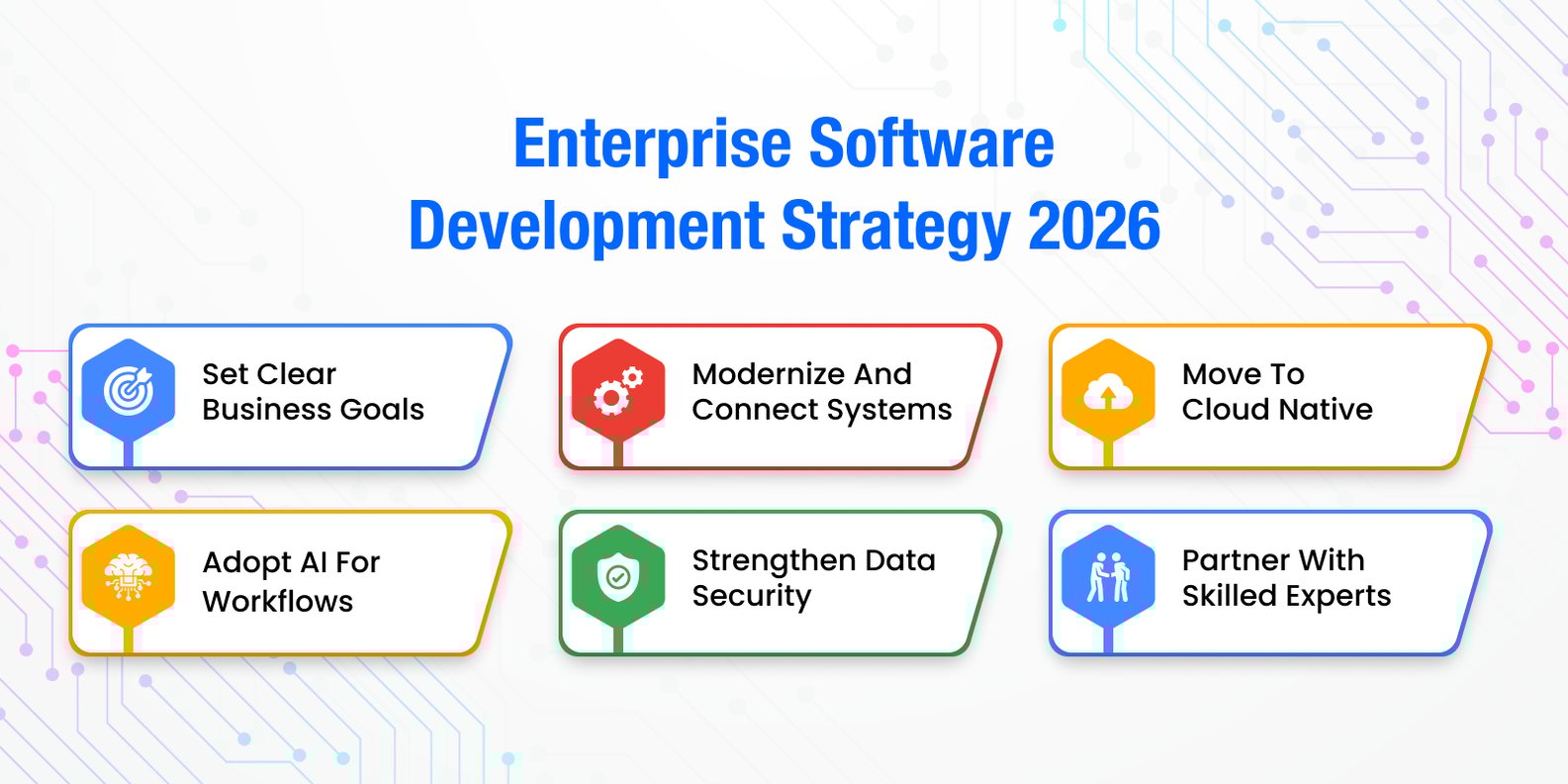
A strong Enterprise Software Development strategy in 2026 requires a combination of strategies that businesses need to consider before diving in full scale development. For any successful software development plan, you need to have a clear set of goals and considerations, and the following checklist helps you ensure that.
Here’s your checklist:
Enterprise Software Development will shape how businesses grow in 2026. Businesses and decision-makers look for simple and strong systems.
The right decisions that you make today help your business stay fast and adaptable. While modernization and automation make work easy for teams, cloud gives space for new ideas.
When everything comes together, your organization becomes future-ready, and the focus will be clear. Technology must guide progress and help everyone do their best work every day.
In 2026, the success of Enterprise Software Development will depend on how well leaders balance modernization, data intelligence, cost control and customer value.
It means enhancing or developing custom software that supports daily business operations and long-term goals. The software is primarily built for the company’s internal needs, which helps teams work faster and improves customer experience, while supporting future growth.
It helps companies with a myriad of things. With this, you can:
It essentially helps decision-makers move quickly in a changing market.
Modern systems run faster and handle more users as they support automation and cloud services. They essentially reduce downtimes and help teams launch updates with confidence. This leads to better service and happy customers.
AI helps teams do more with less effort as it helps predict issues before they grow. It fundamentally makes processes quick and smart and gives clear insights from business data. All of which allow businesses to take action with clarity.
cloud-native development is gaining popularity recently as it improves scalability and reliability, while handling peak demand with ease. An important aspect is that it supports fast releases, while ensuring business services are available from anywhere with strong performance.

Tech.us is an AI development company that builds custom AI solutions for businesses seeking measurable results. We partner with organizations to design, develop, and deploy scalable AI systems that solve complex challenges and unlock new opportunities for growth. Our team delivers practical AI applications that create tangible business impact across industries.
WRITTEN BY

Get Free Tips
NEWSLETTER
Get Free Tips
Submit to our newsletter to receive exclusive stories delivered to vou inbox!
Thanks for submitting the form.
RECENT POSTS
What is Model-Agnostic AI Development? A Guide to Avoid AI Vendor Lock-In
What Do Enterprise AI Readiness Assessments Miss? 6 Critical Gaps
AI Transformation vs. Digital Transformation: Which One Does Your Business...
How Multi-Agent Systems Work in Enterprise Environments
Multi-Agent Systems in Enterprise: Benefits, Use Cases, Risks, and...