Imagine a fast-growing tech company that gears up for custom software development. The idea of which is solid and demand is clear. But the real question is how will they get it built?
The internal team is already stretched thin, and to hire new developers, it will take months. It’s not a unique issue as many businesses might have faced similar situations. The challenge here is about choosing the right model to turn ideas into real, scalable products.
To develop a software product at current times is no longer just about writing code but about assembling the right people and setting priorities. Some companies choose a dedicated development team that works as a long-term extension of their business, while others turn to outsourcing for faster turnaround and lower costs.
Both paths have their own rewards and risks, and both can speed up success but in different ways. Not all engagement models work best for every business.
So how do you make the right choice? That’s what this blog explores as you’ll learn what separates a dedicated team from an outsourced model, how each impacts your business, and we will explore how to pick the one that fits your growth journey best.
What Does a Dedicated Development Team Actually Mean

A dedicated development team is a group of skilled professionals one can hire to work exclusively on a company’s project for a long-term period. They act as an extension of your in-house team, which offers full control and flexibility with your business goals. This model enables businesses to scale faster without being worried about hiring.
Whenever a business thinks about scaling their software development, one model often stands out, which is the dedicated development team. So, what does that really mean in practice?
Imagine you have a strong vision for your next digital product but lack the people to make it happen. You could start hiring locally, which takes time and money; or, you could bring in a dedicated team which works just for you, in an exclusive way, but from anywhere in the world.
These dedicated teams for any software development project are not freelancers who jump from one client to another, but they are long-term partners who understand your goals completely.
You can manage them directly, involve them in daily meetings, and treat them as part of your core business. This gives you the best of both worlds—external expertise with in-house collaboration.
Now, if you might wonder who usually goes for this model, it’s popular among both startups that aim to grow quickly without overloading their budget, as well as established companies that need to expand development capacity for ongoing projects. Many tech-driven companies usually prefer this model as they need steady progress and consistent communication without any lag.
A dedicated team uses preferred tools and communication channels that you suggest. They also adapt to your time zone that aligns with your workflow and regularly report progress. This keeps everyone on the same page and avoids the long feedback loops which can slow projects down.
How is this different from traditional outsourcing? In outsourcing, teams responsible often handle many projects for multiple clients, and you may have limited control. However, in a dedicated team model, you decide how the project runs, who should lead it, how to measure its performance, and many other things. It’s your team, your process, your timeline.
Here are some key takeaways:
- A dedicated team works full-time on your project alone.
- You have full control over workflows and priorities.
- Teams adapt to your tools, processes, and culture.
- Communication is direct and transparent.
- Ownership of code and data stays with you.
- Easy to scale the team based on project needs.
- Ideal for long-term, evolving software projects.
- Encourages innovation and accountability within the team.
What Does Outsourcing Software Development Really Involve
Software development outsourcing means companies hire an external team or company to handle your project. This model enables businesses to considerably reduce costs while saving time and accessing specialized skills all without expanding their internal workforce. The external team manages development from start to finish, which allows you to focus on core business activities while the experts handle execution.
Outsourcing has become one of the most practical ways for businesses to build custom software without any overhead. But what does it really look like in action? Imagine you have a great idea for a new product or require some solution to clear the bottleneck that you have, but lack the technical skills or time to build it internally. So, you hire a specialized software development outsourcing company to take care of it for you.
It’s a flexible model where you hand over either a part or all of your software development project to an external vendor, who could be local, nearshore, or offshore, depending on your needs and budget. The goal is to save time, get access to expert developers, and speed up delivery all without stretching your internal resources too thin.
A question many businesses ask is, “How much control do I have when I outsource my software requirements?”
In outsourcing, the control is limited compared to hiring a dedicated team, in which the vendor manages most of the daily operations, and you monitor progress through periodic updates. For some, this works perfectly but for others, it may feel like they’re too far removed from the process.
- Outsourcing means hiring an external company to build your software.
- It saves time and cuts costs by using expert developers.
- Common models include project-based, managed services, and offshore.
- The vendor manages development while you monitor progress.
- It’s ideal for short-term or well-defined projects.
- Clear communication and trust are vital for success.
- Budgeting is predictable since costs are based on deliverables.
- Great for scaling quickly without internal hiring challenges.
Dedicated Team vs Outsourcing: Key Differences That Matter
The main difference between a dedicated development team and outsourcing is all about control and collaboration. Dedicated teams work as part of your company, which gives full visibility and alignment. On the other hand, outsourcing focuses on quick project delivery with less control but faster execution and lower upfront costs.
|
Criteria |
Dedicated Development Team |
Outsourcing |
|
Engagement Style |
Long-term partnership focused on continuous development |
Mid-term to short-term engagement with defined deliverables |
|
Control and Collaboration |
You manage the team directly and stay involved daily |
The vendor manages most processes with limited visibility |
|
Cost Model |
Predictable monthly or retainer-based cost |
Pay-per-project or hourly payment structure |
|
Scalability |
Easy to scale up or down as needs change |
Scaling requires new contracts or vendor negotiation |
|
Talent Alignment |
Team works only for you and adapts to your culture |
Team may handle multiple clients and follow vendor standards |
|
Knowledge Retention |
High as the team grows with your product over time |
Low because once the project ends, knowledge leaves with the vendor |
|
Project Ownership |
Full control of code, data, and outcomes stays with you |
Ownership depends on vendor agreements and contracts |
|
Innovation and Proactiveness |
High - the team is invested in long-term success |
Limited - focused mainly on completing assigned work |
|
Communication Flow |
Direct and transparent through shared tools and meetings |
Indirect, often filtered through project managers |
|
Best Suited For |
Companies building long-term products or platforms |
Companies needing quick delivery or specialized short-term help |
What Are the Real Benefits of a Dedicated Development Team?
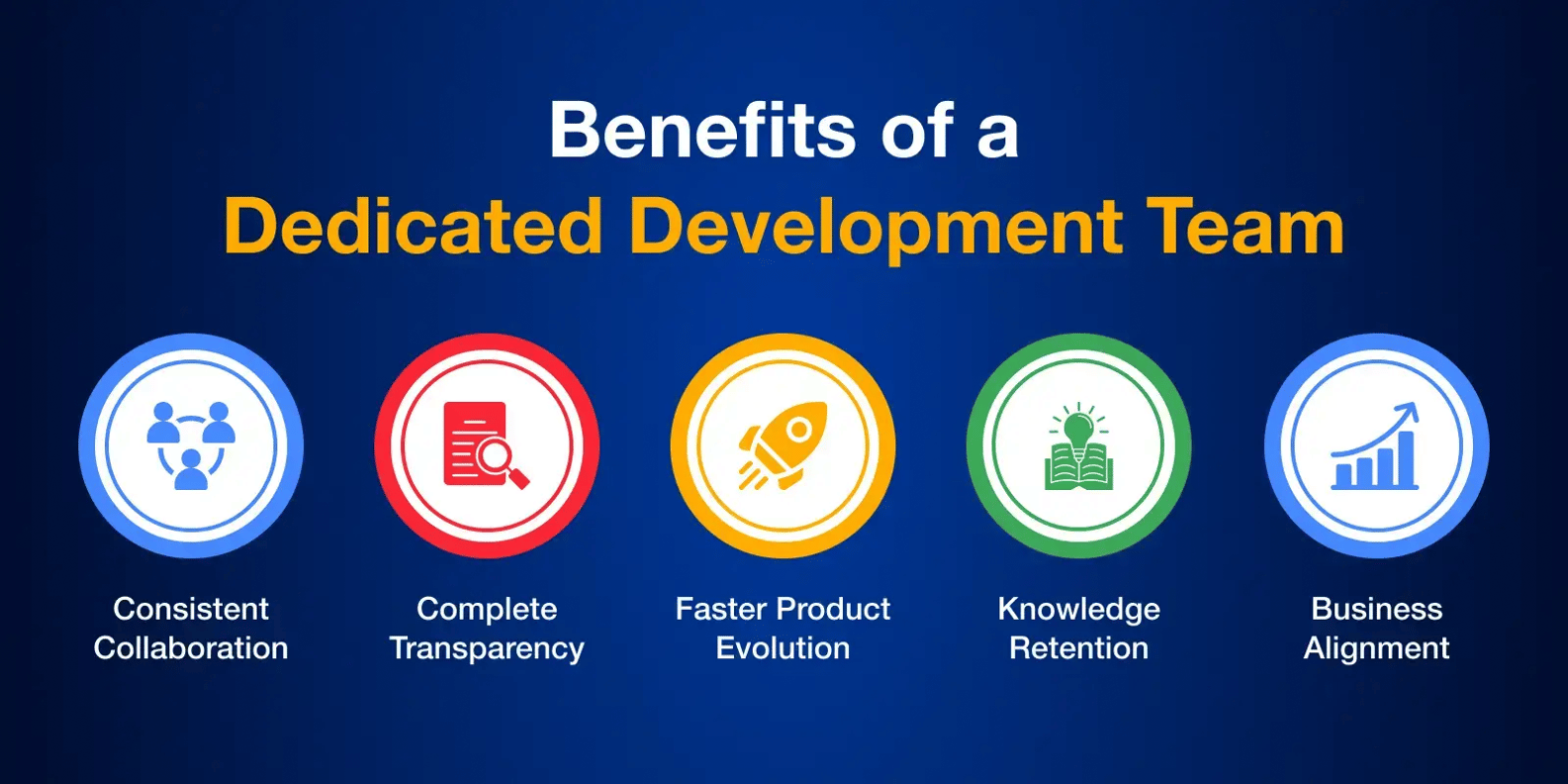
A dedicated development team typically speeds up the development process that your business requires. It’s not just about hiring developers but about building a close-knit unit that plans and executes as one. Here’s how it helps your business move forward with purpose and consistency.
Consistent Collaboration and Transparency
When you work with a dedicated team, communication stays open at all times as you don’t have to chase updates or wonder what’s happening with your project. The team regularly shares what are all the project updates so that you can check if the project aligns with your vision. This level of collaboration builds trust and keeps everyone on the same page.
- Daily or weekly syncs to track progress and priorities.
- Clear visibility into workflows, milestones, and deliverables.
- Real-time communication channels for faster decisions.
Faster Product Evolution and Iteration
A dedicated team helps you move faster from idea to launch as they understand your goals and can quickly adapt to feedback. In this way, you can release updates more often, test new ideas, fine-tune your product based on real user data, and much more. Continuous iteration helps your business stay ahead in the market.
- Agile workflows that support quick experimentation.
- Faster response to changing product needs.
- Shorter time-to-market for new features and releases.
Long-Term Knowledge Retention
A major advantage of having a dedicated team is that they stay with your project for the long term. The team clearly knows your systems inside out, the knowledge and convenience of which reduces onboarding time for new features and ensures smoother transitions when scaling. You don’t lose valuable knowledge when the team grows.
- Deep familiarity with product architecture and workflows.
- Less time spent re-explaining goals or past decisions.
- Strong internal knowledge base built over time.
Strategic Alignment with Business
A dedicated team becomes an extension of your company mainly because they share your goals and ways of working. This alignment builds a sense of ownership and commitment.
- Shared mindset focused on business impact.
- Strong connection with your company culture and mission.
- Commitment to long-term success, not short-term delivery.
Why Do Businesses Still Choose Outsourcing?
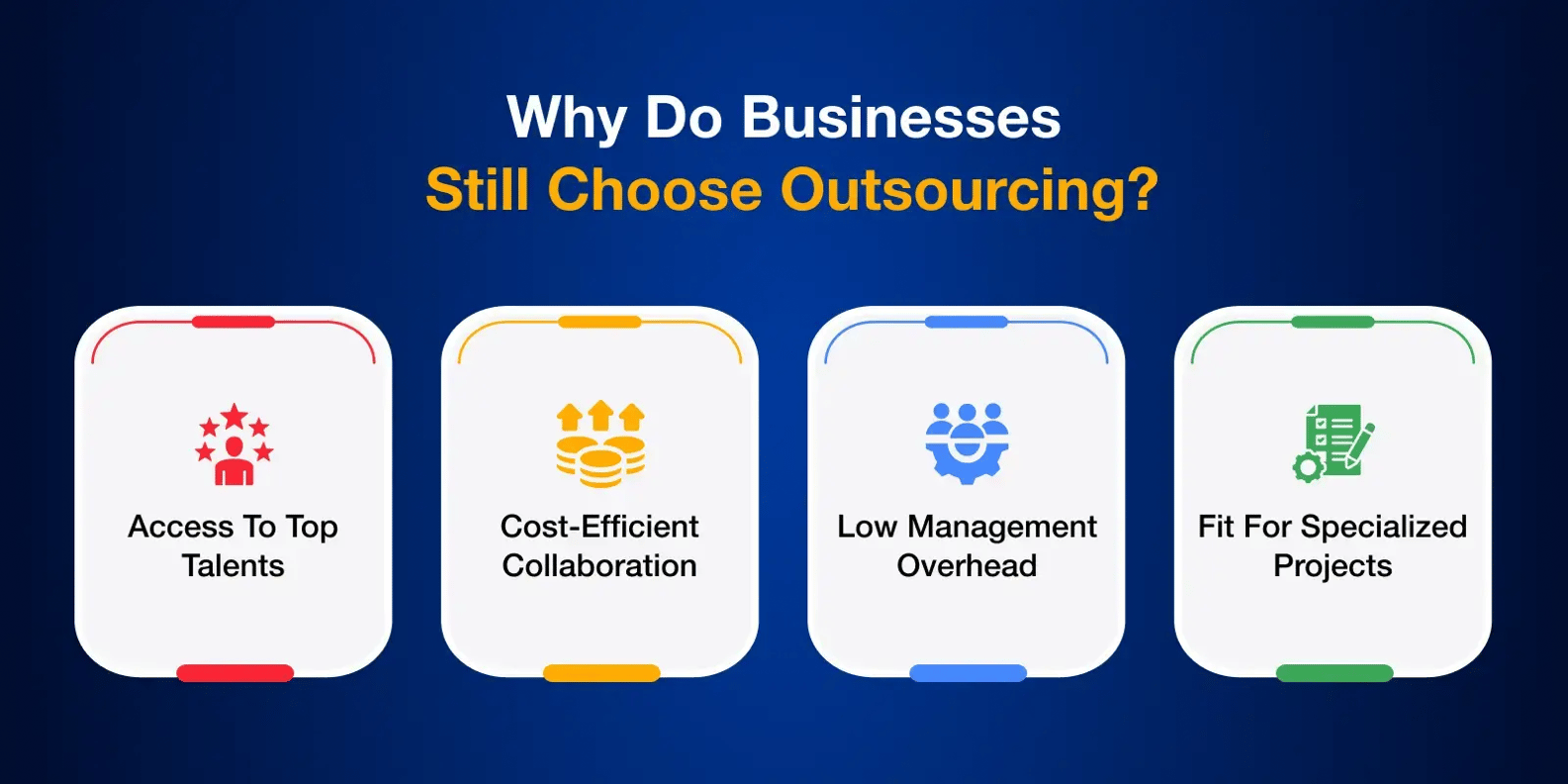
Outsourcing continues to attract many businesses for good reasons, some of which include quick TAT, flexibility, and often cost-effective. Many companies use outsourcing when they need results fast without long-term commitments. Here’s a closer look at why it still makes sense for many projects.
Faster Access to Skilled Talent
Outsourcing typically gives you access to a wide talent pool right away. You don’t have to go through long hiring rounds or training sessions as you can simply find the right people for the job and start working, which helps when your project needs expertise that your in-house team doesn’t currently have.
- Quick onboarding with ready-to-work professionals.
- Access to global talent with niche expertise.
- Minimal time spent on recruitment or setup.
Cost-Efficient for Short-Term Needs
Outsourcing is often the go-to choice for short-term projects mainly because it helps you manage costs better since you only pay for the time and skills you need. You don’t have to invest in full-time salaries and other infrastructure, which makes outsourcing a practical choice when you have a defined project scope.
- No need for long-term hiring or contracts.
- Flexible pricing models for better budget control.
- Reduced overhead compared to permanent staffing.
Low Management Overhead
To manage an outsourced team, it usually takes less effort. Here, the vendor handles much of the supervision, project tracking, reporting, and many others. You can focus on results instead of managing daily operations with this model. This setup works well for companies that prefer to stay strategic while external teams handle execution.
- Less time spent managing day-to-day operations.
- Structured reporting handled by the outsourcing partner.
- Freedom to focus on business strategy and core goals.
Ideal for Specialized Projects
Outsourcing works best for projects that require specific skills for a short period. For instance, you might need a data migration expert or a designer for a limited campaign, and hiring full-time staff for such tasks may not make sense. In such cases, outsourcing lets you fill that gap quickly and complete the work without delays.
- Perfect for projects with clear timelines and goals.
- Quick access to experts for niche requirements.
- Easy to scale up or wrap up once the project ends.
How to Choose the Right Model for Your Business
It’s a crucial decision to choose between a dedicated development team and outsourcing which can feel tricky. Each model fits a different business need, and the key here is to look at your goals, resources, project timeline, and other factors before you decide. Let’s break it down step by step.
Understand Your Product Stage
Start by looking at where your product stands.
If you’re still building the first version or validating an idea, then outsourcing can be a quick way to get it done.
But if your product is growing and you need regular updates or new features, you better go for a dedicated team that makes more sense.
Evaluate Technical Complexity
Think about the kind of technology your project needs.
If it involves complex integrations or deep architecture, a dedicated team gives you better control.
But if the task is straightforward or involves standard tech stacks, you can easily prefer outsourcing.
Check Your Budget and Flexibility
Budgets always influence decisions.
Choose outsourcing if you want to manage costs tightly and avoid long-term expenses.
A dedicated team, on the other hand, needs a steady investment but gives stronger control over quality and speed.
Think About Security and IP
If your project involves sensitive data, client records, or proprietary tech, security becomes pivotal, and you need to safeguard it.
In such cases, a dedicated development team is the safer route.
Outsourcing works fine in case of less confidential projects, but you’ll still need proper NDAs and clear data policies, and check if the outsourcing company complies with GDPR and HIPAA guidelines.
Consider Your Growth Plans
If your business is scaling fast, a dedicated team can grow with you.
You can align the team with your vision, train them, and keep knowledge in-house.
Outsourcing works well for businesses that want to test ideas or handle overflow work without heavy commitments.
Think About Release Cycles
Some products need frequent updates, while others have rare release cycles.
If your product demands constant monitoring, bug fixes, or regular feature drops, a dedicated team offers better consistency.
But if updates are infrequent, outsourcing can handle them effectively.
Quick Decision Checklist
Before you decide, walk through this short checklist. It helps you make a clear, data-backed choice:
- Do I have enough in-house expertise to manage external teams?
- Is this project a short-term task or a long-term roadmap?
- Can I commit to a steady monthly budget for a team?
- Does the project involve confidential or high-security data?
- How often will the product need updates or feature releases?
- Do I want to build internal knowledge or just get the job done?
- Is flexibility more important than control for this project?
- Do I need a team that scales with my business over time?
FAQs
What is an example of a dedicated development team?
A dedicated development team is like having your own in-house tech unit but managed by an external partner.
For example, a SaaS company hiring a full-time remote team to build, test, and maintain its product over time is using a dedicated team model.
How to choose the best dedicated development team?
Look for a team that fits your goals, understands your tech stack, and communicates well.
Here’s what to check before you decide:
- Proven experience in your industry
- Transparent process and collaboration tools
- Strong technical and project management skills
- Focus on long-term partnership, not short-term delivery
When should I hire dedicated developers?
Hire dedicated developers when your project needs continuous work or when you want to build and scale a product for the long term. This model works best when:
- You need full control over the development process
- You want to expand your tech team without local hiring
- Your project requires ongoing updates or maintenance
What is the difference between a dedicated team and an extended team?
A dedicated team works only on your project, fully aligned with your business goals. An extended team, on the other hand, supports your in-house developers on specific tasks. Think of the extended team as an extra hand, while the dedicated team is your complete remote department.
What is the difference between outsourcing and offshoring?
Outsourcing means hiring an external company to handle your project, often for cost or skill advantages.
Offshoring means moving development to another country to tap into global talent. You can outsource locally or offshore internationally — both depend on your goals and comfort level.
Is a dedicated team more expensive than outsourcing?
Cost depends on your project scope and duration. Instead of comparing them by price, think in terms of value.
- Dedicated teams give long-term consistency and control.
- Outsourcing offers flexibility and faster results for short-term projects.
- Plan your budget based on goals, not just hourly rates.
How do I manage a dedicated remote team effectively?
Good communication and structure make all the difference.
Here’s what helps:
- Set clear goals and timelines
- Use collaboration tools like Slack or Jira
- Schedule regular check-ins and progress reviews
- Build trust through open feedback and recognition

Continue reading the blog
with a Tech.us subscription
You’re now subscribed!