blog-img

POPULAR POSTS

  • 01

    Top 10 Companies Offering Software Modernization Consulting Services in 2026

  • 02

    11 Proven Benefits of AI Chatbots for Businesses in 2025

  • 03

    How To Improve Document Processing Accuracy Using Document AI

  • 04

    Top 10 AI Development Companies Offering End-to-End AI Development Services

  • 05

    What Digital Transformation Means for Businesses in 2026

Multi-Agent Systems in Enterprise: Benefits, Use Cases, Risks, and Implementation

Published Date: July 21, 2026 , Written by: Anand Selvadurai , Category: Enterprise AI, Multi-Agent Systems

tech.us-recognized-by-mobile-app-daily

Overview


If you've been following enterprise AI over the last couple of years, then you've probably noticed that most of the conversation happens around chatbots, copilots, and generative AI assistants.


But there is a limit to what those capabilities are designed to do, and most of them sit now on the sidelines. They of course help employees work more efficiently, but they do not actually move the work itself through the business.


That is a bigger issue as organizations look beyond productivity gains and start asking a different question: can AI help execute work, not just assist with it?


The challenge is that enterprise processes are seldom straightforward, and this is where multi-agent systems come into the picture.


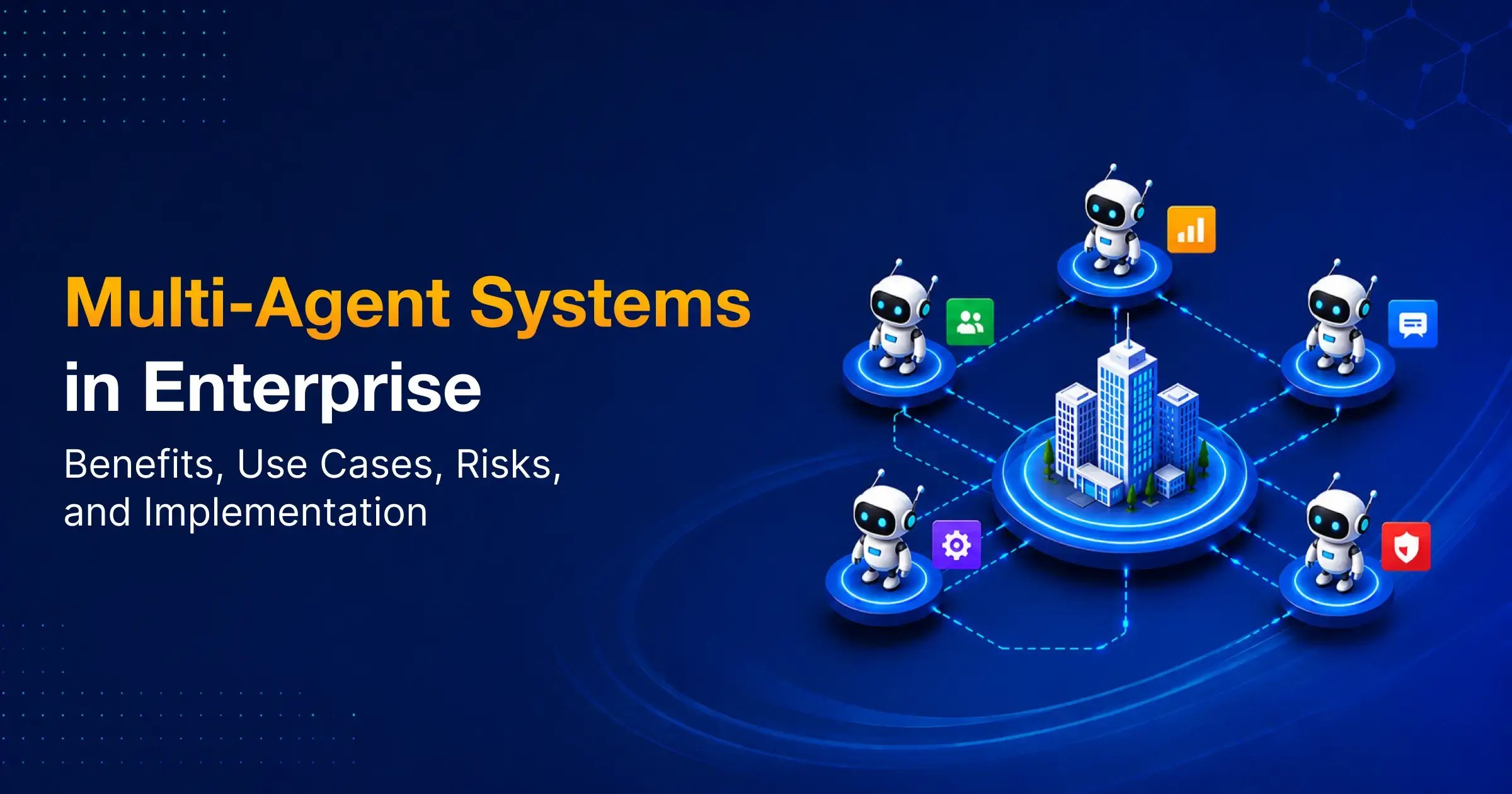
So, instead of relying on a single AI agent to handle everything, organizations can deploy multiple specialized agents that work together and coordinate actions across business workflows. This is one of the core ideas behind agentic AI development, where AI systems are designed to take action rather than simply provide assistance.

Why Enterprises Are Moving Toward Multi-Agent Systems


Most enterprises have already automated the obvious tasks. The challenge now is automating workflows that involve multiple systems, decisions, approvals, and exceptions. That is where interest in multi-agent systems is coming from.


The Limits of Traditional Automation


Traditional automation works well when processes are predictable. RPA bots and workflow tools can follow predefined instructions, but they struggle when something unexpected happens.


Common limitations include:


  • Dependence on fixed rules
  • Difficulty handling exceptions
  • Limited ability to understand context

As a result, employees often end up stepping in whenever a process moves outside the expected path.


Why Single AI Agents Are Not Enough


Single AI agents can reason better than traditional automation, but enterprise work rarely depends on a single capability. Understanding how AI agents work makes it easier to see why enterprises are now exploring multi-agent approaches.


A typical business process may require:


  • Data retrieval from multiple systems
  • Policy validation
  • Decision-making
  • Workflow execution

Trying to centralize all of that into one agent can create complexity and reduce reliability.


The Shift Toward Coordinated AI Execution


Multi-agent systems take a different approach. Instead of one agent doing everything, specialized agents collaborate to complete the workflow.


One agent may retrieve information, another may validate it, while another determines the next action. Together, they can execute work across systems in a way that more closely reflects how real organizations operate.


That is why enterprises are increasingly viewing multi-agent systems not as another AI tool, but as a new operating model for complex business processes. In many organizations, AI agents are already disrupting traditional business processes that once depended entirely on manual coordination.


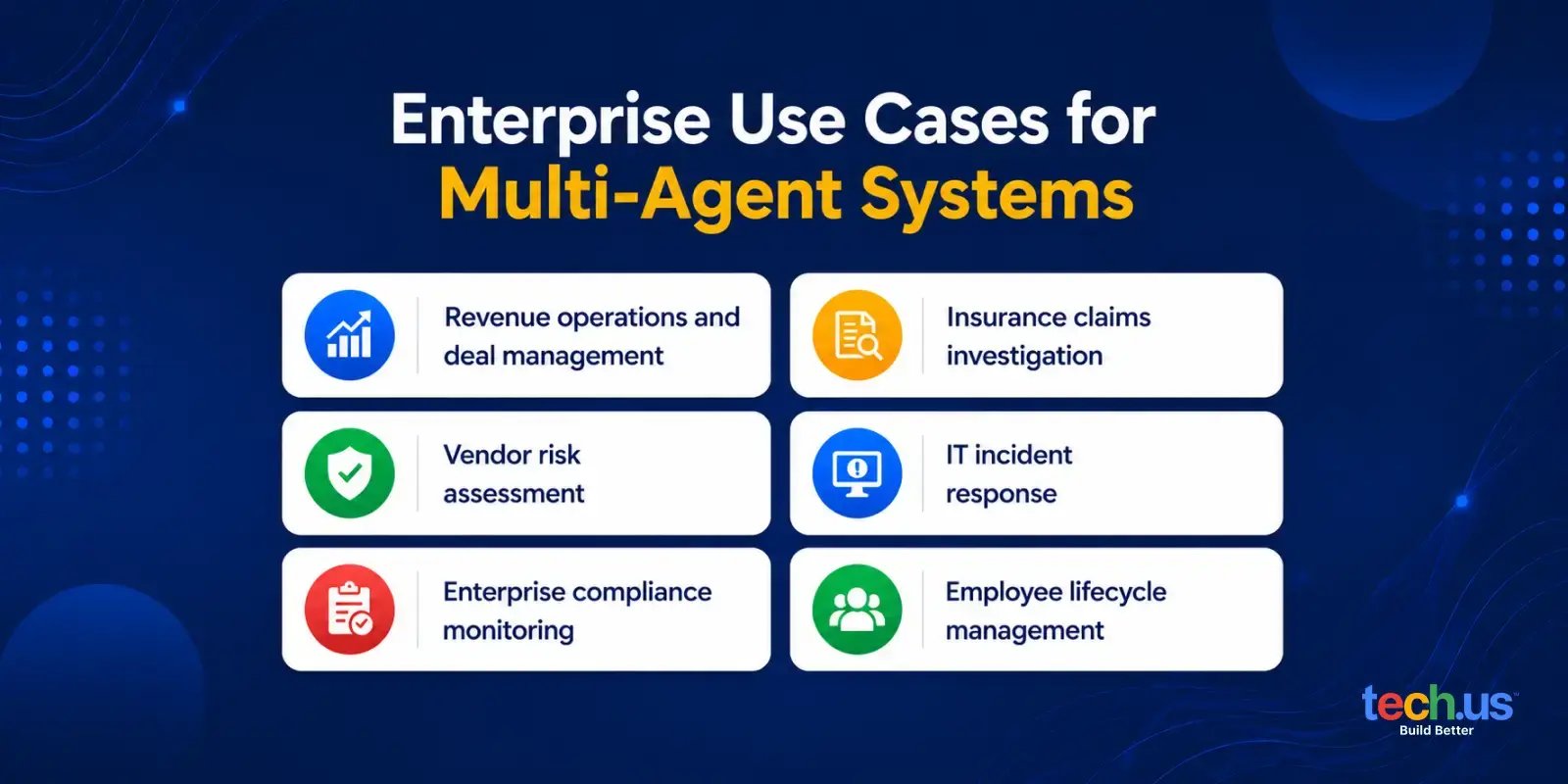
Enterprise Use Cases of Multi-Agent Systems

tech.us-recognized-by-mobile-app-daily

A lot of articles talk about multi-agent systems by department. Customer service. Finance. HR. That sounds neat on paper, but it is not how most enterprises actually operate.


Real work moves through workflows, not org charts.


A customer issue may touch support, operations, billing, and compliance before it is resolved. A contract may bounce between sales, legal, finance, and procurement before anyone signs it. That is why some of the most practical multi-agent use cases are not tied to departments at all. They are tied to processes that constantly move across teams and systems.


Revenue Operations and Deal Desk Management


Anyone who has spent time around enterprise sales knows where deals get stuck.


Not at the customer.


Inside the organization.


A discount needs approval. Legal wants a clause changed. Finance has questions about payment terms. Suddenly a deal that looked ready to close is sitting in someone's inbox.


Multi-agent systems can help coordinate that process by assigning specific responsibilities to different agents, such as:


  • Reviewing contract language
  • Checking pricing policies
  • Assessing commercial risk

Nobody is handing over deal approvals to AI. That is not the point. The value comes from reducing the administrative friction that slows everything down.


Insurance Claims Investigation


Claims teams rarely struggle with making decisions. They struggle with getting the information needed to make those decisions.


Policy details might be stored in one platform. Supporting documents sit somewhere else. Historical claims data may live in a completely different system.


A multi-agent system can gather those pieces, verify what is relevant, and organize the findings before an adjuster even opens the file. That changes the nature of the work. Less searching. More evaluating.


Vendor Risk and Third-Party Assessment


Most organizations perform extensive vendor reviews before onboarding. Then something interesting happens.


The vendor changes.


A supplier may lose an important certification. A software provider may experience a security breach. A financial issue may emerge months after the contract is signed.


Instead of relying on periodic reviews, specialized agents can continuously watch for those changes and surface issues when they actually matter. Not three months later during the next review cycle.


IT Incident Response and Resolution


When a critical system goes down, the first challenge is rarely fixing the problem.


The first challenge is figuring out where to look.


One team starts digging through logs. Another reviews recent deployments. Someone else investigates infrastructure changes. Meanwhile the clock keeps running.


Multi-agent systems allow those investigations to happen simultaneously. Different agents can examine different parts of the environment and bring the findings together. Similar coordination models are increasingly being used in AI agents for robotics development, where multiple systems must work together in real time.


Enterprise Compliance Monitoring


Compliance teams face a simple reality. There is far more activity than people can manually review.


Transactions happen constantly. Approvals are issued every day. Internal communications never stop.


That is why compliance is increasingly becoming a monitoring challenge rather than an auditing challenge.


Multi-agent systems can continuously review activity, identify unusual patterns, and flag issues that deserve attention. The goal is not replacing compliance teams. It is helping them focus on what actually requires investigation.


Employee Lifecycle Management


Most people think onboarding is the complicated part of employee management.


It usually is not.


The real complexity starts later.


Role changes. Access reviews. Internal transfers. Compliance renewals. Offboarding. Every one of those events requires coordination between different teams and different systems.


A multi-agent system can help keep those activities aligned without someone constantly following up, sending reminders, or checking status updates. The result is not just efficiency. It is consistency, which is often the bigger challenge in large organizations.


Business Benefits of Multi-Agent Systems


The benefits of multi-agent systems are often described in terms of automation, productivity, or efficiency. Those outcomes matter, but they are not what usually gets executive teams interested.


What attracts attention is the ability to execute complex work with less operational friction.


Better Handling of Complex Workflows


Most business processes break down at the handoffs.


A customer request moves from support to operations. A contract moves from sales to legal. An invoice moves from procurement to finance. Every transition creates delays, missing context, and follow-up work.


Multi-agent systems are particularly effective in these environments because different agents can own different parts of the workflow while sharing context throughout the process. Instead of employees repeatedly gathering information that already exists somewhere else, the workflow continues moving forward.


Scalability Through Modular Agents


One of the practical advantages of multi-agent systems is that they do not require organizations to rebuild everything when requirements change.


For example, a company may initially deploy agents for invoice validation and payment matching. Six months later, they may need supplier risk analysis as well.


Rather than redesigning the entire architecture, a new specialized agent can be introduced into the workflow. That flexibility becomes increasingly valuable as AI adoption expands across the business.


Faster Decision-Making


Many business decisions are delayed not because they are difficult, but because the necessary information is scattered.


Someone has to retrieve data. Someone else validates it. Another person prepares recommendations.


Multi-agent systems compress much of that preparation work. Agents can gather information, evaluate context, and present decision-ready outputs.


That does not eliminate human judgment. It reduces the time spent getting to it.


Operational Efficiency and Cost Reduction


The biggest efficiency gains often come from work that nobody notices.


Consider how much time organizations spend:


  • Chasing approvals
  • Verifying information across systems
  • Escalating routine exceptions
  • Following up on incomplete tasks

Multi-agent systems reduce a surprising amount of this coordination overhead. As a result, teams spend less time moving work and more time completing it.


Business Agility


Business processes rarely stay fixed for long.


New regulations appear. Internal policies change. Customer expectations evolve. Acquisitions introduce new systems.


Organizations that rely heavily on rigid automation often struggle to adapt. Multi-agent systems provide more flexibility because workflows can evolve through agent-level changes rather than large-scale process redesigns.


Workforce Transformation


Perhaps the most overlooked benefit has nothing to do with technology.


Many knowledge workers spend a significant portion of their day coordinating information rather than applying expertise. They search for updates, request approvals, reconcile conflicting data, and track process status.


Multi-agent systems do not replace that expertise. They remove much of the administrative effort surrounding it.


That shift allows employees to focus on analysis, judgment, problem-solving, and customer interactions, which are usually the areas where they create the most value.


Governance, Security, and Observability for Enterprise Multi-Agent System


Many organizations spend most of their time thinking about what agents can do. The more important question is what agents should be allowed to do.


That is where governance becomes critical.


The reality is that enterprises rarely struggle because an agent generated the wrong answer. They struggle when an agent takes an action it should not have taken, accesses information it should not have seen, or makes a decision that nobody can explain afterward.


Define Roles Before Defining Autonomy


One of the most common mistakes is giving agents broad responsibilities without clear boundaries.


Every agent should have:


  • A specific purpose
  • Defined permissions
  • An owner responsible for oversight
  • A clear escalation path

If nobody can answer who owns an agent's decisions, governance is already broken.


Treat Agents Like Enterprise Identities


In mature deployments, agents should not operate as invisible background processes.


They need identities. They need permissions. And those permissions should be limited to exactly what is required.


The same Zero Trust principles used for employees and applications should apply to agents as well. Access should be verified continuously, not assumed.


Make Every Decision Observable


One of the biggest concerns enterprise leaders have is simple: "How did the agent arrive at that conclusion?"


If teams cannot answer that question, trust disappears quickly.


Organizations should be able to track:


  • Agent decisions
  • Tool usage
  • Workflow handoffs
  • Escalation events

Observability is not just a technical requirement. It is what makes accountability possible.


Build Guardrails Before Scale


Many companies focus on scaling agents before implementing controls.


That sequence creates risk.


Guardrails should detect policy violations, unsafe outputs, unauthorized actions, and situations where human review is required. The larger the deployment becomes, the more important these controls become.


Auditability and Interpretability Matter


In regulated industries especially, "the AI decided" is not an acceptable explanation.


Teams need audit trails that show what happened, when it happened, and why it happened. They also need enough visibility into agent reasoning to investigate errors, improve workflows, and satisfy compliance requirements.


The organizations seeing the most success with multi-agent systems are not necessarily building the smartest agents. They are building the most governable ones.


Risks and Challenges of Multi-Agent Systems


There is a tendency to talk about multi-agent systems as if adding more agents automatically makes a process smarter. In reality, every additional agent introduces another layer of coordination, another decision point, and another opportunity for something to go wrong.


That does not mean multi-agent systems are risky by default. It simply means the risks change.


Coordination Failures


Most problems in multi-agent systems do not start with bad reasoning. They start with bad coordination.


Imagine one agent completes a task and passes the result forward. Sounds simple. But what if the next agent interprets that output differently? What if two agents are working from slightly different versions of the same information?


Small misalignments can compound surprisingly quickly.


In many cases, the issue is not the agent itself. It is how work moves between agents.


Poor Data Quality


One thing does not change just because AI enters the picture: bad data still causes bad outcomes.


If customer information is incomplete, policies are outdated, or systems disagree with one another, agents are forced to make decisions using unreliable inputs. The output may sound convincing. That is exactly what makes it dangerous.


Many organizations discover that their biggest AI challenge is actually a data quality problem they have been carrying for years.


Agent Drift and Unpredictable Behavior


Pilots are controlled environments. Production environments are not.


New scenarios appear. Processes evolve. Business rules get updated. Before long, agents start encountering situations they were never exposed to during testing.


That is why successful organizations treat deployment as the beginning of monitoring, not the end of development.


Security and Compliance Risks


The moment agents gain access to enterprise systems, security becomes a business concern rather than a technical one.


A permission that is too broad. An action that bypasses an approval process. Access to data that was never intended for that agent.


None of these are model failures. They are governance failures.


At a minimum, organizations need:


  • Clear permission boundaries
  • Human oversight for sensitive actions
  • Complete audit trails

Those controls become even more important as agent autonomy increases.


Excessive Complexity


One of the more interesting risks is self-inflicted complexity.


Some teams assume that if two agents are useful, ten agents must be better. That is rarely true.


Every additional agent introduces more communication, more dependencies, and more troubleshooting effort. The strongest implementations are usually the simplest ones. They use only the agents required to solve the problem and nothing more.


Lack of Observability


Sooner or later, something will fail.


When it does, teams need answers.


Was the problem caused by poor input data? Did an agent choose the wrong tool? Was an escalation skipped? Did the workflow break during a handoff?


Without visibility into those decisions, diagnosing failures becomes frustratingly difficult. More importantly, trust starts to disappear.


Unrealistic Expectations


Perhaps the biggest risk has nothing to do with technology.


Some organizations expect multi-agent systems to compensate for poorly designed processes. They cannot.


If ownership is unclear, approvals are inconsistent, or teams already struggle to follow the workflow, agents will not magically solve those issues. They will simply operate inside the same broken process.


The organizations seeing the strongest results are usually the ones that treat multi-agent systems as a process improvement initiative first and an AI initiative second.


Risk

Business Impact

Mitigation Strategy

Coordination failures

Duplicate work, conflicting actions, stalled workflows

Define handoff rules and shared context

Poor data quality

Confident but unreliable outputs

Clean critical data paths before scaling

Agent drift

Decisions move away from intended behavior

Monitor performance and review outcomes regularly

Security and compliance risks

Unauthorized access or policy violations

Apply least-privilege access and approval controls

Excessive complexity

Harder debugging and slower execution

Use only the agents the workflow truly needs

Lack of observability

Failures become difficult to investigate

Track decisions, tool calls, and handoffs

Unrealistic expectations

Poor adoption and weak ROI

Start with clear process ownership and measurable outcomes


How to Implement Multi-Agent Systems in an Enterprise


Most multi-agent initiatives do not fail because the agents are weak. They fail because organizations start with the wrong problem.


Start With a Business Bottleneck


The best implementations usually begin with a workflow that already causes operational pain.


Not a use case brainstorm. Not a technology experiment.


Look for processes where work sits waiting, information moves between multiple teams, or experienced employees spend large amounts of time gathering context before they can make a decision. Those are often stronger candidates than highly repetitive tasks that are already automated.


Identify Workflows With Coordination Problems


A good multi-agent use case is not simply a process with many steps. It is a process with many dependencies.


For example:


  • Multiple systems must be consulted before action can be taken
  • Several departments participate in the same workflow
  • Exceptions require frequent escalation

These are the situations where specialized agents can create meaningful value because coordination itself is part of the problem.


Define Agent Roles Before Building Agents


One mistake that appears frequently is creating agents first and assigning responsibilities later.


In practice, successful teams do the opposite.


They map the workflow, identify decisions, identify information sources, and then determine which responsibilities should belong to which agent. Clear ownership reduces overlap, simplifies governance, and makes troubleshooting significantly easier.


Focus on Integration Earlier Than Expected


Many proof-of-concepts work well because they operate in isolation.


Production environments are different.


The real challenge is connecting agents to business applications, internal knowledge sources, workflow systems, and operational data without creating security or governance issues. That is one reason enterprises often evaluate AI agent development companies in the USA before moving from pilot projects into production deployments.


Establish Governance Before Scale


The worst time to think about governance is after agents start making business decisions.


Permissions, approval requirements, escalation paths, audit logging, and monitoring should be defined before broader deployment begins. Retrofitting controls later is far more difficult.


Pilot, Measure, Then Expand


Organizations often try to automate entire departments too quickly.


A better approach is to start with one workflow, prove business value, measure outcomes, and then expand gradually. The goal is not to deploy the most agents. The goal is to improve the process.


The most successful enterprise deployments treat multi-agent systems as an operational capability that evolves over time rather than a one-time technology project. Many organizations work with experienced agentic AI development partners in the USA to build that capability in a controlled and scalable way.


To Sum Up


The real significance of multi-agent systems is not that they introduce more AI into the enterprise. It is that they change how work gets executed.


Their value comes from coordination. Different agents can gather information, evaluate context, make recommendations, and move workflows forward in a way that mirrors how modern organizations actually operate. But technology alone is not enough.


The organizations seeing meaningful results are the ones that combine multi-agent systems with strong governance, well-defined processes, and clear business objectives. This is a trend increasingly visible in agentic AI development initiatives for enterprises in New York and other major enterprise markets.


When treated as an operational capability rather than an AI experiment, multi-agent systems become a practical way to improve how complex work gets done across the enterprise.


FAQs


Are multi-agent systems only useful for large enterprises?


Not at all. The real question is not company size. It is workflow complexity. If work constantly moves between teams, systems, and approvals, multi-agent systems can be valuable.


Will multi-agent systems replace employees?


In most cases, no. They are better at handling coordination work than judgment work. The goal is usually to reduce chasing, checking, and routing, not replace expertise.


What is the first process a company should automate with multi-agent systems?


Start with a process people complain about internally. Long approval cycles, claims reviews, vendor assessments, and incident response workflows are often good candidates.


Why do some multi-agent projects fail?


Because the organization tries to automate a messy process without fixing it first. Agents can speed up a workflow, but they cannot bring clarity to a workflow that nobody understands.


What matters more: smarter agents or better governance?


Better governance. A highly capable agent without clear boundaries creates risk. A well-governed agent is far more useful in a real business environment.


Tech.us

Tech.us is an AI development company that builds custom AI solutions for businesses seeking measurable results. We partner with organizations to design, develop, and deploy scalable AI systems that solve complex challenges and unlock new opportunities for growth. Our team delivers practical AI applications that create tangible business impact across industries.

1,500+ Projects
Delivered
25+ Years in
Business
30+ Industries
Served
100% Commitment
to Success

WRITTEN BY

Anand Selvadurai

Anand Selvadurai

Director of AI/ML at Tech.us

Director of AI/ML 16+ years experience AI/ML Specialist

Written by Anand Selvadurai, Director of AI & ML at Tech.us — 16+ years experience designing enterprise ML pipelines and deploying production-grade AI systems across Construction, healthcare, fintech, and logistics. Certified Machine Learning Specialist and Research Scholar.


View all articles
How to Identify High-Impact AI Transformation Opportunities

How to Identify High-Impact AI Transformation...

NEWSLETTER


RECENT POSTS


blog-img

Multi-Agent Systems in Enterprise: Benefits, Use Cases, Risks, and...

blog-img

How to Identify High-Impact AI Transformation Opportunities

blog-img

When Should Businesses Build AI Into Custom Software?

blog-img

10 Leading AI Consulting Partners for 2026

blog-img

How to Identify High-ROI AI Automation Opportunities in Your Business