blog-img

POPULAR POSTS

  • 01

    Top 10 Companies Offering Software Modernization Consulting Services in 2026

  • 02

    11 Proven Benefits of AI Chatbots for Businesses in 2025

  • 03

    How To Improve Document Processing Accuracy Using Document AI

  • 04

    What Digital Transformation Means for Businesses in 2026

  • 05

    What is Data Mining

Agentic AI vs Traditional Automation: Which One Should Your Business Use?

Published Date: June 10, 2026 , Written by: Tech.us , Category: AI, Artificial Intelligence, Agentic AI

tech.us-recognized-by-mobile-app-daily

If you are trying to decide between agentic AI and traditional automation for your business, you need to understand that they solve different problems, and the best enterprises are using both.


Traditional automation, particularly Robotic process Automation (RPA), is still the right tool for high-volume, predictable, rule-based work.


Agentic AI is built for things that particularly require judgment, context, and the ability to handle situations that we don’t anticipate.


To understand more clearly, let us consider the below scenario.


It's Monday morning. Your operations team walks in to find 47 automation bots sitting idle, each one stopped in its tracks because a vendor quietly pushed an interface update over the weekend. Neither invoices processed nor approvals moved.


Reports that should have gone out Friday are still waiting. The team spends the next three days not building anything new but simply putting things back the way they were.


According to Forrester Research, bot breakage is one of the most common and costly barriers enterprises face when scaling automation programs.


Now here's what makes this interesting. The same organizations living with that fragility also built something genuinely impressive. They automated thousands of hours of manual work. They created consistency where there was chaos. They proved that machines could handle processes that once required rooms full of people. That's not a small thing.


The question that's now sitting on a lot of executive desks isn't whether automation worked. It's whether the next chapter looks the same as the last one, or whether something has changed enough to warrant a different approach.


That something is agentic AI. And this piece is a straight look at what it actually is, what traditional automation still does better than anything else, and how to figure out which one belongs where in your business.
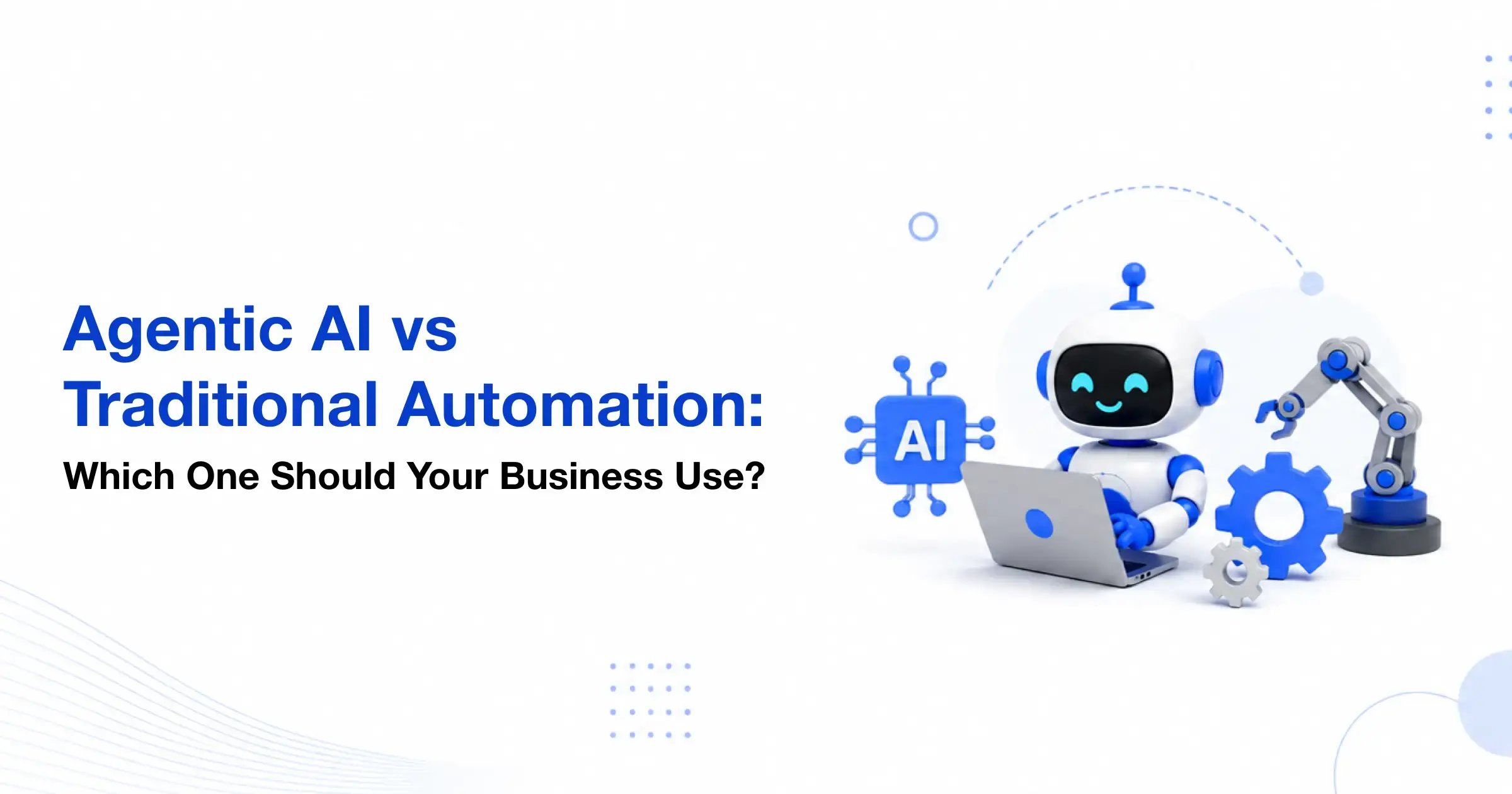

What Is the Difference Between RPA and Agentic AI?


Traditional automation gets used loosely enough that it's worth pinning down before we go any further. It covers Robotic Process Automation (RPA), workflow automation tools, rule-based bots, and scripted macros. Different names, but the same underlying logic: you define the steps, you map the conditions, you anticipate the inputs, and the system executes exactly what you designed, in exactly the order you specified.


That model built an entire industry. The global RPA market didn't reach the scale it has today by accident. It reached it because rule-based automation is fast, consistent, and remarkably good at the jobs it was designed for.


Agentic AI enters from a completely different angle. Rather than following a script, an agentic AI system is given a goal and works out how to reach it. It can read a contract, interpret an email, cross-reference a policy document, and make a judgment call, all without a human scripting each individual step. When something unexpected comes up, it doesn't stop and wait. It reasons through it.


The simplest way to put it: traditional automation does what you tell it. Agentic AI figures out what needs to be done.


That one distinction, understated as it sounds, is what drives every practical difference between the two. One is built for volume and consistency. The other is built for variability and judgment. The interesting part is that most real-world business processes are being reshaped by AI agents in ways that make this distinction more important than ever, which is exactly why the most important question isn't which technology is better. It's which one belongs where.


What Traditional Automation Does Really Well


The majority of large enterprises globally have already implemented RPA in at least one business function. It works. For the right kind of work, it works exceptionally well.


Thermo Fisher Scientific is a good example. According to UiPath, they process 824,000 invoices annually using RPA, with a 70% reduction in processing time. No AI reasoning required. Just a well-designed bot doing the same thing, reliably, at a scale no human team could match.


The business case is equally straightforward. For suitable use cases, most organizations see full RPA ROI within 6 to 9 months. That's a short payback window by any capital investment standard.


Where traditional automation earns its keep most naturally:


  • High-volume data entry across fixed-format systems
  • Payroll and finance operations that follow the same rules every cycle
  • Regulatory and compliance reporting where the output format never varies
  • Data migration between structured, predictable sources

The pattern across all of these is consistency. Same inputs. Same rules. Same outputs. That's the environment where traditional automation doesn't just survive, it thrives.


The challenge comes when the environment stops being consistent. When the inputs vary, when exceptions pile up, when judgment enters the picture. That's not a flaw in the technology. It's simply the boundary of what it was designed to do.


The Hidden Cost of Scaling Rule-Based Automation


Here's something that doesn't make it into the vendor brochure. The further you scale traditional automation, the more of your team's time goes toward keeping it running rather than building something new.


Every time a vendor updates their software interface, adds a field, or restructures a page, the bots that depend on that interface break. Someone has to find the breakage, diagnose it, rebuild the script, test it, and redeploy. Multiply that across dozens or hundreds of bots running across multiple systems, and you start to see where the hours go.


According to Forrester and EY summarized by Tech Crunch, 30 to 50% of RPA projects fail to scale beyond their initial deployment. And for the ones that do scale, annual maintenance costs routinely consume up to 50% of the original build cost every single year. That's not a one-time investment. It's a subscription to fragility.


When Bots Scale, So Do the Exceptions


The fragility problem is one side of the coin. The exception problem is the other, and in some ways it's more quietly damaging.


Consider how a healthcare system might deploy RPA to handle insurance prior authorization requests. For the 70% of cases that follow a clean, predictable pattern, the bots perform exactly as designed.


But the remaining 30% involve edge cases: unusual diagnoses, missing data fields, out-of-network complexity, documents that don't match the expected format. The bot can't reason through any of that. So it flags them as errors and routes them to a human queue.


Here's the uncomfortable result. The automation eliminated the easy work and concentrated all the difficult, time-consuming cases onto your team's plate. The queue of hard cases doesn't shrink. It grows.


Staff who expected relief from automation end up spending their days on exactly the messy, judgment-heavy situations they hoped the technology would handle.


The Maintenance Burden Nobody Budgets For


This is what makes scaling traditional automation genuinely tricky for growing enterprises:


  • Bot maintenance quietly consumes engineering bandwidth that could go toward new builds
  • Exception queues grow in proportion to automation volume, not shrink
  • Teams end up managing the automation rather than benefiting from it

None of this makes RPA the wrong choice. It makes it the wrong choice for the wrong processes. And the more an enterprise tries to stretch rule-based automation into variable, judgment-intensive territory, the more that hidden cost compounds. That's the gap agentic AI development was built to address.


How Agentic AI Surpasses RPA


Agentic AI isn't a smarter version of RPA. It's a different category of tool entirely, built on a different premise. Where RPA asks "what steps do I follow," agentic AI asks "what outcome am I trying to reach." That shift in starting point changes everything about how it behaves when things get complicated.


It Reasons Toward Goals, Not Rules


A traditional automation bot is only as good as the script behind it. Give it something outside that script and it stops. An agentic AI system, by contrast, receives an objective and works out the path to get there on its own. It can sequence tasks, make mid-course decisions, and adjust when something doesn't go as expected, without a human scripting every contingency in advance.


  • Operates from outcomes, not step-by-step instructions
  • Handles situations it was never explicitly programmed for
  • Adjusts its approach in real time when conditions change
  • Coordinates actions across multiple systems without pre-coded integration paths for every scenario

It Can Actually Read Your Data


Roughly 80 to 90% of enterprise data is unstructured. Emails, PDFs, contracts, handwritten notes, scanned documents. Traditional automation can't touch most of it without significant pre-processing to convert it into a structured format first. Agentic AI reads it directly. If you want to understand how this works in practice, document AI is a good place to start.


  • Interprets contracts, medical records, and supplier bids in their native formats
  • Extracts meaning from emails and written communications without templates
  • Cross-references information across documents without manual data preparation
  • Makes sense of inputs that vary in structure, layout, and language every time

It Handles Exceptions Without Stopping


This is where the practical difference becomes most visible. When an agentic system encounters an edge case, it doesn't flag it and route it to a human queue.


It reasons through it. It looks for relevant context, checks against related information, and either resolves it or escalates with a full briefing already prepared.


Think about a manufacturing plant where a sensor detects an anomaly at 2am. An agentic system cross-references maintenance logs, identifies the failure pattern, checks parts inventory, places a reorder, schedules a maintenance window, and sends the plant manager a summary before the morning shift arrives. An RPA bot would have sent an alert and waited.


  • Resolves edge cases independently rather than accumulating them in exception queues
  • Escalates intelligently when human judgment is genuinely needed, with context already prepared
  • Learns from outcomes over time, improving how it handles similar situations in the future

It Gets Smarter Over Time


Traditional automation doesn't improve with use. The hundredth invoice processed looks exactly like the first one to an RPA bot. Agentic AI learns from outcomes, refines its approach, and gets progressively better at the tasks it handles regularly. That compounding improvement is something rule-based systems structurally cannot offer.


  • Improves accuracy on recurring tasks the more it encounters them
  • Identifies patterns across large volumes of cases that no human team would spot
  • Builds institutional knowledge into the system rather than keeping it in people's heads

Put all of that together and the picture that emerges isn't agentic AI versus traditional automation. It's a tool that finally makes it possible to automate the business processes the 30 to 40% of every workflow that rule-based systems always had to hand back to humans.


The Real-World Evidence


The conversation around agentic AI has moved well past theory. A handful of large enterprises have been running these systems in production long enough to have real numbers, and the results are worth paying attention to.


JPMorgan Chase: 450+ Use Cases and Counting


JPMorgan Chase currently runs over 450 agentic AI use cases in daily production operations, with AI-attributed business benefits growing 30 to 40% year over year since inception. Nearly half of the firm's employees now use AI tools as part of their regular work.


Klarna: The Hybrid Reality


Klarna's experience tells a more complete story. In its first month, Klarna's AI agent handled the equivalent workload of 700 full-time customer service agents, cutting average response times from 11 minutes to under 2 minutes.


But Klarna later moved to a hybrid model after recognising that fully automated responses lacked the emotional judgment that complex customer situations require. That's not a cautionary tale. It's the honest shape of how mature enterprise deployments actually look.


What the Analysts Are Seeing Across the Board


Zooming out, Gartner projects that 40% of enterprise applications will include task-specific AI agents by the end of 2026, up from less than 5% in 2025.


The Gap Between Ambition and Execution


That said, ambition and execution are still two different things. Only 17% of organizations have deployed AI agents in production today, despite over 60% planning to within two years. The technology is ready. The implementation discipline, in many organizations, is still catching up.


Agentic AI or RPA: Which One Does Your Business Actually Need?

tech.us-recognized-by-mobile-app-daily

This is the question most comparison pieces avoid answering directly. So here's a practical way to think through it, using three questions you can apply to any process in your business right now.


Is your business process stable or variable enough for RPA?


Start here because it cuts through most of the noise immediately. A stable process has the same inputs, the same rules, and the same expected output every single time.


Payroll. Invoice processing. Scheduled compliance reports. If that describes what you're looking at, RPA is the right tool. Don't over-engineer it.


A variable process looks different. Exceptions are common. Inputs arrive in different formats. The rules shift depending on context. If your team regularly has to exercise judgment to move a process forward, that's a signal you're working at the edge of what rule-based automation can handle well.


Is your automation bottleneck about volume or judgment?


These are two fundamentally different problems that get lumped together under "we need to automate this."


A volume bottleneck means you have too much of a predictable thing. Fifty thousand invoices that all follow the same format. A thousand data entries that need to move between two fixed systems. RPA was built for exactly this and it handles it better than anything else at that price point.


A judgment bottleneck is different. Your team isn't drowning in volume. They're drowning in decisions. Reading a contract and flagging unusual terms.


Interpreting a patient record and matching it to coverage criteria. Reviewing supplier bids that all arrive in different formats. That's where agentic AI starts to make a compelling case for itself.


Where is your RPA maintenance burden costing you the most?


This one is worth an honest internal conversation. If your automation team is spending more time fixing broken bots than building new capabilities, that's the fragility tax at work. It compounds quietly and it's easy to normalise because it happens gradually.


Agentic systems are architecturally more resilient here because they reason toward goals rather than following brittle, step-by-step scripts. When an interface changes or an input arrives in an unexpected format, the system adapts rather than stops. That doesn't eliminate maintenance entirely, but it changes the nature of it significantly.


Agentic AI vs Traditional Automation (RPA)


If you prefer to see it laid out plainly, here it is:


Features

Traditional Automation / RPA

Agentic AI

How it works

Follows explicit, pre-scripted rules step by step

Reasons toward a goal and adapts as conditions change

Best for

High-volume, stable, structured tasks

Variable, judgment-intensive, multi-step workflows

Handles exceptions?

No. It stops or routes to a human queue

Yes. It adapts and resolves independently

Handles unstructured data?

No. It requires structured, predictable input formats

Yes. It reads PDFs, emails, contracts, and more

Maintenance burden

High. It breaks when interfaces or formats change

Lower. It self-adapts to environmental changes

Time to ROI

6 to 9 months for suitable use cases

Within the first year for 74% of deployments

Where to start

Payroll, invoicing, data entry, compliance reports

Contract review, prior auth, supply chain, customer service


The Hybrid Way: Why the Best Enterprises Are Using Both


Here's where a lot of comparison pieces get it wrong. They build toward a conclusion that one technology replaces the other. The evidence from enterprises that have actually deployed agentic AI at scale tells a different story.


The most effective automation strategies right now aren't RPA or agentic AI. They're RPA and agentic AI, each doing the job it was built for.


Think of RPA as your factory floor worker. Precise, consistent, and extraordinarily good at high-volume repetitive work. Agentic AI is the supervisor on that floor.


Contextually aware, capable of handling exceptions, and able to make judgment calls when the situation demands it. Neither makes the other redundant. Together they cover the full range of what a modern enterprise actually needs to automate.


How to Make the Transition Without Disrupting What Already Works


The enterprises doing this well follow a straightforward three-phase approach.


Phase 1: Audit Your Existing RPA Estate


To start with, audit your existing RPA estate honestly. Sort your automated processes into what's working well and should stay as-is, what's exception-heavy and creating growing human queues, and what breaks regularly and consumes disproportionate maintenance time. That last two categories are your agentic AI candidates.


Phase 2: Run a Contained Agentic Pilot


Now, run a contained pilot on one high-exception workflow. Measure handle time, exception resolution rate, and cost per case. A focused pilot typically shows clear results within 8 to 12 weeks.


Phase 3: Scale Based on Evidence, Not Enthusiasm


Last, scale based on what the data tells you, not on vendor roadmaps or market momentum. Build the hybrid model one proven process at a time.


FAQs


What is the main difference between RPA and agentic AI?


RPA follows explicit, pre-written rules to complete tasks the same way every time. Agentic AI reasons toward a goal, handles exceptions, and makes contextual decisions without a human scripting every step.


Is RPA becoming obsolete?


Not at all. RPA remains the right tool for high-volume, structured, predictable work and most enterprises have too much invested in it to simply walk away. The shift happening right now is about knowing where RPA ends and where agentic AI picks up.


Can RPA and agentic AI work together?


Yes, and this is exactly how most mature enterprises are deploying them. RPA handles the high-volume execution layer while agentic AI manages exceptions, coordinates across systems, and handles anything that requires judgment.


How is agentic AI different from traditional AI and automation tools?


Traditional AI recognizes patterns and generates outputs when prompted. Agentic AI goes further by setting its own action sequence, using tools, coordinating across systems, and executing multi-step workflows toward a defined goal with minimal human intervention.


What business processes are best suited for agentic AI?


Any process where exceptions are common, inputs arrive in varied formats, or decisions require reading context rather than following a fixed rule. Contract review, insurance prior authorization, supply chain exception handling, and customer service escalations are among the most common starting points.

10 Leading Enterprise AI Development Companies in the USA 2026

10 Leading Enterprise AI Development Companies in the...

NEWSLETTER


RECENT POSTS


blog-img

Agentic AI vs Traditional Automation: Which One Should Your Business Use?

blog-img

10 Leading Enterprise AI Development Companies in the USA 2026

blog-img

7 Hidden Costs of AI Development That Are Quietly Draining Your Budget

blog-img

Generative AI vs AI Agents vs Agentic AI: Understanding the Difference

blog-img

How Much Does Custom AI Development Cost in 2026?