blog-img

POPULAR POSTS

  • 01

    Top 10 Companies Offering Software Modernization Consulting Services in 2026

  • 02

    11 Proven Benefits of AI Chatbots for Businesses in 2025

  • 03

    Top 10 AI Development Companies Offering End-to-End AI Development Services

  • 04

    How To Improve Document Processing Accuracy Using Document AI

  • 05

    What Digital Transformation Means for Businesses in 2026

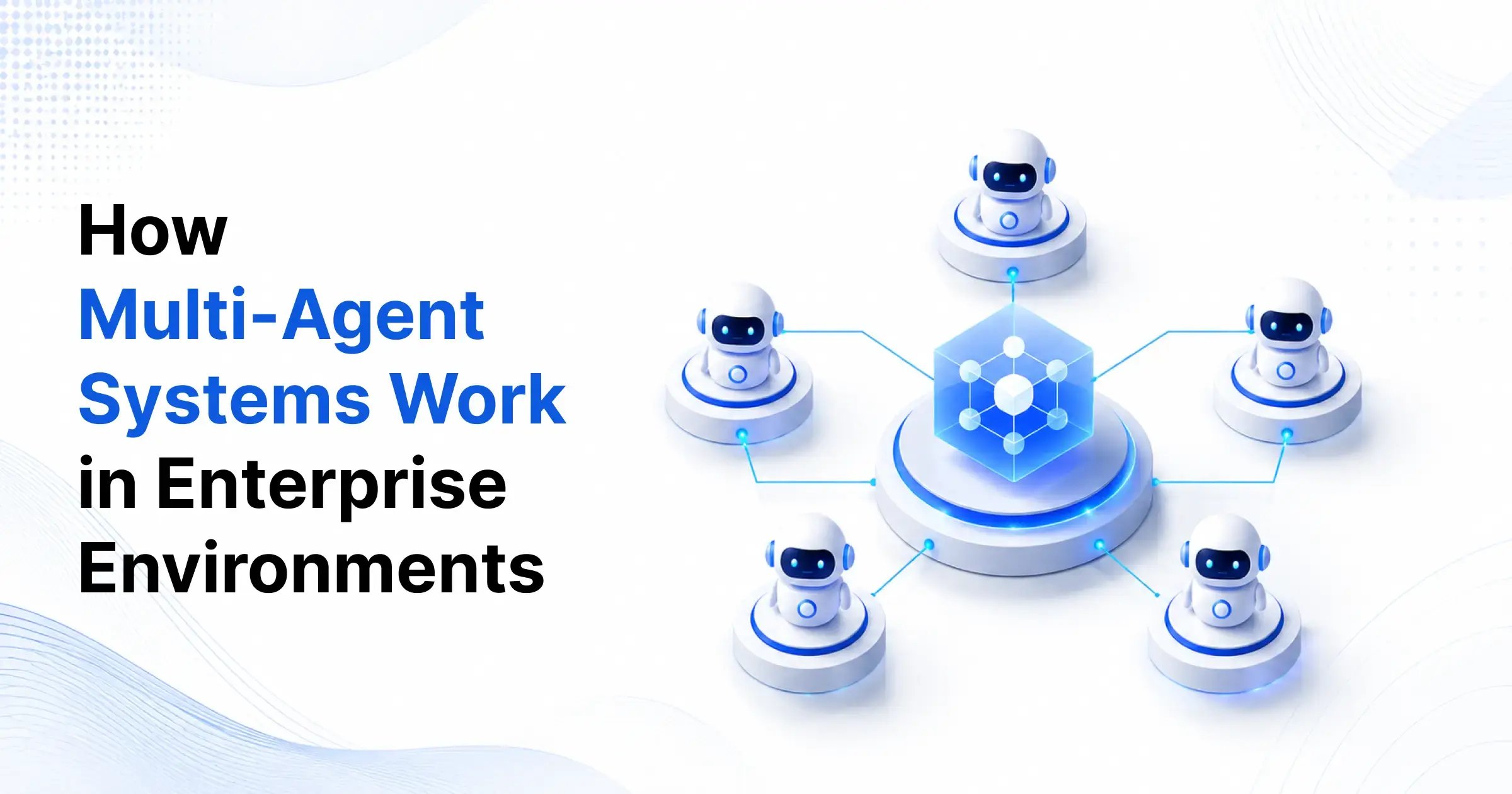
How Multi-Agent Systems Work in Enterprise Environments

Published Date: July 29, 2026 , Written by: Anand Selvadurai , Category: AI Agent, Multi Agents

tech.us-recognized-by-mobile-app-daily

Overview


Most enterprises do not have one simple workflow problem. They have many small moving parts sitting across teams, tools, approvals, documents, customer records, legacy systems, and decision layers.


That is where single AI agents start to feel limited.


A single agent can answer a question, summarize a file, trigger a task, or support one defined workflow. Useful? Absolutely. But enterprise work rarely stays inside one clean lane. A customer issue may touch support, billing, product, compliance, and account management. A procurement request may need vendor checks, budget validation, contract review, and approval routing.


So the shift is natural.


Enterprises are moving from isolated AI tools to coordinated AI workflows where multiple agents can. This shift is one of the primary drivers behind agentic AI development.


  • handle different parts of the same process
  • share context with each other
  • coordinate actions across systems
  • escalate when human judgment is needed

That is the real promise of multi-agent systems: not more AI, but better division of work.


What is a Multi-Agent System?


The easiest way to think about a multi-agent system is to imagine a team rather than an individual.


A single AI agent works much like an employee handling a task on their own. If you're new to the concept, understanding how AI agents work provides useful context before exploring multi-agent systems.


A multi-agent system, on the other hand, brings together multiple AI agents, each responsible for a specific part of a larger objective.


Each agent operates with its own:


  • Role and responsibilities
  • Access to tools and data
  • Context about the task
  • Decision-making boundaries

But the real value is not in the individual agents themselves. It comes from how they work together.


For example, if a customer submits a complex service request, one agent might gather information, another may analyze account history, a third could check compliance requirements, and a fourth might prepare a response. Individually, none of these agents solve the entire problem. Together, they complete the workflow.


That is why a multi-agent system is best understood as a coordinated network of AI agents working toward a shared goal. The outcome depends on collaboration, communication, and coordination rather than the performance of any single agent.


Multi-Agent Systems vs Single-Agent Systems

tech.us-recognized-by-mobile-app-daily

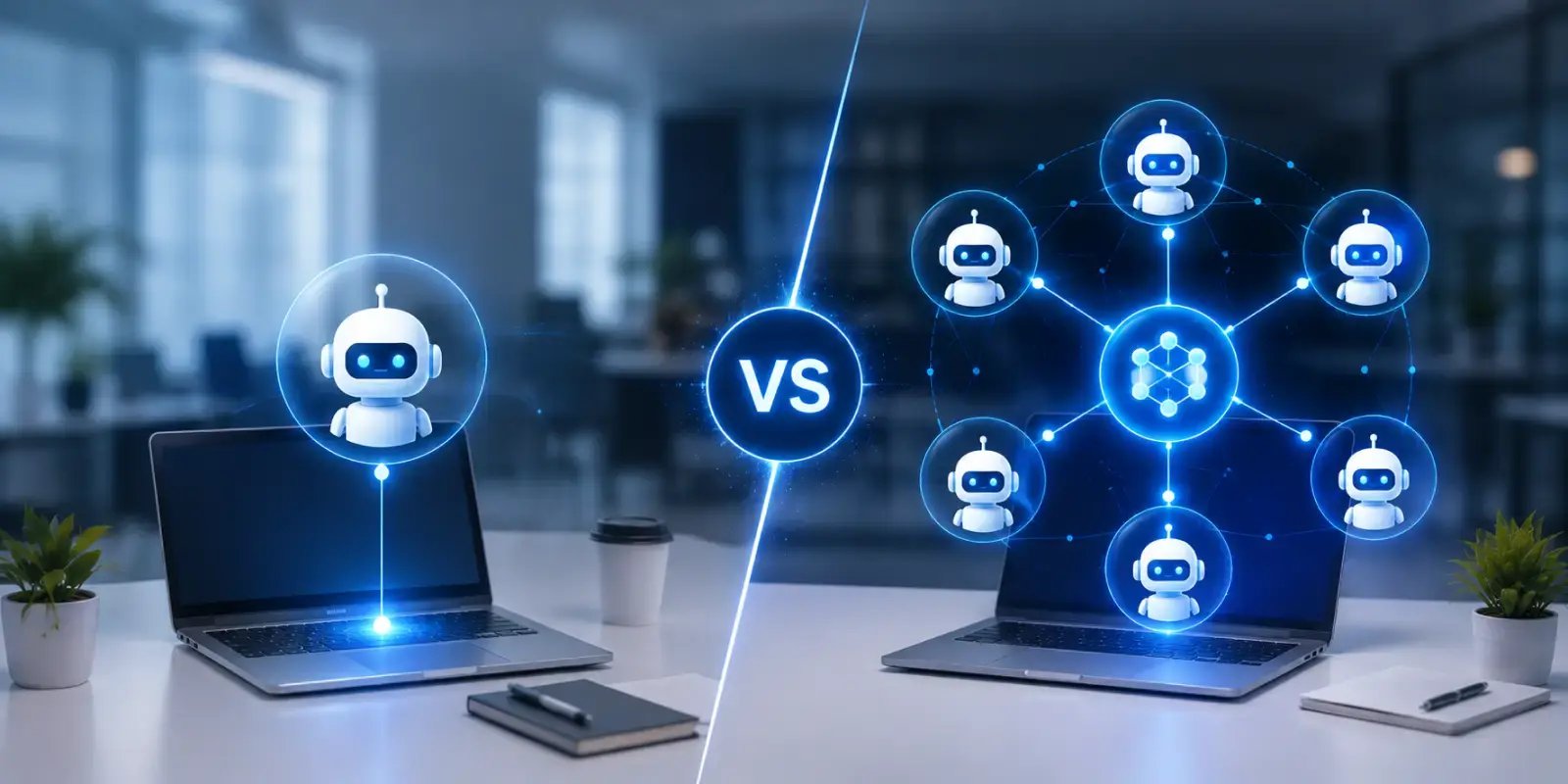
Many people assume a multi-agent system is simply a bigger version of a single AI agent. In reality, the difference is architectural.


A single-agent system is designed to handle a task from beginning to end. It receives input, performs reasoning, accesses tools if needed, and produces an output. This approach works well for focused use cases such as document summarization, customer support assistance, or report generation.


The challenge appears when the process becomes larger than what one agent can reasonably manage.


Enterprise workflows rarely follow a straight line. They involve multiple decisions, dependencies, systems, stakeholders, and exceptions. This growing complexity is one reason AI agents are disrupting traditional business processes across industries. Expecting one agent to manage all of that can create bottlenecks and make the system harder to maintain.


Multi-agent systems address this by distributing responsibilities across specialized agents. Instead of one agent trying to do everything, agents collaborate by sharing information, coordinating actions, planning tasks, and passing work to the most appropriate agent.


Think of it as the difference between a generalist employee and a well-organized team. Both can solve problems, but the team can usually handle larger and more complex work more effectively.


Single-Agent vs Multi-Agent Systems


Area

Single-Agent System

Multi-Agent System

Scope

One task or workflow

Complex, multi-step processes

Responsibility

One agent handles most work

Specialized agents divide work

Coordination

Limited

Core system capability

Scalability

Harder as complexity grows

Easier through modular agents

Enterprise Fit

Best for focused use cases

Designed for cross-functional workflows

Decision Making

Centralized in one agent

Distributed across multiple agents

Adaptability

Limited flexibility

Easier to extend with new agents

Failure Impact

Single point of failure

Workloads can be distributed and rerouted


The growing interest in multi-agent systems is not because enterprises need more AI agents. It is because modern business processes increasingly resemble interconnected networks of work. As complexity grows, collaboration becomes more valuable than individual capability, and that is exactly what multi-agent systems are designed to support.


Core Components of a Multi-Agent System

tech.us-recognized-by-mobile-app-daily

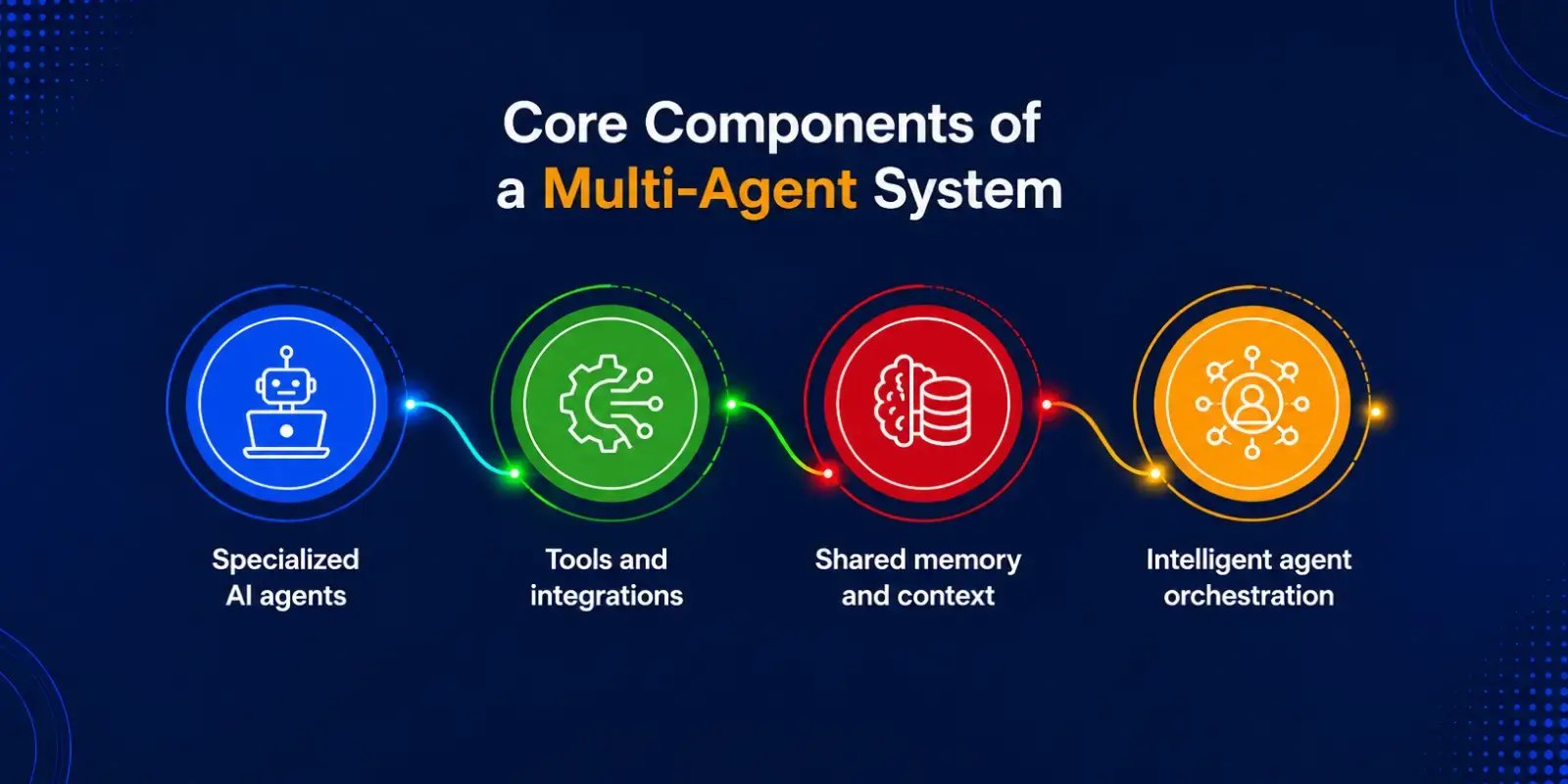
A multi-agent system is often described as a collection of AI agents working together. That definition is technically correct, but it leaves out something important. The agents alone are not what make the system work.


In enterprise environments, agents need access to business data, tools, historical context, coordination mechanisms, and governance controls. Without those supporting layers, even highly capable agents struggle to execute complex workflows reliably.


AI Agents


At the center of every multi-agent system are the agents themselves. An AI agent is designed to perform three fundamental functions:


  • Perceive information
  • Reason about available context
  • Take action toward a goal

That may sound straightforward, but enterprise workflows introduce a level of complexity that makes these functions far more challenging than they appear.


Different agents are often assigned different responsibilities. One may specialize in gathering information. Another may focus on analysis. A third may make recommendations or trigger actions in business systems. This specialization is one of the reasons multi-agent systems can handle larger and more complex workflows than a single agent acting alone.


Tools and System Connections


A language model can generate answers. An enterprise agent needs to do much more than that. An agent becomes truly useful when it can interact with systems beyond the language model itself.


This is where tools and integrations come into play. Enterprise agents commonly connect with:


  • APIs
  • Databases
  • ERP systems
  • CRM platforms
  • Knowledge bases
  • Document repositories
  • Workflow and ticketing systems

Without these connections, an agent can only provide suggestions. With them, an agent can retrieve information, update records, trigger workflows, create tickets, generate reports, and complete operational tasks.


Memory and Context


Enterprise workflows rarely begin and end in a single interaction.


A procurement request may move through several approvals over multiple days. An insurance claim can pass through different departments before reaching a decision. A customer support issue may involve multiple conversations spread across weeks.


For agents to operate effectively in these environments, they need memory.


Memory allows agents to retain awareness of what has already happened. That can include previous interactions, workflow status, past decisions, user preferences, or information collected earlier in the process.


Without memory, every interaction becomes an isolated event. The system is forced to repeatedly gather the same information and re-establish context. With memory, agents can continue where they left off, maintain consistency across long-running processes, and collaborate with other agents using a shared understanding of the task at hand.


In many enterprise scenarios, memory is what transforms a series of disconnected actions into a coherent workflow.


Orchestration Layer


As organizations add more agents, a new challenge emerges. Many enterprises evaluating adoption begin by researchingAI agent development companies in the USA that have experience with orchestration and enterprise integrations.


Who decides which agent should do what? That responsibility belongs to the orchestration layer.


The orchestration layer acts as the coordination mechanism that keeps the system organized. It determines how work moves through the system, which agents should be involved, when tasks should be handed off, and how progress should be tracked from start to finish.


Imagine an onboarding process for a new employee. One agent may collect required information, another may create system accounts, while a third verifies compliance requirements. Without coordination, these agents operate independently. With orchestration, they work as part of a structured process where each action occurs in the correct sequence.


As multi-agent systems become larger and more sophisticated, orchestration often becomes the most important component in the entire architecture. The agents perform the work, but orchestration ensures they work together effectively.


How Multi-Agent Systems Work Step by Step


Understanding the components of a multi-agent system is one thing. Understanding how they work together in practice is where things become much clearer.


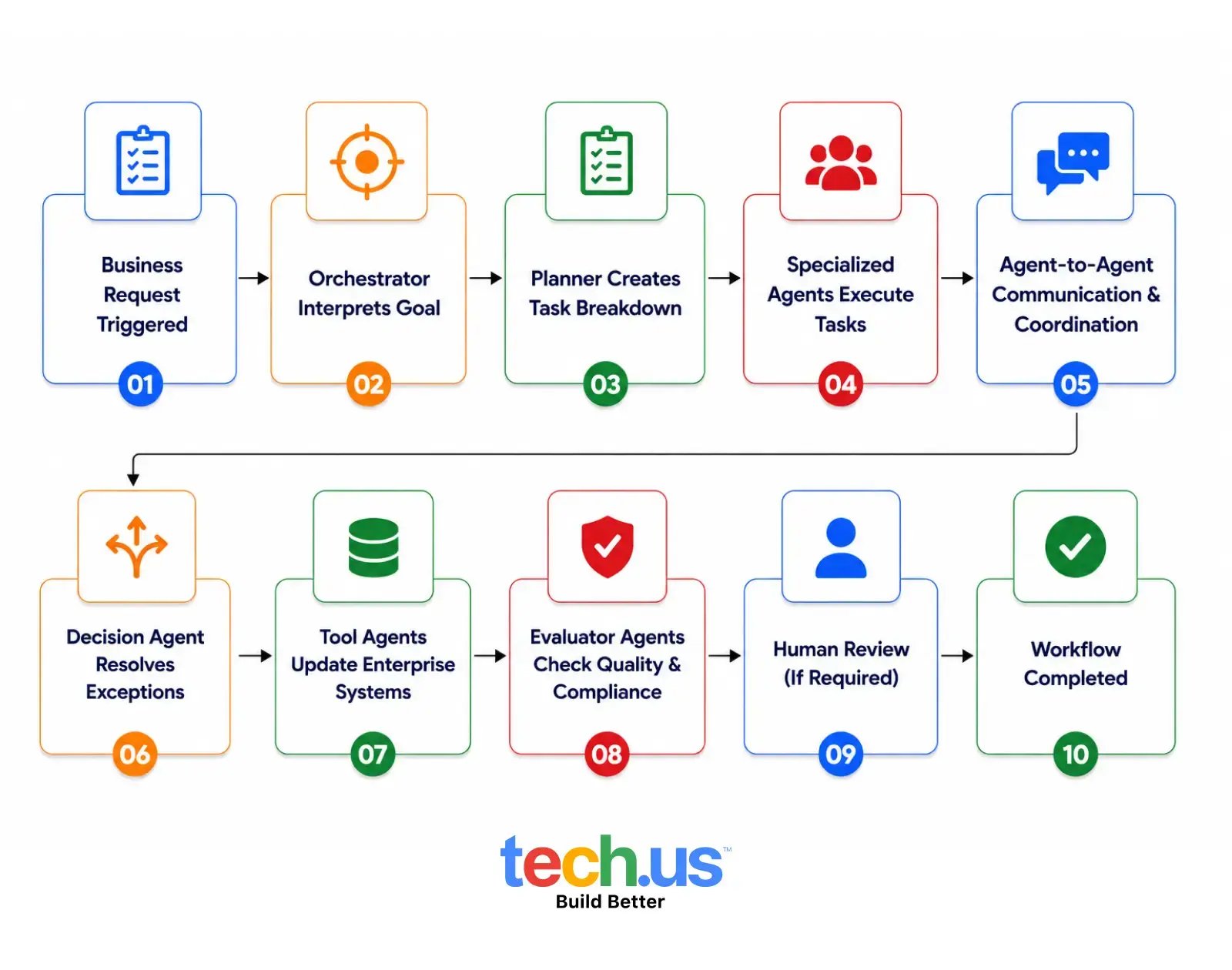
Although implementations vary across organizations, most enterprise multi-agent systems follow a similar pattern. A request enters the system, agents collaborate to complete different parts of the work, and the final outcome is delivered through a coordinated process rather than a single decision-maker.


Step 1: A Request Triggers the Workflow


Every workflow starts with a trigger.


The trigger could come from a user, another application, a business event, or an automated process. A customer submitting a service request, a finance team receiving an invoice, or a monitoring system detecting an issue can all initiate a multi-agent workflow.


At this stage, the system's primary goal is to understand what needs to be accomplished before deciding how the work should proceed.


Step 2: The Orchestrator Interprets the Goal


Once a request enters the system, the orchestration layer takes control.


Its job is not to perform the work itself. Instead, it determines how the workflow should be executed. The orchestrator analyzes the request, identifies the required capabilities, selects the appropriate agents, and establishes the sequence of activities.


Think of it as a project manager assigning work rather than an individual contributor completing it.


Step 3: A Planner Breaks the Work into Tasks


Many business requests are too large to be handled as a single activity.


This is where planner agents become important. They decompose the objective into smaller, manageable tasks that can be distributed across specialized agents.


For example, a request may require data retrieval, document analysis, compliance validation, and system updates. Rather than asking one agent to perform everything, the planner creates a structured execution plan.


Step 4: Specialized Agents Execute Their Responsibilities


Once tasks have been assigned, individual agents begin working within their area of expertise.


Some agents may retrieve information from enterprise systems. Others may analyze documents, validate business rules, generate recommendations, or prepare outputs for downstream processes.


This specialization is one of the key advantages of multi-agent systems. Each agent focuses on a narrow responsibility instead of attempting to solve the entire problem independently.


Step 5: Agents Share Information and Coordinate Actions


As work progresses, agents exchange information with one another.


Outputs generated by one agent often become inputs for another. The quality of this communication is critical because agents must operate with a shared understanding of the workflow.


Without coordination, duplicate work, conflicting decisions, and process failures become much more likely. Effective communication ensures the system behaves as a unified workflow rather than a collection of isolated components.


Step 6: Decisions, Validation, and System Actions

Not every workflow follows a predictable path.


When exceptions arise, decision-oriented agents evaluate available information and determine the appropriate next step. Once decisions are made, tool-enabled agents can interact with enterprise systems to update records, trigger workflows, create tickets, or initiate downstream actions.


Before execution is finalized, evaluator or monitoring agents may review outputs for quality, risk exposure, policy compliance, or operational anomalies. Human reviewers are typically involved only when confidence levels are low, policies require approval, or significant business risk is detected.


tech.us-recognized-by-mobile-app-daily

Common Agent Roles in Enterprise Multi-Agent Systems


Not every agent in a multi-agent system does the same kind of work. That is the whole point.


In enterprise environments, agent roles are usually separated based on responsibility. Some agents plan. Some retrieve data. Some make decisions. Others monitor quality or coordinate the workflow. This separation makes the system easier to scale, easier to govern, and easier to troubleshoot when something goes wrong.


Planner Agents


Planner agents break a larger business goal into smaller tasks.


They are useful when a request is too broad for one agent to handle directly. For example, “process this insurance claim” is not a single task. It may involve checking policy details, reviewing documents, validating customer information, identifying missing data, and deciding whether the claim needs human review. A planner agent turns that larger objective into a workable sequence of steps.


Tool Agents


Tool agents connect the multi-agent system with enterprise systems.


They interact with APIs, databases, CRMs, ERPs, ticketing systems, document repositories, and workflow platforms. This role matters because an agent that cannot access business systems can only recommend action. A tool agent can actually retrieve records, update fields, create tickets, trigger workflows, or send information to the right application.


Task-Specific Agents


Task-specific agents handle focused responsibilities.


These agents are usually designed around a narrow function such as document processing, transaction validation, data extraction, monitoring, analytics, or classification. Their strength comes from focus. Instead of asking one general agent to perform every task, enterprises can assign specialized agents to work where accuracy and consistency matter most.


Process Orchestration Agents


Process orchestration agents manage how work moves across a long-running workflow.


They are especially important in enterprise processes like order-to-cash, employee onboarding, supply chain coordination, claims management, or clinical operations. These workflows involve multiple steps, systems, conditions, and approvals. The orchestration agent keeps the process moving by managing handoffs, tracking status, and making sure each step happens in the right order.


Decision-Making Agents


Decision-making agents evaluate options and choose the next best action within defined limits.


They may apply business rules, compare available evidence, handle exceptions, or decide whether something should be approved, rejected, routed, or escalated. In sensitive workflows, these agents should not operate without guardrails. Their decisions need to be explainable, traceable, and aligned with business policy.


Learning Agents


Learning agents improve based on feedback, outcomes, and repeated patterns.


In practice, this does not mean the agent freely changes its behavior without control. In enterprise systems, learning should be monitored and governed. These agents can help refine recommendations, improve predictions, or identify recurring workflow patterns that may need process improvement.


Evaluator or Monitoring Agents


Evaluator agents check whether the work produced by other agents is accurate, safe, and aligned with policy.


They may review outputs for errors, incomplete reasoning, hallucinations, compliance risks, or unusual behavior. In mature enterprise deployments, this role becomes essential because visibility is just as important as automation. Teams need to know not only what agents did, but whether the result can be trusted.


Multi-Agent Architecture Patterns


Not all multi-agent systems are structured the same way.


The architecture determines how agents communicate, how decisions are made, how work is distributed, and how much control exists across the system. Choosing the right pattern is not simply a technical decision. It affects scalability, governance, resilience, and operational complexity.


In practice, most enterprise implementations are built around a handful of common architectural models. Designing these systems often requires expertise from experienced agentic AI development partners in the USA.


Handoff Architecture


The handoff model is the simplest architecture used in multi-agent systems.


In this approach, one agent completes its task and passes the output to the next agent in the workflow. Each agent performs a specific function before handing responsibility forward.


This architecture works well for structured business processes where activities follow a predictable sequence. Document review, invoice processing, and customer onboarding are common examples.


The advantage is simplicity. The downside is that the workflow becomes highly dependent on each stage functioning correctly. If one agent fails or produces poor output, the entire process can be disrupted.


Network Architecture


In a network architecture, agents operate more like peers.


Instead of following a predefined sequence, agents communicate directly with one another and request assistance when required. An agent can consult other agents, exchange information, and dynamically determine the best path forward.


This model is useful when workflows are less predictable and require collaboration between specialized capabilities. The tradeoff is complexity. As the number of agents grows, communication paths increase significantly, making coordination and governance more difficult.


Supervisor Architecture


The supervisor model introduces a central coordinating agent.


Rather than allowing agents to interact freely, a supervisor agent assigns work, monitors progress, evaluates outputs, and determines when intervention is necessary. Individual agents focus on execution while the supervisor maintains overall control.


This approach has become increasingly popular in enterprise environments because it improves visibility and governance. The trend is particularly noticeable in large-scale agentic AI development initiatives for enterprises in New York and other major business hubs.


Organizations can more easily monitor decision flows and enforce operational controls. The primary risk is over-reliance on the supervisor. If it becomes a bottleneck, system performance can suffer.


Hierarchical Architecture


A hierarchical architecture expands on the supervisor concept.


A lead agent receives a business objective, breaks it into subtasks, and delegates those tasks to specialized agents. Those agents may further coordinate with lower-level agents responsible for specific activities.


This structure closely resembles how work is organized within large companies. Strategic decisions remain at higher levels while execution is distributed across specialists. It is particularly effective for complex workflows involving multiple business functions, but it requires strong observability and monitoring to ensure tasks remain aligned with the original objective.


Centralized vs Decentralized Architectures


Many enterprise systems ultimately fall somewhere between centralized and decentralized designs.


In centralized architectures, communication and coordination are managed through a central authority. This creates a shared source of truth and simplifies governance, auditing, and policy enforcement. However, the central coordinator becomes a critical dependency.


Decentralized architectures distribute responsibility across agents. Similar coordination models are increasingly being explored in AI agents for robotics development, where multiple autonomous systems must collaborate in real time.


There is no single point controlling every interaction. This improves resilience and flexibility because agents can continue operating even when parts of the system become unavailable. The challenge is maintaining consistency, governance, and coordination across a distributed environment.


As organizations scale multi-agent systems, balancing centralized control with decentralized autonomy becomes one of the most important architectural decisions they face.


Multi-Agent Architecture Patterns


Architecture

Best For

Main Risk

Handoff Architecture

Simple, sequential workflows with clearly defined steps

A failure in one stage can disrupt the entire process

Network Architecture

Dynamic collaboration between specialized agents

Communication and coordination complexity

Supervisor Architecture

Enterprise workflows requiring governance and oversight

Over-dependence on the supervising agent

Hierarchical Architecture

Complex multi-step processes involving multiple functions

Requires strong observability and task tracking

Centralized Architecture

High-control environments with strict governance requirements

Central point of failure or bottleneck

Decentralized Architecture

Distributed and resilient systems operating at scale

Harder coordination, governance, and consistency management

In a Nutshell


Multi-agent systems are often discussed as the next evolution of AI, but their real significance lies elsewhere. They represent a different way of organizing work.


Most enterprise processes are not isolated tasks. They involve multiple systems, decisions, dependencies, and stakeholders. That is why organizations are increasingly moving beyond single-agent approaches and adopting architectures where specialized agents collaborate toward a common objective.


The technology itself is important, but the bigger shift is operational. Success depends on how well agents are coordinated, governed, and integrated into existing business processes. As enterprises pursue more complex AI initiatives, multi-agent systems are emerging not as a replacement for people, but as a practical framework for executing work across increasingly connected organizations.


Frequently Asked Questions


Are multi-agent systems just multiple AI agents working together?


Not quite. The real value comes from how those agents coordinate, share context, divide responsibilities, and work toward a common outcome. Without that coordination layer, you simply have several disconnected agents.


When should a business use a multi-agent system instead of a single AI agent?


A single agent is often enough for focused tasks. Multi-agent systems start making sense when a process involves multiple decisions, systems, approvals, or specialized functions that need to work together.


Do multi-agent systems eliminate the need for human involvement?


No. In most enterprise environments, humans are still involved in approvals, exception handling, compliance reviews, and high-impact decisions. The goal is usually to reduce routine work, not remove oversight.


What is the biggest challenge in building a multi-agent system?


Most organizations discover that coordination is harder than intelligence. Getting agents to communicate effectively, share context, and stay aligned with business rules is often more difficult than building the agents themselves.


Which multi-agent architecture works best for enterprises?


There is no universal answer, but supervisor and hierarchical architectures are becoming common because they provide a balance between autonomy and control. That balance matters when workflows affect customers, revenue, or compliance.

Tech.us

Tech.us is an AI development company that builds custom AI solutions for businesses seeking measurable results. We partner with organizations to design, develop, and deploy scalable AI systems that solve complex challenges and unlock new opportunities for growth. Our team delivers practical AI applications that create tangible business impact across industries.

1,500+ Projects
Delivered
25+ Years in
Business
30+ Industries
Served
100% Commitment
to Success

WRITTEN BY

Anand Selvadurai

Anand Selvadurai

Director of AI/ML at Tech.us

Director of AI/ML 16+ years experience AI/ML Specialist

Written by Anand Selvadurai, Director of AI & ML at Tech.us — 16+ years experience designing enterprise ML pipelines and deploying production-grade AI systems across Construction, healthcare, fintech, and logistics. Certified Machine Learning Specialist and Research Scholar.


View all articles
Multi-Agent Systems in Enterprise: Benefits, Use Cases, Risks, and Implementation

Multi-Agent Systems in Enterprise: Benefits, Use...

NEWSLETTER


RECENT POSTS


blog-img

How Multi-Agent Systems Work in Enterprise Environments

blog-img

Multi-Agent Systems in Enterprise: Benefits, Use Cases, Risks, and...

blog-img

How to Identify High-Impact AI Transformation Opportunities

blog-img

When Should Businesses Build AI Into Custom Software?

blog-img

10 Leading AI Consulting Partners for 2026