Are You Using the Right AI, or Just the Most Talked-About One?
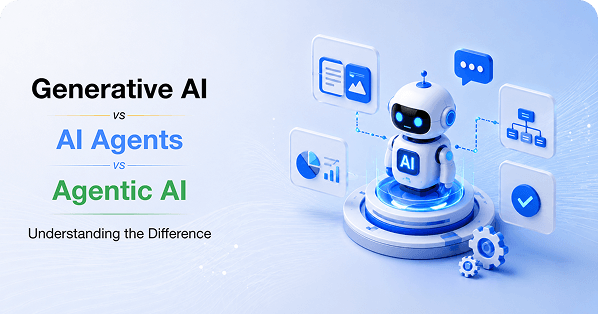
Every business leader has heard the terms. Generative AI. AI agents. Agentic AI. They show up in the same conversations, often used interchangeably, sometimes used incorrectly, and most of the time without a clear explanation of what separates them.
Somewhere along the way, they all blur into one big "AI strategy" that nobody can quite define.
That blurriness is expensive. According to PwC's May 2025 survey of 308 US business executives, 79% say AI agents are already being adopted inside their companies, and 88% say their team or business function plans to increase AI-related budgets in the next 12 months because of agentic AI. The investment is moving fast. The clarity, for most businesses, is not keeping up.
Most companies today are building an enterprise AI strategy around one of these while expecting the results of another. That mismatch is where the frustration lives.
What is Generative AI, and What Can it Actually Do for Your Business?

Most people's first real experience with AI was generative AI. They typed a question into ChatGPT, got a surprisingly good answer, and thought – okay, this changes things.
And it does. Just not in the way most businesses assume. So, what is Generative AI? Generative AI is best understood as a system that produces content when prompted as it does not act, it responds. Ask it to draft a proposal, summarize a meeting, explain a contract clause, or write a product description as it delivers. Quickly, and usually well.
That is genuinely useful. But there is a ceiling.
Why Does Generative AI Still Need You to Do the Actual Work?
Let’s picture an operations manager at a mid-sized logistics company prepping for a vendor review meeting. She opens ChatGPT or some LLM, pastes in a 40-page supplier contract, and asks it to pull out the key penalty clauses and flag anything unusual. Within seconds, she has a clean, readable summary with the exact sections highlighted.
She is impressed. Her team is impressed.
Then she asks it to send the flagged clauses to the legal team, update the vendor record in their system, and schedule a follow-up call.
Nothing happens.
Because that is not what generative AI does. It gave her everything she needed to act. But the acting part? That was still entirely hers to do.
It is just how technology works. For businesses expecting real-time operational impact, it is a hard limit.
A few things generative AI genuinely cannot do:
- Access your internal systems or live data without being connected to an external source
- Take action after generating a response
- Make decisions or move a workflow forward on its own
- Remember context from a previous session unless specifically designed to
Where are Businesses Already Using Generative AI?
Generative AI is not a new experiment anymore. According to Bain, 95% of US companies are already using it in some form, an adoption curve faster than cloud computing and mobile combined.
- Drafting client communications, proposals, and reports
- Summarizing long documents, contracts, or research
- Answering internal knowledge questions
- Generating first drafts of marketing and sales content
- Supporting customer-facing chat for common queries
Generative AI for business is a technology that produces content that includes text, images, summaries, code, or reports, all based on a prompt you give.
What is an AI Agent, and How is it Different from Generative AI?
So, the operations manager now has her summary. The penalty clauses are flagged, the unusual terms are highlighted, and she knows exactly what needs to go to the legal team.
But she still has to send the email. Update the vendor record. Schedule the call.
Every. Single. Time.
Multiply that across a team of ten people running vendor reviews every week, and suddenly the "AI is saving us time" story starts to feel a little thin.
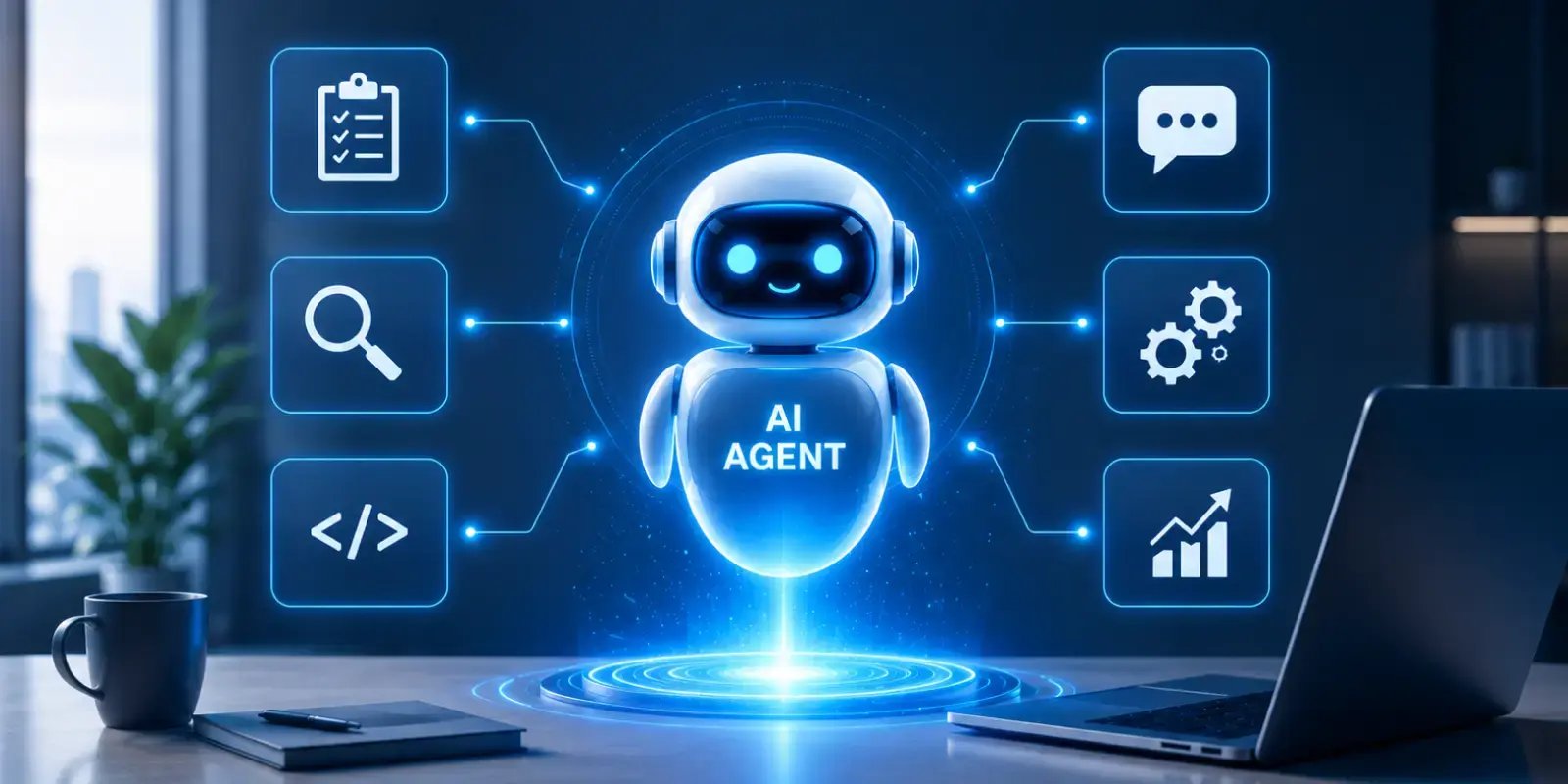
An AI agent, in the context of business operations, is a system that takes action on your behalf for a specific, well-defined task. It does not just generate a response and hand the baton back to you. Interestingly, it picks up the baton and runs
What Can an AI Agent Do that Generative AI Can’t?
That is the behavioral shift. Generative AI is an advisor, it gives you what you need to act. An AI agent is more like a contractor: you define the task, it gets it done.
- Searching live data sources and returning real-time results
- Triggering actions in connected systems -- sending emails, updating records, booking appointments
- Making simple decisions within a task -- like choosing the lowest-cost option from a set of results
- Completing a defined workflow from start to finish without step-by-step instructions
An AI agent for business operations, is a system that takes action on your behalf for a specific, defined task. Unlike generative AI, which responds to prompts and stops at the output, an AI agent decides what steps to take and executes them. It can access live data, interact with external systems, and complete a task end to end.
Where Do AI Agents Work Best in a Business Setting?
- Scheduling and calendar management
- Routing and responding to customer queries
- Pulling reports and triggering alerts based on thresholds
- Processing approvals and notifications
- Searching, comparing, and logging vendor or supplier data
But Here are the Limitations of AI Agents
The logistics manager's vendor review is one task. Clean, contained, repeatable. An AI agent handles that well.
What is Agentic AI, and Why is it Different?

Fair question. And the answer is not about a single feature. It is about a fundamentally different relationship between AI and work. In other words, AI development and agentic AI differ in fundamental ways.
- Planning ahead instead of waiting to be told what to do next
- Coordinating across tools and systems on its own
- Adjusting when something changes mid-task
- Self-correcting when something goes wrong
Unlike generative AI, which responds to prompts, agentic AI for business works toward objectives. That is not a small distinction. That is a completely different mode of operation.
How Does Agentic AI Handle Complex Business Goals That Agents Cannot?
A doctor puts in a single order. But what follows?
- The pharmacy prepares the medication
- Nursing gets notified with the right timing and dosage
- The patient's history gets checked for contraindications
- Billing gets updated
- If the patient is transferring from another facility, records get pulled and reconciled
None of those steps are independent. Each depends on information from another. And if something changes, an allergic reaction, a dosage adjustment, everything downstream has to shift simultaneously.
So what does each type of AI do here?
A generative AI tool tells the nurse what the standard protocol is. An AI agent sends the pharmacy notification.
But coordinating the entire chain, catching the contraindication before it becomes a problem, and keeping every department in sync, that is agentic AI territory.
Agentic AI operates like a capable operations manager who takes a high-level goal and determines the plan, the steps, and the execution -- without waiting for instruction at every turn.
Most businesses are curious about agentic AI. According to McKinsey's 2025 State of AI survey, 62% of organizations are at least experimenting with AI agents, but only 23% are actually scaling it within a business function. The interest is clearly there. The follow-through, for most businesses, is still catching up.
Is Agentic AI Always Multiple Agents Working Together? Not necessarily, and this surprises a lot of people.
- Plan across multiple steps without being prompted for each one
- Reason through complexity and shifting conditions
- Self-correct when something does not go as expected
The headcount is not the point. The behavior is. Can it pursue a goal without being hand-held through every decision? If yes, that is agentic AI. Whether it is one agent or ten.
Does giving AI this level of autonomy mean losing control?
No. Agentic AI does not mean unsupervised AI. The most effective deployments keep humans in the loop for decisions that carry real business risk.
A well-designed agentic system handles routine steps independently and surfaces high-stakes calls to the right person. Autonomy is not the absence of oversight. It is the intelligent allocation of it.
How Do Generative AI, AI Agents, and Agentic AI Compare Side by Side?
Three sections in, the differences are clear in theory. But sometimes a side-by-side view makes it click in a way that prose cannot.
Here is a simple comparison of Generative AI vs AI Agent vs Agentic AI:
| Capabilities | Generative AI | AI Agent | Agentic AI |
|---|---|---|---|
| What does it do? | Produces content when prompted | Executes a specific defined task | Plans and runs complex multi-step workflows |
| Does it take action? | No, you implement the output | Yes, for one defined task | Yes, across multiple tasks and systems |
| Does it need input at every step? | Yes, fully prompt driven | Partially, once the task is set | No, it sets its own sub-goals |
| Can it adapt mid-task? | No | No | Yes, it self-corrects as it goes |
| Can it work with other systems? | Limited | Limited | Yes, coordinates tools and agents |
| Best business use case | Content, drafts, summaries, Q&A | Scheduling, alerts, lookups, notifications | End-to-end workflow and process automation |
| Best suited for | Teams that need faster content and knowledge support | Businesses automating a specific repetitive task | Organizations ready to transform entire workflows |
| Level of autonomy | Low | Medium | High |
Which Type of AI is the Right Fit for Your Business Right Now?
Not every business needs agentic AI right now. And not every business should start with generative AI either. The right fit depends on one thing more than anything else as the complexity of the problem sitting in front of you.
Does It Depend on the Size of Your Business or the Complexity of Your Operations?
A simpler way to think about it:
- Need faster content, better communication, or quick knowledge on demand? Start with generative AI. Lowest barrier, fastest results.
- Have a specific task that eats up human time every single week and follows a predictable pattern? An AI agent is the right next step.
- Running an end-to-end workflow that touches multiple teams, multiple systems, and involves decisions along the way? That is agentic AI territory.
Can a Business Use All Three Types of AI at the Same Time?
FAQs
Generative AI responds to prompts and produces content as the action still falls on the person asking. Agentic AI works toward objectives, planning and executing steps autonomously until the goal is reached.
No, though they are closely related. An AI agent handles a task. Agentic AI handles a goal. Think of agents as individual components and agentic AI as the system that puts those components to work toward something larger.
Accessible agentic AI platforms have lowered the barrier significantly because business size matters far less than operational readiness. If a small business has a complex, repeatable workflow that costs real time and money, agentic AI is worth exploring.
In its base form, ChatGPT is generative AI as it responds to prompts and produces content. When connected to tools like web search or code execution, it takes on agent-like behavior. When embedded into a larger autonomous workflow, it becomes a component of an agentic AI system.
Robotic process automation (RPA) follows rigid, pre-defined rules and breaks the moment something unexpected happens. Agentic AI reasons through complexity, adapts when conditions change, and self-corrects, which makes it far better suited for dynamic, real-world business workflows.
It depends on the use case, but agentic AI for business operations carries the highest potential ROI for complex workflows because it replaces entire multi-step processes, not just individual tasks. The more human time a workflow consumes today, the stronger the case for agentic AI.
Healthcare is using it for patient coordination and clinical workflows. Financial services are applying it to compliance monitoring and reporting. Logistics companies are using it for supply chain orchestration. Legal teams are deploying it for contract review and due diligence. Customer operations teams are using it to manage end-to-end service workflows autonomously.
Four questions worth asking before any commitment:
- What level of human oversight is built into the system for high-stakes decisions?
- How does the system handle unexpected changes or failures mid-workflow?
- What existing tools and systems does it integrate with out of the box?
- What does implementation actually look like, and who owns it after go-live?

Tech.us is an AI development company that builds custom AI solutions for businesses seeking measurable results. We partner with organizations to design, develop, and deploy scalable AI systems that solve complex challenges and unlock new opportunities for growth. Our team delivers practical AI applications that create tangible business impact across industries.